Contractor Holding Retention Money or RA Bills? Recover Now (2026)
subcontractor retention money recovery legal notice india, pay when paid clause validity in india, back to back payment clause subcontractor recovery, contractor not releasing retention money defect liability period, section 24 msmed act overriding effect pay when paid, commercial dispute running account bills recovery

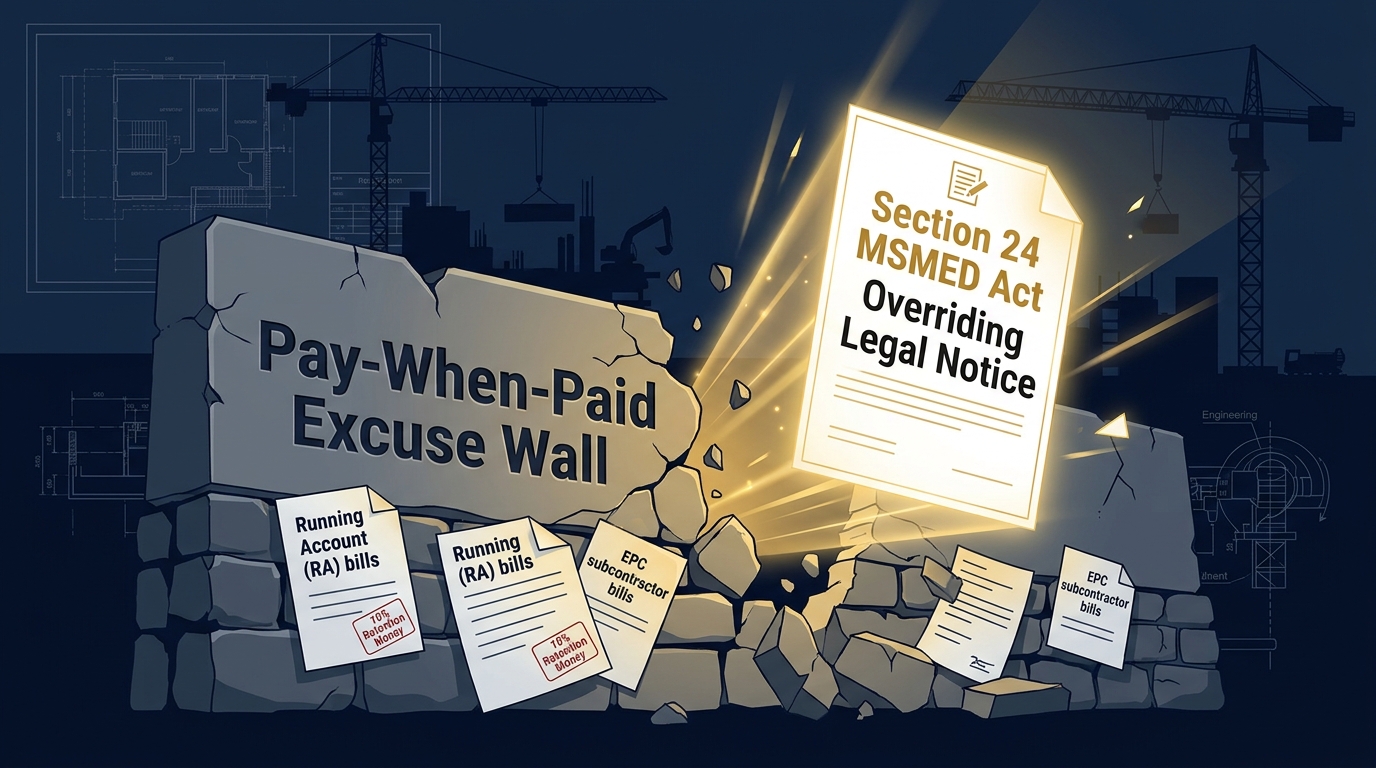
Table of Contents
Table of Contents
Swipe →Working as a subcontractor in India often feels like bearing all the project risk with none of the control. You deploy engineers, hire skilled labor, and pour concrete on site. You purchase steel, run optical fiber, or write custom software code. You submit your Running Account or RA bills every month. The project manager signs the measurement book and clears the quality inspection.
Yet when payment time arrives, the main contractor stalls. They pay a partial sum and withhold the rest. Even worse, they deduct 5 to 10 percent from every bill as retention money. They promise to release this retention cash once the Defect Liability Period or DLP ends. But months after project handover, your retention money remains locked. When you demand your dues, the contractor points to a small line in your work order: the back-to-back or pay-when-paid clause.
They claim that because the project owner, government agency, or real estate developer has not cleared their main bill, they have zero legal duty to pay you. This excuse breaks cash flow for thousands of Indian engineering, civil, and IT subcontractors. Many believe they must wait years for the main contractor to finish fighting the client. But under Indian commercial law, that belief is completely false.
The Pay-When-Paid Trap in Indian Subcontracts
The pay-when-paid clause is one of the most unfair terms in commercial contracting. Prime contractors use it to shift their financing costs onto smaller vendors. In a typical engineering, procurement, and construction or EPC setup, the main contractor signs a large head contract with the project employer. They then break the project into small work orders for specialized subcontractors.
To protect their own profit margins, main contractors insert contingent payment wording. They write that payment to the subcontractor will only happen after the employer releases funds to the prime contractor. If the employer delays payment, raises unrelated counterclaims, or enters insolvency, the main contractor uses that dispute to stop all subcontractor payments.
This tactic creates an unfair bottleneck. You have zero direct contract with the end employer. You cannot inspect the master accounts between the employer and the main contractor. You have no control over whether the main contractor submitted correct paperwork or met project milestones. Shifting the risk of third-party non-payment onto a subcontractor who performed flawless work violates the basic principles of fair trade.
Why Back-to-Back Payment Clauses Fail Under Indian Law
Under the Indian Contract Act, 1872, contracts must be interpreted fairly. Indian courts make a sharp distinction between a condition precedent to liability and a provision that merely sets a reasonable timeline for payment. A pay-when-paid clause cannot be used as an eternal excuse to withhold money for work already accepted.
Indian courts have repeatedly held that unless a contract contains explicit pay-if-paid wording that clearly warns the subcontractor of total forfeiture risk, payment timing clauses merely create a reasonable credit window. The main contractor cannot enjoy the complete commercial benefit of your labor, materials, and machinery without paying for them.
This principle is codified in Section 70 of the Indian Contract Act, 1872. Section 70 governs the obligation of a person enjoying the benefit of a non-gratuitous act. When a main contractor uses your work to claim milestone completion from the employer, they cannot turn around and claim they owe you nothing. Keeping the financial benefit while denying payment constitutes unjust enrichment.
The Section 24 MSMED Act Trump Card for Subcontractors
If your enterprise holds an active Udyam Registration, you possess the strongest statutory weapon in Indian commercial law. The Micro, Small and Medium Enterprises Development Act, 2006 completely changes the legal balance of power between prime contractors and subcontractors.
Under Section 15 of the MSMED Act, any buyer who purchases goods or hires services from a registered Micro or Small enterprise must clear payment within the agreed period. That agreed period can never exceed 45 days from the date of acceptance or deemed acceptance. The law does not permit any contract term to push payment beyond 45 days.
Section 24 of the MSMED Act provides the decisive knockout blow. Section 24 states that the provisions of Sections 15 to 23 have full overriding effect notwithstanding anything inconsistent contained in any other law or agreement. This non-obstante clause means that any pay-when-paid, back-to-back, or prolonged retention clause in your work order is null and void.
If you are an MSME, the main contractor cannot plead that the end client has not paid them. The statutory 45-day clock starts ticking the moment your RA bill and measurement sheet are submitted. If they fail to pay within 45 days, Section 16 mandates compound interest at three times the RBI bank rate compounded monthly. You can learn more in our detailed MSME delayed payment interest recovery guide.
Defeating Joint Measurement Delays and Deemed Acceptance Rules
A favorite delaying tactic of main contractors is refusing to sign the joint measurement sheets or inspection reports. Subcontractors pour concrete, erect scaffolding, or lay cables on site. When the monthly RA bill is submitted, site engineers sit on the paperwork. They claim they are too busy to conduct the joint site survey.
Indian law directly prevents this abuse through the concept of deemed acceptance. Under Section 2(b) of the MSMED Act, when an enterprise delivers goods or renders services, the buyer has exactly 15 days to raise written objections. If the contractor does not point out specific defects in writing within 15 days, the work is deemed legally accepted by law.
Furthermore, under Section 41 and 42 of the Sale of Goods Act, 1930, keeping and utilizing supplied materials without prompt rejection constitutes final commercial acceptance. When the prime contractor incorporates your civil works or electrical installations into the main building and bills the client, they cannot claim uncertified measurements against you.
Defeating Defect Liability Period Retention Money Holds
Retention money is another massive drain on subcontractor capital. Contracts typically allow the prime contractor to withhold 5 to 10 percent of gross bill value during the Defect Liability Period, which usually runs for 12 to 24 months. While temporary retention for verified defect repairs is standard, permanent retention withholding is entirely illegal.
To retain your money legally during the DLP, the contractor must satisfy strict legal conditions. First, they must provide formal written notice of specific defects within the DLP window. Second, they must give you a reasonable opportunity to cure those defects on site. Third, they must prove the exact expenditure incurred if they hired a third party to rectify the flaws.
In most disputes, main contractors issue zero defect notices during the entire DLP. Then, when the DLP expires, they invent vague oral complaints or claim the end client has not released the main retention pool. If the DLP has ended and no written defect notice was issued during that period, the contractor has zero legal right to hold your money. Withholding retention cash after DLP expiry amounts to civil misappropriation.
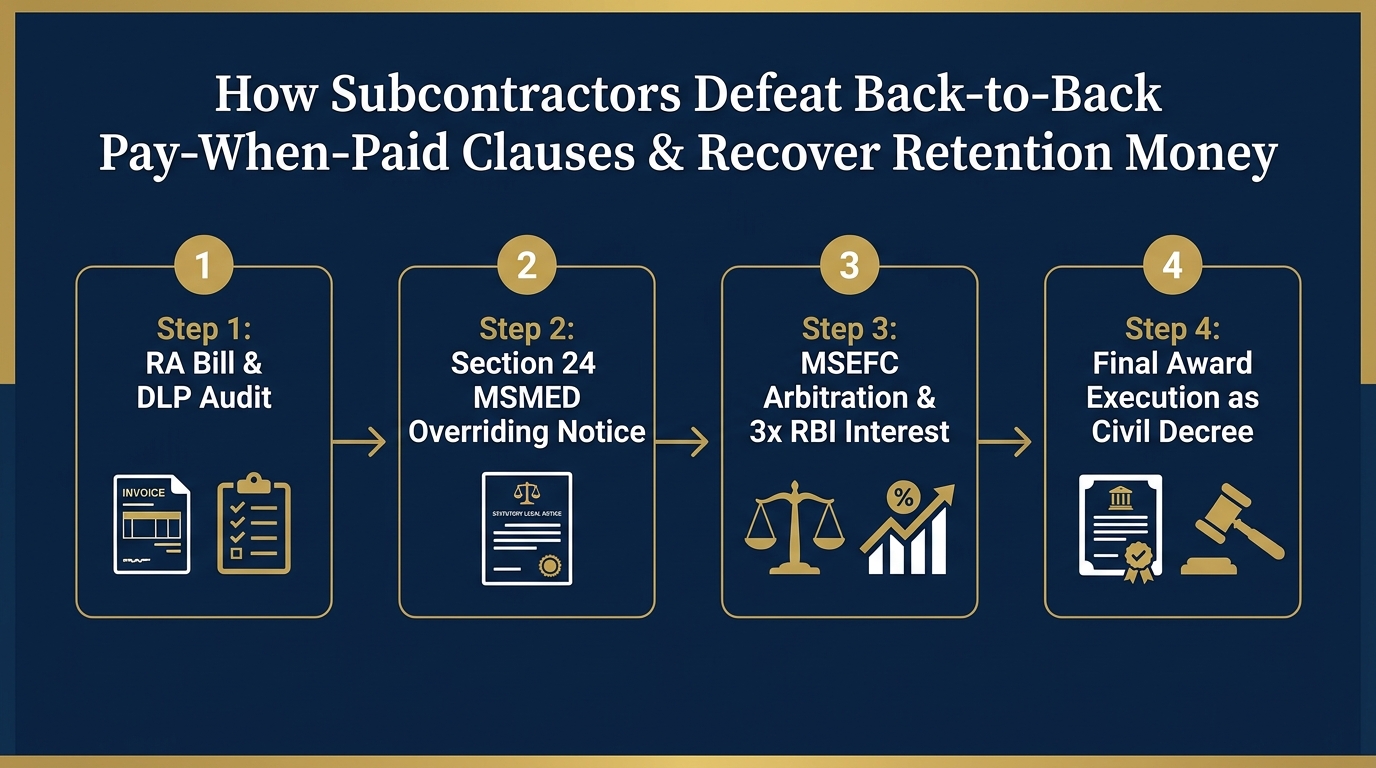
Visual Dispute Resolution & Recovery Framework
Why Coerced No-Claims Certificates and Discharge Vouchers Are Void
When the Defect Liability Period finally concludes, contractors often unleash their final trap. They prepare an arbitrary final settlement sheet with steep unilateral cuts. They tell the subcontractor: sign this unconditional No-Claims Certificate or you will not receive a single rupee of your retention money.
Desperate for cash flow, many small vendors sign these pre-printed discharge vouchers. Later, they fear they have surrendered all legal rights to claim the balance dues or statutory interest. Fortunately, the Supreme Court of India has settled this issue decisively.
In landmark judgments such as National Insurance Company Limited versus Boghara Polyfab Private Limited and Ambica Construction versus Union of India, the Supreme Court ruled that discharge vouchers obtained under economic duress or financial coercion are voidable. A contractor with superior bargaining power cannot compel a struggling subcontractor to waive rightful statutory dues. Even if you signed a pre-printed discharge voucher to get partial payment, you can legally claim the remaining balance and statutory interest.
Four Steps to Recover Stuck RA Bills and Retention Funds
Recovering your unpaid subcontractor bills requires a decisive, structured approach. Follow this proven four-step legal recovery path:
- Step 1: Build Your Measurement and Reconciliation Dossier: Collect every joint measurement sheet, signed Delivery Challan, site inspection report, and RA bill. Gather proof of handover, completion certificates, and all email correspondence. Check if the contractor ever issued a formal defect notice in writing. If they took input tax credit on your GST bills, preserve your GSTR-2B filing records. Read our guide on unpaid invoices recovery guide for Indian businesses.
- Step 2: Serve a Formal Advocate Legal Demand Notice: Stop having casual phone talks with site managers. Instruct a commercial recovery advocate to issue a formal Legal Notice to the contractor corporate office. Invoke Section 70 of the Contract Act, Section 15 and 24 of the MSMED Act, and demand release of all RA bills and retention funds within 15 days. Take immediate action and send an Advocate Notice to Contractor Legal Team now.
- Step 3: File a Reference Before the MSME Facilitation Council: If the contractor does not clear payment within 15 days, registered MSME suppliers can immediately file an online claim on the MSME Samadhaan portal. The council will initiate statutory conciliation. If conciliation fails, the council arbitrates the dispute directly and awards the principal amount with 3x RBI compound interest.
- Step 4: Initiate Commercial Court Pre-Litigation Mediation: If you are not registered under the MSMED Act, file for pre-institution mediation under Section 12A of the Commercial Courts Act, 2015. Commercial courts handle construction disputes on fast-track timelines. Review our detailed guide on commercial court summary suit recovery Delhi Mumbai Bangalore and discover strategic techniques for B2B vendor payment recovery.
Subcontractor Retention and Interest Recovery Calculation Matrix
When calculating your total legal demand against a main contractor, you must account for all withheld components. Do not accept a raw principal settlement that ignores statutory interest and wrongful deductions. You can verify your exact interest dues using our delayed payment interest calculator.
Here is an illustration of an enforceable recovery claim for a mechanical and electrical subcontractor with stuck bills on an industrial project:
| Disputed Claim Component | Main Contractor Excuse | Statutory Legal Right | Total Claimable Amount |
|---|---|---|---|
| Certified RA Bills (Months 8 to 12) | End client has not cleared master milestone | Section 15 MSMED Act (45-day statutory limit) | ₹28,50,000 |
| 10% DLP Retention Money Withheld | Project owner has not released retention pool | DLP expired with zero written defect notices | ₹7,20,000 |
| Unilateral Debits for Site Cleaning | Arbitrary internal back-charges levied | Section 73 Contract Act (unproven damages void) | ₹1,45,000 |
| Statutory Compound Interest (14 Months) | Contract states zero interest on delayed bills | Section 16 MSMED Act (3x RBI rate compounded) | ₹6,88,400 |
| Legal Notice and Advocate Expenses | Not acknowledged by contractor | Section 35 CPC and commercial contract costs | ₹50,000 |
| Total Enforceable Commercial Demand | Zero Payment Offered by Contractor | Binding Claim Before MSEFC / Court | ₹44,53,400 |
Comparing Recovery Forums for Construction and IT Subcontractors
Choosing the right legal forum depends on your contract terms, registration status, and dispute value. Review the comparison matrix below to determine the best legal strategy for your business:
| Legal Escalation Route | Statutory Legal Basis | Expected Timeframe | Settlement Rate | Enforceability Status |
|---|---|---|---|---|
| Advocate Legal Notice to Directors | Section 70 Contract Act & MSMED Section 24 | 15 to 30 Days | 70% to 75% Early Resolution | Direct commercial settlement |
| MSME Samadhaan Council (MSEFC) | Section 18 MSMED Act, 2006 | 60 to 120 Days | High for registered subcontractors | Executable as a Civil Court Decree |
| Commercial Court Pre-Mediation (12A) | Commercial Courts Act, 2015 | 30 to 60 Days | Moderate to High settlement rate | Settlement has force of Court Decree |
| Sole Arbitrator Proceedings | Arbitration & Conciliation Act, 1996 | 6 to 12 Months | High for certified measurement sheets | Binding Award executable under Section 36 |
| IBC Section 9 Insolvency Notice | Insolvency and Bankruptcy Code, 2016 | 10 Days Notice | High settlement pressure for ₹1 Cr+ debts | Adjudication before NCLT Bench |
How to Serve a Bulletproof Advocate Legal Demand Notice
A casual WhatsApp message or polite email to a site manager will never release stuck retention money. Prime contractors only act when their board of directors and legal department see real statutory risk. A formal Advocate Legal Notice changes the game completely.
Your legal notice must be addressed to the registered corporate office of the main contractor. If they are a private or public limited company, name the company and its managing directors. State your contract reference number, the date of mobilization, and the date of final project handover.
Clearly list the breakdown of unpaid certified RA bills and retention money. Highlight that the Defect Liability Period has lapsed without any written notice of defects. If you are an MSME, explicitly cite Section 24 of the MSMED Act to show that their pay-when-paid clause is legally void. Demand full payment with statutory interest within 15 days, failing which legal proceedings will commence.
Deliver the notice via Speed Post with Acknowledgment Due and registered email. Keep postal tracking proofs safely. Over 70 percent of commercial contractors choose to negotiate and release funds at this stage to avoid paying heavy compound interest and tarnishing their credit rating with banks and government clients.
Never let a prime contractor hold your business hostage with empty contractual excuses. The law gives you clear, powerful rights to claim every single rupee you earned through your hard labor. Take decisive legal action today and secure the cash flow your business deserves.
Popular Searches & Related Topics

Legal Recovery is India's trusted consumer protection and legal tech platform. We specialize in holding corporations accountable for unfair trade practices, deceptive marketing, and commercial fraud. With over 15,000 customers counselled, our mission is to provide fast, out-of-court resolutions by connecting you with top-tier panel advocates for immediate legal action.
Client Reviews
"Our electrical contracting firm had ₹34 Lakhs in RA bills and retention money stuck with a major EPC contractor for 14 months. They kept repeating that the highway authority had not paid them. Team LegalRecovery issued an Advocate Notice citing Section 24 MSMED Act. Within 30 days, the contractor cleared our entire principal dues."
Suresh Narayanan
"We provided HVAC ducting for a commercial tech park in Noida. The prime contractor held back 10% retention money even after the 12-month DLP expired without any complaints. LegalRecovery drafted a powerful legal notice that broke through their delay tactics. Full payment received with interest."
Manish Aggarwal
"As a software staffing subcontractor, our firm faced a tough pay-when-paid clause from an IT services prime vendor who withheld ₹18 Lakhs. LegalRecovery guided us through Section 70 Contract Act and pre-litigation mediation. We recovered our complete invoice value without expensive court battles."
Karthik Venkatraman
"Exceptional legal acumen on construction contracts and MSME law. The team showed us how Section 24 completely overrides the unfair back-to-back clauses in standard EPC work orders. Recovered ₹26 Lakhs of stuck pipeline fabrication bills in record time."
Gurpreet Singh Dhillon
"Our civil contracting company struggled for two years to recover retention money on an industrial warehouse project. LegalRecovery's structured legal demand notice and MSEFC filing strategy forced the contractor to settle the full claim before arbitration commenced."
Rameshwar Prasad
Frequently Asked Questions
Related Articles
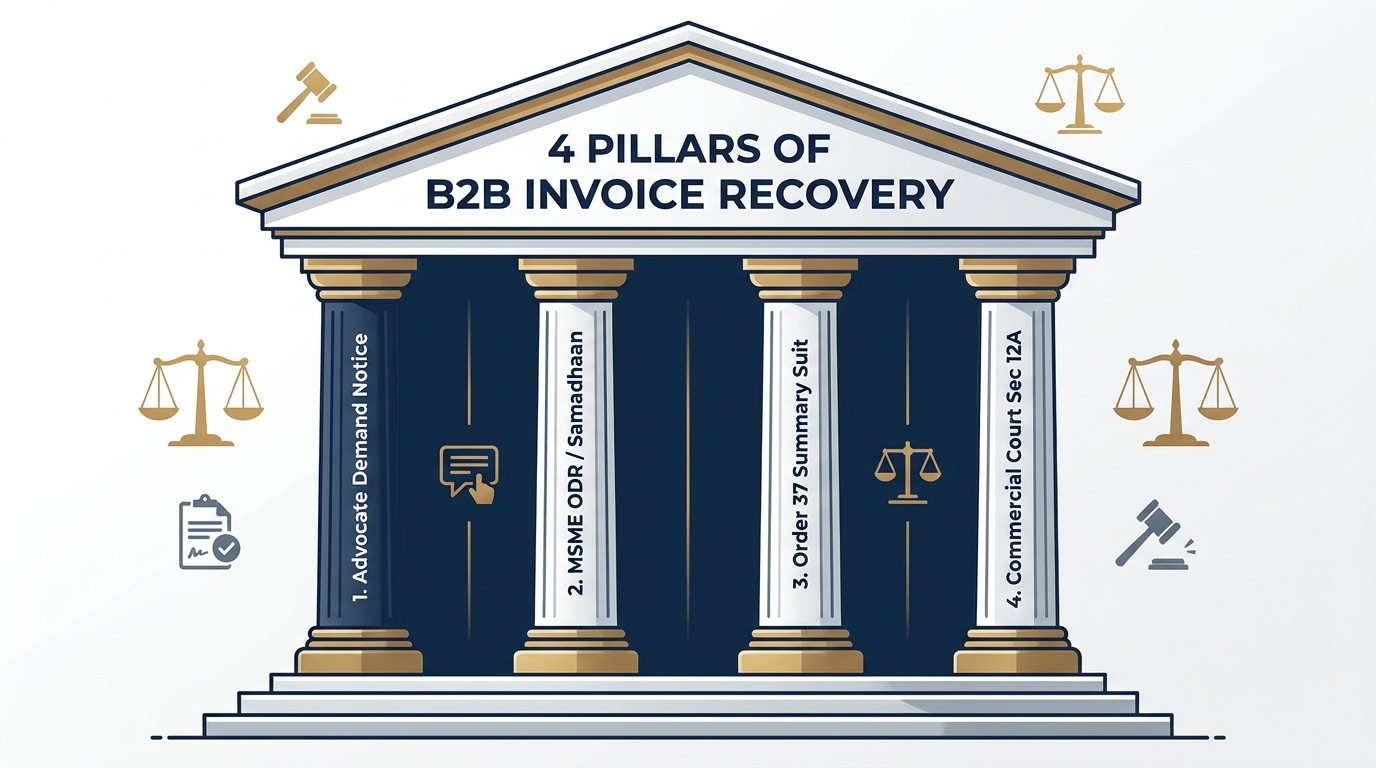
MSME ODR vs Order 37 vs Commercial Court: Fast Invoice Recovery (2026)
msme odr portal vs summary suit order 37, fastest way to recover unpaid b2b invoice in india, commercial courts act section 12a pre institution mediation, can medium enterprise or trader file msme samadhaan, 75 percent deposit rule section 19 msmed act, order 37 cpc summary suit recovery, recover money from unpaid business invoice india, b2b commercial recovery advocate notice, delayed payment dispute resolution india, msefc arbitration vs commercial summary suit
Read Article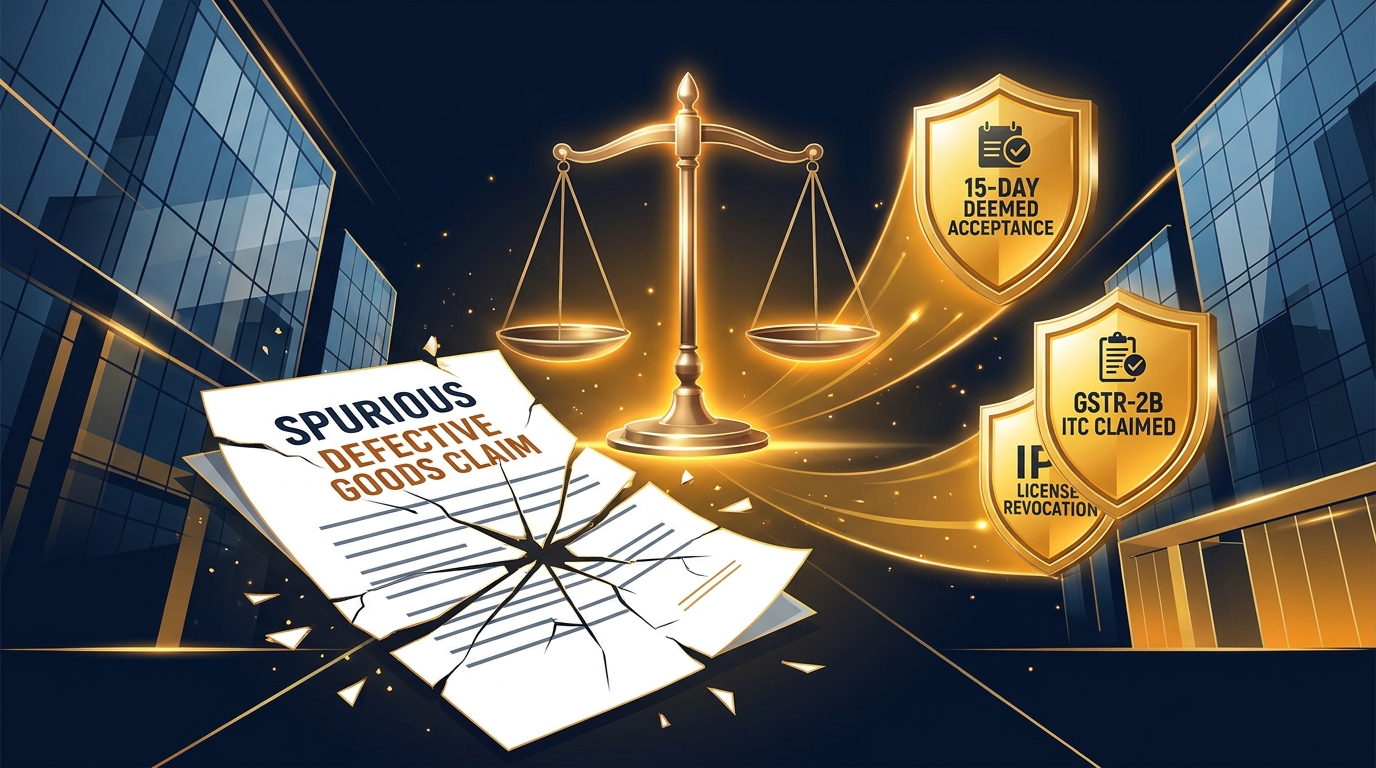
Client Refusing to Pay Final Invoice Citing Fake Quality Issues (2026)
client refusing to pay invoice citing quality issues, buyer raising fake dispute after invoice due date, section 42 sale of goods act deemed acceptance, client using software or design without paying final milestone, it agency unpaid milestone recovery legal notice, gst GSTR 2B input tax credit admission of invoice, 180 day itc reversal rule 37 cgst act, msmed act 15 day objection window deemed acceptance, recovering unpaid freelance milestone delivery accepted, order 37 summary suit quality dispute sham defense
Read Article
Section 43B(h) & MSME 45-Day Invoice Recovery Legal Notice (2026)
section 43bh msme invoice recovery legal notice, recover money from unpaid business invoice, msme 45 days payment rule legal notice format, section 16 msmed act 3x rbi compound interest calculator, how to force corporate buyer to pay unpaid invoice, form msme 1 MCA reporting unpaid vendor invoice, section 22 msmed act statutory disclosure, delayed payment to micro and small enterprise recovery, msme payment recovery legal notice, b2b commercial debt recovery india, udyam registration invoice payment enforcement, corporate buyer unpaid invoice legal action
Read Article
How to Recover Unpaid Salary & FNF from a Shutting Down Startup
startup not paying salary due to funding issues, can directors be held liable for unpaid employee salary, nclt operational creditor employee salary recovery, legal notice to startup founders for unpaid fnf, summary suit for unpaid salary and fnf, recover unpaid salary and fnf from shutting down startup, section 14a epf act director liability, section 276b income tax act tds default, section 33c2 industrial disputes act revenue recovery certificate, order 37 cpc liquidated salary debt, first mover liquidity strategy startup shutdown
Read ArticleAbout Author
Anuj Anand Malik
View ProfileAnuj Anand Malik, Founder of AMA Legal Solutions, is a trusted advocate, loan settlement expert, legal advisor, and banking lawyer. With over a decade of experience in loan settlement, corporate law, financial disputes, and compliance, he leads a result-driven law firm based in India that helps individuals, startups, and businesses achieve legal and financial stability.
Connect on LinkedInNeed Legal Help?
Get expert advice on loan settlement, banking disputes and debt relief.
Start Recovery NowRequest Callback