Legal Notice to Hospital for Medical Negligence & Refund
Demand full refund of treatment expenses, overbilled ICU charges, and multi-lakh compensation for surgical errors, misdiagnosis, and deficiency in medical service across India.
Table of Contents
Swipe →Quick Answer
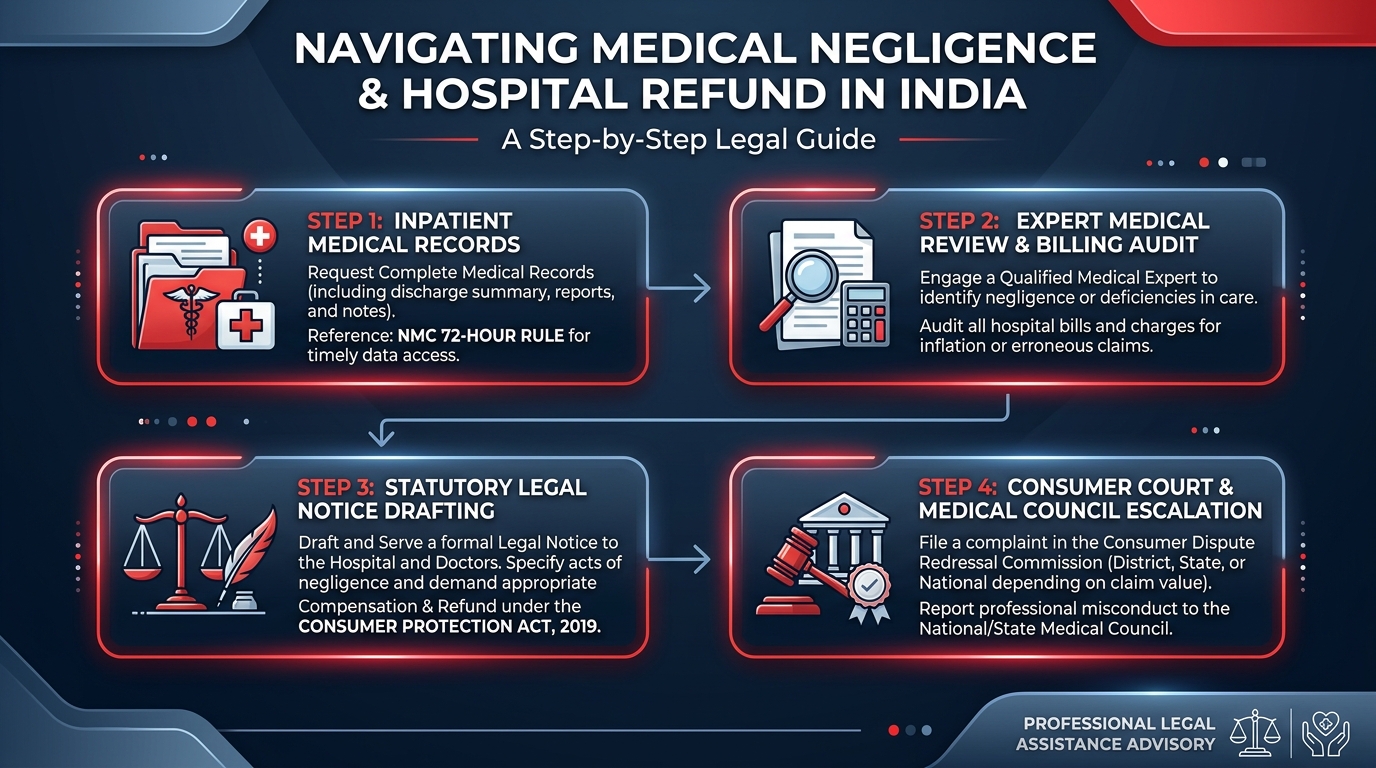
An aggrieved patient or legal heir can issue an advocate-drafted statutory legal notice to a hospital, nursing home, or treating doctor under Section 2(42) and Section 35 of the Consumer Protection Act, 2019, demanding full refund of paid medical expenses, corrective treatment reimbursement, and financial compensation for medical negligence within 15 days. Healthcare services provided by commercial hospitals for monetary payment constitute "services" under Indian consumer law as held by the Supreme Court in Indian Medical Association v. V.P. Shantha. Under National Medical Commission regulations, the hospital is statutorily bound to furnish certified inpatient medical records within 72 hours of written request, and failure to settle the demand notice empowers the victim to file a formal complaint before the District, State, or National Consumer Commission (NCDRC) alongside disciplinary proceedings before the State Medical Council.
1. Statutory Framework: Healthcare Under CPA 2019
Medical treatment and hospital care in India operate within an intricate web of consumer protection statutes, clinical establishment regulations, tort principles, and medical council ethics codes. The primary legislative instrument for redressing medical malpractice, diagnostic errors, and commercial hospital overcharging is the Consumer Protection Act, 2019 (CPA 2019), which repealed and substantially strengthened the earlier 1986 enactment.
Under Section 2(42) of the CPA 2019, "service" is comprehensively defined to encompass any service made available to potential users, excluding only free services or services rendered under a contract of personal service. Ever since the constitutional bench ruling of the Supreme Court in Indian Medical Association v. V.P. Shantha (1995) 6 SCC 651, it is settled law that medical practitioners, private nursing homes, and corporate hospital networks are accountable under consumer forums whenever treatment is rendered for direct payment, insurance reimbursement, or employer contribution.
Furthermore, Section 2(11) of the CPA 2019 defines "deficiency" as any fault, imperfection, shortcoming, or inadequacy in the quality, nature, and manner of performance required by law or undertaken under contract. When a hospital fails to maintain sterile operating theatres, assigns unqualified resident doctors, or fails to monitor vital signs in the ICU, it commits an actionable deficiency of service. Complementing this, Section 2(47) penalizes "unfair trade practices", making hospitals liable for inflated bills, hidden charges, and mandatory tied selling of hospital pharmacy items at exorbitant prices.
Statutory regulatory oversight is additionally governed by the National Medical Commission Act, 2019 (NMC Act) and the Clinical Establishments (Registration and Regulation) Act, 2010, which mandate standard treatment protocols, transparency in package pricing, and strict adherence to patient rights charters formulated by the Ministry of Health and Family Welfare (MoHFW) and the National Human Rights Commission (NHRC).
2. Actionable Grounds: Negligence, Surgical Error & Billing Fraud
A well-structured statutory legal notice must clearly articulate the specific factual breaches and deviations from accepted medical protocols. Indian consumer jurisprudence recognizes several distinct categories of hospital malpractice and commercial exploitation:
Surgical Errors & Retained Foreign Bodies (Res Ipsa Loquitur)
Incidents such as leaving surgical swabs, gauze, needles, or instruments inside the body cavity during surgery; operating on the wrong organ or limb; performing laparoscopic procedures without required anatomical visualization causing perforation of the bile duct or bowel; and substandard post-operative surgical wound closure.
Diagnostic Errors & Delayed Critical Treatment
Misinterpreting histopathology biopsy reports, failing to report critical ECG changes in emergency admissions, misreading CT/MRI scans leading to irreversible disease progression, or initiating aggressive chemo/radiation therapy based on erroneous diagnostic laboratory findings.
Lack of Informed Consent
Performing high-risk surgical procedures or amputations without executing a legally valid, comprehensive informed consent document that clearly explains known risks, procedure alternatives, potential complications, and expected mortality/morbidity rates to the patient or authorized next-of-kin.
Hospital-Acquired Infections (HAI) & Unsanitary ICU Conditions
Severe hospital-acquired bloodstream infections (septicemia), ventilator-associated pneumonia, or surgical site infections caused by unsterilized OT equipment, reuse of single-use consumables, or inadequate microbial surveillance in ICU/NICU wards.
Commercial Billing Fraud & Unfair Excess Charging
Charging for phantom medical procedures never performed, double-billing for consumables and PPE kits, billing ICU charges when the patient is in a general room, refusing to discharge patients or dead bodies until exorbitant disputed bills are settled, and refusing refunds for unutilized admission deposits.
Anesthesia Complications & Medication Overdose
Administering incorrect anesthetic doses without pre-anesthetic evaluation (PAC), administering medications known to cause documented allergic anaphylaxis, or dispensing wrong pharmaceuticals due to hospital pharmacy fulfillment negligence.
3. Landmark Supreme Court Rulings on Hospital Liability
Citing binding Supreme Court of India precedents inside your advocate-vetted legal notice establishes immense legal authority, demonstrating to hospital management and their legal counsel that you are prepared for high-stakes litigation:
Spring Meadows Hospital v. Harjol Ahluwalia (1998) 4 SCC 39
Established the absolute vicarious liability of hospitals for negligent acts of their resident doctors, nurses, and staff. The Court ruled that parents/guardians are consumers entitled to compensation for mental agony and suffering caused by pediatric medical negligence.
Savita Garg v. National Heart Institute (2004) 8 SCC 56
Hospitals cannot escape liability by claiming that treating doctors were independent visiting consultants. The burden of proof shifts to the hospital to demonstrate absence of negligence once prima facie deficiency is established by the patient.
Jacob Mathew v. State of Punjab (2005) 6 SCC 1
Defined the medical standard of reasonable skill and care under the Bolam test. Reaffirmed that while doctors are not liable for bona fide errors of clinical judgment, failure to possess or exercise standard medical competence constitutes actionable civil negligence.
Malay Kumar Ganguly v. Sukumar Mukherjee (2009) 9 SCC 221
Awarded a historic landmark compensation of over ₹11 Crores for gross medical negligence, establishing modern multipliers for lost lifetime earnings, emotional trauma, and systemic hospital care deficiencies.
4. The 72-Hour Statutory Medical Records Rule
Securing un-tampered medical records is the single most critical pre-litigation step in medical malpractice disputes. Private hospitals frequently attempt to stall or edit Inpatient Bed Head Tickets (BHT), anesthesia monitoring sheets, and operative notes once they suspect legal action.
⚠️ Mandatory 72-Hour Medical Records Disclosure Rule
Under Regulation 1.3.2 of the Medical Council of India / National Medical Commission Code of Medical Ethics Regulations:
"If any request is made for medical records either by the patients / authorized attendant or legal authorities involved, the same may be duly acknowledged and documents shall be issued within the period of 72 hours without fail."
The legal notice must formally place the hospital on record demanding immediate preservation and dispatch of the following unedited original records:
5. Consumer Commissions: Jurisdictions & Compensation Multipliers
Determining the correct forum and accurately calculating the monetary quantum of damages is vital before serving the statutory legal notice. Under the Consumer Protection Act, 2019, pecuniary thresholds are determined based on the total value of consideration paid plus total compensation claimed:
| Consumer Adjudication Forum | Pecuniary Claim Limit | Filing Procedure & Portal | Appellate Hierarchy |
|---|---|---|---|
| District Consumer Disputes Redressal Commission (DCDRC) | Up to ₹50 Lakhs | Direct filing or online via e-Daakhil portal (edaakhil.nic.in) | State Commission (within 45 days) |
| State Consumer Disputes Redressal Commission (SCDRC) | ₹50 Lakhs to ₹2 Crores | State capital commission registry / e-Daakhil | NCDRC New Delhi (within 30 days) |
| National Consumer Disputes Redressal Commission (NCDRC) | Exceeding ₹2 Crores | NCDRC Registry (Upbhokta Nyay Bhawan, New Delhi) | Supreme Court of India (within 30 days) |
Formula for Compensation Calculation in Medical Malpractice
Following the Supreme Court guidelines in Nizam's Institute of Medical Sciences v. Prasanth S. Dhananka (2009) 6 SCC 1 and Malay Kumar Ganguly, compensation is quantified across five heads:
- Actual Medical Expenditure: Full refund of all hospital admission bills, surgical fees, diagnostics, and pharmaceutical receipts.
- Revision & Corrective Medical Costs: Estimated financial expenses required to undergo corrective surgeries at another tertiary healthcare facility.
- Loss of Income & Earning Capacity: Loss of active salary/business revenue during hospitalization plus future loss calculated using the multiplier method based on patient age and permanent disability percentage.
- Pain, Suffering & Mental Agony: Substantial non-pecuniary damages for physical agony, permanent scarring, trauma, and diminished quality of life.
- Litigation & Caregiver Expenses: Costs of legal drafting, expert medical reviews, and 24/7 home nursing assistance.
6. Essential Clauses in a Medical Negligence Notice
An advocate-drafted statutory notice must be drafted with clinical and legal precision. Omitting critical statutory recitals can weaken subsequent consumer court petitions:
Chronology of Admission, Treatment & Initial Consultation
Explicitly state the exact date and time of admission, preliminary diagnosis communicated by the attending physician, admission deposit paid, and room/ICU allotment details.
Specific Enumeration of Medical Omissions & Errors
Identify the exact acts of omission or commission: failure to perform mandatory pre-op diagnostic tests, administration of wrong dosage, intra-operative surgical laceration, or failure of timely resuscitation.
Causation & Consequential Bodily Harm / Disability
Establish a direct causal nexus between the hospital/doctor's negligent act and the resultant physical harm, prolonged ICU stay, permanent organ damage, or patient demise.
Itemized Billing Inflation & Unfair Trade Practice Claims
Itemize all inflated charges, unauthorized diagnostic markups, double-billed consumables, and unrefunded deposit balances with reference to receipt numbers.
15-Day Strict Compliance Mandate & Multi-Forum Escalation Warning
Demand full refund of fees, corrective medical reimbursement, and specified compensation within 15 days, failing which formal complaints will be lodged before the Consumer Commission, State Medical Council, and National Medical Commission.
7. Post-Notice Roadmap: Commission & NMC Disciplinary Filing
If the hospital management or insurance underwriters fail to offer a satisfactory settlement or refund within the 15-day notice window, Legal Recovery guides clients through a structured, multi-pronged enforcement strategy:
Hospital Internal Grievance & Medico-Legal Committee Negotiation
In over 68% of cases, receipt of an advocate-vetted statutory notice citing NCDRC precedents compels the hospital's internal risk management and insurance underwriters (TPA) to convene an out-of-court settlement negotiation, offering billing refunds and compensation.
Filing Formal Consumer Complaint (e-Daakhil / Consumer Forum)
Instituting a formal complaint under Section 35 of the Consumer Protection Act, 2019 before the District Commission, State Commission, or NCDRC with an expert medical opinion affidavit, claiming refund, interest at 12-18% p.a., and punitive damages.
Disciplinary Complaint to State Medical Council (SMC) & NMC
Filing an ethics complaint against treating doctors under the NMC Act, 2019 for professional misconduct, failure to provide medical records within 72 hours, and breach of standard clinical care, seeking suspension or cancellation of medical license.
Criminal Complaint under BNS 2023 (In Gross Negligence Cases)
Where medical negligence involves extreme recklessness or phantom billing fraud, lodging a police complaint under Section 106(1) (causing death by negligence) or Section 318 (cheating) of the Bharatiya Nyaya Sanhita, 2023 in accordance with Supreme Court procedural guidelines.
8. Frequently Asked Questions
Authoritative Legal & Statutory References:
- Consumer Protection Act, 2019 — Ministry of Consumer Affairs, consumeraffairs.nic.in
- National Consumer Disputes Redressal Commission (NCDRC) — Official Portal, ncdrc.nic.in
- National Medical Commission (NMC) — Code of Medical Ethics & Professional Conduct Regulations, nmc.org.in
- Supreme Court of India — Indian Medical Association v. V.P. Shantha (1995) 6 SCC 651, main.sci.gov.in
- Clinical Establishments (Registration and Regulation) Act, 2010 — MoHFW, mohfw.gov.in
- Bharatiya Nyaya Sanhita, 2023 — Section 106(1) & Section 318, indiacode.nic.in
More Consumer Protection & Dispute Guides

Legal Recovery
India's Trusted Recovery Platform
Legal Recovery is India's trusted online legal notice and dispute resolution platform, connecting patients, consumers, businesses, and individuals with experienced panel advocates for fast, advocate-vetted statutory notices at transparent flat fees. With ₹100 Crore+ recovered and 10,000+ cases resolved, Legal Recovery delivers verified legal impact without the delays of traditional law firm engagement.
Hospital Medical Negligence or Overbilling?
Send an advocate-vetted statutory notice today. 68% of private hospitals settle disputed bills and malpractice claims upon receiving formal notice from Legal Recovery.
Flat fee • Advocate-drafted • Sent same day
Client Reviews
Dr. Sameer Kulkarni
"When a renowned private hospital in Delhi botched my mother's gallbladder laparoscopic surgery and charged an inflated ICU bill of ₹6.4 Lakhs, they refused to furnish medical records. Legal Recovery drafted a formidable statutory legal notice citing CPA 2019, NMC 72-hour records rule, and the Spring Meadows Hospital precedent. Within 11 days, the hospital management convened a settlement committee, refunded ₹3.8 Lakhs in disputed charges, and agreed to bear full revision treatment costs. Truly exemplary legal support."