Legal Notice for Unfair Trade Practice
Combat deceptive marketing, hidden corporate fees, and false claims. Force businesses to compensate you under the robust frameworks of the Consumer Protection Act.
Table of Contents
Swipe →Quick Answer
Consumers face unfair trade practices whenever a company engages in false advertising, hidden pricing, or misleading warranties to secure a commercial advantage. Sending a formal legal notice for an unfair trade practice complaint provides the offending business a stringent 15-day deadline to rectify the financial injury and cease the deceptive behavior. Failure to comply establishes robust grounds to seek a full refund and punitive damages through litigation under the Consumer Protection Act.
1. Identifying Unfair Trade Practices
Before dispatching a legal notice for an unfair trade practice complaint, it is vital to correctly classify the corporate behavior under the statutory definitions provided by law. Section 2(47) of the Consumer Protection Act, 2019 comprehensively defines an "unfair trade practice" as any trade method or deceptive practice adopted for the purpose of promoting the sale, use, or supply of any goods or services.
These deceptive practices often manifest in ways that manipulate the consumer's purchasing decision. For instance, a common violation involves e-commerce platforms artificially inflating the "Maximum Retail Price" (MRP) only to offer a fabricated "discount" to lure buyers. Another widespread issue involves educational institutions or gymnasiums embedding one-sided, non-refundable clauses in their contracts, trapping consumers who wish to exit deficient services. Such asymmetric contracts are explicitly classified as unfair.
Bait-and-switch advertising, where a company advertises a high-quality product at a low price but substitutes it with inferior goods post-payment, is a textbook violation. To combat these tactics, the Central Consumer Protection Authority (CCPA) possesses the mandate to penalize entities engaging in misleading advertisements and unfair trade practices on a macroscopic level, while individual consumers can seek personal redressal through a targeted legal notice.
2. Statutory Protections Under Law
The Indian legal framework heavily favors the consumer when dealing with corporate deception. A well-drafted legal notice for an unfair trade practice complaint leverages these statutes to compel immediate corporate compliance, bypassing the necessity for a prolonged court battle.
- Section 2(47) of the Consumer Protection Act, 2019: This core section establishes the legal definition of unfair trade practices, encompassing false representations regarding the standard, quality, or grade of goods and services.
- Section 89 & 90 of the Consumer Protection Act, 2019: These provisions introduce stringent penalties for manufacturers or service providers caught issuing misleading advertisements, threatening them with imprisonment and substantial fines.
- The Consumer Protection (E-Commerce) Rules, 2020: These rules explicitly prohibit digital marketplaces from manipulating search algorithms to favor certain sellers or artificially inflating prices, establishing liability for digital unfair trade practices.
- Section 73 of the Indian Contract Act, 1872: This statute permits the aggrieved consumer to demand compensation for any loss or damage naturally arising from the breach of contract initiated by the deceptive practice.
3. Quantifying Your Compensation
A critical component of a legal notice for an unfair trade practice complaint is the precise quantification of damages. Vague demands allow corporate legal teams to dismiss the notice as frivolous. Your advocate will strategically structure the demand clause to encompass multiple tiers of compensation.
Firstly, the notice demands the refund of the principal amount paid for the goods or services, augmented by an interest rate (typically 12% to 18% per annum) calculated from the date of the deceptive transaction. Secondly, it quantifies the damages for mental agony and harassment. While subjective, this amount should remain proportionate to the principal loss to maintain credibility before the National Consumer Disputes Redressal Commission (NCDRC) or lower courts. Finally, the notice demands reimbursement for the legal costs incurred in drafting and dispatching the document itself.
4. Notice Drafting & Dispatch Process
Sending a legal notice for an unfair trade practice complaint requires absolute procedural correctness. Any technical flaw can be exploited by the opposing party to invalidate your claim. Follow this strict chronological procedure:
Evidence Compilation
Archive all deceptive advertisements, brochures, emails, and transaction receipts. Ensure timestamps are visible on digital evidence.
Corporate Identification
Locate the exact registered corporate address and the details of the Grievance Officer or Managing Director of the offending company.
Advocate Drafting
Engage an advocate to draft the notice on official letterhead, establishing the legal link between the company's actions and the statutory definitions of unfair trade practices.
Registered Dispatch
Dispatch the physical notice via Registered Post with Acknowledgment Due (RPAD) to secure an undeniable proof of delivery.
5. Essential Elements of the Notice
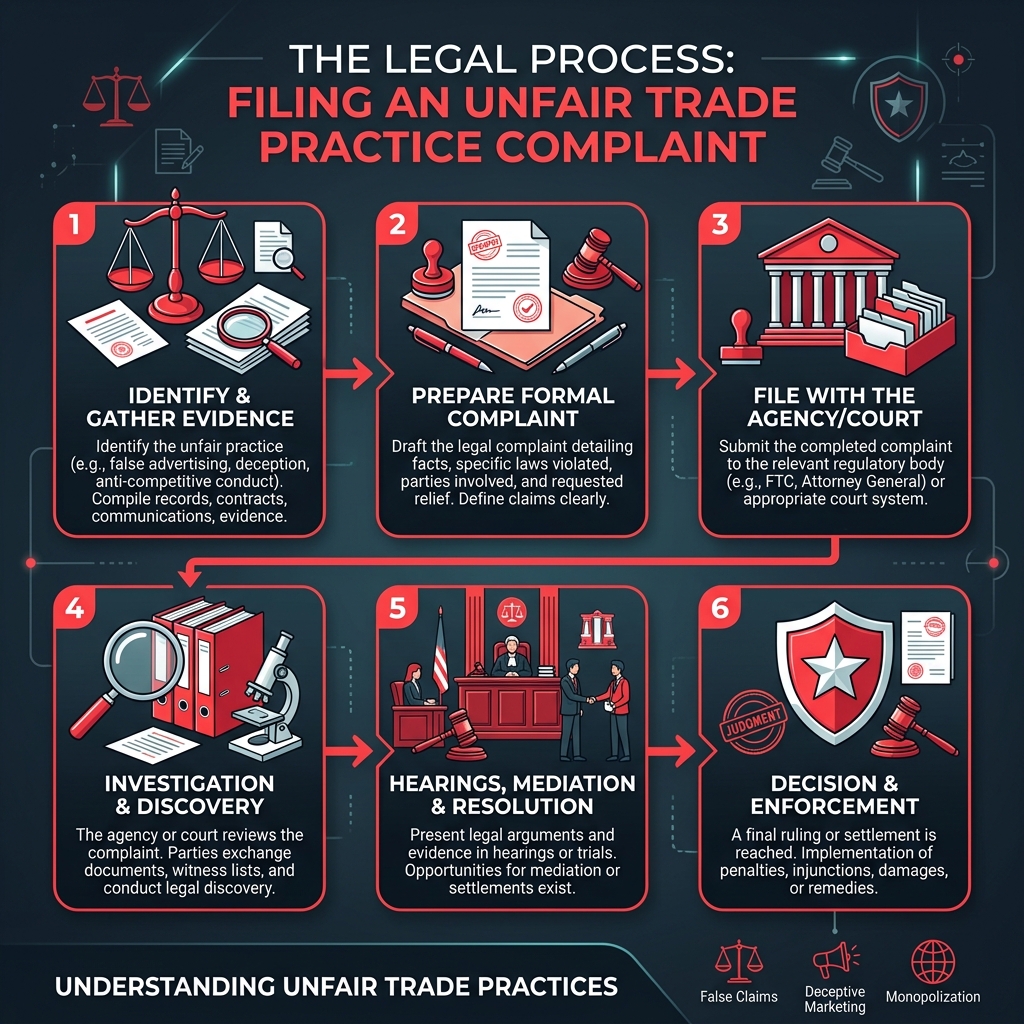
A standard email complaint is easily ignored, but a meticulously drafted legal notice forces the corporate legal department to intervene. To command authority, the notice must contain:
- The Advocate's Authority: A clear statement that the notice is issued under the instructions of the aggrieved client.
- Detailed Chronology: A step-by-step recounting of the transaction, highlighting exactly when the deceptive practice occurred.
- Statutory Mapping: Explicit mapping of the company's behavior to the subsections of Section 2(47) of the Consumer Protection Act.
- Evidence Reference: A declaration that incontrovertible evidence (emails, recordings, contracts) is currently in the client's possession.
- The 15-Day Ultimatum: A non-negotiable deadline demanding compliance, failing which the client will initiate civil and consumer proceedings.
6. Escalation to Consumer Forums
If the company fails to honor the demands set forth in the legal notice for an unfair trade practice complaint within the 15-day stipulation, the dispute enters the litigation phase. The consumer is now legally positioned to file a complaint via the national e-Daakhil portal.
The jurisdiction of the consumer court depends entirely on the value of the goods or services paid as consideration. The District Commission handles cases up to ₹50 Lakhs, the State Commission oversees matters between ₹50 Lakhs and ₹2 Crores, and the National Commission (NCDRC) adjudicates disputes exceeding ₹2 Crores. The previously sent legal notice, along with its postal tracking receipt, serves as Annexure-A in your complaint petition, proving to the judge that the corporation willfully ignored an opportunity to resolve the matter amicably.
7. Frequently Asked Questions
Disclaimer: This legal guide is for informational purposes only. Every dispute requires custom legal drafting to be enforceable.
Send Legal Notice
We match you with a panel advocate, handle the custom drafting, physically post the notice, and track its delivery in real-time.
Client Reviews
"A prominent real estate builder hit me with hidden charges that were never disclosed in the brochure. Sent a legal notice for an unfair trade practice complaint through Legal Recovery. The builder waived the charges immediately to avoid litigation."
More Consumer Protection Guides
Defective Product Notice
Learn how to send a legal notice if you received a faulty or damaged product from an e-commerce platform.
Consumer Court Filing
Step-by-step guide to escalating your grievance to the National Consumer Disputes Redressal Commission.
E-Commerce Disputes
Fight back against major platforms that illegally reject your legitimate return or refund requests.

Legal Recovery is India's trusted consumer protection and legal tech platform. We specialize in holding corporations accountable for unfair trade practices, deceptive marketing, and commercial fraud. With over 15,000 customers counselled, our mission is to provide fast, out-of-court resolutions by connecting you with top-tier panel advocates for immediate legal action.