Salary Deducted During Notice Period: Legal Action in India
Recover unlawfully withheld notice period wages, F&F settlement deductions, and delayed relieving letters under the Payment of Wages Act, Code on Wages, and Indian Contract Act.
Table of Contents
Swipe →Quick Answer
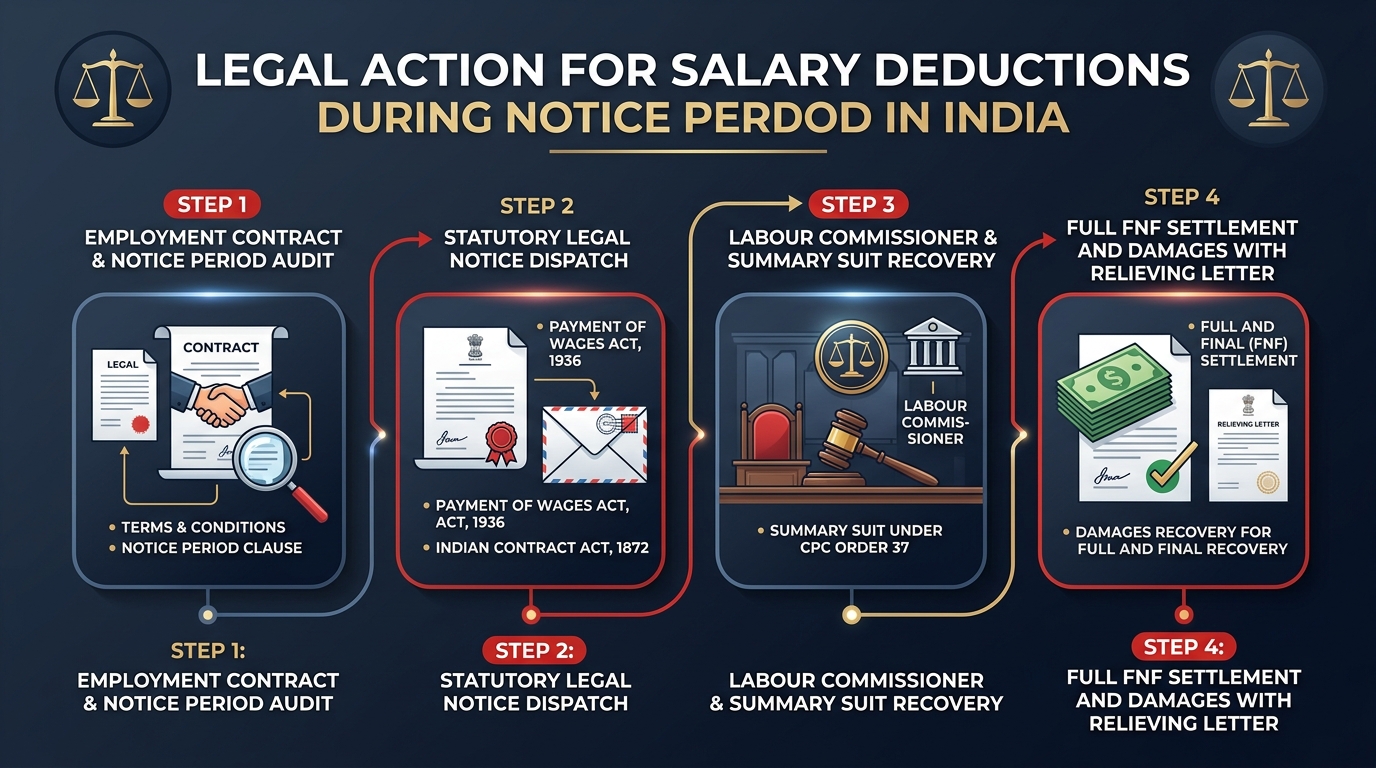
Under Section 7 and Section 15 of the Payment of Wages Act, 1936, Section 18 of the Code on Wages, 2019, and Section 74 of the Indian Contract Act, 1872, an employer in India cannot lawfully deduct salary or withhold wages during an employee's active notice period unless the deduction is strictly authorized by statute or represents a proportionate basic salary shortfall for unserved days. If an employer makes unauthorized deductions from monthly pay or the Full and Final (FNF) settlement, the aggrieved employee can serve an advocate-vetted statutory legal demand notice giving the management 15 days to refund the deducted amount with interest and release all service certificates. Continued non-compliance empowers the employee to initiate summary recovery proceedings under Order 37 of the Code of Civil Procedure, 1908, file a statutory claim before the Labour Commissioner with up to ten times penalty compensation, and register a complaint under the applicable State Shops and Establishments Act.
1. Statutory Framework: Notice Period Wages & Deduction Laws
In corporate, IT, manufacturing, banking, and consulting establishments across India, notice periods are standard contractual clauses intended to ensure orderly knowledge transfer and continuity of operations. However, corporate employers routinely weaponize the notice period by unilaterally withholding monthly salary credits, making unauthorized deductions, inflating shortfall charges, or forfeiting accrued statutory benefits in the Full and Final (FNF) settlement.
Indian labor and contract jurisprudence provides uncompromising statutory safeguards to protect employees against coercive wage deductions during their resignation transition:
- Payment of Wages Act, 1936 (Sections 7 & 15): Section 7 specifies an exhaustive list of permissible deductions (such as income tax, court attachments, provident fund, and authorized absence from duty). Any deduction not explicitly enumerated under Section 7 is deemed an illegal deduction. Under Section 15(3), the Labour Authority is empowered to direct full refund of the deducted wage along with statutory compensation up to ten times the withheld amount.
- Code on Wages, 2019 (Sections 17 & 18):Section 17 mandates that when an employee resigns or is terminated, all wages due must be disbursed within two working days of the cessation of employment. Section 18 strictly regulates deductions and caps total monthly deductions at 50% of the employee's total earnings.
- Indian Contract Act, 1872 (Section 74 - Liquidated Damages vs Penalty): Under Section 74, an employer cannot enforce a punitive forfeiture clause. Any notice shortfall deduction must represent a reasonable, proven pre-estimate of actual loss incurred by the employer, not a penal extraction. Unilateral salary cuts without proving tangible commercial loss are void ab initio.
- Indian Contract Act, 1872 (Section 27 - Restraint of Trade): Unreasonable notice lock-ins (e.g., 90-day mandatory notice with zero buyout options, combined with threats of relieving letter withholding) have been interpreted by Indian courts as indirect restraints on trade, violating Section 27.
- State Shops and Commercial Establishments Acts: Legislation such as the Maharashtra Shops and Establishments Act, Delhi Shops and Establishments Act, Karnataka Shops and Commercial Establishments Act, and Telangana Shops Act statutorily mandate prompt payment of all accumulated wages, overtime, and leave encashment upon resignation.
Landmark Supreme Court & High Court Jurisprudence
In Central Inland Water Transport Corporation v. Brojo Nath Ganguly (1986) 3 SCC 156, the Hon'ble Supreme Court held that unequal bargaining power between employers and employees cannot give rise to unconscionable, one-sided contractual terms. Any clause that gives the management unbridled discretion to confiscate earned wages or penalize employees is unconstitutional and contrary to public policy under Section 23 of the Contract Act.
Similarly, in Superintendence Company of India (P) Ltd. v. Krishan Murgai (1980) 2 SCC 246, the Apex Court affirmed that restrictive covenants and punitive financial bars imposed on an employee after the cessation of employment are completely void under Indian law.
2. Actionable Grounds: Common Illegal Deduction Scenarios
Corporate employers employ a variety of opaque accounting maneuvers and punitive HR policies to withhold employee wages during resignation. When drafting an advocate-vetted demand notice, identifying the precise actionable breach is paramount:
Withholding Monthly Salary During Active Notice Period
Refusing to credit the monthly salary for the 30, 60, or 90 days the employee is actively reporting to work, logging hours, and executing handovers, under the arbitrary claim that "all notice period wages will be cleared only in FNF after 90 days".
Unilateral Deductions Despite Written Early Release / Buyout Approvals
Reporting managers or HR providing written or email consent for an early release date or notice waiver, but subsequently reversing the agreement in the FNF calculation and docking 30-60 days of salary as an unauthorized shortfall.
Calculating Notice Shortfall on Full Gross CTC Instead of Basic Pay
Deducting notice shortfall penalties by multiplying unserved days by the employee's total Gross Cost to Company (CTC)—including PF, medical insurance, gratuity provision, and variable components—instead of basic salary.
Arbitrary Forfeiture of Earned Leave (EL) & Accrued Variable Bonus
Refusing to adjust accumulated privilege leaves against notice shortfall or completely wiping out accrued quarterly performance bonuses, commissions, and contractual retention payouts earned prior to resignation.
Fabricated Asset Damage, Training Bond & IT Clearance Deductions
Levying unilateral financial penalties for alleged wear and tear on laptops, claiming unliquidated "training bond" damages without proving actual specialized expense, or creating bogus clearance delays without an internal domestic enquiry.
Coercive Withholding of Relieving & Experience Letters
Using the relieving letter and service certificate as extortionate leverage to force the resigning employee into signing a blank "No Dues Certificate" or accepting steep, illegal financial deductions.
3. Legal Remedies: Labour Authority, Summary Civil Suits & Shops Act
Depending on your employment designation, salary structure, and contract terms, Indian law provides multiple expedited forums to recover unlawfully deducted notice wages:
| Recovery Forum & Statute | Eligible Employee Category | Jurisdictional Threshold | Statutory Remedies & Penalties |
|---|---|---|---|
| Payment of Wages Authority (Sec 15, Payment of Wages Act, 1936) | Non-managerial staff & wage earners covered under the Act | Monthly wage ceiling under Act / Code on Wages | Order directing 100% wage refund plus statutory compensation up to 10x deducted amount |
| Labour Commissioner / Industrial Tribunal (Sec 33C(2) ID Act, 1947) | Workmen, operational engineers, technical specialists | No monetary limit | Recovery certificate issued to District Collector for revenue attachment of company accounts |
| Summary Suit under Order 37 CPC (Code of Civil Procedure, 1908) | Managers, Executives, Directors, Tech Leads, Consultants | Civil Court Pecuniary Jurisdiction | Fast-track decree for liquidated debt on salary slips & offer letter; defense must secure leave to defend |
| State Shops & Commercial Establishments Inspectorate | All commercial establishment & IT/BPO employees | Statewide jurisdiction | Inspection notice to employer, criminal compounding fines, and wage recovery orders |
| Bharatiya Nyaya Sanhita, 2023 (BNS Sec 316 & 318) | Cases involving fraudulent intent & trust violation | Criminal complaint | Personal criminal liability for directors, HR heads, and promoters for criminal breach of trust |
High Court Rulings on Unlawful Notice Shortfall Deductions
The Delhi High Court and Bombay High Court have repeatedly ruled that employers cannot turn the notice period into a punitive revenue mechanism. In instances where an employee has completed handovers or where the employer has replaced the candidate without incurring specific recruitment advertising expenses, deducting full notice compensation violates Section 74 of the Indian Contract Act. The employer carries the strict legal burden of proving actual quantifiable damages in a court of law before any deduction can be sustained.
4. Notice Period Calculation Rules: Basic Pay vs Gross CTC
One of the most widespread unlawful practices among Indian corporations is calculating notice period buyout or shortfall deductions using the employee's Gross Cost to Company (CTC) rather than Basic Salary. Indian labor standards and standard employment law principles establish strict computation parameters:
Gross CTC / Total Package Deduction
Deducting variable pay, employer PF matching, gratuity reserves, medical insurance premiums, and travel allowances for unserved notice days is entirely unlawful and judicially invalid.
Basic Salary + Dearness Allowance
Under standard model standing orders and labor jurisprudence, any lawful notice recovery is strictly limited to the proportional Basic Pay + DA component for the exact unserved days.
Accrued Paid Leaves Offset
Employees have a legal entitlement to adjust their accumulated Earned Leaves (EL) / Privilege Leaves (PL) against any notice shortfall before any financial deductions are made.
Lawful Pro-Rata Shortfall Calculation Formula
Lawful Shortfall Recovery = [ (Basic Salary + DA) / 30 ] × [ Total Notice Days − (Days Served + Approved Leave Adjustments) ]
Any amount deducted by the employer exceeding this statutory formula constitutes an unauthorized wage deduction recoverable with statutory damages and interest.
5. Pre-Notice Evidentiary Checklist & MCA Verification
Serving an advocate-vetted statutory demand notice requires compiling conclusive documentary proof of your employment, resignation timeline, handover completion, and unauthorized salary deductions:
1. Employment & Contractual Foundation
- ✓ Signed Appointment / Employment Offer Letter
- ✓ Employment Agreement & Notice Period Clause
- ✓ Latest Salary Increment / Promotion Letters
2. Resignation & Handover Trails
- ✓ Official Resignation Email with Date Stamp
- ✓ Manager / HR Resignation Acceptance Email
- ✓ Signed Knowledge Transfer (KT) & Asset Handover Receipts
3. Financial & Deduction Statements
- ✓ Monthly Salary Slips for the 3-6 Months Prior to Notice
- ✓ Bank Account Statements showing missing / docked credits
- ✓ Full & Final (FNF) Statement detailing unauthorized deductions
4. Written Communications & Objections
- ✓ Email protests against illegal FNF deductions
- ✓ Written confirmation of early release or leave adjustments
- ✓ Requests for Relieving Letter & Experience Certificate
🏛️Corporate Verification via MCA Portal & GSTIN Registries
To ensure unassailable legal validity before court, the statutory demand notice must be addressed to the exact registered entity, citing its Corporate Identification Number (CIN), registered corporate headquarters, and active Board of Directors as verified on the Ministry of Corporate Affairs (MCA) database. Legal Recovery automatically verifies MCA records to ensure constructive legal service on the Managing Director and Head of Human Resources.
6. Key Clauses in a Statutory Demand Notice to Employer
A formidable legal notice drafted by a labor advocate establishes strict liability, highlights statutory penalties, and leaves no room for corporate evasion:
Employment Chronology & Resignation Compliance Recital
Sets forth the exact date of appointment, designation, monthly CTC breakdown, resignation tender date, agreed notice period terms, and comprehensive proof of completed knowledge transfer (KT) handovers.
Itemized Breakdown of Unlawful Deductions & Withheld Wages
Details the exact sums illegally withheld from monthly pay or FNF settlement, demonstrating how the company violated Section 7 of the Payment of Wages Act, Section 18 of the Code on Wages, and Section 74 of the Contract Act.
Tortious Withholding of Relieving & Experience Credentials
Formally places on record that withholding service documents constitutes unlawful restraint on trade under Section 27 of the Contract Act and intentional malicious interference with the employee's professional livelihood.
Statutory Interest Demand & Compensation for Mental Harassment
Claims statutory interest on delayed wage payment at 18% per annum along with exemplary damages for mental agony, loss of career progression, and advocate drafting expenses.
15-Day Peremptory Window & Multi-Forum Litigation Warning
Mandates full refund of the deducted amount and unconditional dispatch of the relieving letter within exactly 15 days of notice receipt, failing which the employee will initiate Order 37 summary proceedings, Labour Authority claims with 10x penalties, and BNS Section 316 criminal breach of trust complaints.
7. Strategic Roadmap: 15-Day Notice to Full Settlement
When served through an established legal notice platform, over 75% of corporate notice period salary disputes settle within the statutory 15-day notice period. In cases of continued corporate recalcitrance, Legal Recovery executes a seamless multi-stage escalation:
Advocate Notice Dispatch via Speed Post AD & Digital Channels
The notice is prepared on the advocate's official letterhead, digitally signed under Section 5 of the Information Technology Act, 2000, and served simultaneously via India Post Speed Post with Acknowledgment Due (AD), official corporate HR email, and WhatsApp delivery tracking.
Pre-Litigation Settlement & ODR Virtual Mediation
Upon receipt of notice, corporate legal counsel and HR leadership frequently initiate settlement dialogue. Legal Recovery provides structured Online Dispute Resolution (ODR) negotiation rooms to execute binding digital settlement agreements and release relieving letters.
Labour Commissioner Claim for 10x Penalty Recovery
If the company fails to settle, our panel advocates lodge a formal claim before the Payment of Wages Authority / Labour Commissioner under Section 15(3) of the Payment of Wages Act, triggering regulatory inspection notices and severe statutory penalties against the employer.
Fast-Track Summary Suit (Order 37 CPC) & Relieving Letter Mandamus
For executive and managerial personnel, our advocates file an expedited Summary Suit under Order 37 CPC in Civil Court for immediate debt decree alongside mandatory injunction petitions for immediate release of service credentials.
8. Frequently Asked Questions
Authoritative Legal & Statutory References:
- Payment of Wages Act, 1936 — Section 7 (Permissible Deductions) & Section 15 (Claims out of Deductions) (labour.gov.in)
- Code on Wages, 2019 — Section 17 (Time Limit for Payment of Wages) & Section 18 (Deductions) (labour.gov.in)
- Indian Contract Act, 1872 — Section 27 (Agreements in Restraint of Trade) & Section 74 (Liquidated Damages vs Penalty) (indiacode.nic.in)
- Supreme Court of India — Central Inland Water Transport Corp. v. Brojo Nath Ganguly (1986) 3 SCC 156 (main.sci.gov.in)
- Supreme Court of India — Superintendence Company of India (P) Ltd. v. Krishan Murgai (1980) 2 SCC 246 (main.sci.gov.in)
- Code of Civil Procedure, 1908 — Order 37 Summary Procedure for Liquidated Debts (indiacode.nic.in)
- Ministry of Corporate Affairs (MCA) — Company Master Data & Registered Office Verification (mca.gov.in)
- Bharatiya Nyaya Sanhita, 2023 — Section 316 (Criminal Breach of Trust) & Section 318 (Cheating) (indiacode.nic.in)
More Employment & Legal Notice Guides

Legal Recovery
India's Trusted Recovery Platform
Legal Recovery is India's trusted online legal notice and dispute resolution platform, connecting working professionals, corporate executives, managers, and employees with seasoned labor and commercial advocates for rapid, advocate-vetted statutory demand notices at transparent flat fees. With ₹100 Crore+ recovered and 10,000+ cases handled across India, Legal Recovery ensures swift financial restitution and reputation protection without the delays and uncertainty of traditional litigation.
Salary Deducted During Notice Period?
Send an advocate-vetted statutory notice today. 75% of employers reverse illegal salary deductions and release relieving letters within 15 days upon receiving formal notice from Legal Recovery.
Flat fee • Advocate-drafted • Sent same day
Client Reviews
Ananya Deshmukh
"After submitting my 60-day notice with an agreed management buyout for the remaining 30 days of a 90-day policy, my employer unilaterally deducted ₹3,45,000 from my final two months' salary under the pretext of "unauthorized notice shortfall" and refused to release my relieving letter. Legal Recovery drafted and served an aggressive statutory legal notice citing Section 7 and 15 of the Payment of Wages Act, Section 74 of the Indian Contract Act, and Maharashtra Shops & Establishments Act. Within just 11 days of receiving the advocate-signed notice, the corporate HR reversed all unlawful deductions, credited my full ₹3.45 Lakhs F&F balance with statutory interest, and issued my unconditional relieving experience letter. Exceptional legal service for working professionals!"