Legal Notice to Employer for Not Paying PF Provident Fund
Recover deducted but undeposited employee provident fund contributions, claim Section 7Q statutory interest and 14B damages, and initiate criminal breach of trust action against defaulting employers.
Table of Contents
Swipe →Quick Answer
An employee can issue an advocate-drafted statutory legal notice to an employer for not depositing deducted Provident Fund (PF) contributions with the Employees' Provident Fund Organisation (EPFO). The legal notice establishes an enforceable 15-day pre-litigation deadline demanding immediate remittance of accumulated arrears along with 12% statutory interest under Section 7Q and damages under Section 14B of the EPF & MP Act, 1952. Non-compliance empowers the employee to initiate criminal prosecution for criminal breach of trust under Section 405/406 of the Indian Penal Code (Section 316 BNS) and file statutory recovery proceedings before the Regional Provident Fund Commissioner (RPFC).
1. Statutory Framework for Employer PF Non-Remittance
Provident Fund contributions represent a sacrosanct statutory social security benefit guaranteed to Indian employees under the Employees' Provident Funds and Miscellaneous Provisions Act, 1952 (EPF & MP Act, 1952). Every commercial establishment, manufacturing entity, tech startup, or corporate enterprise employing 20 or more persons is legally mandated to register with the Employees' Provident Fund Organisation (EPFO) under the aegis of the Ministry of Labour and Employment.
Under Section 6 of the EPF & MP Act, 1952 read with Paragraph 38 of the Employees' Provident Funds Scheme, 1952, the employer is legally obligated to deduct 12% of the employee's basic wages, dearness allowance (DA), and retaining allowance, match it with a mandatory 12% employer contribution (distributed into 8.33% Employees' Pension Scheme and 3.67% EPF account), and deposit the entire aggregate sum with EPFO on or before the 15th day of the following calendar month.
When an employer deducts the 12% employee share from the employee's monthly paycheck but fails to deposit the funds into the employee's Universal Account Number (UAN) passbook, the employer does not merely commit a civil contractual breach; the establishment commits a severe, non-bailable financial crime. Under Explanation 1 to Section 405 of the Indian Penal Code, 1860 (and corresponding Section 316 of the Bharatiya Nyaya Sanhita, 2023), any employer who deducts employee wages under statutory welfare legislation but fails to remit the funds into the designated welfare account is legally deemed to have committed Criminal Breach of Trust, punishable under Section 406 with rigorous imprisonment extending up to 3 years, substantial fines, or both.
Furthermore, under Section 7Q of the EPF & MP Act, defaulting employers are statutorily liable to pay simple interest at the rate of 12% per annum on all defaulted sums from the due date until final realization. Under Section 14B of the Act, the RPFC possesses sweeping judicial powers to levy punitive damages scaling up to 100% of the arrears. Serving an advocate-vetted statutory legal notice is the vital evidentiary prerequisite that crystallizes employer liability, punctures corporate shielding, and paves the way for direct enforcement against company directors and designated partners.
2. Common PF Default Patterns & Employer Violations
Corporate non-compliance in PF contributions takes multiple deceptive forms, ranging from direct wage misappropriation to complex payroll manipulations designed to illegally depress statutory liabilities. Identifying the specific violation pattern ensures that the legal notice applies the precise statutory provisions required to secure rapid compliance.
Salary Slip Deduction Without EPFO Remittance (Ghost Deductions)
The employer routinely shows statutory deductions under "EPF Deduction" on monthly payslips, yet the EPFO Member Passbook reflects zero Electronic Challan cum Return (ECR) credits for consecutive quarters. This constitutes an open-and-shut case of Criminal Breach of Trust under Section 405/406 IPC.
Non-Enrollment & Unlawful Exemption of Eligible Staff
Employers frequently deceive employees by claiming PF is optional or entirely inapplicable if gross compensation exceeds ₹15,000 per month. Under EPFO regulations, while mandatory statutory coverage applies to basic pay up to ₹15,000, un-exempted establishments must continue deductions unless explicit statutory opt-out forms were executed at the commencement of employment.
Artificial Wage Camouflage & Basic Pay Splitting
Following the landmark Supreme Court ruling in Surya Roshni Ltd. v. EPFO (2019), employers are strictly prohibited from fragmenting universally paid basic wages into artificial special allowances (e.g., conveyance allowance, medical allowance, performance incentive) to evade the 12% statutory PF liability.
Withholding PF During Notice Period & FnF Settlement
Companies retaliate against departing staff by freezing PF contributions during the notice period or withholding the employer's matching contribution in the Full and Final (FnF) statement under the pretext of unreturned company assets or unresolved exit clearances.
Refusal to Seed UAN, Approve Joint Declarations, or Transfer Accounts
Former employers deliberately ignore or reject digital transfer requests on the EPFO Unified Portal, blocking employees from transferring accumulated provident fund balances to their new employer.
3. Evidentiary Audit & Document Checklist
A devastating legal notice requires an unshakeable evidentiary foundation. By assembling salary records alongside official EPFO portal statements, legal counsel can construct a bulletproof financial discrepancy schedule that leaves the defaulting employer with zero legal escape routes.
Salary & Compensation Records
- Monthly itemized salary slips showing explicit PF deductions
- Employment offer letter and signed employment contract detailing CTC structure
- Bank statements reflecting net monthly salary credits
- Full and Final (FnF) settlement calculation sheets
EPFO & Statutory Tax Portals
- EPFO Member Passbook PDF downloaded from the Unified Member Portal
- Universal Account Number (UAN) service history page
- Form 16 and Form 26AS / AIS tax statements showing salary and TDS
- EPFiGMS grievance reference numbers and status logs
Corporate Due Diligence Records
- Establishment EPFO Code and Regional Office jurisdiction
- MCA Director Identification Numbers (DIN) and active directorship master data
- Company registered office address and operating branch details
- Designated HR, Payroll, and Finance officer designations
Internal Communications
- Email escalations sent to HR, Finance, or Executive Management
- WhatsApp chats, Slack logs, or written acknowledgments of delayed PF
- Resignation letter, acceptance email, and relieving/experience certificates
- Section 65B Indian Evidence Act certificate for digital records
4. Strategic Forum Comparison for PF Debt Recovery
Depending on the employer's corporate structure, the duration of default, and whether the enterprise is actively solvent or undergoing financial distress, employees can pursue multiple judicial and quasi-judicial enforcement avenues following the issuance of a statutory legal notice.
| Legal Pathway | Governing Statute | Statutory Remedies & Penalties | Expected Timeline | Strategic Advantage |
|---|---|---|---|---|
| Advocate Statutory Legal Notice | EPF Act, 1952 & IPC / BNS | 15-Day cure deadline; Demand for 12% Sec 7Q interest + 14B damages | 7 to 15 Days | Highest out-of-court settlement rate; holds directors personally and criminally liable. |
| RPFC Section 7A Quasi-Judicial Inquiry | EPF & MP Act, 1952 (Sec 7A/7Q/14B) | Attachment of employer bank accounts (Sec 8B) and arrest warrants (Sec 8G) | 3 to 6 Months | No legal fees for employee; EPFO recovery officers possess civil court execution powers. |
| Police FIR for Criminal Breach of Trust | Section 405/406 IPC & Sec 316 BNS | Non-bailable criminal prosecution; up to 3 years imprisonment for directors | Immediate (Post-FIR) | Creates immense personal pressure on key management personnel and directors. |
| Labour Court Money Claim | Industrial Disputes Act, 1947 (Sec 33C(2)) | Recovery certificate executed via District Collector as land revenue arrears | 6 to 12 Months | Covers all unpaid statutory dues, retrenchment compensation, and back wages. |
| NCLT Priority Claim in Insolvency | Insolvency & Bankruptcy Code, 2016 (Sec 36(4)) | Provident Fund excluded from liquidation estate; cleared with super-priority | During CIRP / Liquidation | Guarantees 100% PF recovery ahead of secured financial creditors and banks. |
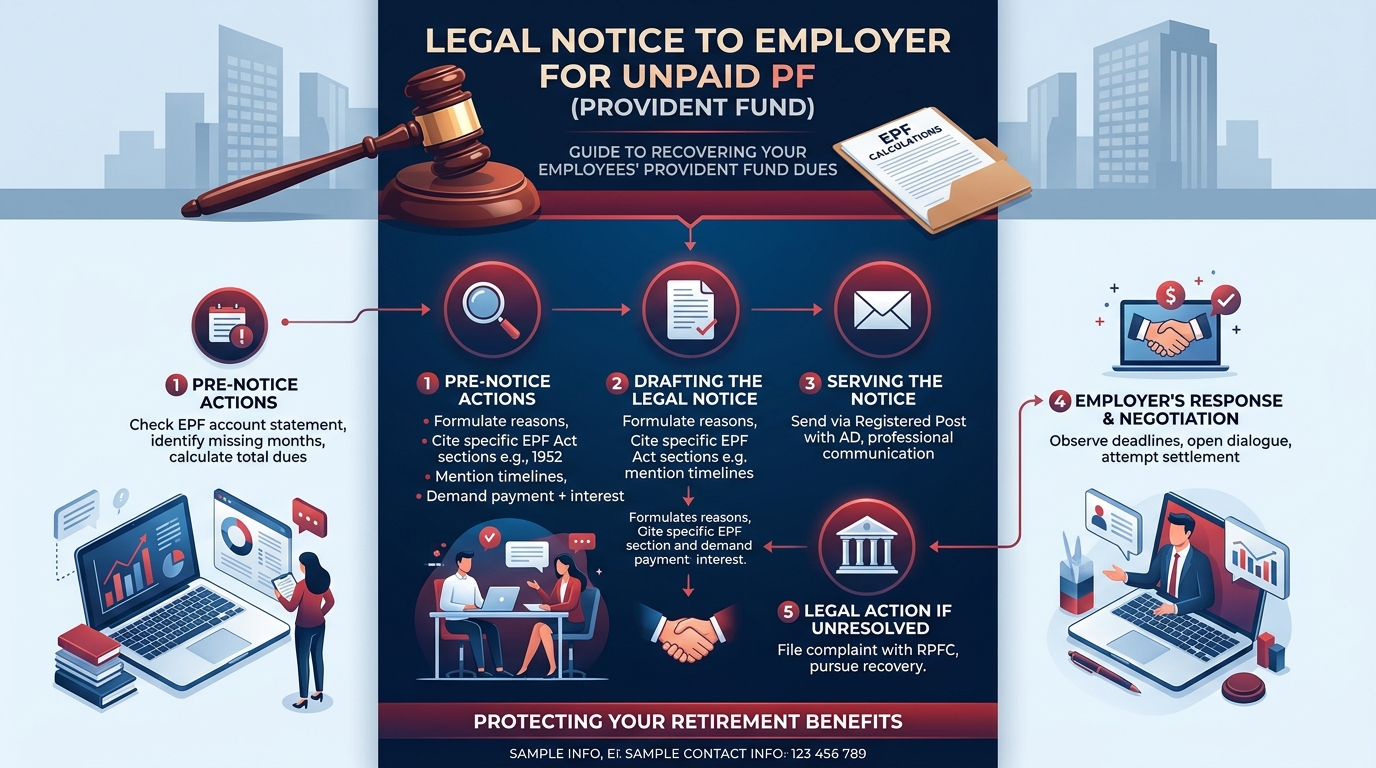
5. Step-by-Step Legal Notice Drafting & Dispatch Process
Serving a legally enforceable demand notice requires strict adherence to statutory protocols. Following a disciplined, multi-step process ensures maximum legal impact while creating an irrefutable court record.
Passbook Reconciliation & Discrepancy Auditing
Compare each monthly salary slip against the EPFO Member Passbook ledger. Calculate the exact principal shortfall in employee contributions deducted from wages, unremitted matching employer contributions, and accrued 12% statutory interest under Section 7Q.
Corporate Entity & Director Liability Profiling
Extract the company's Master Data from the Ministry of Corporate Affairs (MCA) database. Identify Managing Directors, Executive Directors, Chief Financial Officers, and designated payroll heads to establish personal and vicarious criminal culpability under Section 14A of the EPF Act.
Advocate Drafting on Official Bar Council Letterhead
Have an experienced labour advocate draft the formal notice on their official legal stationery with Bar Council enrollment details. The notice must detail the complete employment chronology, establish salary deductions, cite Explanation 1 to Section 405 IPC, and quantify Section 7Q and 14B liabilities.
Stipulation of 15-Day Statutory Cure Period
Provide a strict 15-day pre-litigation deadline for the employer to deposit all outstanding PF arrears into the employee's UAN account, furnish the ECR deposit receipt, and reimburse advocate legal drafting expenses.
Multi-Channel Verifiable Postal & Electronic Dispatch
Dispatch original signed legal notices via India Post Registered Post with Acknowledgment Due (RPAD) and Speed Post to the company registered office and all director addresses. Concurrently, transmit a certified digital copy via official company emails and WhatsApp to secure timestamped delivery evidence under Section 65B of the Evidence Act.
6. Essential Clauses of a High-Impact PF Notice
A generic letter or casual email is easily brushed aside by company HR departments. To trigger immediate compliance, an advocate-drafted statutory demand notice must incorporate specific mandatory legal clauses:
- Advocate Authority & Client Representation: Explicit statement confirming that the notice is served under the express legal instructions of the aggrieved employee.
- Employment Matrix & Salary Structure: Detailed breakdown of appointment date, designation, employee ID, UAN number, EPF account number, monthly gross salary, and basic wage components.
- Month-by-Month Default Schedule: A tabulated annexure listing each defaulted month, gross salary paid, PF amount deducted as per payslip, and actual deposit status on the EPFO ECR portal.
- Criminal Misappropriation Notice (IPC Sec 405/406 & BNS Sec 316): Clear invocation of Explanation 1 to Section 405 IPC, explicitly notifying directors that holding deducted salary amounts constitutes non-bailable criminal breach of trust.
- Section 7Q Statutory Interest & Section 14B Penalties: Computation of 12% annual interest along with notice of impending 100% penal damages under the EPF & MP Act, 1952.
- Vicarious Director Liability under Section 14A: Holding Managing Directors, Promoters, and Partners personally liable for establishment defaults under Section 14A of the EPF Act.
- 15-Day Ultimatum & Cost Demands: Strict 15-day cure window with a clear demand for legal notice drafting and advocate consultation fees.
7. Resolution Timeline, Employer Defenses & Enforcement
Over 80% of employers resolve PF non-remittance disputes within the 15-day legal notice window once they realize their personal criminal exposure under Section 406 IPC and the risk of immediate EPFO bank account freezing. Employers typically attempt to rely on standard frivolous defenses, which are thoroughly dismantled under established labour jurisprudence:
Rebuttal to "Company Financial Hardship or Cash Crunch": The Supreme Court in Organo Chemical Industries v. Union of India established that financial losses, liquidity shortages, or commercial insolvency do not justify non-remittance of statutory provident fund dues, as employee deductions do not belong to the employer.
Rebuttal to "EPFO Unified Portal Technical Glitches": Portal maintenance issues do not excuse continuous, multi-month non-deposit of statutory contributions. Under EPF regulations, employers are mandated to deposit dues manually or submit offline bank challans if digital payment gateways fail.
Rebuttal to "Pending Exit Clearance or Asset Recovery": Provident Fund is an independent statutory trust fund. Employers cannot exercise a contractual lien or offset civil damages against statutory social security benefits.
If the defaulting establishment fails to deposit all PF arrears upon expiry of the 15-day statutory window, the employee possesses conclusive evidence of deliberate default and can immediately initiate the following enforcement actions:
1. Lodge Formal EPFO Complaint & Trigger Section 7A Inquiry
Submit an official complaint on the EPFiGMS Grievance Portal and CPGRAMS. The RPFC initiates quasi-judicial Section 7A inquiry summons, issues production orders for company wage registers, and attaches corporate bank accounts under Section 8B.
2. Register Criminal FIR under Section 406 / 420 IPC (Section 316 BNS)
File a formal criminal complaint with the jurisdictional Police Station or Cyber/Economic Offences Wing (EOW) for criminal breach of trust, enclosing salary slips, UAN passbook, and the unanswered legal notice.
3. File Recovery Application in Labour Court (Section 33C(2) ID Act)
Institute an application before the Labour Court for recovery of computed statutory dues, obtaining a formal Revenue Recovery Certificate executed through the District Collector.
8. Frequently Asked Questions
References: [1] Employees' Provident Funds and Miscellaneous Provisions Act, 1952 (Sections 6, 7A, 7Q, 14, 14B). [2] Employees' Provident Fund Organisation (EPFO) Operational Guidelines. [3] EPFiGMS Portal for Online Grievance Redressal. [4] Centralised Public Grievance Redress and Monitoring System (CPGRAMS). [5] Ministry of Labour & Employment, Government of India. [6] Insolvency & Bankruptcy Code, 2016 (Section 36(4)(a)(iii) - Provident Fund Super-Priority).
Recover Unpaid PF Dues
Connect with specialized employment recovery advocates. We audit your UAN passbook, calculate Section 7Q statutory interest, and draft enforceable demand notices with criminal breach of trust warnings.
Client Reviews
"My former IT company deducted employee PF contributions from my monthly salary for 14 months but never remitted the funds to EPFO, resulting in a ₹2.35 Lakh shortfall. Legal Recovery drafted and served a hard-hitting legal notice citing Section 406 IPC criminal breach of trust and EPF Act Section 14B damages. Within 10 days of notice receipt, the company remitted the entire arrears with interest to my UAN account. Outstanding legal assistance!"
More Employment & Legal Notice Guides
Recovery of Salary & Employment Dues
Learn statutory procedures to recover unpaid salary, pending incentives, and full & final settlement arrears in India.
PF Amount Recovery Guide
Step-by-step roadmap to claim stuck provident fund amounts, uncredited ECR balances, and EPFO transfers.
Notice Period Salary Withheld
Legal notice framework to recover salary withheld during resignation notice periods and exit clearances.
How to Recover Unpaid Salary Legally
Comprehensive legal roadmap for Indian employees to recover salary arrears via Labour Courts and Civil Courts.
Legal Notice to Employer for Unpaid Salary
Understand the procedure, timelines, and legal impact of sending a pre-litigation demand notice for salary dues.
Send a Legal Notice Portal
Access comprehensive pre-litigation legal notice drafting and verified postal dispatch across India.

Legal Recovery is India's trusted consumer protection and commercial debt resolution platform. Founded in 2022 and headquartered in New Delhi, Legal Recovery has counselled 15,000+ businesses, professionals, and employees on employment disputes, statutory social security non-compliance, and delayed salary settlements. Legal Recovery accelerates out-of-court settlements and connects you with top verified panel advocates.