Legal Notice to Employer for Deducting Salary Without Notice
Recover unauthorized wage deductions, arbitrary penalties, and slashed variable pay under the Payment of Wages Act, Code on Wages 2019, and Industrial Disputes Act.
Table of Contents
Swipe →Quick Answer
An employee or corporate professional can issue an advocate-vetted statutory legal notice to an employer for deducting salary without prior written notice under Section 7 and Section 10 of the Payment of Wages Act, 1936, Section 18 of the Code on Wages, 2019, and Section 73 of the Indian Contract Act, 1872, demanding immediate refund of unlawfully withheld wages with 18% per annum commercial interest within a 15-day peremptory deadline. Employers are strictly prohibited by law from imposing unilateral fines, project loss deductions, or arbitrary penalty clawbacks without serving a formal show-cause notice and conducting a fair disciplinary inquiry. If the employer fails to refund the deducted salary within the 15-day notice window, the aggrieved employee can initiate recovery proceedings before the Payment of Wages Authority (seeking up to ten times compensation under Section 15(3)), file a recovery petition under Section 33C(2) of the Industrial Disputes Act, 1947, institute an Order 37 summary suit in civil court, or file criminal proceedings for criminal breach of trust under Section 316 of the Bharatiya Nyaya Sanhita, 2023.
1. Statutory Framework: Indian Wage Protection Laws & Deduction Limits
In Indian employment jurisprudence, salary earned by an employee is recognized as a fundamental property right. Under Article 300A of the Constitution of India and established Supreme Court precedents, no person shall be deprived of their property—including lawful remuneration and accrued wage benefits—save by the authority of explicit legislation. When a corporate employer, startup founder, or business enterprise unilaterally deducts salary, withholds variable allowances, or slashes pay slips without prior written notice or due process, the act constitutes an unlawful deprivation of livelihood.
The substantive rights of employees against unauthorized salary cuts are governed by a multi-tiered statutory architecture across central and state labor legislations:
- Section 7, Payment of Wages Act, 1936 (Exhaustive Deduction List): Wages must be disbursed in full without any deductions other than those explicitly authorized by statute. Any deduction not expressly listed under sub-section (2) is deemed illegal per se.
- Section 8 (Statutory Restrictions on Fines):No fine can be imposed on any employee unless a prior notice specifying acts or omissions has been officially approved by the State Government, and the employee is afforded an opportunity of showing cause against the fine. Fines cannot exceed 3% of the employee's wages for that wage period.
- Section 10 (Strict Conditions for Damage or Loss Deductions): Deductions for alleged damage to or loss of goods expressly entrusted to the employee cannot exceed the actual damage caused, and no deduction can be made until the employee is given an opportunity of showing cause against the deduction.
- Section 18, Code on Wages, 2019 (Modern Deduction Restraints):Codifies permissible deductions across all commercial establishments and imposes an absolute statutory cap under Section 18(3), mandating that total deductions in any wage period shall not exceed 50% of the employee's total wages.
- Section 15(3), Payment of Wages Act (Up to 10x Compensation): Empowers the judicial Authority to direct the employer to refund the unlawfully deducted wages alongside penal compensation of up to ten times the amount wrongfully deducted.
- Section 73, Indian Contract Act, 1872 (Breach of Contract & Interest): Mandates that an employer committing breach of the employment agreement is liable to pay compensatory damages and commercial interest on withheld funds.
In the landmark ruling of State of Punjab v. K.R. Erry & Sobhag Rai Mehta (1973) 1 SCC 120, the Supreme Court of India held that any arbitrary deduction or reduction from an employee's earned emoluments without affording a prior opportunity of being heard violates the inviolable principles of natural justice (audi alteram partem) and is void ab initio. This doctrine was further reinforced in M/s Bennett Coleman & Co. Ltd. v. Punya Priya Das Gupta (1969) 2 SCC 1, confirming that recovery proceedings apply directly to all unauthorized wage deductions.
2. Permissible vs. Unlawful Salary Deductions: Comparative Breakdown
Employers frequently rely on vague employee handbook clauses, internal HR memos, or informal manager approvals to slash employee salaries. However, Indian courts draw a strict legal boundary between statutorily permissible withholdings and illegal, actionable deductions:
| Deduction Category | Statutory Status | Legal Pre-Condition / Mandatory Requirement | Actionability & Risk for Employer |
|---|---|---|---|
| Statutory Taxes (Income Tax TDS under Sec 192) | Permissible | Mandated by Income Tax Act; Form 16 / 26AS reflection mandatory | Non-actionable if remitted to Central Govt within tax timelines |
| EPF & ESIC Contributions (Employee Share) | Permissible | Calculated strictly on statutory wage ceilings under EPF & MP Act 1952 | Non-actionable if credited to EPFO portal; criminal if retained by company |
| Arbitrary Penalties for Alleged Project Delays / Losses | STRICTLY ILLEGAL | Requires formal inquiry, show-cause notice, proof of personal wilful neglect | Actionable; 100% refund with up to 10x penalty under Sec 15(3) |
| Unilateral Sashing of Variable Pay / Quarterly Bonus | STRICTLY ILLEGAL | Contractual terms apply; cannot be altered retroactively after achievement | Actionable breach of contract under Section 73 Indian Contract Act |
| Notice Period Salary Deduction Without Buyout Consent | STRICTLY ILLEGAL | Employer cannot deduct notice pay if employee served full notice period | Actionable before Labour Court; wage recovery decree with interest |
| Training Bond Penalty Slashed Directly from Monthly Pay | STRICTLY ILLEGAL | Bonds are void in terrorem; employer must prove actual expenditure in court | Unlawful under Sec 27 Contract Act; immediate refund claimable |
Lack of Written Show-Cause Notice
An employer who executes a salary deduction without issuing a prior written show-cause letter explaining the exact alleged breach automatically commits an irremediable procedural violation under Indian law.
Breach of 50% Maximum Deduction Cap
Any salary deduction that reduces an employee's net monthly take-home pay below 50% of their gross earnings directly breaches Section 18(3) of the Code on Wages, 2019, rendering the entire deduction unlawful.
Unproven "Equipment Damage" Accusations
Deducting thousands of rupees for alleged laptop scratches, wear-and-tear, or office hardware depreciation without an independent technical inquiry is prohibited under Section 10 of the Payment of Wages Act.
Retaliatory Slashes Post-Resignation
Freezing, slashing, or deducting salary from the final two months of employment following an employee's resignation is actionable as malicious wage withholding and criminal breach of trust.
3. Legal Action & Recovery Forums: Labour Authority to Civil Courts
Depending on the employee's job designation, monthly compensation structure, and state jurisdiction, Indian law provides four parallel, highly effective legal enforcement channels to recover unlawfully deducted salary:
Payment of Wages Authority (Labour Commissionerate)
Governed by Section 15 of the Payment of Wages Act, 1936. Aggrieved employees within statutory wage limits can file an expedited petition before the appointed Authority. The Authority is empowered not only to order full refund of the deducted amount but also to award penal compensation up to ten times (10x) the deducted wage.
Labour Court Recovery Petition under Section 33C(2) IDA 1947
Under Section 33C(2) of the Industrial Disputes Act, 1947, any workman entitled to receive from the employer any money or benefit capable of being computed in terms of money can file a recovery application before the Labour Court. The court computes the quantified dues and issues a revenue recovery certificate executed through the District Collector.
Summary Civil Recovery Suit under Order 37 of CPC, 1908
For senior IT architects, managers, directors, and executives outside the traditional workman definition, our panel advocates file an expedited Summary Suit under Order 37 of the Code of Civil Procedure. Because the salary claim is based on written appointment letters and pay slips, the employer cannot defend without special leave of court, resulting in swift decrees.
State Shops & Commercial Establishments Inspectorate
Employers in IT hubs (such as Bengaluru, Hyderabad, Pune, Gurugram, Mumbai, Chennai, and Noida) are bound by State Shops and Establishments Acts. Labour inspectors have statutory power to inspect payroll registers, issue immediate compliance notices, and prosecute employers for unauthorized wage deductions.
Criminal Complaint under Bharatiya Nyaya Sanhita, 2023 (BNS)
When company management fraudulently promises remuneration, induces work, and dishonestly misappropriates earned wages through fabricated deductions, employees can initiate criminal proceedings under Section 316 (Criminal Breach of Trust) and Section 318 (Cheating) against company directors and HR leadership.
4. Pre-Notice Evidentiary Checklist & MCA Corporate Audit
A legally robust statutory demand notice must be backed by an airtight documentary trail. Prior to drafting the notice, consolidate the following evidentiary records:
Employment & CTC Contract Records
- ✓ Signed Appointment Letter & Employment Contract
- ✓ Annexure detailing Fixed CTC, Allowances & Variable Pay
- ✓ Promotional / Appraisal Increment Letters
Salary & Discrepancy Evidence
- ✓ Previous 6 Months Certified Pay Slips
- ✓ Pay Slip showing the specific unauthorized deduction
- ✓ Bank Account Statements showing reduced credit amount
Written Communication & Grievances
- ✓ Email queries sent to HR / Payroll raising the dispute
- ✓ HR response / refusal citing company policy or stonewalling
- ✓ Absence of any written show-cause notice or inquiry report
Work & Attendance Verification
- ✓ Biometric / Punch-In Attendance & Timesheet Logs
- ✓ Approved Leave Application Approvals & Email Records
- ✓ Project Completion Sign-offs & Client Deliverable Trails
🏛️Statutory Employer Verification via MCA & Labour Portals
To ensure that your legal notice carries full judicial enforceability, the notice must be addressed to the exact corporate legal entity, citing its Corporate Identification Number (CIN), registered office address, and Board of Directors as recorded on the Ministry of Corporate Affairs (MCA) portal. Serving the notice on individual branch managers or HR executives without naming the registered company and active managing directors creates procedural defects in court. Legal Recovery automatically cross-checks MCA company master data to serve directors directly.
5. Key Clauses in a Statutory Notice for Illegal Wage Deduction
An advocate-drafted statutory demand notice must be structured with clinical precision, combining chronological factual recitals with stringent statutory warnings:
Capacity of Parties & Contractual Terms of Remuneration
Defines the employee's date of appointment, designation, agreed gross salary, fixed monthly components, and variable pay terms as executed in the formal contract.
Itemized Chronology of Unauthorized Wage Deductions
Presents an exhaustive tabular breakdown showing the gross salary due, the exact unauthorized deduction figure, the net amount credited, and the specific pay period of default.
Violation of Natural Justice & Statutory Wage Restrictions
Affirmatively establishes that no show-cause notice, disciplinary inquiry, or explanation opportunity was afforded, citing violations of Sections 7 & 10 of the Payment of Wages Act, Section 18 of the Code on Wages, and Article 300A.
Demand for 18% Commercial Interest & 10x Statutory Compensation
Formally claims the immediate refund of the principal deducted amount along with 18% per annum commercial interest and alerts the employer to statutory 10x damages under Section 15(3).
15-Day Peremptory Compliance Window & Multi-Forum Litigation Warning
Gives the company exactly 15 days to credit the deducted salary into the employee's bank account, failing which recovery petitions before the Labour Commissioner, Order 37 civil suits, and BNS criminal complaints will be filed at the employer's sole risk and expense.
6. Strategic Roadmap: 15-Day Notice to Fast-Track Enforcement
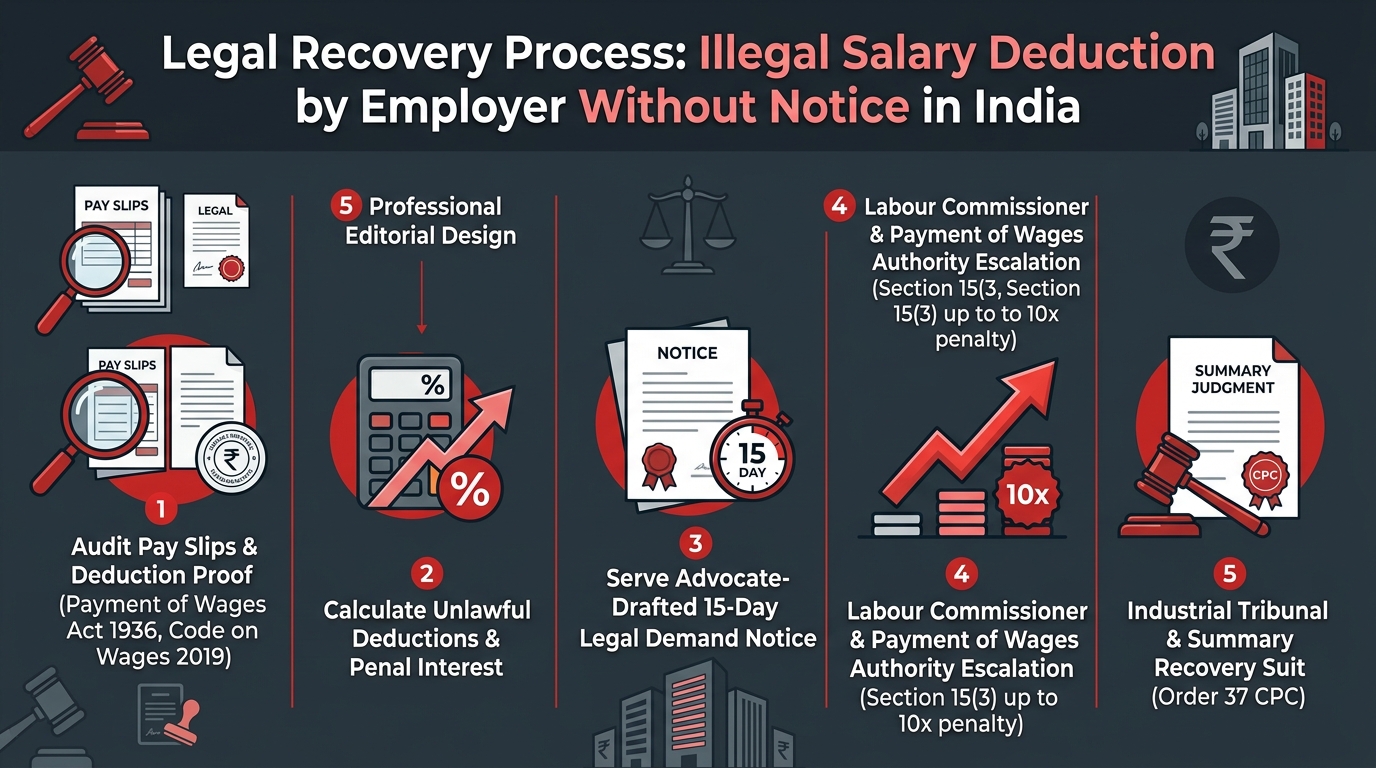
Over 78% of employers reverse unauthorized salary deductions within the statutory 15-day notice period when served with a formal legal demand from an established legal platform. If the employer remains defiant, Legal Recovery follows a structured multi-stage escalation:
Advocate Notice Served via Multi-Channel Hybrid Dispatch
The notice is prepared on the advocate's official letterhead, digitally signed under Section 5 of the Information Technology Act, 2000, and dispatched simultaneously via India Post Registered Post AD, Speed Post, verified corporate email, and tracked WhatsApp.
Pre-Litigation Settlement & Conciliation Dialogue
Upon receiving the statutory notice, company legal counsel or HR leadership typically initiates settlement discussions. Legal Recovery facilitates structured negotiations to ensure full wage reversal without employer retaliation.
Filing Petition Before Payment of Wages Authority / Labour Court
In case of non-compliance, our panel advocates file an expedited wage recovery petition under Section 15(3) of the Payment of Wages Act or Section 33C(2) of the Industrial Disputes Act, demanding principal plus statutory penalties.
Summary Civil Suit (Order 37 CPC) & Director Liability Action
For executive and senior roles, a summary civil suit is instituted for rapid debt recovery. In egregious cases of bad-faith wage theft, criminal complaints are lodged under Sections 316 and 318 of the Bharatiya Nyaya Sanhita, 2023.
7. Frequently Asked Questions
Authoritative Legal & Statutory References:
- Payment of Wages Act, 1936 — Sections 7, 8, 9, 10 & 15 (Authorized Deductions & Claims), labour.gov.in
- Code on Wages, 2019 — Section 18 (Deductions from Wages & 50% Statutory Cap), labour.gov.in
- Indian Contract Act, 1872 — Section 73 (Compensation for Breach of Employment Contract), indiacode.nic.in
- Industrial Disputes Act, 1947 — Section 33C(2) (Recovery of Money Due from Employer), indiacode.nic.in
- Supreme Court of India — State of Punjab v. K.R. Erry & Sobhag Rai Mehta (1973) 1 SCC 120, main.sci.gov.in
- Supreme Court of India — M/s Bennett Coleman & Co. Ltd. v. Punya Priya Das Gupta (1969) 2 SCC 1, main.sci.gov.in
- Ministry of Corporate Affairs (MCA) — Company Master Data & Corporate Identification Number (CIN), mca.gov.in
- Bharatiya Nyaya Sanhita, 2023 — Section 316 (Criminal Breach of Trust) & Section 318 (Cheating), indiacode.nic.in
More Consumer Protection & Dispute Guides

Legal Recovery
India's Trusted Recovery Platform
Legal Recovery is India's trusted online legal notice and dispute resolution platform, connecting employees, corporate professionals, executives, and businesses with seasoned panel advocates for rapid, advocate-vetted statutory demand notices at transparent flat fees. With ₹100 Crore+ recovered and 10,000+ cases resolved across India, Legal Recovery delivers verified legal impact without the delays and unpredictability of traditional law firms.
Employer Deducted Your Salary?
Send an advocate-vetted statutory notice today. 78% of employers reverse unauthorized deductions within 15 days upon receiving formal notice from Legal Recovery.
Flat fee • Advocate-drafted • Sent same day
Client Reviews
Devendra Kulkarni
"When my employer arbitrarily slashed ₹2,85,000 from my salary and quarterly retention pay citing unverified "project rework expenses" without issuing any show-cause notice or explanation inquiry, I was left in extreme financial stress. The HR department stonewalled my emails and claimed management discretion under company policy. Legal Recovery drafted and served an uncompromising statutory legal demand notice on advocate letterhead citing Section 7 and Section 10 of the Payment of Wages Act, Section 18 of the Code on Wages, and criminal breach of trust under BNS. Within 11 days of receiving the Speed Post and tracked email notice, company management reversed the entire ₹2,85,000 deduction into my salary account with written confirmation. The fastest, most authoritative legal recovery service in India!"