Legal Notice to Company for Leave Encashment Not Paid
Recover unpaid earned leave wages, accumulated privilege leaves, and delayed Full & Final (F&F) settlements under the Factories Act, State Shops & Establishments Acts, and Payment of Wages Act.
Table of Contents
Swipe →Quick Answer
An employee, executive, or workman in India can serve an advocate-drafted statutory legal notice to an employer for unpaid leave encashment under Section 79(11) of the Factories Act, 1948, the applicable State Shops and Commercial Establishments Act, and Section 15 of the Payment of Wages Act, 1936, demanding the release of accumulated earned leave wages within a strict 15-day compliance window. Leave encashment constitutes an accrued statutory property right under Article 300A of the Constitution of India, as reaffirmed by the Supreme Court of India in State of Jharkhand v. Jitendra Kumar Srivastava (2013), and cannot be forfeited or withheld through arbitrary internal corporate policies. If the employer fails to disburse the earned leave balance upon resignation, retirement, or termination, the aggrieved employee can initiate recovery proceedings before the Labour Commissioner, file a summary recovery claim under Order 37 of the Code of Civil Procedure, 1908, or petition the Labour Court under Section 33C(2) of the Industrial Disputes Act, 1947.
1. Statutory Framework: Leave Encashment as an Accrued Property Right
In the Indian employment and labor landscape, leave encashment represents the monetary conversion of unavailed Earned Leave (EL), Annual Leave (AL), or Privilege Leave (PL) accrued by an employee over the duration of active service. Corporate employers frequently attempt to treat leave encashment as a discretionary perk or ex-gratia allowance that management can withhold at will during an employee's Full and Final (F&F) settlement. However, Indian constitutional jurisprudence and statutory labor enactments place leave encashment on an entirely non-negotiable legal footing.
The Supreme Court of India in the landmark constitutional bench judgment State of Jharkhand & Ors. v. Jitendra Kumar Srivastava & Anr. (2013) 12 SCC 210 authoritatively held that terminal employment benefits, including leave encashment and pensionary dues, constitute “property” under Article 300A of the Constitution of India. The Apex Court ruled that an individual cannot be deprived of earned statutory property except by the express authority of law. A company cannot withhold, deplete, or forfeit leave encashment through administrative circulars, subjective HR performance reviews, or unproven allegations.
Core Statutory Foundations for Leave Encashment Recovery in India:
- •Factories Act, 1948 (Section 79 & 80): Mandates 1 day of paid annual leave for every 20 days worked. Under Section 79(11), if an employee quits, resigns, or is discharged, all unavailed leave wages must be fully settled before the expiry of the second working day.
- •State Shops & Commercial Establishments Acts: Govern IT/ITeS companies, BFSI corporations, consultancies, and commercial offices. These Acts mandate 15 to 18 days of earned leave annually, allow accumulation up to statutory ceilings (typically 30 to 60 days), and enforce compulsory encashment upon separation.
- •Payment of Wages Act, 1936 (Section 2(vi) & 15): Statutorily defines “wages” to encompass any sum payable upon termination of employment. Withholding leave encashment constitutes an illegal deduction, empowering authorities to levy statutory penalties and compensation up to 10 times the withheld sum under Section 15(3).
- •The Code on Wages, 2019 (Section 17 & 18): Consolidates Indian wage laws and mandates that all wages, including earned leave encashment and terminal dues, must be disbursed within two working days of resignation, retrenchment, or dismissal.
2. Actionable Grounds: Unlawful Forfeiture & Arbitrary HR Policies
Employers deploy a wide array of unlawful administrative pretexts to wipe out or refuse earned leave payouts when an executive or employee submits their resignation. Understanding these common default scenarios is essential for framing an unyielding, advocate-vetted statutory legal notice:
Arbitrary “Use-It-or-Lose-It” Forfeiture
Employers enforce internal HR emails claiming all unavailed leaves lapse at calendar year-end without carry-forward or encashment. Such clauses directly violate mandatory accumulation thresholds under State Shops and Establishments Acts, making the forfeiture legally void.
Illegal Notice Period Adjustments
When an employee serves a buyout notice or requests early release, employers frequently deduct unavailed earned leaves against notice shortfall without compensating the remaining balance or unilaterally cancel accumulated leaves as a punitive measure.
Indefinite F&F Settlement Delays
Holding back Full & Final settlements beyond the statutory window (typically 30 to 45 days contractually, or 2 working days under modern wage codes) under the guise of pending IT clearances, client project audits, or managerial sign-offs.
Calculation on Depressed Wage Components
Calculating leave encashment solely on a fractional Basic Salary while excluding mandated Dearness Allowance, or dishonoring explicit appointment letter clauses promising leave encashment on Gross CTC remuneration.
3. Statutory Computation Formulas & State Accumulation Caps
Leave entitlements, maximum carry-forward limits, and encashment obligations in India are governed primarily by state-specific Shops and Commercial Establishments legislations. The table below outlines statutory benchmarks across major commercial and industrial hubs:
| State / Jurisdiction | Governing Legislation | Annual Earned Leave (EL) | Max Accumulation Cap | Encashment on Separation |
|---|---|---|---|---|
| Karnataka (Bengaluru) | Karnataka Shops & Commercial Establishments Act, 1961 (Sec 15) | 1 day for every 20 days worked (~15-18 days) | Up to 30 or 45 days | Mandatory upon F&F |
| Maharashtra (Mumbai/Pune) | Maharashtra Shops & Establishments Act, 2017 (Sec 18) | 1 day for every 20 days worked | Up to 45 days | Mandatory upon separation |
| Delhi (NCR) | Delhi Shops & Establishments Act, 1954 (Sec 22) | 15 days for every 12 months continuous service | Up to 45 days (3x annual) | Statutory obligation |
| Haryana (Gurugram) | Punjab Shops & Commercial Establishments Act, 1958 (Sec 14) | 1 day for every 20 days worked (~18 days) | Up to 30 days | Compulsory settlement |
| Telangana (Hyderabad) | Telangana Shops & Establishments Act, 1988 (Sec 40) | 15 days per year of service | Up to 60 days | Mandatory in F&F |
| Tamil Nadu (Chennai) | Tamil Nadu Shops & Establishments Act, 1947 (Sec 25) | 12 to 15 days per 12 months | Up to 45 days | Full encashment required |
Standard Statutory Computation Mathematical Formula:
Statutory Leave Encashment = [(Monthly Basic Salary + Dearness Allowance) / 26 or 30] × (Accumulated Unavailed Earned Leaves)
*Note: If the appointment contract or executive policy prescribes Gross CTC or Total Fixed Remuneration for leave encashment calculations, the higher contractual figure legally supersedes the statutory minimum under Indian Contract Law.
4. Legal Remedies: Labour Commissioner, Summary Suits & Section 33C(2)
When an employer refuses to disburse leave encashment following a formal demand, multiple legal avenues exist across administrative and judicial forums depending on the employee's job role and contractual status:
A. Application before the Controlling Authority / Labour Commissioner
ADMINISTRATIVE RECOVERYAggrieved employees can file a petition under Section 15 of the Payment of Wages Act, 1936 or under the enforcement provisions of the applicable State Shops and Establishments Act. The Labour Inspector or Assistant Labour Commissioner (ALC) issues summons to company directors, conducts conciliation, and has statutory powers to issue recovery certificates enforced as arrears of land revenue.
B. Labour Court Application under Section 33C(2) of Industrial Disputes Act
LABOUR COURT ADJUDICATIONWhere an existing statutory or contractual right to leave encashment exists but remains uncomputed or unpaid, a petition under Section 33C(2) of the Industrial Disputes Act, 1947 enables the Labour Court to compute the exact monetary benefit and order direct recovery with penal interest.
C. Summary Civil Suit under Order 37 of Code of Civil Procedure, 1908
FAST-TRACK CIVIL DEBT RECOVERYFor senior executives, managers, and corporate professionals, an unpaid leave encashment backed by written employment contracts, HRMS leave ledgers, and F&F acknowledgments constitutes an actionable liquidated commercial debt. Filing a Summary Suit under Order XXXVII of the Code of Civil Procedure, 1908 disallows frivolous employer defenses and compels expedited recovery decrees.
D. Commercial Court Litigation & Pre-Institution Mediation
COMMERCIAL SUIT (ABOVE ₹3 LAKHS)Commercial recovery disputes exceeding ₹3,00,000 in specified value can be channelled through the Commercial Court framework under the Commercial Courts Act, 2015, mandating pre-institution mediation under Section 12A via the District Legal Services Authority (DLSA) to enforce fast-track settlement.
5. Pre-Notice Evidentiary Checklist & Document Audit
Prior to drafting and serving the statutory legal notice, consolidating irrefutable documentary evidence is imperative to dismantle employer defenses. Ensure the following records are securely archived:
6. Key Clauses in a Statutory Notice for Leave Encashment Recovery
A legally formidable notice drafted by a High Court advocate contains precise statutory invocations, chronological fact assertions, mathematical calculations, and stern legal consequences:
Clause 1: Statement of Employment History & Valid Separation
Formal recital of employment tenure, official designation, gross compensation, flawless service record, submission of valid resignation, completion of notice period, and full handover of corporate assets without any pending company claims.
Clause 2: Itemized Leave Ledger & Monetary Computation
Precise itemization of accumulated Earned/Privilege Leaves standing to the employee's credit on the last working day, along with mathematical daily wage rate computations establishing the liquidated principal sum due.
Clause 3: Statutory & Constitutional Invocations
Direct citations to Section 79(11) of the Factories Act 1948, relevant State Shops & Establishments Acts, Section 15 of the Payment of Wages Act, and Article 300A constitutional protections affirmed in State of Jharkhand v. Jitendra Kumar Srivastava.
Clause 4: Demand for Commercial Interest & 15-Day Compliance Ultimatum
Unambiguous demand for immediate wire transfer of the principal leave encashment along with commercial interest at 18% per annum from the date of separation until actual realization, within a strict 15-day compliance deadline.
Clause 5: Notice of Multi-Forum Litigation & Cost Liabilities
Explicit warning of initiating summary civil recovery under Order 37 CPC, filing penal complaints before the Labour Commissioner, and holding directors personally liable for legal costs and criminal breach of trust under Section 316 of the Bharatiya Nyaya Sanhita, 2023.
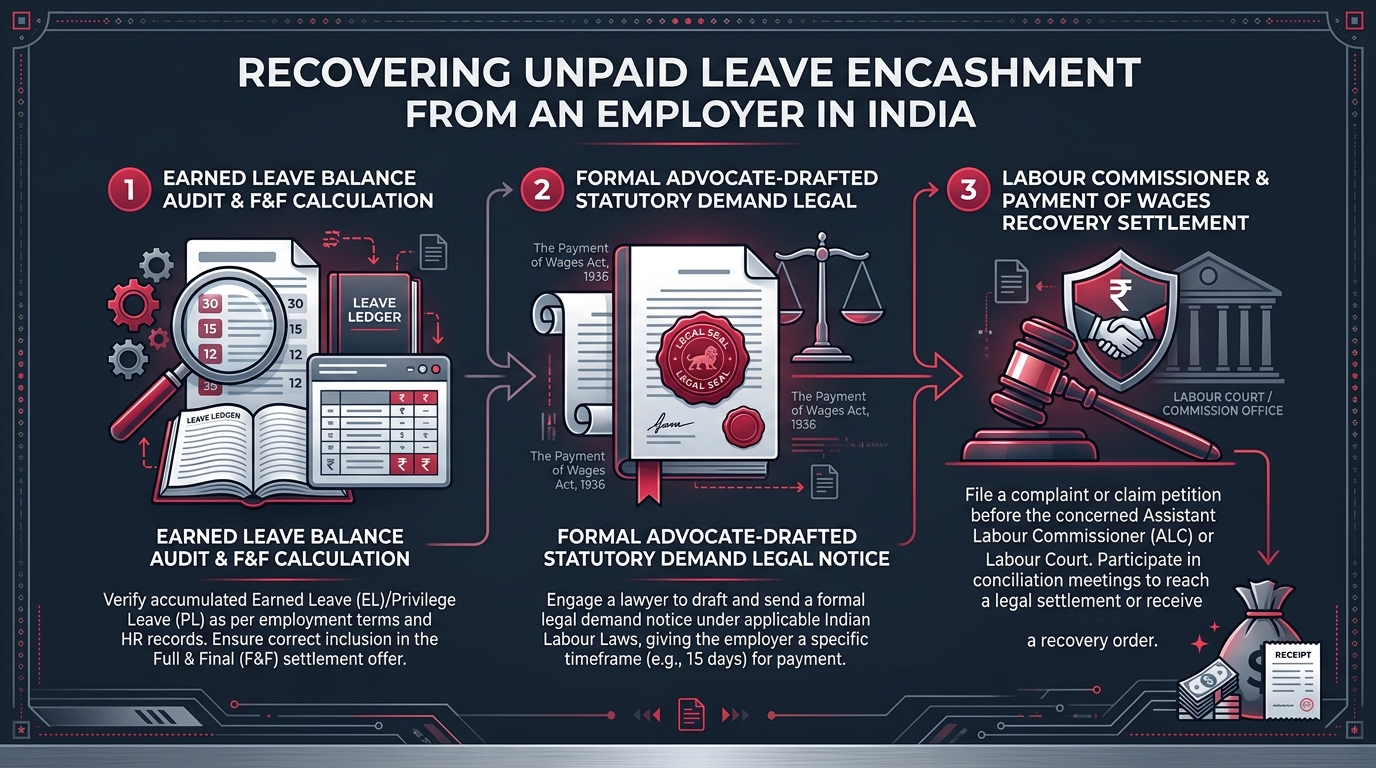
7. Strategic 15-Day Roadmap: Notice Dispatch to Out-of-Court Settlement
Legal Recovery executes a rigorous, multi-channel statutory notice strategy designed to maximize pre-litigation recovery success without forcing clients into prolonged court proceedings:
Case Intake & Leave Balance Forensic Audit (Day 1)
Client submits HRMS screenshots, F&F statements, and appointment letters. Panel advocates audit the employment contract, determine applicable state statutes, and compute exact leave encashment principal plus interest.
Advocate Drafting & Statutory Grounding (Day 1–2)
Experienced labor and commercial advocates draft a customized legal notice under high-court advocate letterhead, integrating statutory labor enactments and Supreme Court precedents.
Dual-Track Statutory Service & MCA Verification (Day 2–3)
Notice is dispatched via India Post Registered Post with Acknowledgment Due (RPAD) and Speed Post to the company’s registered office and Managing Director, accompanied by authenticated digital service via official corporate email.
Tracking 15-Day Compliance Window & Legal Negotiations (Day 4–15)
Legal Recovery monitors India Post delivery tracking. Upon delivery acknowledgment, corporate legal and HR departments typically initiate settlement dialogue to avoid Labour Court citations and summary debt suits.
Execution of Settlement / Escalation to Labour Authority (Day 16+)
Disbursement of the full leave encashment directly into the client’s bank account, followed by execution of formal F&F clearance and delivery of relieving documents. If unpaid, immediate escalation to the Labour Commissioner or Order 37 CPC summary suit.
8. Frequently Asked Questions
Authoritative Legal & Statutory References:
- Factories Act, 1948 — Section 79 (Annual Leave with Wages) & Section 80 (Wages during Leave Period), indiacode.nic.in
- Ministry of Labour & Employment — The Code on Wages, 2019 (Act No. 29 of 2019), labour.gov.in
- Supreme Court of India — State of Jharkhand & Ors. v. Jitendra Kumar Srivastava (2013) 12 SCC 210 (Leave Encashment as Property under Article 300A)
- Payment of Wages Act, 1936 — Section 2(vi) Definition of Wages & Section 15 Claims Arising Out of Deductions
- Industrial Disputes Act, 1947 — Section 33C(2) Recovery of Money Due from Employer
- Code of Civil Procedure, 1908 — Order XXXVII Summary Suits for Liquidated Debts
- Ministry of Corporate Affairs (MCA) — Company Master Data & Registered Office Verification
- Bharatiya Nyaya Sanhita, 2023 — Section 316 (Criminal Breach of Trust) & Section 318 (Cheating)
More Employment & Consumer Dispute Guides

Legal Recovery
India's Trusted Recovery Platform
Legal Recovery is India's trusted online legal notice and dispute resolution platform, connecting employees, software engineers, corporate managers, and professionals with experienced panel advocates for fast, advocate-vetted statutory demand notices at transparent flat fees. With ₹100 Crore+ recovered and 10,000+ disputes resolved across India, Legal Recovery delivers authoritative legal impact without the delays and unpredictability of traditional law firms.
Employer Withholding Your Leave Encashment?
Send an advocate-vetted statutory legal notice today. 76% of employers settle unpaid earned leave wages and F&F dues within 15 days of notice service.
Flat fee • Advocate-drafted • Sent same day
Client Reviews
Vikramaditya Sengupta
"Following my resignation as a Lead Software Architect at a multinational tech enterprise in Bengaluru after 5.5 years of service, the management withheld my earned leave encashment totaling ₹3,84,500 for 68 accumulated Privilege Leaves, arbitrarily citing a revised internal policy capping leave encashment upon resignation. Legal Recovery drafted and served an impeccable, advocate-vetted statutory legal notice citing Section 79(11) of the Factories Act, 1948, Section 15 of the Karnataka Shops and Commercial Establishments Act, 1961, Section 15 of the Payment of Wages Act, and Supreme Court precedent in State of Jharkhand v. Jitendra Kumar Srivastava establishing leave encashment as an accrued property right under Article 300A. Within 14 days of notice dispatch via registered post and digital tracking, the company’s HR Director and legal counsel reached out, conceded the statutory violation, and disbursed the entire ₹3,84,500 into my salary account along with full F&F clearance and relieving documentation. Highly effective pre-litigation recovery platform."