Legal Notice to Company for Not Paying Commission
Recover unpaid sales commissions, broker fees, channel partner overrides, and performance incentives under the Indian Contract Act, Commercial Courts Act, and Code on Wages.
Table of Contents
Swipe →Quick Answer
A commercial agent, freelance consultant, broker, or sales professional can serve an advocate-drafted statutory legal notice to a company for unpaid commission under Section 73 and Section 219 of the Indian Contract Act, 1872, demanding immediate disbursement of accrued incentives, sales commissions, and contractual overrides within 15 days. If the company withholds commission earned under employment or contractual terms, the claimant can initiate recovery proceedings under Order 37 of the Code of Civil Procedure, 1908 for summary debt recovery or trigger mandatory pre-institution mediation under Section 12A of the Commercial Courts Act, 2015. Additionally, registered MSME agents and service providers are entitled to claim compound interest at three times the RBI bank rate under Section 16 of the MSMED Act, 2006 alongside potential prosecution of company directors under Section 316 and Section 318 of the Bharatiya Nyaya Sanhita, 2023 for criminal breach of trust and fraudulent inducement.
1. Statutory Framework: Commission & Agency Laws in India
In the modern Indian commercial ecosystem, commission structures form the operational backbone of real estate brokerage, insurance distribution, financial advisory, software SaaS sales, pharmaceutical distribution, and channel partner networks. When a corporate principal or employer wrongfully withholds, delays, or arbitrarily slashes earned commission payouts, the aggrieved party has robust statutory protections under Indian civil, labor, and commercial jurisprudence.
The core substantive legislation governing commercial commission claims is the Indian Contract Act, 1872 (ICA). Several specific provisions create an unassailable legal mandate for full commission payment:
- Section 219 (Agent's Right to Remuneration): In the absence of any special contract, payment for the performance of any act is not due to the agent until the completion of such act. Once the deal is procured, client signed, or milestone delivered, the right to the commission crystallizes immediately.
- Section 217 & Section 221 (Agent's Lien on Principal's Property): An agent is legally empowered to retain goods, papers, and monies received on account of the principal until all commission and professional disbursements are fully settled.
- Section 73 (Compensation for Breach of Contract): When a contract is broken, the party who suffers by such breach is entitled to receive from the defaulting party compensation for any loss or damage naturally arising in the usual course of things, including lost commission earnings and commercial interest.
- Section 74 (Liquidated Damages): If the agency contract or partner agreement stipulates a specific penalty or interest rate for delayed disbursements, courts uphold reasonable pre-estimates of damages.
For salaried professionals and retained executives, sales commissions and performance incentives are statutorily recognized as integral components of "wages" under the Code on Wages, 2019 and the Payment of Wages Act, 1936. Section 2(y) of the Code on Wages defines wages to include all remuneration expressed in terms of money, including contractual commission payable upon fulfilling employment terms. Employers who unlawfully withhold earned commissions commit an actionable labor offense punishable with statutory penalties and interest under Section 15(3) of the Payment of Wages Act.
2. Actionable Grounds: Unlawful Withholding & Arbitrary Clawbacks
A well-drafted statutory demand notice must pinpoint the exact factual breaches, corporate bad-faith actions, and contractual defaults committed by the company. Indian courts recognize several distinct commercial default scenarios:
Arbitrary Post-Facto Target Slicing & Quota Alterations
Company management unilaterally increasing sales quotas, shifting commission brackets, or altering target milestones retroactively after deals have been closed or quarterly billing numbers achieved.
Unjustified Clawback & Delayed Client Billing Excuses
Withholding commission on the pretext of internal client billing delays, extended credit periods granted to customers without agent consent, or applying unauthorized clawbacks outside explicit contract terms.
Channel Partner & Broker Override Default
Refusing payment to real estate brokers, DSA loan distributors, or software resellers after the principal enterprise has executed purchase orders and received payments directly from the referred client.
Withholding Commission During Notice Period / Post-Resignation
Refusing or freezing accrued sales incentives, quarterly bonuses, or deal overrides in the Full and Final (FNF) settlement simply because the sales executive served a resignation notice.
Bad-Faith Termination Prior to Milestone Payment Date
Abruptly terminating an independent contractor, agency, or employment agreement days before a substantial commission payout or annual milestone cycle to avoid multimillion-rupee liabilities.
Non-Issuance of TDS Form 16A & Tax Accounting Non-Compliance
Deducting Tax Deducted at Source (TDS under Section 194H of the Income Tax Act) from accrued commission ledgers but failing to disburse the net balance or remit taxes to the central government.
3. Legal Remedies: Civil Suits, Commercial Courts & MSME Samadhaan
Depending on the legal status of the claimant (individual employee, freelance broker, sole proprietor, or corporate distributor), Indian law provides multiple expedited forums for debt recovery:
| Recovery Forum & Legal Provision | Applicability & Claim Type | Pecuniary Threshold | Key Advantage & Remedies |
|---|---|---|---|
| Commercial Courts Act, 2015 (Sec 2(1)(c)(x) & Sec 12A) | Agency, distribution, licensing & mercantile disputes | Specified Value ≥ ₹3 Lakhs | Mandatory pre-institution mediation; expedited time-bound commercial bench trials |
| Order 37 CPC Summary Suit (Code of Civil Procedure, 1908) | Liquidated debts on written contracts, invoices & email admissions | Based on Court Jurisdiction | Defendant must obtain leave to defend; instant decree if defense is frivolous |
| MSME Samadhaan (MSMED Act, 2006 Sections 15–18) | Registered Udyam MSME agents, brokers & consultants | No monetary ceiling | Mandatory 3x RBI bank rate compound monthly interest on delayed payments |
| Payment of Wages Authority / Labour Commissioner | Employed sales executives, business development managers | Statutory wage ceiling / Code on Wages | Up to 10x compensation on withheld salary & contractual commission dues |
| Bharatiya Nyaya Sanhita, 2023 (BNS Sec 316 & 318) | Fraudulent inducement, cheating & criminal breach of trust | Criminal proceedings | Personal criminal liability for company directors, managing agents, and promoters |
Mandatory Pre-Institution Mediation under Section 12A Commercial Courts Act
Under the landmark Supreme Court ruling in Patil Automation Pvt. Ltd. v. Rakheja Engineers Pvt. Ltd. (2022) 10 SCC 1, Section 12A of the Commercial Courts Act, 2015 is strictly mandatory. A plaintiff seeking recovery of commercial dues (including agency commissions) must undergo pre-institution mediation through the District Legal Services Authority (DLSA) before filing a suit, unless urgent interim relief is claimed. Serving a statutory legal notice prior to mediation establishes the formal record of default and substantially accelerates the settlement process.
4. Pre-Notice Evidentiary Checklist & MCA Verification
The evidentiary weight of your statutory demand notice depends entirely on consolidating clear documentation of your agency agreement, deal closures, and payout entitlements. Before drafting, assemble the following materials:
Contractual Foundation
- ✓ Signed Agency / Broker Agreement
- ✓ Employment Offer & Incentive Policy Letter
- ✓ Channel Partner Onboarding Agreement
Deal Performance Records
- ✓ Executed Client Sales Purchase Orders
- ✓ Invoices Raised on Referred Clients
- ✓ CRM Lead Attribution & Won Deal Logs
Financial & Banking Trails
- ✓ Prior Commission Payment Slips & Ledgers
- ✓ Bank Statements showing historical payouts
- ✓ Form 26AS / AIS showing TDS under Sec 194H
Written Admissions of Debt
- ✓ Email approvals from VP/Head of Sales
- ✓ WhatsApp / Slack chats confirming targets
- ✓ Client Payment Confirmation Receipts
🏛️Corporate Entity Verification via MCA & GSTIN Registries
To guarantee legal validity in court, the legal notice must be addressed to the exact corporate entity, citing its Corporate Identification Number (CIN), registered office address, and active Board of Directors as recorded on the Ministry of Corporate Affairs (MCA) portal. Legal Recovery automatically verifies MCA records and GSTIN databases to prevent technical defects and ensure constructive legal service on all managing directors.
5. Key Clauses in a Statutory Notice for Recovery of Commission
An advocate-drafted statutory demand notice must be structured with clinical precision, articulating factual chronology and statutory recitals to withstand judicial scrutiny:
Capacity of Parties & Contractual Terms of Remuneration
Establish the exact date of engagement, role (Sales Executive, Channel Partner, Broker, Consultant), governing agreement date, agreed commission percentage, milestone thresholds, and disbursement schedule.
Itemized Statement of Procured Business & Milestone Fulfillment
Set out a clear tabular annexure listing every closed client account, deal value, invoice number, company revenue realized, and the exact corresponding commission accrued under contract.
Default, Wrongful Denial & Unlawful Withholding Recital
Document the company's repeated failures, overdue disbursement dates, evasive email responses, unlawful clawback attempts, or failure to clear commission in the final settlement ledger.
Statutory Interest Demand & Commercial Damages Assessment
Formally claim interest on delayed payments at 18% to 24% per annum under Section 73 of the Contract Act (or compound interest under Section 16 of the MSMED Act) along with costs for mental harassment.
15-Day Strict Peremptory Notice & Multi-Forum Litigation Warning
Demand unconditional disbursement of the total quantified dues within exactly 15 days of notice receipt, failing which the claimant will institute Order 37 summary proceedings, Commercial Court suits, and BNS criminal complaints at the company's sole risk and expense.
6. Strategic Roadmap: 15-Day Notice to High-Impact Enforcement
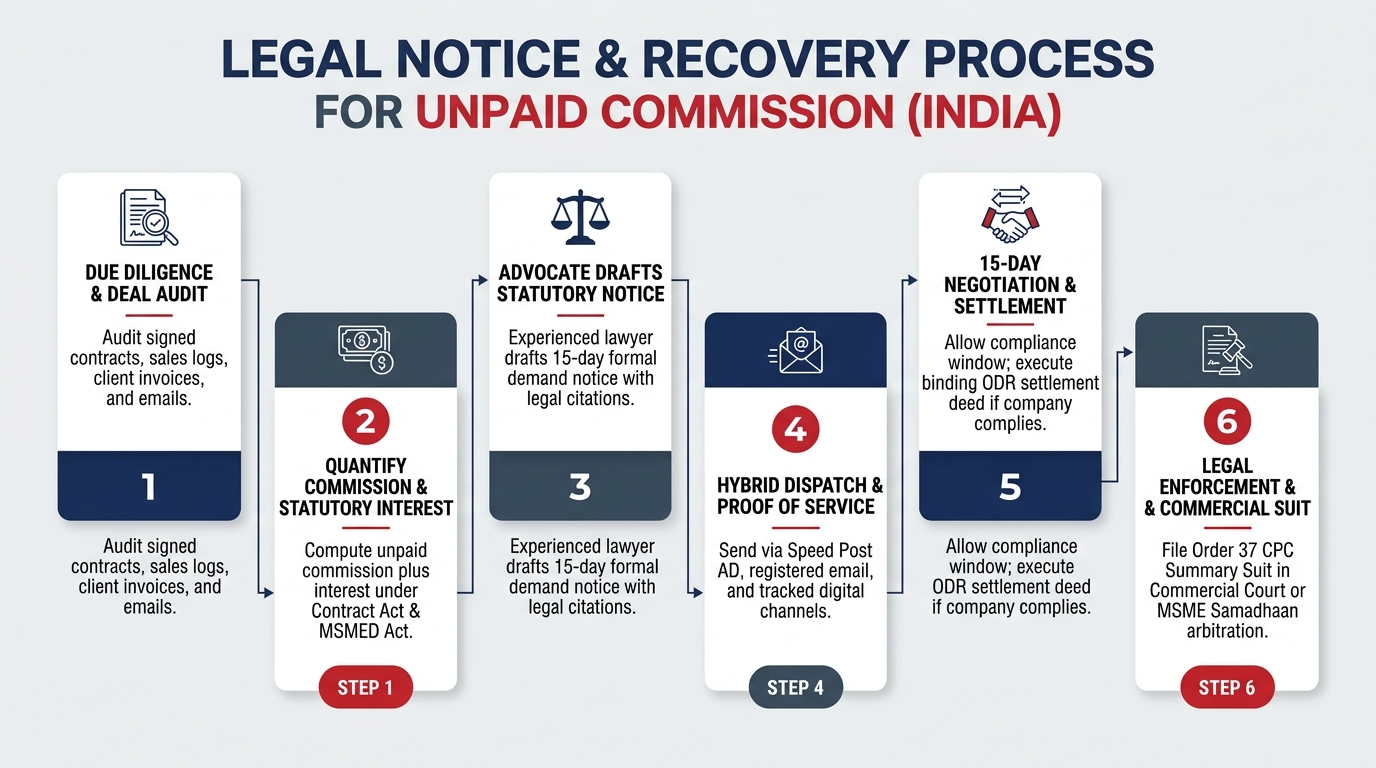
When served through an established legal platform, over 74% of commercial commission disputes settle within the statutory 15-day notice period. If the company remains non-compliant, Legal Recovery executes a seamless multi-stage escalation:
Advocate-Vetted Statutory Notice Served via Hybrid Channels
The notice is prepared on the advocate's official letterhead, digitally signed under Section 5 of the Information Technology Act, 2000, and served simultaneously via India Post Speed Post with AD, verified company email, and WhatsApp with delivery tracking.
Pre-Litigation Settlement & ODR Virtual Mediation
Upon receipt of notice, company management often initiates settlement talks. Legal Recovery provides secure Online Dispute Resolution (ODR) negotiation rooms to execute binding e-signed settlement deeds.
Fast-Track Summary Suit (Order 37 CPC) or Commercial Court Filing
In the event of default, our panel advocates file an Order 37 summary recovery petition in civil court or initiate mandatory Section 12A DLSA mediation followed by commercial suit filing.
MSME Samadhaan Facilitation & Director Liability Proceedings
For registered MSMEs, claims are lodged on the MSME Samadhaan portal for statutory compound interest. In fraudulent default cases, private criminal complaints under BNS Sections 316 and 318 are initiated against company directors.
7. Frequently Asked Questions
Authoritative Legal & Statutory References:
- Indian Contract Act, 1872 — Sections 73, 217, 219 & 221, indiacode.nic.in
- Commercial Courts Act, 2015 — Section 2(1)(c) & Section 12A Mandatory Pre-Institution Mediation, indiacode.nic.in
- Micro, Small and Medium Enterprises Development (MSMED) Act, 2006 — Sections 15–18 Delayed Payment Rules, msme.gov.in
- Code on Wages, 2019 — Definition of Wages & Payment Timelines, labour.gov.in
- Supreme Court of India — Patil Automation Pvt. Ltd. v. Rakheja Engineers Pvt. Ltd. (2022) 10 SCC 1, main.sci.gov.in
- Ministry of Corporate Affairs (MCA) — Company Master Data & Registered Office Verification, mca.gov.in
- Bharatiya Nyaya Sanhita, 2023 — Section 316 (Breach of Trust) & Section 318 (Cheating), indiacode.nic.in
More Consumer Protection & Dispute Guides

Legal Recovery
India's Trusted Recovery Platform
Legal Recovery is India's trusted online legal notice and dispute resolution platform, connecting sales executives, channel partners, brokers, businesses, and professionals with seasoned panel advocates for rapid, advocate-vetted statutory demand notices at transparent flat fees. With ₹100 Crore+ recovered and 10,000+ cases resolved across India, Legal Recovery delivers verified legal impact without the delays and unpredictability of traditional law firms.
Company Withholding Your Commission?
Send an advocate-vetted statutory notice today. 74% of companies settle unpaid commission and partner dues within 15 days upon receiving formal notice from Legal Recovery.
Flat fee • Advocate-drafted • Sent same day
Client Reviews
Rajeshwar Menon
"As a senior enterprise sales channel partner, I was owed ₹14.8 Lakhs in milestone-based commissions after closing a major B2B SaaS deal. The company abruptly terminated our partner agreement and withheld my payouts under vague clawback clauses. Legal Recovery drafted and served a formidable statutory legal notice citing Sections 73 and 219 of the Indian Contract Act, 1872, the Commercial Courts Act, and criminal breach of trust provisions. Within 12 days of receiving the advocate-vetted notice, the company's legal department reached out, waived their arbitrary deductions, and released my entire pending commission with agreed interest. Outstanding legal expertise for commercial recovery."