Legal Notice for B2B Invoice Not Received
Recover unpaid commercial invoices, vendor billing defaults, and overdue trade credit balances with an advocate-drafted statutory demand notice backed by MSMED Act 3x compound interest.
Table of Contents
Swipe →Quick Answer
Vendors, suppliers, manufacturers, and corporate service providers can issue a formal advocate-vetted legal notice to recover unpaid B2B invoices and overdue commercial trade credit. The statutory demand notice establishes an enforceable 15-day pre-litigation ultimatum demanding the principal invoice amount along with statutory compound interest under the Micro, Small and Medium Enterprises Development (MSMED) Act, 2006 or agreed contractual terms. Non-compliance empowers the creditor to initiate expedited summary recovery proceedings in commercial courts, invoke MSME Samadhaan arbitration, or initiate insolvency proceedings for defaulted operational debt.
1. Statutory Framework for Unpaid B2B Commercial Invoices
In the modern Indian economy, business-to-business (B2B) commerce relies upon unsecured trade credit agreements, supply contracts, purchase orders, and tax invoices. When a corporate buyer, wholesaler, distributor, or procurement entity deliberately withholds invoice payment, it creates severe liquidity deficits, disrupts payroll cycles, and jeopardizes vendor viability. Indian commercial jurisprudence establishes rigorous statutory protections designed to curb trade defaults and enforce commercial accountability.
Under Section 15 of the Micro, Small and Medium Enterprises Development (MSMED) Act, 2006, any buyer purchasing goods or procuring services from an enterprise registered with an Udyam certificate is statutorily obligated to settle payment on or before the mutually agreed credit date, which cannot exceed 45 calendar days under any circumstances. Where no credit tenure is established in writing, Section 15 mandates that payment must be released within 15 calendar days from the date of physical receipt and acceptance of goods or services.
If the buyer defaults beyond the statutory timeline, Section 16 of the MSMED Act imposes a non-derogable obligation to pay compound interest with monthly rests at three times the Reserve Bank of India (RBI) notified bank rate. For commercial transactions outside the MSME framework, Section 73 of the Indian Contract Act, 1872 entitles the aggrieved supplier to full damages for direct financial losses arising from contractual breach, while the Sale of Goods Act, 1930 (Sections 45 to 55) guarantees the rights of an unpaid seller to sue for the price of goods delivered and accepted.
Furthermore, Section 12A of the Commercial Courts Act, 2015 governs pre-institution mediation and expedited commercial recovery suits under Order XXXVII of the Code of Civil Procedure, 1908. Serving a formal advocate-drafted legal notice constitutes the essential foundational milestone that establishes an unassailable evidentiary baseline, calculates statutory interest liabilities, and puts corporate management on notice regarding impending legal and financial exposure.
2. Common Grounds for B2B Invoice Defaults & Defenses
Commercial debtors frequently employ standardized delay tactics and fabricated counter-claims to resist payment obligations or coerce vendors into accepting unreasonable settlement haircuts. Anticipating these defense vectors enables legal counsel to neutralize them directly within the primary demand notice.
Post-Facto Quality & Defect Disputes
Debtor companies often raise unverified claims regarding sub-standard material, product defects, or delayed deliveries months after accepting goods. Under Sections 41 and 42 of the Sale of Goods Act, 1930, retaining commercial consignments beyond a reasonable inspection window without issuing written rejection notices constitutes deemed legal acceptance.
Unilateral Debit Notes & Penalty Deductions
Corporate procurement teams frequently generate unilateral debit notes or arbitrary SLA penalty deductions without obtaining supplier concurrence. In commercial contract law, debit notes lack evidentiary enforceability unless backed by mutual written consent or explicit contractual indemnity clauses.
GST Input Tax Credit (ITC) Estoppel & CGST Rule Violations
Debtors claiming non-receipt of goods while simultaneously availing tax credits on GST E-Invoices face complete legal estoppel under Section 16(2) of the CGST Act. Furthermore, failing to pay the supplier within 180 days forces the buyer to reverse ITC with 18% interest under the second proviso to Section 16(2).
Dishonor of Commercial Cheques & Electronic Mandates
When commercial debtors issue post-dated cheques or NACH electronic payment mandates that bounce due to insufficient funds, the default transcends civil liability. It creates immediate criminal exposure under Section 138 of the Negotiable Instruments Act, 1881 and Section 25 of the Payments and Settlement Systems Act, 2007.
3. Crucial Evidence Checklist for B2B Debt Recovery
A high-impact commercial legal notice must be substantiated by an airtight documentary record. Establishing an undeniable chain of contract formation, delivery verification, and financial default ensures swift settlement or rapid court decree.
Invoicing & GST Compliance Records
- GST Tax Invoices bearing IRN and verifiable QR codes
- Generated GST E-Way Bills (Part A and Part B tracking)
- Supplier GSTR-1 outward supply filings
- Buyer GSTR-2B Input Tax Credit reconciliation statements
Contracts & Delivery Logistics
- Executed Master Service Agreements (MSA) or Purchase Orders
- Signed Physical Delivery Challans or Proof of Delivery (POD)
- Transporter Lorry Receipts (LR) and consignment notes
- Material Inspection Acceptance Reports or milestone sign-offs
Financial & Ledger Documentation
- Certified ledger statement of accounts reflecting running balance
- Bank account statements evidencing partial payments or non-receipt
- Dishonored cheques alongside original bank Return Memos
- Udyam MSME Registration Certificate of the supplier
Communications & Electronic Proof
- Email correspondence requesting payment and ledger confirmations
- WhatsApp chats acknowledging debt or promising settlement dates
- MCA database extracts of the debtor company and directors
- Section 65B Indian Evidence Act electronic certificates
4. Strategic Comparison of Commercial Recovery Forums
Selecting the most advantageous judicial pathway following the legal notice period depends upon enterprise registration, transaction quantum, debtor entity type, and whether criminal default elements exist.
| Recovery Forum | Governing Statute | Statutory Interest Rate | Expected Timeline | Strategic Legal Advantage |
|---|---|---|---|---|
| MSEFC Samadhaan Filing | MSMED Act, 2006 (Sec 18) | 3x RBI Bank Rate (Compounded monthly) | 3 to 6 Months | Zero court fees; mandatory 75% pre-deposit by debtor to challenge award under Sec 19. |
| Summary Suit (Order 37 CPC) | Commercial Courts Act, 2015 | Agreed Contractual Rate / 18% p.a. | 6 to 12 Months | Expedited decree unless debtor obtains leave to defend by depositing disputed sum in court. |
| Section 138 NI Act Complaint | Negotiable Instruments Act, 1881 | Up to 20% Interim Compensation (Sec 143A) | 6 to 18 Months | Criminal prosecution of directors; imprisonment up to 2 years and fine up to 2x cheque value. |
| Insolvency Petition (IBC Sec 9) | Insolvency & Bankruptcy Code, 2016 | Principal Operational Debt + Agreed Interest | 6 to 14 Months | Applicable for corporate debts over ₹1 Crore; triggers Corporate Insolvency Resolution (CIRP). |
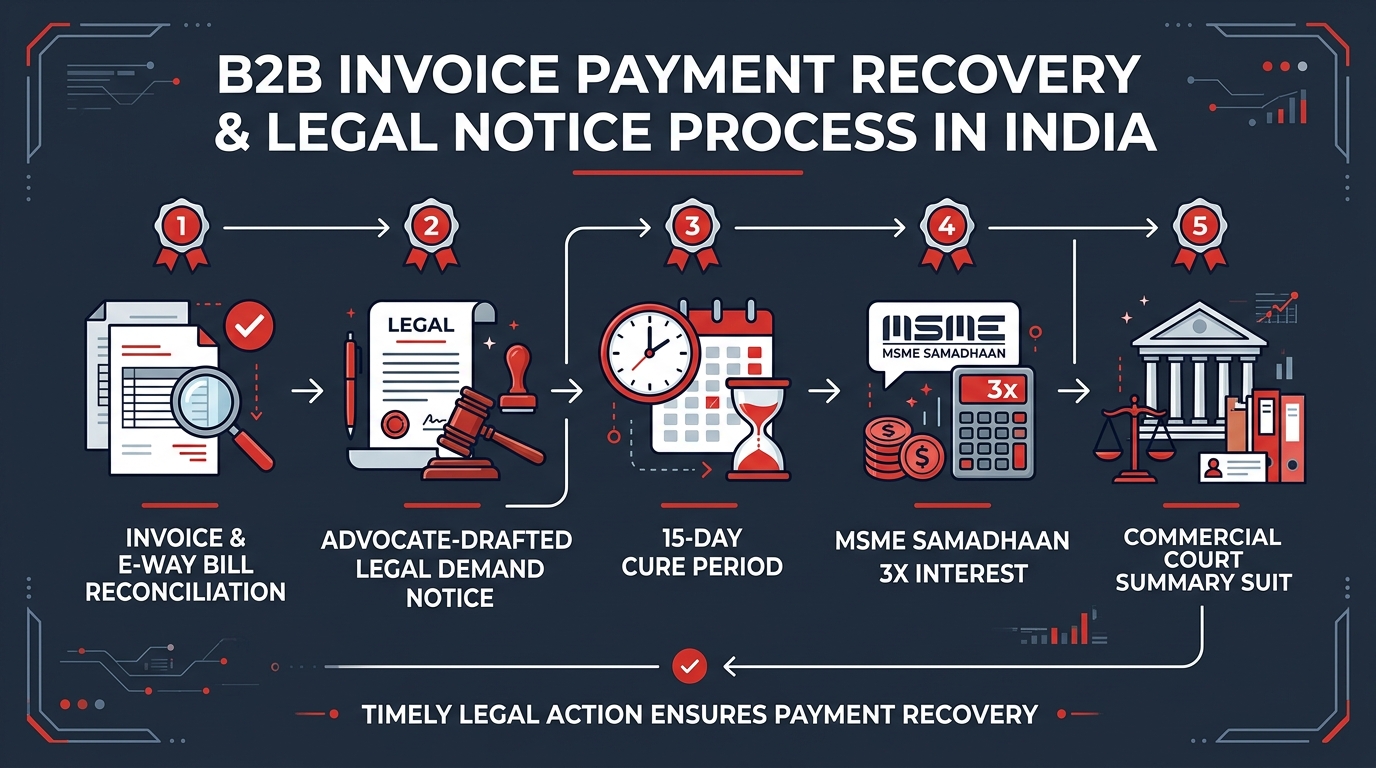
5. Step-by-Step Process to Send a B2B Legal Notice
Issuing an enforceable B2B debt recovery legal notice demands strict procedural adherence. Following a structured multi-stage workflow ensures the notice creates maximum commercial pressure while satisfying statutory litigation preconditions.
Audit of Invoices & Ledger Reconciliation
Conduct a comprehensive financial audit across all pending invoices, purchase orders, credit notes, and bank receipts. Determine the exact crystallized principal amount overdue past the agreed credit maturity date.
Corporate & Director Entity Due Diligence
Extract official corporate records from the Ministry of Corporate Affairs (MCA)to verify the debtor's registered office address, CIN/LLPIN, and identity of active managing directors or designated partners for joint and several liability.
Advocate Drafting on Official Letterhead
Engage an experienced commercial advocate to structure the notice on official legal letterhead with Bar Council credentials. The draft articulates the contractual background, itemizes unpaid invoices, calculates statutory compounding interest, and issues a formal demand.
Stipulation of 15-Day Statutory Cure Period
Accord the defaulting buyer exactly 15 business days from notice receipt to clear the outstanding principal dues, accrued commercial interest, and legal drafting costs into the creditor's nominated bank account.
Multi-Channel Verifiable Dispatch & Tracking
Serve the notice via India Post Registered Post with Acknowledgment Due (RPAD) and Speed Post to secure undeniable delivery tracking receipts. Simultaneously transmit certified digital copies via corporate email and WhatsApp under Section 65B of the Evidence Act.
6. Essential Elements of an Enforceable Commercial Demand
A hastily prepared legal notice lacking precision often triggers evasive rejoinders or evidentiary challenges in court. To ensure immediate legal and commercial impact, an enforceable B2B legal demand notice must incorporate the following foundational clauses:
- Advocate Authority & Client Retainer: Formal declaration confirming that the advocate is acting under explicit instructions and power of attorney of the aggrieved supplier.
- Detailed Invoicing Matrix: A structured schedule detailing every purchase order reference, tax invoice number, invoice date, delivery challan number, E-Way bill number, total value, partial credits, and outstanding principal.
- MSMED Act Compound Interest Computation: Transparent mathematical breakdown of 3x RBI bank rate compounding interest calculated with monthly rests from each invoice due date.
- GST Tax Credit Estoppel Assertion: Explicit citation of the buyer's GSTR-2B filings, establishing that the buyer claimed input tax credits on the supply invoices, thereby legally barring them from denying goods receipt.
- Vicarious Director & Partner Liability: Holding corporate directors, managing trustees, or partners individually and jointly liable for fraudulent inducement and breach of commercial trust.
- Demand for Legal Expenses: Specific claim demanding reimbursement for advocate professional fees and statutory dispatch expenses incurred in issuing the notice.
7. Resolution Timelines & Post-Notice Judicial Actions
Upon physical receipt of an advocate-backed legal notice, commercial debtors in India typically initiate settlement discussions within 7 to 12 days to avoid credit rating downgrades, vendor blacklisting, or judicial attachment of corporate bank accounts. Over 78% of B2B invoice disputes handled through Legal Recovery reach amicable financial resolution within the 15-day statutory cure window.
If the debtor company fails to clear the outstanding dues or issues an evasive denial upon expiry of the 15-day notice period, the supplier holds conclusive proof of pre-litigation compliance. The creditor can immediately activate the following legal enforcement mechanisms:
1. Online MSEFC Samadhaan Arbitration: File the recovery application directly on the MSME Samadhaan portal. The facilitation council conducts statutory conciliation and arbitrates the dispute to issue a final executable award within 90 days.
2. Commercial Court Summary Suit (Order 37 CPC): Institute a Summary Suit in the competent District Commercial Court for fast-track recovery, preventing the debtor from dragging trial proceedings without depositing security in court.
3. Section 138 NI Act Criminal Prosecution: If dishonored cheques or NACH payment mandates exist, file a criminal complaint before the Metropolitan Magistrate within 30 days of the statutory demand period expiry.
4. IBC Section 9 Operational Creditor Insolvency: For corporate operational debts exceeding ₹1 Crore, serve a statutory Form 3 demand notice followed by an insolvency application before the National Company Law Tribunal (NCLT).
8. Frequently Asked Questions
References: [1] Micro, Small and Medium Enterprises Development Act, 2006 (Sections 15-18). [2] Indian Contract Act, 1872 (Section 73 - Compensation for Breach). [3] Commercial Courts Act, 2015 (Pre-Institution Mediation & Summary Suits). [4] Negotiable Instruments Act, 1881 (Section 138). [5] Insolvency and Bankruptcy Code, 2016 (Section 8 & 9 Operational Debt). [6] GST E-Invoice System & E-Way Bill Portal.
Recover B2B Invoices
Connect with specialized commercial debt recovery advocates. We draft customized statutory demand notices, calculate MSME 3x compound interest, and execute verified postal dispatch.
Client Reviews
"A corporate automotive client withheld ₹23.4 Lakhs in B2B component supply invoices for over 6 months citing internal restructuring. Legal Recovery drafted an advocate-backed statutory demand notice citing MSMED compounding interest and GSTR-2B credit estoppel. The debtor firm disbursed the entire pending balance within 10 days of notice delivery to avoid commercial court proceedings. Exemplary corporate legal service."
More Commercial & Debt Recovery Guides
Vendor & Invoice Recoveries
Learn statutory procedures to recover delayed commercial invoices and unpaid B2B supplier dues in India.
Unpaid Business Invoices
Step-by-step roadmap to recover corporate and retailer pending bills through legal channels.
MSME Samadhaan Recovery
Claim 3x compound interest on delayed payments for registered MSME suppliers and enterprises.

Legal Recovery is India's trusted consumer protection and commercial debt resolution platform. Founded in 2022 and headquartered in New Delhi, Legal Recovery has counselled 15,000+ businesses and consumers on financial disputes, commercial contract breaches, and delayed invoices. Legal Recovery accelerates out-of-court settlements and connects you with top verified panel advocates.