Legal Notice for Vendor Not Paying Pending Payment
Recover overdue commercial invoices, pending vendor balances, supply contract retainers, and defaulted supplier advances with 3x RBI compound interest under the MSMED Act, 2006, Commercial Courts Act, 2015, and Indian Contract Act, 1872.
Table of Contents
Swipe →Quick Answer
Under Section 15 and Section 16 of the Micro, Small and Medium Enterprises Development (MSMED) Act, 2006, Section 70 and Section 73 of the Indian Contract Act, 1872, and Section 55 of the Sale of Goods Act, 1930, a vendor or supplier has the statutory right to issue an advocate-drafted legal notice demanding immediate settlement of overdue commercial invoices with compound interest at three times the RBI benchmark rate. The legal notice establishes a mandatory 15-day peremptory demand, formalizes documentary proof of debt (Purchase Orders, Delivery Challans, and GST E-Invoices), and serves as an indispensable prerequisite before filing an MSEFC claim on the MSME Samadhaan portal, initiating Pre-Institution Mediation under Section 12A of the Commercial Courts Act, 2015, or filing an Order 37 summary suit in civil court.
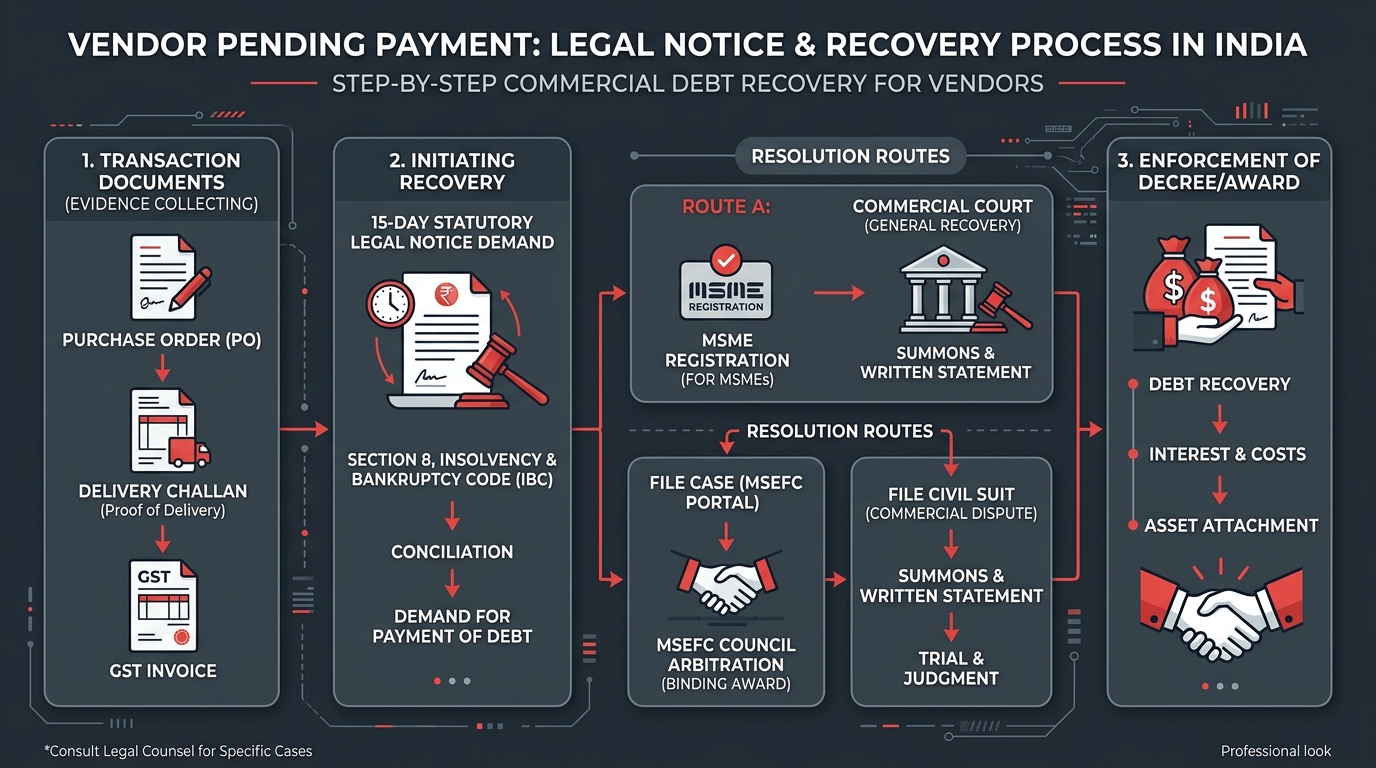
Figure 1: Statutory Roadmap for Commercial Vendor Debt Recovery & Dispute Resolution under MSMED Act, Commercial Courts Act & IBC.
1. Statutory Framework: MSMED Act, Contract Act & Sale of Goods Act
Commercial transactions in India operate within a stringent legislative framework designed to prevent working capital strangulation of vendors, component manufacturers, sub-contractors, and service providers. When a corporate buyer, general contractor, or retail aggregator receives goods or consumes services but unlawfully withholds payment, multiple federal statutes create enforceable legal remedies.
MSMED Act, 2006 (Sections 15–19)
Imposes a strict statutory 45-day payment window from the date of deliverable acceptance under Section 15 MSMED Act. Section 16 mandates payment of compound interest with monthly rests at 3x the RBI Bank Rate for every day of delay. Section 24 provides an overriding statutory effect over any conflicting buyer-vendor contract terms.
Indian Contract Act, 1872 (Sec 70 & 73)
Under Section 70 of the Indian Contract Act, any party that enjoys the commercial benefit of a non-gratuitous delivery of goods or services is legally bound to make compensation. Section 73 entitles the aggrieved vendor to recover direct damages and loss naturally arising in the usual course of business from the buyer's contractual breach.
Sale of Goods Act, 1930 (Sec 45 & 55)
Defines an unpaid vendor as an "unpaid seller" under Section 45 when the whole price has not been paid or tendered. Under Section 55 Sale of Goods Act, the seller may sue the buyer for the agreed price of the goods, irrespective of property transfer, along with statutory interest under Section 61.
Commercial Courts Act, 2015 (Sec 12A)
Governs commercial disputes arising out of mercantile documents, export/import transactions, and supply contracts. Under Section 12A Commercial Courts Act, mandatory Pre-Institution Mediation and Settlement (PIMS) through the Legal Services Authority provides an accelerated, court-annexed resolution mechanism.
2. Debunking Buyer Delay Tactics: Debit Notes & Quality Excuses
Corporate buyers and institutional contractors frequently utilize standardized administrative pretexts to postpone disbursements, suppress cash outflows, and force vendors into unconscionable discounts. A statutory legal notice systematically dismantles these specious defenses using established statutory jurisprudence.
Under Section 41 and Section 42 of the Sale of Goods Act, 1930, a buyer must inspect goods within a reasonable time. If the buyer puts the goods into production, blends raw materials, or fails to lodge a formal written rejection within the inspection window (or the 15-day deemed acceptance period under Section 2(b) MSMED Act), acceptance is legally absolute. Unilateral debit notes created months later to resist payment are deemed invalid afterthoughts by courts.
Under Indian contract law, vendor obligations and principal contractor obligations exist in independent contractual privity unless an explicit, unambiguous, and bilateral pay-when-paid covenant was executed prior to work commencement. The Delhi High Court has held that general contractors cannot shift downstream financial liquidity risks onto sub-vendors once deliverables are accepted.
Under Section 10 of the Indian Contract Act, 1872, an agreement does not require a complex deed to be legally binding. A valid contract is formed through purchase orders, email approvals, stamped delivery challans, and GST e-invoices. Furthermore, under Section 70, enjoying the benefits of supplied goods creates an enforceable statutory liability to pay the fair market price.
Retention money can only be withheld strictly in accordance with contractual milestones and during the defined Defect Liability Period (DLP). Upon DLP expiry without formal defect notices, retention balances become immediate liquidated debts bearing commercial interest under the Interest Act, 1978.
3. Statutory Interest Matrix: MSME 3x RBI Rate vs Contractual Dues
One of the most potent weapons in a vendor legal notice is the aggressive computation of pre-litigation and pendente lite statutory interest. Defaulting buyers routinely delay payments when they assume debt is interest-free. Itemizing accrued compounding interest instantly shifts the financial calculus in favor of immediate settlement.
| Statutory Route | Interest Computation Formula | Effective Annual Yield | Statutory Primacy | Tax Deductibility for Debtor |
|---|---|---|---|---|
| MSMED Act, 2006 (Section 16) | 3 × RBI Bank Rate (Compound interest with monthly rests) | ~19.5% – 21.75% p.a. | Overrides all contrary contract clauses (Sec 24) | Disallowed as business expense (Sec 23) |
| Commercial Contract Terms | Agreed interest rate specified in Invoice / PO terms | 18.00% – 24.00% p.a. | Enforceable under Section 73 Contract Act | Allowed subject to TDS (Sec 194A) |
| Interest Act, 1978 (Section 3) | Prevailing commercial bank lending rate from notice date | 10.00% – 12.50% p.a. | Applies when no contractual interest clause exists | Allowed business expenditure |
| CPC, 1908 (Section 34) | Discretionary commercial rate in civil summary suit | 6.00% – 18.00% p.a. | Awarded at the discretion of the presiding judge | Taxable as interest income |
4. Pre-Notice Evidentiary Checklist & Section 63 BSA Digital Records
A successful commercial debt recovery notice requires a flawless documentary trail. Under the newly enacted Bharatiya Sakshya Adhiniyam, 2023 (BSA), electronic records, GST portal filings, and digital communications carry statutory admissibility when properly certified.
Contractual Mandates
Purchase Orders (PO), Work Orders, Vendor Registration Deeds, Master Service Agreements (MSA), or Rate Contract Agreements specifying agreed payment terms (e.g., Net-30, Net-45) and billing milestones.
Proof of Delivery (POD)
Physical or digital Delivery Challans with security gate stamp, Goods Receipt Note (GRN), Consignment Notes (LR), or Material Inward Slips confirming receipt without demur or rejection.
GST E-Invoices & E-Way Bills
GST Tax Invoices with Invoice Reference Number (IRN) and QR Code, verified active E-Way Bills (Part A & Part B), and proof that the buyer claimed Input Tax Credit (ITC) on GSTR-2B.
Reconciliation & BSA Records
Certified Statement of Accounts (Ledger), email trails discussing pending invoices, WhatsApp payment promises, and an electronic data certificate under Section 63 of Bharatiya Sakshya Adhiniyam, 2023.
5. Critical Clauses in a Vendor Statutory Legal Notice
A boilerplate legal notice drafted without domain knowledge fails to exert adequate pressure on corporate buyers. An advocate-drafted statutory demand notice for vendor debt recovery incorporates seven indispensable legal clauses:
Clause 1: Entity Capacities & Operational Jurisdiction
Formally identifies the vendor (including Udyam Registration Number, GSTIN, and corporate status) and establishes the debtor company, its Managing Director, Chief Financial Officer, and authorized procurement signatories as jointly and severally accountable parties.
Clause 2: Chronological Supply Narrative & Deemed Acceptance
Records the precise date of Purchase Order issuance, specifications delivered, physical consignment receipt, and lack of contemporaneous quality objections within the statutory 15-day period, establishing deemed acceptance under Section 42 of the Sale of Goods Act, 1930.
Clause 3: Comprehensive Overdue Invoice Schedule
Itemizes every unpaid invoice in a tabulated schedule showing Invoice Number, Date, PO Reference, HSN/SAC Code, Taxable Value, GST Claimed, Due Date, Overdue Days, and Accrued Interest to date.
Clause 4: Mandatory Statutory Interest Computation
Explicitly invokes Section 16 of the MSMED Act, 2006 (compounding monthly at 3x RBI Bank Rate) or contractual 18%-24% commercial interest under Section 73 of the Indian Contract Act, 1872, noting that interest accrues daily until realization.
Clause 5: Rebuttal of Frivolous Quality Deductions & Debit Notes
Anticipates and pre-emptively dismisses baseless quality claims by citing the buyer's commercial utilization of goods, lack of rejected return shipments, and admission of debt in ledger/GST reconciliations.
Clause 6: 15-Day Peremptory Cure Window & Multi-Forum Escalation
Gives a strict 15-day peremptory notice to disburse the full outstanding amount, warning that failure will trigger immediate filing before the MSEFC Samadhaan portal, Section 12A Commercial Court mediation, Order 37 summary suit, Section 138 NI Act prosecution, or Section 8 IBC insolvency demand.
Clause 7: Legal Fee Indemnification & Litigation Costs
Demands reimbursement of advocate notice drafting and dispatch charges, placing all future litigation expenses, advocate retainers, and court fees onto the defaulting debtor under Section 35 of the Code of Civil Procedure, 1908.
6. Multi-Forum Remedies: MSEFC, Summary Suit, Sec 138 NI Act & IBC
When a buyer or corporate client fails to comply with the 15-day statutory legal notice, the vendor can execute targeted judicial remedies across specialized commercial and quasi-judicial forums.
| Remedy / Legal Forum | Governing Statute | Threshold / Scope | Statutory Timeline | Strategic Recovery Advantage |
|---|---|---|---|---|
| MSME Samadhaan (MSEFC) | MSMED Act, 2006 (Sec 18) | Any amount (Udyam registered suppliers) | 90-day statutory mandate | 3x RBI compound interest + 75% pre-deposit mandatory for buyer to appeal (Sec 19) |
| Summary Suit (Order 37 CPC) | Code of Civil Procedure, 1908 | Liquidated debt based on written contract/bills | 6 – 12 months | Debtor has no automatic right of defense; must obtain "leave to defend" by proving substantial defense |
| Commercial Suit & PIMS | Commercial Courts Act, 2015 | Specified value of ₹3 Lakhs & above | 3 months mediation + fast-track trial | Strict summary judgment provisions (Order XIII-A CPC) & heavy actual cost indemnification |
| Cheque Dishonor Complaint | NI Act, 1881 (Sec 138) | Dishonored cheque / NACH mandate | 30-day notice + 30-day court filing | Criminal prosecution of directors, up to 2 years imprisonment + 2x cheque penalty (Sec 143A interim 20% deposit) |
| Insolvency Petition (CIRP) | Insolvency & Bankruptcy Code, 2016 | Undisputed operational debt ≥ ₹1 Crore | 10-day Sec 8 demand + NCLT filing | Risk of losing corporate control and board management prompts immediate executive settlement |
| Criminal Fraud / Cheating | Bharatiya Nyaya Sanhita, 2023 (Sec 316/318) | Dishonest inducement & fraudulent intent | Police FIR / Magistrate 156(3) | Personal non-bailable criminal liability for promoters and procurement heads involved in fraudulent inducement |
7. Step-by-Step Strategic Roadmap for Vendor Debt Recovery
Executing an aggressive, legally compliant recovery process maximizes the probability of full payment realization without entering prolonged court litigation.
Ledger Audit & Evidence Assembly
Reconcile your accounts ledger against the debtor’s GST portal filings (GSTR-2B/GSTR-1). Collate all Purchase Orders, work orders, signed delivery challans, e-way bills, and email approvals. Ensure digital communication transcripts are backed by a Section 63 BSA certificate.
Pre-Notice Demand & Statutory Interest Assessment
Determine whether your enterprise is covered under Udyam MSME provisions to calculate the statutory 3x RBI compound interest from the 45th day post-delivery, or compute contractual commercial damages at 18%-24% p.a.
Advocate Legal Notice Drafting
Engage specialized commercial recovery advocates on Legal Recovery to draft a watertight statutory legal notice itemizing invoices, delivery acknowledgments, interest schedules, and multi-forum litigation warnings.
Multi-Channel Formal Service & Delivery Tracking
Dispatch the legal notice simultaneously via India Post Registered Speed Post with Acknowledgment Due (AD) to registered corporate headquarters, tracked email to the Board of Directors and CFO, and digital WhatsApp transmission with read receipt capture.
15-Day Peremptory Cure & Negotiation Phase
During the 15-day notice window, Legal Recovery panel advocates lead commercial negotiations, review counter-proposals, and execute legally binding settlement deeds or structured payment escrow schedules.
Judicial Enforcement upon Notice Expiry
If the debtor fails to disburse payment within 15 days, immediately file a petition on the MSME Samadhaan portal (MSEFC), institute Pre-Institution Mediation / Order 37 summary suit in commercial court, or issue a Section 8 IBC statutory demand notice.
8. Frequently Asked Questions
Statutory References & Official Regulatory Authorities
Related Commercial Recovery & Statutory Legal Notice Guides

Legal Recovery
India's Trusted Commercial Recovery Platform
Legal Recovery is India's trusted online legal notice and commercial debt dispute resolution platform, connecting manufacturers, MSME vendors, suppliers, contractors, and corporate enterprises with seasoned commercial panel advocates for rapid, advocate-vetted statutory demand notices at transparent flat fees. With ₹100 Crore+ recovered and 10,000+ commercial cases resolved across India, Legal Recovery delivers verified legal impact without the delays and unpredictability of traditional law firms.
Buyer Withholding Vendor Payment?
Send an advocate-vetted statutory demand notice today. Over 82% of commercial debtors settle overdue vendor invoices within 15 days of notice delivery.
Flat fee • Advocate-drafted • Sent same day
Client Reviews
Vikramaditya Sengupta
"When our precision manufacturing firm delivered ₹28,40,000 worth of customized industrial fabrication assemblies and tooling components to a Tier-1 automotive equipment manufacturer in Pune under standard Net-30 credit terms, the buyer stopped all disbursements. For five months, their accounts department gave baseless excuses about internal audit delays and then manufactured a frivolous quality deduction claim. Legal Recovery drafted a devastating statutory legal demand notice invoking Section 15 and 16 of the MSMED Act, 2006, Section 70 and 73 of the Indian Contract Act, 1872, and Section 55 of the Sale of Goods Act, 1930, putting them on strict notice of MSEFC arbitration with 3x RBI compound interest and Section 8 IBC insolvency proceedings. Within 12 days of notice delivery via Speed Post AD and tracked email, the corporate client called us for reconciliation and cleared the entire ₹28,40,000 principal plus statutory interest. Exemplary legal precision and commercial debt recovery!"