Legal Notice to Tenant to Recover Money for Property Damage
Recover structural repair expenses, defaced fixture costs, civil restoration charges, and consequential rental loss exceeding the security deposit under the Transfer of Property Act, Indian Contract Act, and Commercial Courts Act.
Table of Contents
Swipe →Quick Answer
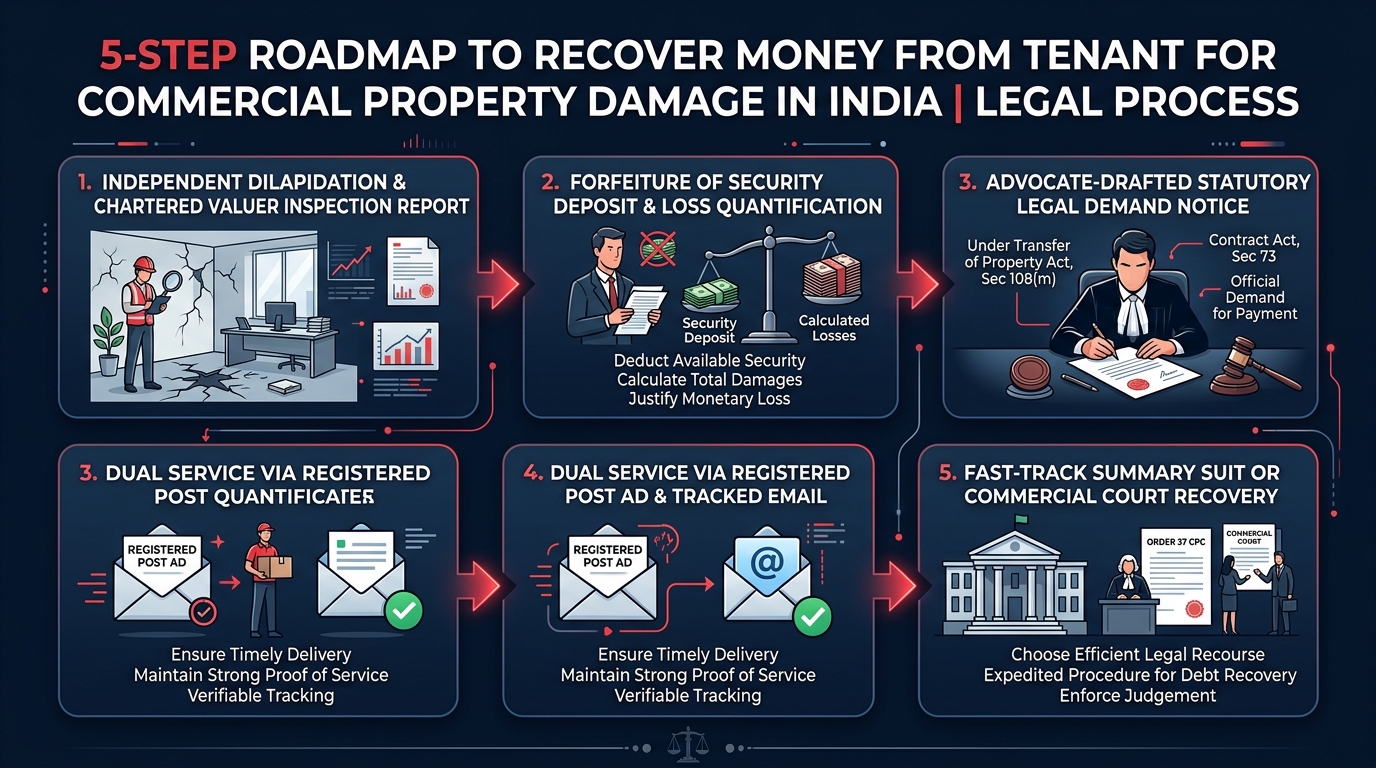
A commercial or residential landlord can serve an advocate-vetted statutory legal notice to a defaulting tenant for property damage under Section 108(m) and Section 108(o) of the Transfer of Property Act, 1882 read with Section 73 of the Indian Contract Act, 1872, demanding full reimbursement for structural repairs, demolished partitions, destroyed HVAC/electrical systems, and lost rental income within 15 days. If the quantified restoration costs exceed the retained security deposit, the landlord is statutorily entitled to forfeit the deposit, demand the remaining balance through the notice, and initiate expedited civil recovery under Order 37 of the Code of Civil Procedure, 1908 or file a commercial suit under the Commercial Courts Act, 2015. Furthermore, deliberate vandalism, unauthorized structural alteration, or dismantling of leased plant machinery attracts criminal prosecution under Section 324 and Section 316 of the Bharatiya Nyaya Sanhita, 2023.
1. Statutory Framework: Property Damage & Waste Laws in India
In the Indian real estate and leasing sector, the rights and covenants governing property condition, tenant maintenance, and post-tenancy redelivery are anchored in rigorous statutory principles. When a tenant—whether an individual occupying a luxury apartment or a corporate entity leasing commercial office floors, retail showrooms, or industrial warehouses—vacates the demised premises in a damaged, stripped, or defaced state, the landlord possesses comprehensive legal remedies under property, contract, and commercial codes.
The primary codified statute governing lessor-lessee obligations is the Transfer of Property Act, 1882 (TPA). Section 108 of the TPA delineates the non-negotiable statutory obligations of the lessee:
- Section 108(m) (Duty to Restore and Repair): The lessee is legally bound to keep, and upon lease determination to restore, the demised property in as good a condition as it was in at the time possession was delivered, subject only to changes caused by reasonable wear and tear or irresistible force (vis major).
- Section 108(o) (Prohibition of Waste & Injurious Acts):The lessee must not use the property for unauthorized purposes, pull down or damage buildings, destroy permanent fixtures, or commit any act that is destructive or permanently injurious to the landlord's freehold interest.
- Section 108(p) (Prohibition on Unauthorized Permanent Structures): The lessee is prohibited from erecting permanent structures or altering the fundamental architecture of the building without the express written consent of the lessor.
- Section 108(h) (Right to Remove Fixtures before Termination): While tenants may detach their own movable trade fittings, they cannot pull down landlord fittings or leave the property in a defaced, structurally compromised condition.
Complementing property statutes, the Indian Contract Act, 1872 provides the compensatory framework under Section 73. When a tenant breaches the maintenance, redelivery, or restoration clauses of a registered lease deed or leave and license agreement, the landlord is entitled to compensation for all actual direct damages naturally arising from the breach. This encompasses the total civil contractor reinstatement cost, procurement of replacement HVAC/electrical machinery, architect certification fees, and consequential compensation for lost rental revenue during the repair period.
In the landmark judgment Bharat Petroleum Corporation Ltd. v. N.R. Vairamani (2004) 8 SCC 579, the Supreme Court of India reiterated that a commercial tenant holding over or vacating demised premises cannot escape the obligation to redeliver the property in its original state, affirming the landlord's right to claim substantial damages for structural alterations, dilapidations, and site remediation.
2. Commercial vs Residential Tenancy: Scope of Actionable Damage
The distinction between ordinary wear and tear and legally actionable property destruction is vital when quantifying claims and serving a statutory demand notice. Commercial tenancies involve high-value fit-outs, industrial utilities, and structural modifications that carry severe financial ramifications if vacated improperly.
| Damage Category | Permissible Wear & Tear (Non-Actionable) | Actionable Property Destruction (Recoverable by Notice) |
|---|---|---|
| HVAC & Air Conditioning | Routine filter clogging, minor gas depletion from regular usage | Dismantled VRV/AHU copper lines, crushed ducting, removed external compressors, vandalized chillers |
| Electrical & Networking | Faded switch plates, burnt light bulbs, natural wire aging | Ripped 3-phase busbars, stripped copper wiring, demolished server racks, destroyed main distribution boards (MDBs) |
| Civil & Structural Architecture | Hairline plaster drying cracks, standard sun-bleached exterior paint | Demolished brick/drywall partitions, core-cut load-bearing beams, damaged false ceilings, shattered marble/granite flooring |
| Plumbing & Sanitary Ware | Minor washer leakage, standard limescale deposits on taps | Cracked commercial WC fixtures, severed soil/waste pipes, severe untreated water seepage causing structural dampness |
| Glass Facades & Entrances | Minor surface smudges, ordinary hinge loosening from daily footfall | Shattered toughened glass partitions, removed automated sensor sliding doors, warped structural aluminum framing |
| Site Clearance & Debris | Empty rooms requiring routine housekeeping sweep | Piles of toxic construction rubble, hazardous chemical waste, abandoned heavy scaffolding requiring industrial removal |
In commercial properties (offices, IT parks, retail showrooms, cloud kitchens, and warehouses), lease contracts typically include a rigorous "Reinstatement / De-fitting Clause" requiring the lessee to deliver bare-shell or warm-shell premises at their sole cost. Failure to restore the property gives the landlord an immediate cause of action for breach under Section 73 of the Contract Act.
3. Security Deposit Forfeiture vs Excess Dilapidations Claim
A pervasive misconception among defaulting tenants is that their liability is strictly capped at the amount of the interest-free refundable security deposit held by the landlord. Under Indian contract jurisprudence, a security deposit is merely a pledge or collateral security; it does not operate as a liability ceiling.
When tenant damages exceed the security deposit, the landlord must follow a systematic legal accounting protocol:
Step 1: Total Gross Loss Quantification
Consolidate all civil restoration quotes, MEP (Mechanical, Electrical, Plumbing) repair bills, specialized valuer assessment fees, and hazardous debris clearance expenses into a unified gross repair schedule.
Step 2: Security Deposit Set-Off & Forfeiture
Formally apply the retained security deposit against the gross repair bill in accordance with lease terms, generating a certified ledger entry showing the exact amount absorbed by the deposit.
Step 3: Crystallization of Uncovered Deficit Balance
Calculate the net uncovered deficit (Gross Restoration Cost minus Forfeited Deposit) as a liquidated, actionable debt payable immediately by the ex-tenant.
Step 4: Consequential Loss of Rent / Mesne Profits
Under Section 73 of the Contract Act and Section 2(12) CPC, claim compensation for lost rental revenue for the entire reasonable timeframe during which the property is unrentable due to ongoing repairs.
⚖️Judicial Precedent on Dilapidations & Consequential Rental Loss
In accordance with principles laid down by Indian High Courts and the Supreme Court in Union of India v. Rampur Distillery & Chemical Co. Ltd. (1973) 1 SCC 649, damages for breach of contract must represent genuine pre-estimated losses or actual losses proved. A landlord who establishes that tenant vandalism directly prevented new tenant occupancy during remediation is entitled to recover both civil restoration costs and lost market rent.
4. Pre-Notice Evidentiary Checklist & Chartered Valuer Assessment
To ensure your statutory legal notice is legally unassailable and capable of securing a summary court decree, the claim must be corroborated by robust contemporary documentary evidence. Assembling this evidentiary dossier before drafting the notice eliminates frivolous tenant defenses:
1. Contractual & Ingoing Records
- ✓ Registered Lease / Leave & License Deed with Reinstatement Clause
- ✓ Handover Protocol & Ingoing Photographic Inventory at start of lease
- ✓ Approved Fit-out / Architectural drawings signed by both parties
2. Contemporaneous Exit Documentation
- ✓ Notice of termination / lease expiry correspondence
- ✓ Joint Exit Walkthrough Inspection Minutes / Defect Schedule
- ✓ High-resolution date-stamped photographs & 4K video walkthroughs
3. Independent Technical Assessment
- ✓ Government-Approved Chartered Civil Valuer Dilapidations Report
- ✓ Licensed Electrical & MEP Engineer structural integrity certificate
- ✓ Detailed Bill of Quantities (BOQ) with market-standard itemized rates
4. Financial Trails & Tenant Identity
- ✓ GST Invoices and payment receipts from licensed civil contractors
- ✓ Ledger of security deposit received, interest applied & deductions
- ✓ Tenant MCA Corporate Master Data, CIN, and Director DIN records
The Strategic Value of a Chartered Valuer Dilapidations Report
A Dilapidations Report prepared by a registered Chartered Engineer or government-approved valuer carries substantial evidentiary weight under Section 45 of the Indian Evidence Act, 1872 (now Section 39 of the Bharatiya Sakshya Adhiniyam, 2023) as expert testimony. Annexing an independent BOQ to the legal demand notice prevents the tenant from claiming that repair rates were unilaterally inflated or arbitrary.
5. Key Clauses in a Statutory Demand Notice for Property Damage
A statutory legal notice issued on an advocate's letterhead must set forth facts with forensic precision. The following core clauses form the structural backbone of an enforceable notice for recovery of property damage:
Tenancy Particulars & Ingoing Property Condition Recitals
Explicitly establish the lease execution date, tenure, demised premises specifications, agreed monthly rent, security deposit quantum, and the ingoing property condition verified as flawless at handover.
Specific Covenants of Maintenance, Repair & Reinstatement
Quote exact clauses from the lease agreement mandating the tenant to keep the premises in tenantable repair, obtain written permission prior to alterations, and reinstate the property to bare-shell/original status upon vacation.
Itemized Schedule of Unauthorized Alterations & Property Destruction
Present a detailed tabular schedule categorizing civil, electrical, HVAC, plumbing, and structural damage, contrasting the pristine ingoing state with the defaced condition documented upon exit.
Accounting Ledger: Deposit Forfeiture, Excess Deficit & Consequential Loss
Explicitly set off the available security deposit against certified repair quotes, quantify the net deficit balance, and add consequential claims for lost rental income and architect valuation fees.
15-Day Strict Peremptory Notice & Multi-Forum Litigation Warning
Demand unconditional electronic remittance of the total quantified dues within exactly 15 days of notice receipt, warning of Order 37 summary suits, Commercial Court filings under Section 12A, and criminal prosecution under BNS Sections 316 and 324 at the tenant's sole cost and consequence.
6. Multi-Forum Legal Remedies: Commercial Courts, Summary Suits & Criminal Action
If the defaulting tenant or corporate entity ignores the 15-day statutory notice or refuses to liquidate the repair arrears, Legal Recovery initiates immediate multi-forum judicial escalation:
| Legal Forum & Statute | Nature of Property & Claim | Pecuniary Jurisdiction | Key Strategic Benefit |
|---|---|---|---|
| Commercial Courts Act, 2015 (Sec 2(1)(c)(vii) & Sec 12A) | Commercial offices, retail shops, industrial premises | Specified Value ≥ ₹3 Lakhs | Mandatory DLSA pre-institution mediation; designated fast-track commercial judges |
| Order 37 Summary Suit (Code of Civil Procedure, 1908) | Liquidated repair bills & written lease covenants | Civil Court Jurisdiction | Defendant must prove substantial defense to get leave to defend; swift money decree |
| Bharatiya Nyaya Sanhita, 2023 (BNS Sec 324 & 316) | Vandalism, theft of fixtures, criminal damage | Criminal Magistrate Court | Personal criminal liability for corporate directors and delinquent tenants |
| Civil Recovery Suit for Mesne Profits (Sec 2(12) CPC) | Compensation for lost market rent during repair period | District Court / High Court | Full recovery of consequential rental revenue along with commercial interest |
High-Impact Digital Service with Electronic Tracking under BSA 2023
To eliminate common tenant evasions such as refusing physical postal deliveries, Legal Recovery serves every statutory notice via a dual-channel framework: India Post Registered Post AD / Speed Post combined with digitally signed email and WhatsApp delivery. Under Section 63 of the Bharatiya Sakshya Adhiniyam, 2023, our system automatically generates digital certificates of delivery, establishing conclusive constructive service before civil and commercial benches.
7. Frequently Asked Questions
Authoritative Legal & Statutory References:
- Transfer of Property Act, 1882 — Section 108 (Rights and Liabilities of Lessor and Lessee), indiacode.nic.in
- Indian Contract Act, 1872 — Section 73 (Compensation for Loss or Damage Caused by Breach), indiacode.nic.in
- Commercial Courts Act, 2015 — Section 2(1)(c) Commercial Disputes & Section 12A Mandatory Pre-Institution Mediation, indiacode.nic.in
- Supreme Court of India — Bharat Petroleum Corp Ltd v. N.R. Vairamani (2004) 8 SCC 579, main.sci.gov.in
- Supreme Court of India — Patil Automation Pvt. Ltd. v. Rakheja Engineers Pvt. Ltd. (2022) 10 SCC 1, main.sci.gov.in
- Bharatiya Nyaya Sanhita, 2023 — Section 324 (Mischief & Property Damage) & Section 316 (Criminal Breach of Trust), indiacode.nic.in
- Bharatiya Sakshya Adhiniyam, 2023 — Section 63 Admissibility of Electronic Records, indiacode.nic.in
More Consumer Protection & Dispute Guides

Legal Recovery
India's Trusted Recovery Platform
Legal Recovery is India's trusted online legal notice and dispute resolution platform, connecting commercial landlords, property managers, individual lessors, and businesses with seasoned panel advocates for rapid, advocate-vetted statutory demand notices at transparent flat fees. With ₹100 Crore+ recovered and 10,000+ cases resolved across India, Legal Recovery delivers verified legal impact without the delays and unpredictability of traditional law firms.
Tenant Damaged Your Property?
Send an advocate-vetted statutory notice today. Over 74% of defaulting tenants settle repair costs and rental deficits within 15 days upon receiving formal notice from Legal Recovery.
Flat fee • Advocate-drafted • Sent same day
Client Reviews
Vikramaditya Singhania
"When our commercial tenant vacated a 4,500 sq. ft. Grade-A office space in BKC, they left behind devastating property damage: broken VRV air-conditioning ducting, demolished load-bearing partitions, stripped three-phase copper cabling, and smashed Italian marble flooring. The repair assessment came to ₹26.5 Lakhs—far exceeding their ₹12 Lakh security deposit. Legal Recovery drafted a formidable statutory legal notice under Section 108(m) of the Transfer of Property Act, Section 73 of the Contract Act, and the Commercial Courts Act, supported by an independent chartered civil engineer's dilapidations report. Within 14 days of receiving the notice, the tenant company's directors agreed to an out-of-court settlement and transferred the entire ₹14.5 Lakh deficit plus compensation for lost rent during repairs. Exceptional legal capability for commercial landlords."