Legal Notice to Landlord for Not Giving Back Security Deposit
Recover unrefunded commercial lease deposits, office rental advances, and residential tenant security funds. Enforce your statutory rights under the Transfer of Property Act, Model Tenancy Act, and Commercial Courts Act with 18% penal interest.
Table of Contents
Swipe →Quick Answer
A legal notice to a landlord for not giving back the security deposit is a formal statutory demand drafted by an advocate that requires the landlord to refund the full unreturned deposit with interest within 15 days of receipt. Under Section 108 of the Transfer of Property Act, 1882, the Indian Contract Act, 1872, and the Model Tenancy Act, landlords cannot arbitrarily forfeit rental deposits or make unreasonable deductions for normal wear and tear once the tenant vacates and hands over vacant possession. Serving a verified legal notice establishes essential pre-litigation proof, entitling the commercial or residential tenant to claim 12% to 18% annual penal interest and initiate a Summary Suit under Order XXXVII of the Code of Civil Procedure or institute proceedings before the competent Rent Authority or Commercial Court.
1. Statutory & Contractual Architecture for Security Deposit Recovery
In both commercial and residential leasing arrangements across India, a security deposit (or interest-free refundable security deposit - IFRSD) is furnished by the tenant to secure the faithful performance of lease covenants, timely rental payments, and the preservation of property infrastructure. Under Indian jurisprudence, a security deposit does not represent consideration or absolute property of the lessor; rather, it constitutes a trust fund held in fiduciary capacity that must be refunded simultaneously upon the surrender of vacant physical possession, subject only to contractually permissible and verifiable adjustments.
The core statutory bedrock governing rental relationships is codified under the Transfer of Property Act, 1882 (TPA). Under Section 108(q) of the TPA, the tenant is bound to put the lessor into possession of the property upon determination of the lease. Reciprocally, under Section 108(m), the lessee is bound to keep and restore the property in as good condition as it was at the commencement of the lease, "reasonable wear and tear and irresistible force excepted." Therefore, any unilateral retention by the landlord claiming routine degradation violates express statutory mandates.
Contractual rights and breach remedies are anchored in the Indian Contract Act, 1872. When a landlord refuses to return a security deposit upon valid lease determination, it constitutes an actionable breach of contract under Section 73 (compensation for loss or damage caused by breach of contract) and Section 74 (liquidated damages and penalties). Furthermore, the Model Tenancy Act, 2021 (MTA) formulated by the Ministry of Housing and Urban Affairs provides a clear regulatory ceiling, capping security deposits (maximum 2 months for residential and maximum 6 months for commercial properties) and requiring mandatory refund within one month of vacating after agreed deductions.
For corporate entities, retail chains, and MSME enterprises occupying commercial real estate, high-quantum security deposits (often ranging from ₹10 Lakhs to several Crores) fall under the ambit of commercial disputes governed by the Commercial Courts Act, 2015. Serving a formal advocate-drafted demand notice is the indispensable statutory prerequisite to trigger mandatory Pre-Institution Mediation under Section 12A or institute fast-track recovery proceedings.
2. Commercial Leases vs. Residential Tenancies: Critical Distinctions
While residential deposit disputes typically involve modest sums and basic wear-and-tear contentions, commercial lease deposit disputes involve complex corporate balance sheet allocations, extensive fit-out capitalization, lock-in period penalty clauses, Goods and Services Tax (GST) adjustments, and Common Area Maintenance (CAM) reconciliations.
Commercial Lease Architecture
- Substantial Deposit Quantum: Deposits generally represent 3 to 12 months of rental yield, frequently tying up substantial working capital.
- Lock-in Periods & Minimum Tenures: Leases frequently stipulate 3 to 5 year lock-in clauses with heavy penalty covenants that landlords attempt to enforce illegally upon early business exit.
- Fit-out & Bare Shell Handover: Handover conditions require reinstatement to "bare-shell" or "warm-shell" condition, triggering extensive disputes over demolition and structural restoration costs.
- CAM & Utility Auditing: Complex reconciliations involving chiller charges, power factor penalties, common area diesel generator (DG) fuel backups, and property taxes.
- GST & Tax Deduction at Source (TDS): Treatment of GST on forfeited amounts and issuance of TDS credit certificates under Section 194-I of the Income Tax Act.
Residential Tenancy Architecture
- Fixed Deposit Caps: Typically capped at 2 to 3 months of rent in modern metropolitan leases under Model Tenancy guidelines (though Bengaluru/Mumbai historically demanded 6-10 months).
- Informal Move-out Protocols: Handover often conducted verbally without joint inspection reports, leaving tenants vulnerable to unproven post-vacation claims.
- Routine Repainting Deductions: Landlords routinely attempt automatic 1-month rent deductions for painting and deep cleaning despite zero tenant negligence.
- Consumer Protection Access: Residential tenants qualify as consumers under the Consumer Protection Act, 2019 for deficiency in service, whereas commercial enterprises must pursue civil/commercial court remedies.
3. Legitimate Deductions vs. Unlawful Forfeiture & Bogus Claims
Landlords frequently invent unjustified pretexts to retain tenant capital. Indian courts have consistently differentiated between legitimate contractual offsets and unlawful, arbitrary deductions.
Lock-in Period Forfeiture vs. Actual Loss Proof
In landmark judgments including Kailash Nath Associates v. Delhi Development Authority (2015) 4 SCC 136 and Maula Bux v. Union of India (1969) 2 SCC 554, the Supreme Court of India held that under Section 74 of the Indian Contract Act, damages can only be awarded when actual loss is proved. A landlord cannot automatically forfeit the entire deposit for early exit if the premises were promptly re-let or if the landlord suffered no real financial loss.
Routine Painting & Normal Wear and Tear
Under Section 108(m) of the TPA, tenants are explicitly exempted from repairing natural degradation resulting from standard usage and passage of time. Repainting costs, minor floor scuffs, and aging fixtures are the owner's capital maintenance responsibility and cannot be unilaterally deducted from the security deposit without express contractual agreement and proof of abnormal damage.
Absence of Third-Party Repair Invoices
Any lawful deduction requires strict documentary substantiation, including GST-compliant contractor repair invoices, material purchase vouchers, and comparative pre-and-post handover photographic proof. Unsubstantiated estimates or self-declared deduction figures are routinely rejected by civil courts and consumer commissions.
CAM & Electricity Surcharge Overbilling
In commercial buildings and tech parks, landlords often withhold security deposits claiming pending CAM reconciliations or power tariff escalations. The tenant has the absolute legal right to demand certified utility sub-meter logs and audited building maintenance statements before any offset is finalized.
4. Pre-Notice Evidentiary Checklist & Handover Dossier
Prior to issuing an advocate legal demand notice, assembling a comprehensive documentary dossier is vital to establish uncontroverted proof of compliance, vacant handover, and financial disbursement.
Executed Lease & Deposit Proofs
- Registered or notarized Lease / Leave and License Agreement
- Bank statement / NEFT / RTGS receipts showing deposit transfer
- Signed deposit acknowledgment receipt from landlord
- TDS certificates (Form 16A) for commercial rental payments
Termination & Handover Records
- Formal lease termination / vacation notice served by tenant
- Signed Key Handover Protocol and Move-out Inspection Sheet
- High-resolution date-stamped photographs/videos of vacant premises
- Society / Building Management Move-out Gate Pass and NOC
Utility & CAM Clearance Proofs
- Paid electricity, water, and piped gas utility bills up to exit date
- Final paid maintenance receipt from building RWA / facility management
- Broadband and telecom equipment surrender receipts
- Sub-meter final meter reading log signed by building engineer
Written Refund Demands & Refusals
- Email communications requesting deposit refund with bank details
- WhatsApp chats acknowledging handover and promising refunds
- Written records of baseless deduction claims or refusal to pay
- Certificate under Section 63 Bharatiya Sakshya Adhiniyam, 2023 for digital evidence
5. Step-by-Step Notice Drafting & Statutory Service Protocol
Serving an advocate-vetted legal demand notice requires strict adherence to procedural protocols to ensure unassailable evidentiary admissibility in civil, commercial, or consumer courts.
Contractual Audit & Handover Reconciliation
Audit the tenancy agreement clauses regarding security deposit refund timelines, notice periods, and dispute resolution mechanisms. Compute the exact net refund amount payable after subtracting any mutually agreed and verified final utility dues.
Advocate Drafting on Formal Letterhead
Engage a legal counsel to draft the formal statutory notice on advocate letterhead. The notice articulates the tenancy history, proves complete compliance by the tenant, demonstrates surrender of vacant peaceful possession, refutes frivolous deduction pretexts, and asserts the legal liability of the landlord.
Inclusion of Penal Interest & Damages Claims
Claim statutory commercial penal interest at 12% to 18% per annum from the date of physical property handover until actual realization, alongside compensation for illegal financial retention, corporate working capital disruption, and advocate legal notice expenses.
Stipulation of 15-Day Mandatory Compliance Window
Grant the landlord a definitive 15-day cure period from the date of notice receipt to remit the full unreturned security deposit directly into the tenant's designated corporate or personal bank account.
Multi-Channel Verifiable Dispatch & Tracking
Serve the signed legal notice via India Post Registered Post with Acknowledgment Due (RPAD) and Speed Post to the landlord's registered and residential addresses. Concurrently dispatch digitally signed PDF copies via registered email and WhatsApp with delivery confirmation logs to establish constructive service.
6. Anatomy & Key Clauses of an Airtight Legal Demand Notice
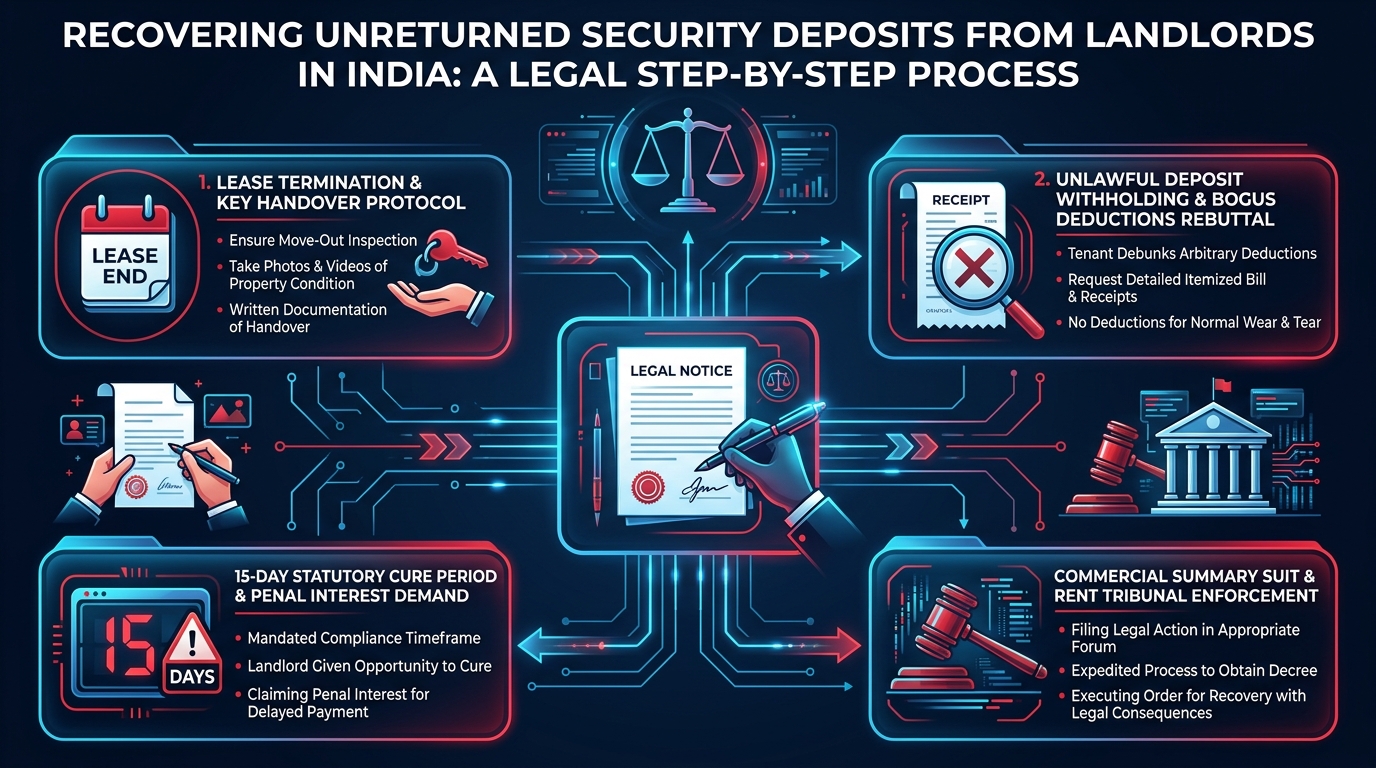
A rigorously drafted legal notice eliminates potential defense arguments in subsequent litigation. An airtight security deposit demand notice must contain the following core clauses:
- Advocate Authority Recital: Express recital stating the notice is issued under the specific instructions, authorization, and retainer of the tenant.
- Tenancy & Consideration Particulars: Exact details of the Lease / License Agreement date, premise description, monthly rental amount, security deposit amount paid, and transaction reference numbers.
- Lease Determination & Possession Handover: Clear timeline establishing when termination notice was served, date of vacant peaceful possession handover, return of physical keys, and execution of handover protocols.
- Proof of Zero Arrears: Categorical declaration supported by receipts showing that all electricity, water, CAM, and ancillary maintenance bills were paid in full by the tenant up to the date of vacation.
- Rebuttal of Unlawful Deductions: Explicit legal rebuttal under Section 108(m) TPA rejecting unproven painting charges, routine wear-and-tear claims, or unauthorized lock-in penalty forfeitures.
- Specific Financial Demand with Penal Interest: Quantified financial demand specifying the exact principal deposit plus 18% p.a. commercial interest and legal drafting fees.
- Litigation Warning: Explicit warning of immediate institution of Summary Suits under Order 37 CPC, Commercial Court claims, or Consumer Forum complaints holding the landlord personally liable for all legal costs and damages.
7. Post-Notice Judicial Escalation Pathways Matrix
Over 70% of defaulting landlords settle security deposit dues within the 15-day notice period to avoid public litigation and legal expenses. When a landlord refuses to comply, the tenant can deploy the following targeted judicial escalation pathways:
| Legal Forum / Pathway | Governing Law | Target Tenant Profile | Average Resolution Timeline | Key Strategic Advantage |
|---|---|---|---|---|
| Commercial Summary Suit | Order 37 CPC / Commercial Courts Act, 2015 | Commercial office & retail leases ≥ ₹3 Lakhs | 6 to 12 Months | Defendant must apply for leave to defend; instant decree if defense is frivolous. |
| Pre-Institution Mediation | Section 12A, Commercial Courts Act | Corporate tenants & business entities | 1 to 3 Months | Court-annexed fast settlement with legal enforceability equal to a court decree. |
| Consumer Commission | Consumer Protection Act, 2019 | Residential tenants & PG / coliving occupants | 6 to 14 Months | Nominal court fee; award of mental harassment damages and litigation costs. |
| Rent Authority / Tribunal | Model Tenancy Act / State Rent Acts | Registered tenancy agreements | 2 to 6 Months | Fast-track administrative recovery with statutory deposit refund mandates. |
| Sole Arbitrator Proceeding | Arbitration & Conciliation Act, 1996 | Institutional & tech-park commercial leases | 4 to 9 Months | Binding arbitral award enforceable as a civil court decree under Section 36. |
8. Frequently Asked Questions
References:[1] Transfer of Property Act, 1882 (Section 108 Rights and Liabilities of Lessor and Lessee) • [2] Indian Contract Act, 1872 (Section 73 Compensation for Loss or Damage & Section 74 Penalty Clauses) • [3] Ministry of Housing and Urban Affairs Model Tenancy Act, 2021 • [4] Commercial Courts Act, 2015 (Pre-Institution Mediation and Settlement under Section 12A) • [5] Supreme Court of India (Kailash Nath Associates v. DDA & Maula Bux v. Union of India) • [6] National Consumer Disputes Redressal Commission (Tenancy Security Deposit Deficiency Jurisprudence).
Recover Landlord Security Deposit
Partner with senior property and commercial recovery advocates. We draft statutory demand notices, challenge illegal deductions, compute 18% penal interest, execute verifiable postal & digital dispatch, and handle court recovery.
Client Reviews
"When our commercial landlord in Gurgaon withheld our ₹18.5 Lakh security deposit citing baseless fit-out repainting and lock-in deductions after we vacated our retail showroom, Legal Recovery drafted and served a comprehensive advocate notice under the Transfer of Property Act and Commercial Courts Act. The landlord's counsel contacted us within 11 days of receiving the notice and released 100% of our deposit with interest to avoid commercial summary suit proceedings. Exceptional speed, legal precision, and corporate client support."
More Consumer & Rental Protection Guides
Security Deposits & Rental Recoveries
Comprehensive legal framework to recover withheld rent advances and commercial tenancy deposits across India.
Unreasonable Landlord Deductions
How to challenge bogus repainting, maintenance, and deep cleaning deductions under Section 108 TPA.
PG & Hostel Deposit Refund Notice
Legal notice roadmap for students and young professionals to recover paying guest security deposits.

Legal Recovery is India's trusted consumer protection and commercial debt resolution platform. Founded in 2022 and headquartered in New Delhi, Legal Recovery has counselled 15,000+ businesses, financial institutions, and consumers on debt recovery, commercial contract breaches, and loan defaults. Legal Recovery accelerates out-of-court settlements and connects you with top verified panel advocates.