Legal Notice to School or College for Admission Fee Refund
Recover unrefunded tuition fees, capitation deposits, annual developmental charges, and hostel fees from schools, colleges, and deemed universities under UGC Guidelines, AICTE Norms, and Consumer Protection Act 2019.
Table of Contents
Swipe →Quick Answer
A parent or student can serve an advocate-vetted statutory legal notice to any school, college, or private university demanding a full refund of tuition, capitation, admission, hostel, or caution fees upon admission cancellation under University Grants Commission (UGC) Fee Refund Norms, AICTE Approval Process Handbook, and Section 2(47) of the Consumer Protection Act, 2019. Educational institutions in India are legally prohibited from enforcing non-refundable clauses or retaining unearned fees for unavailed academic semesters when a seat is surrendered before or near the commencement cutoff. If the institution fails to disburse the refund within 15 days of receiving the legal notice, the claimant can initiate summary recovery before the District Consumer Disputes Redressal Commission (DCDRC), claim 18% per annum statutory interest, and report the management to regulatory bodies for de-recognition and punitive penalties.
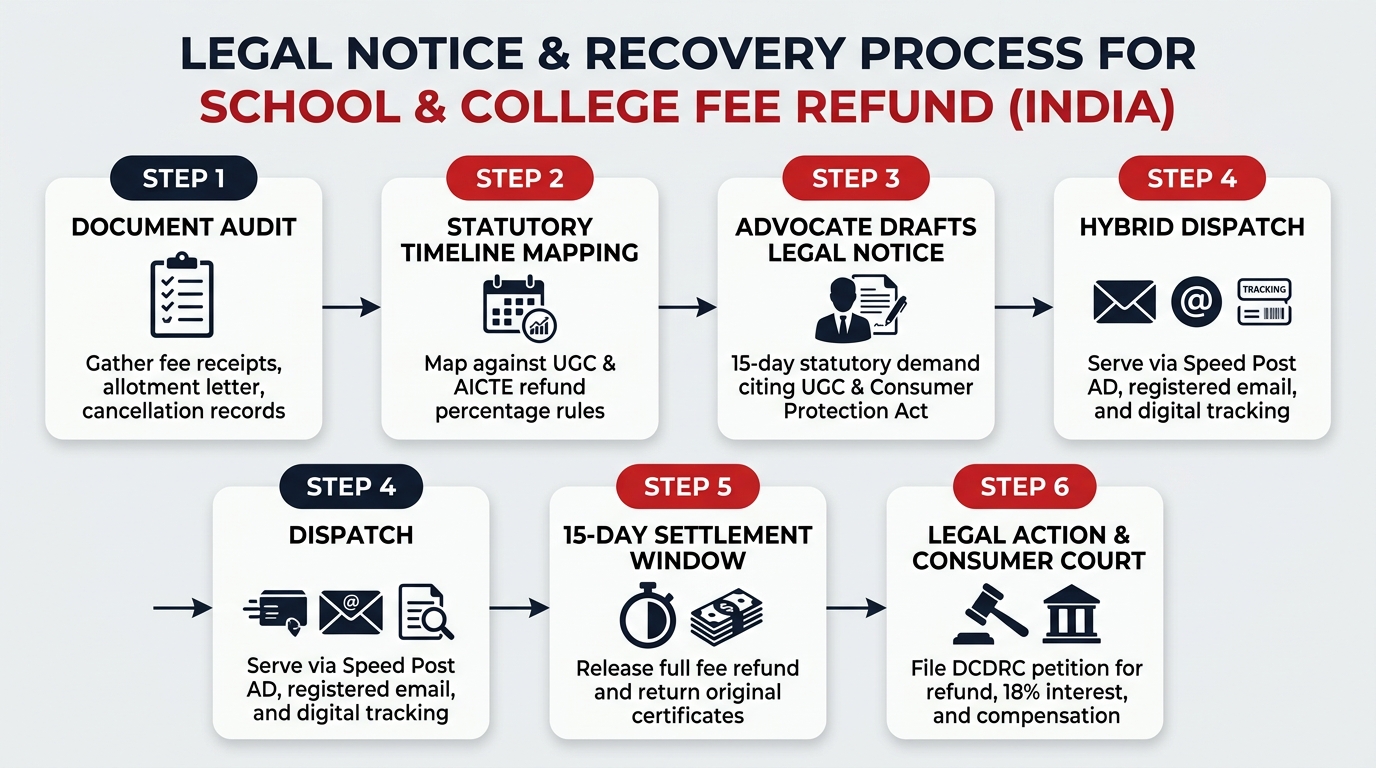
1. Regulatory Mandates: UGC, AICTE & School Fee Refund Laws
Every academic year, thousands of students across India secure multiple admission offers or change career streams, necessitating the cancellation of provisional admissions at schools, coaching academies, engineering colleges, medical universities, and private institutions. In response, many institutions unlawfully withhold lakhs of rupees in advance tuition, development charges, and security deposits under the guise of internal "no-refund" policies. Under Indian jurisprudence, these unilateral forfeiture clauses are legally untenable, unenforceable, and constitute actionable unfair trade practices.
Statutory regulatory bodies and the apex judiciary have established rigid, binding guidelines governing educational fee refunds in India:
- UGC Fee Refund & Document Retention Regulations: The University Grants Commission (UGC) mandates that all Higher Educational Institutions (HEIs), deemed universities, and affiliated colleges must refund 100% of fees charged (with a maximum processing deduction of ₹1,000) if the candidate withdraws 15 days or more prior to the formally notified last date of admission. UGC explicitly prohibits universities from retaining original academic credentials.
- AICTE Approval Process Handbook (APH) Norms: The All India Council for Technical Education (AICTE) stipulates that technical and management institutes must refund complete tuition and security deposits after deducting a maximum processing fee of ₹1,000 if the seat vacated by the student is filled by another candidate before the cutoff date.
- Consumer Protection Act, 2019 (CPA): Under Section 2(47) and Section 2(11) of the CPA 2019, educational institutions providing services for consideration fall squarely within the ambit of consumer law. Refusing refunds for unavailed educational services constitutes both an "unfair trade practice" and "deficiency in service".
- Right to Education Act, 2009 (RTE Sec 13): Prohibits schools from receiving capitation fees or subjecting children and parents to screening procedures, rendering any non-refundable donation or capitation levy completely illegal under Section 13 of the RTE Act, 2009.
In the landmark Supreme Court ruling in Islamic Academy of Education v. State of Karnataka (2003) 6 SCC 697, the apex court ruled that educational institutions cannot charge advance fees for the entire multi-year course duration and cannot retain fees for unavailed semesters if a student leaves mid-way. Retaining fees without delivering academic instruction amounts to unjust enrichment and profiteering under Indian contract and consumer laws.
2. Actionable Grounds: Unlawful Forfeiture & Unfair Trade Practices
An advocate-drafted statutory demand notice must clearly articulate the specific statutory violations and administrative malpractices committed by the school, college, or coaching institute. Common actionable grounds recognized by consumer courts include:
Enforcement of Void "No-Refund" Clauses in Admission Prospectus
Institutions relying on boilerplate prospectus disclaimers claiming fees once paid will not be refunded under any circumstances. National Consumer Commission (NCDRC) has repeatedly struck down such clauses as unconscionable and void.
Forfeiture of Full-Course Fees for Early Admission Withdrawal
Withholding complete annual tuition, laboratory, library, and development fees when the student withdrew seat weeks before the academic session commenced or during early counseling rounds.
Hostage-Taking of Original Mark Sheets & Migration Certificates
Illegally holding class 10th/12th mark sheets, transfer certificates (TC), or migration records to coerce students into forfeiting fee refunds or paying remaining unavailed semester installments.
Unlawful Retention of Caution Money & Security Deposits
Refusing to release refundable library, laboratory, hostel, and mess caution deposits long after the student has formally vacated the seat and obtained no-dues clearance.
Unjust Enrichment on Filled / Re-Allotted Vacated Seats
Collecting full tuition from the outgoing candidate while simultaneously admitting a waitlisted candidate against the same vacated seat, generating double revenue on a single student desk.
Misleading Affiliation Claims & Substandard Infrastructure
Inducing admission by misrepresenting UGC/AICTE approvals, NAAC accreditations, or faculty qualifications, forcing the student to cancel admission due to institutional fraud.
3. Statutory Refund Percentage Slabs & Cutoff Timelines
The University Grants Commission (UGC) and All India Council for Technical Education (AICTE) have laid down standardized 5-tier fee refund percentage slabs that bind all universities, deemed institutions, autonomous colleges, and polytechnics across India:
| Tier / Timeline of Notice Submission | Statutory Refund % | Max Deduction Allowed | Applicable Statutory Regulatory Authority |
|---|---|---|---|
| 15 days or more before formally notified last date of admission | 100% Refund | Max ₹1,000 processing fee | UGC Fee Refund Norms & AICTE APH |
| Less than 15 days before formally notified last date of admission | 90% Refund | 10% of aggregate fees | UGC Fee Refund Policy |
| 15 days or less after formally notified last date of admission | 80% Refund | 20% of aggregate fees | UGC Standard Operating Guidelines |
| Between 16 and 30 days after formally notified last date of admission | 50% Refund | 50% of aggregate fees | UGC Regulatory Notification |
| Vacated seat filled by waitlisted candidate before admission cutoff | 100% (Less ₹1,000) | Max ₹1,000 processing fee | AICTE Handbook & NCDRC Case Law |
| Caution Money / Security Deposits (Library, Lab, Hostel) | 100% Full Refund | Zero deductions allowed | Consumer Protection Act 2019 |
Special Protection for Private Coaching Institutes & Ed-Tech Platforms
Under the landmark NCDRC ruling in FIITJEE Ltd. v. Dr. Minathi Rath (2012) and Ministry of Consumer Affairs guidelines for coaching centres, coaching institutes cannot collect lump-sum advance fees for two, three, or four-year foundation programs. If a student leaves coaching mid-stream due to illness, relocation, or dissatisfaction, the coaching institute is legally bound to refund the unexpired term fees on a pro-rata basis within 10 days.
4. Pre-Notice Evidentiary Checklist for Parents & Students
To ensure maximum legal potency and eliminate bureaucratic excuses, your statutory demand notice must be backed by comprehensive documentary evidence establishing seat allocation, fee transfer, and timely cancellation notification:
Admission & Fee Payment Records
- ✓ Provisional Seat Allotment Letter
- ✓ Official Fee Receipts / Invoices Issued
- ✓ Bank Account Statement / NEFT / UPI UTR
Cancellation Communication Trail
- ✓ Formal Written Seat Withdrawal Letter
- ✓ Sent Email with Delivery Timestamp
- ✓ Portal Cancellation Acknowledgement Slip
Prospectus & Admission Schedule
- ✓ Institution Information Brochure / Prospectus
- ✓ Official Academic Calendar & Cutoff Dates
- ✓ Document Acknowledgment Receipt
Institutional Non-Compliance Proof
- ✓ Rejection Emails from Accounts/Registrar
- ✓ Written Refusal Citing "No Refund Policy"
- ✓ Speed Post Tracking of Prior Follow-up
🎓Serving Notice on Key Management & Trust Trustees
To guarantee legal validity in court and regulatory accountability, the statutory notice must be addressed jointly to the Principal/Dean, Registrar, Chairman of the Governing Body, and the registered Educational Trust/Society managing the institution. Legal Recovery automatically verifies registered society records, university affiliations, and official addresses to ensure flawless service across all key decision-makers.
5. Crucial Clauses in a Statutory Educational Fee Refund Notice
A formidable, advocate-vetted statutory demand notice must be structured with precision, setting out chronological facts, statutory provisions, and non-negotiable legal consequences:
Identity of Student, Enrolled Course & Fee Remittance Specifics
Detail the candidate’s full name, roll number/application ID, course applied for, total fee demanded, date of payment, mode of remittance (UTR/cheque number), and official receipt references.
Date of Admission Cancellation & Timely Seat Relinquishment
Establish the exact date and mode of admission withdrawal, demonstrating compliance with UGC/AICTE timeline slabs prior to or near the academic cutoff date, allowing the institution to re-allocate the seat.
Statutory Recital of UGC Norms, AICTE Handbook & CPA 2019
Explicitly cite binding UGC Fee Refund Notifications, AICTE Approval Process Handbook regulations, Section 2(47) of the Consumer Protection Act 2019, and apex court precedents prohibiting fee forfeiture.
Demand for Release of Original Academic Credentials & Deposits
Strictly mandate the immediate unconditional return of all original mark sheets, transfer certificates, migration records, caution deposits, and hostel fees without arbitrary administrative deductions.
Quantified Financial Claim with 18% p.a. Interest & Damages
Set out the exact principal refund due, commercial interest at 18% per annum from the date of cancellation application, compensation for mental harassment, and legal drafting costs.
15-Day Peremptory Compliance Window & Multi-Forum Warning
Give the management 15 days to credit the refunded funds to the parent’s bank account, failing which immediate consumer litigation before DCDRC, UGC portal complaints, and BNS criminal proceedings will commence.
6. Multi-Tier Escalation Roadmap: 15-Day Notice to Consumer Commission
Serving an advocate legal notice through an established legal platform resolves over 78% of school, college, and coaching fee refund disputes within 15 days. When institutions fail to comply, Legal Recovery executes a swift multi-pronged escalation strategy:
Advocate Statutory Demand Notice Served on Official Letterhead
The notice is prepared by specialized education consumer advocates, signed under Section 5 of the IT Act 2000, and served simultaneously via India Post Registered Post AD, Speed Post, and tracked official email to the Principal and Trust Board.
UGC e-Samadhan & AICTE Grievance Portal Escalation
If the college delays refund, an official statutory complaint is lodged on the UGC e-Samadhan portal and AICTE Centralized Grievance Redressal System, triggering regulatory inquiry and potential loss of funding/approval for the institution.
Consumer Complaint Filing before DCDRC (e-Daakhil Portal)
Upon expiry of the 15-day notice window, a formal consumer complaint is filed before the District Consumer Disputes Redressal Commission claiming full refund, 18% p.a. interest, ₹1 Lakh+ compensation for harassment, and litigation costs.
Criminal Complaint for Document Hostage & Unlawful Detention
In instances where the institution refuses to surrender original mark sheets or TC, a formal police complaint and Magistrate petition under Section 316 of the Bharatiya Nyaya Sanhita, 2023 for criminal breach of trust are initiated.
7. Frequently Asked Questions
Authoritative Legal & Statutory References:
- University Grants Commission (UGC) — Notification on Fee Refund Policy and Document Retention Norms (ugc.gov.in)
- All India Council for Technical Education (AICTE) — Approval Process Handbook (APH) Fee Refund Guidelines (aicte-india.org)
- Consumer Protection Act, 2019 — Section 2(47) (Unfair Trade Practice) & Section 35 (Complaint Filing) (consumeraffairs.nic.in)
- National Consumer Disputes Redressal Commission (NCDRC) — FIITJEE Ltd. v. Dr. Minathi Rath & Educational Refund Precedents (ncdrc.nic.in)
- Supreme Court of India — Islamic Academy of Education v. State of Karnataka (2003) 6 SCC 697 (main.sci.gov.in)
- Right to Education Act, 2009 — Section 13 (Prohibition of Capitation Fee & Screening) (indiacode.nic.in)
- Indian Contract Act, 1872 — Section 73 (Breach of Contract) & Section 74 (Unreasonable Penalties) (indiacode.nic.in)
- Bharatiya Nyaya Sanhita, 2023 — Section 316 (Criminal Breach of Trust) & Section 318 (Cheating) (indiacode.nic.in)
More Consumer Protection & Dispute Guides

Legal Recovery
India's Trusted Recovery Platform
Legal Recovery is India's trusted online legal notice and dispute resolution platform, connecting students, parents, consumers, and professionals with seasoned panel advocates for rapid, advocate-vetted statutory demand notices at transparent flat fees. With ₹100 Crore+ recovered and 10,000+ cases resolved across India, Legal Recovery delivers verified legal impact without the delays and unpredictability of traditional law firms.
School or College Withholding Your Fee?
Send an advocate-vetted statutory notice today. 78% of educational institutions refund fees and return original documents within 15 days of receiving formal notice from Legal Recovery.
Flat fee • Advocate-drafted • Sent same day
Client Reviews
Dr. Arvind Deshmukh
"My son cancelled his B.Tech admission at a prominent private engineering college in Pune three weeks before classes started after securing a seat in an NIT. The college administration flatly refused to refund the ₹3.25 Lakhs advance tuition and hostel fee, pointing to a "no refund under any circumstance" clause in their admission prospectus. Legal Recovery drafted and dispatched a high-impact advocate legal notice citing UGC Fee Refund Regulations, AICTE norms, and Section 2(47) of the Consumer Protection Act 2019. Within 10 days of notice delivery, the college registrar reached out, processed the 100% refund deducting only ₹1,000 processing fee, and returned his original migration certificate. Highly effective legal service for students and parents."