MSME ODR vs Order 37 vs Commercial Court: Fast Invoice Recovery (2026)
msme odr portal vs summary suit order 37, fastest way to recover unpaid b2b invoice in india, commercial courts act section 12a pre institution mediation, can medium enterprise or trader file msme samadhaan, 75 percent deposit rule section 19 msmed act, order 37 cpc summary suit recovery, recover money from unpaid business invoice india, b2b commercial recovery advocate notice, delayed payment dispute resolution india, msefc arbitration vs commercial summary suit

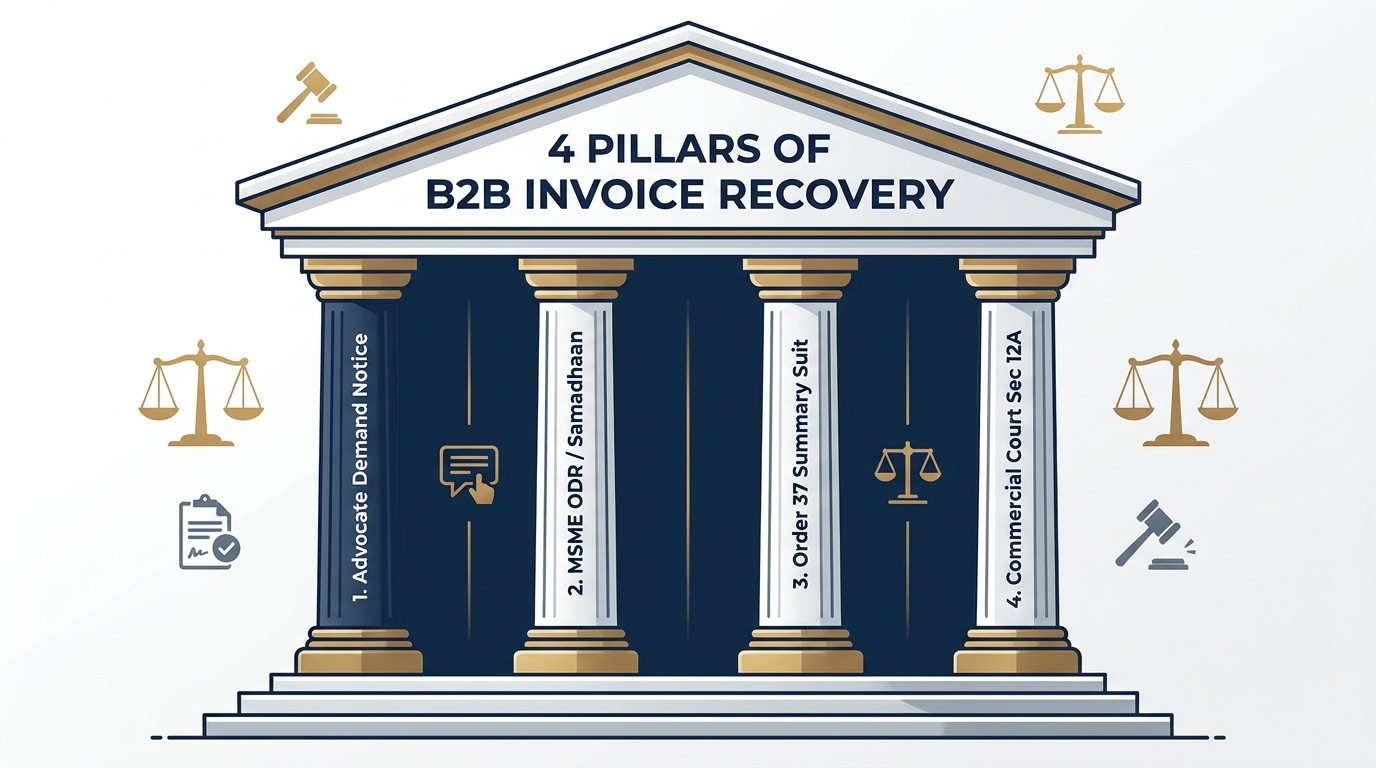
Table of Contents
Table of Contents
Swipe →Unpaid business bills can break any growing firm in India. You ship goods or finish tech jobs on time. Your customer accepts the delivery receipt without any complaints. Yet, when the bill is due, the buyer finance team goes silent. Phone calls go to voicemail. Accounts staff claim that internal approvals are stuck. Months pass, and your hard-earned funds stay trapped in your client bank account.
Every business vendor faces the exact same problem: Which legal route recovers unpaid money fastest? Some advisors claim that the government MSME Samadhaan portal solves everything. Other lawyers suggest filing a regular civil suit in local court. Meanwhile, some consultants advise filing for insolvency under the IBC. Picking the wrong forum wastes precious months and burns legal cash without getting back a single rupee.
The truth is that each forum suits a distinct business profile. For example, if you are a wholesale trader or a medium firm, the MSME Council will reject your delayed payment claim. If you file a regular civil case, you might wait three years for a trial. However, if you file an Order 37 Summary Suit or use Section 12A mediation in Commercial Court, you can freeze debtor tactics in weeks. This guide compares all four recovery routes under Indian law in 2026.
The B2B Invoice Trap: Why Vendors Get Trapped in Endless Delays
Corporate debtors in India rarely hold back money due to an absolute cash shortage. In most commercial deals, payment delays are a calculated choice. Defaulting buyers treat vendor payables as free working credit to fund their daily operations.
Knowing how bad buyers manipulate informal chats helps suppliers take firm legal steps early.
How Corporate Debtors Exploit Informal Recovery Channels
When an invoice is 60 or 90 days overdue, accounts teams deploy standard stall tactics. They ask for fresh account checks. They demand duplicate copies of tax bills and delivery receipts. They promise full payment in the next billing run. These polite promises are simple tricks meant to buy time.
Friendly follow-up emails carry zero financial threat for a defaulting firm. Corporate finance heads clear bills based strictly on legal risk. A polite reminder stays at the bottom of the pile. A sharp demand notice sent by an advocate moves your bill straight to the CFO desk. For specialized legal help with bad corporate buyers, our dedicated B2B vendor payment recovery team enforces immediate payment compliance.
The Fatal Mistake: Choosing the Wrong Forum and Losing 8 Months
The costliest mistake suppliers make is picking the wrong forum. Many small vendors file on the MSME Samadhaan portal without checking their Udyam date. If your Udyam signup took place after the supply deal, the council has no legal power.
Similarly, retail and wholesale traders often wait eight months for an MSME Council hearing. At that hearing, the council drops their case because government rules bar traders from delayed payment relief. During those wasted eight months, the buyer may move funds or pile up fresh debt. In commercial debt claims, speed is life. You must also track the strict time limit to file a money recovery case in India, which gives you a three-year window from the invoice due date.
The Master Comparison: 4 Legal Forums for Unpaid Invoice Recovery
Indian law offers multiple fast tracks to recover unpaid business debts. Each route has distinct eligibility rules, court fees, time frames, and appeal hurdles for the debtor. The comparison table below shows how these four legal options work side by side:
| Recovery Forum & Route | Who Qualifies (Eligibility) | Claim Threshold & Filing Cost | Average Recovery Timeline | Buyer Deposit to Challenge / Appeal | Strategic Enforcement Leverage |
|---|---|---|---|---|---|
| Pre-Litigation Advocate Notice | All vendors, contractors, traders, and service providers | No minimum claim threshold; nominal legal fee | 15 to 30 Days | Not applicable; pre-court legal demand | Creates immediate board-level tax and audit risk; 78% pre-court settlement rate |
| MSME Samadhaan & ODR (MSEFC) | Registered Micro and Small firms with prior Udyam certificate | No minimum claim limit; zero court fee in most states | 90 to 180 Days | Mandatory 75% cash deposit under Section 19 MSMED Act | High compound interest at 3x RBI Bank Rate; award acts as a civil court decree |
| Order 37 CPC Summary Suit | All firms with written contracts, purchase orders, or bills | No minimum limit; standard state court fee applies | 4 to 8 Months | Court can order up to 100% cash deposit to defend suit | Debtor cannot defend by right; direct decree if leave to defend is denied |
| Commercial Court (Section 12A) | All business entities with commercial disputes | Minimum claim value of ₹3 Lakhs; fixed court fee | 3 to 6 Months | Standard civil court deposit on appeal | Mandatory time-bound mediation; summary judgment under Order 13A without long trial |
| Section 9 IBC Insolvency (NCLT) | Operational creditors claiming against corporate debtors | Minimum debt floor of ₹1 Crore; ₹25,000 court fee | 6 to 12 Months | Insolvency appeal needs high proof of clear debt | Threatens total loss of company control; prompts fast high-value settlement |
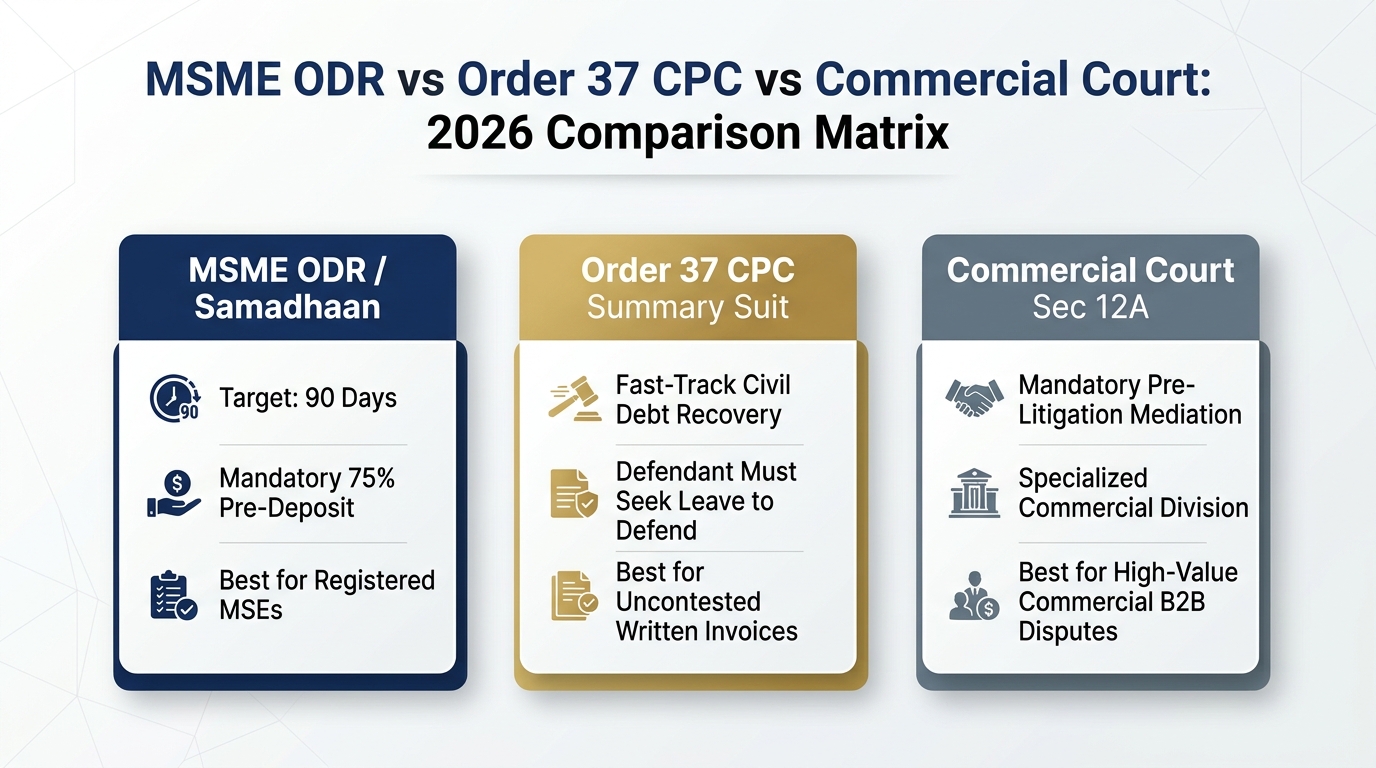
Every business creditor must weigh these points before filing a case. If your firm is an eligible micro or small maker, the MSME Samadhaan route gives you zero court fees and a strict 75 percent appeal deposit rule. However, if you are a wholesale distributor, a medium firm, or hold a late Udyam certificate, filing an Order 37 Summary Suit in Commercial Court gives you faster relief.
Option 1: MSME Samadhaan & ODR Portal via MSEFC Arbitration
The Micro, Small and Medium Enterprises Development (MSMED) Act, 2006 built a specialized dispute system under Chapter V. The MSME Samadhaan portal is the central online tool for micro and small suppliers to file claims against late corporate buyers.
When a supplier files a claim online, the local Micro and Small Enterprise Facilitation Council (MSEFC) takes up the case under Section 18 of the Act.
Who Is Eligible: The Strict Manufacturing and Services Test
The benefits of the MSMED Act do not apply to every commercial firm. Section 2(n) of the Act defines who qualifies as a supplier. To use the MSEFC route, your business must meet two statutory tests:
- Enterprise Size: Your firm must be a Micro enterprise (plant investment under ₹1 Crore, turnover under ₹5 Crores) or a Small enterprise (plant investment under ₹10 Crores, turnover under ₹50 Crores). Medium firms cannot use delayed payment rules.
- Business Type: Your business must manufacture physical goods or render commercial services.
If your firm qualifies, the buyer must clear all dues within 45 days under Section 15. Late payments draw compound interest at three times the RBI Bank Rate under Section 16. To review the online steps in detail, see our full guide on MSME Samadhaan portal delayed payment recovery steps.
Why Traders and Post-Dated Udyam Registrations Get Rejected
Many suppliers file claims on the MSME Samadhaan portal only to face swift dismissal. Two clear legal barriers cause these rejections:
- The Silpi Industries Timing Rule: In the landmark case M/s Silpi Industries v. Kerala State Road Transport Corporation (2021), the Supreme Court of India ruled that a supplier must hold an active MSME or Udyam certificate before signing the supply deal. If you registered on Udyam after signing the deal, you cannot use the MSEFC route for that contract.
- The Trader Bar: Under Ministry of MSME Circular No. 5/2(2)/2021-E/P&G/Policy, retail and wholesale traders can register on Udyam only for bank loan priority. The circular clarifies that traders cannot claim Chapter V delayed payment rights. If a trading firm files an MSEFC case, the council will dismiss the petition.
If your firm falls into either group, do not worry. You can skip the MSME Council and recover your unpaid funds through swift civil court actions.
Section 19 MSMED Act: The 75 Percent Mandatory Deposit Hammer
For eligible micro and small makers, Section 19 of the MSMED Act provides massive leverage. In ordinary civil litigation, a losing debtor can appeal an order and stall payment for years while posting little to no security.
Section 19 changes the rules completely. It states that no court can hear a buyer challenge against an MSEFC award unless the buyer first deposits 75 percent of the awarded sum in court. In top rulings such as Tirupati Steels v. Shubh Industrial Component and Goodyear India Ltd. v. Norton Inks, the Supreme Court held that this 75 percent deposit is mandatory. Courts cannot waive or reduce this cash deposit. Defaulting buyers know that challenging an award burns instant cash, which forces them to settle early.
Option 2: Order 37 CPC Summary Suit for Undisputed Debt Claims
When an unpaid creditor cannot use the MSME Council, what is the best civil path? The answer is Order XXXVII (Order 37) of the Code of Civil Procedure, 1908. Order 37 creates a specialized fast track for recovering clear commercial debts.
Unlike regular civil suits where debtors file broad replies to drag out cases, Order 37 tilts the legal balance firmly in favor of the creditor.
Liquidated Demands: When Written Invoices Form a Summary Claim
An Order 37 summary suit applies to specific commercial debt claims where the money due is clear and fixed. Under Rule 1 of Order 37, a creditor can sue on:
- Written contracts signed between both parties, such as supply agreements or work orders.
- Accepted purchase orders backed by signed delivery challans and tax invoices.
- Bills of exchange, cheques, and promissory notes.
- Dishonored cheques and acknowledged ledger statements.
Indian courts hold that an accepted GST tax invoice serves as a written contract under Order 37 CPC. When your buyer takes delivery of goods and claims tax credit (ITC) on the bill, the debt becomes an admitted claim. To see how these claims work in practice, check our clear guide on summary suit for money recovery in India.
The 10-Day Summons Trap: Leave to Defend Standards Under CPC
The rules of Order 37 put heavy pressure on the debtor. In ordinary civil suits, a defendant gets 30 to 90 days to file a reply. Under Order 37, the defendant has no basic right to defend the claim.
The court follows a strict two-step summons track:
- Summons for Appearance: The court serves notice on the defendant. The defendant must appear in court within exactly 10 days. If the debtor fails to appear within 10 days, the claims in the plaint are accepted as true, and the creditor gets an instant decree.
- Summons for Judgment: After the debtor appears, the creditor serves a Summons for Judgment. The debtor must file for Leave to Defend within 10 days with a sworn statement.
In the landmark ruling IDBI Trusteeship Services Ltd. v. Hubtown Ltd. (2017), the Supreme Court set clear rules for granting leave to defend. If the defense is weak, false, or baseless, the court denies leave and grants an immediate decree. If the debtor shows a possible defense, the court can order them to deposit up to 100 percent of the invoice sum in cash before granting trial rights. This rule stops corporate buyers from cooking up fake disputes.
Why Order 37 Protects Traders and Non-MSME Corporate Vendors
Order 37 is the ideal legal shield for businesses excluded from the MSMED Act. Wholesale distributors, retail stockists, trading firms, medium businesses, and large companies can all use Order 37 without restriction.
In addition, an Order 37 summary decree is a binding civil court judgment. You can immediately move for execution under Order 21 of the CPC to freeze debtor bank accounts, attach trade stocks, and seize movable assets. The entire suit often wraps up within four to eight months, saving years of trial delay.
Visual Dispute Resolution & Recovery Framework
Option 3: Commercial Court Suit and Section 12A Mediation Rules
For high-value corporate disputes, the Commercial Courts Act, 2015 provides a dedicated judicial forum built for quick resolutions. Commercial Courts run with specialized judges trained in corporate and trade law.
If your unpaid invoice claim exceeds ₹3 Lakhs, your suit falls under the jurisdiction of the Commercial Court.
Mandatory Pre-Institution Mediation Within 3 Months
The core feature of the Commercial Courts Act is Section 12A, which sets up mandatory early mediation. Section 12A requires that a commercial suit cannot start unless the creditor first tries pre-institution mediation.
Mediation is run by the District Legal Services Authority (DLSA). The statutory process runs on a tight clock:
- The mediation office sends formal notices to the debtor to attend conciliation talks.
- The statutory process must wrap up within three months from the filing date.
- The period can be extended by two months if both parties agree.
- If the debtor signs a settlement in mediation, that pact carries the force of a court decree and executes directly.
In the landmark ruling Patil Automation Pvt. Ltd. v. Rakheja Engineers Pvt. Ltd. (2022), the Supreme Court held that Section 12A mediation is mandatory. If a creditor files a commercial suit without trying mediation first, the court must reject the plaint under Order 7 Rule 11 CPC. To learn the full court process, read our detailed guide on the money recovery court case process in India.
When Urgent Interim Relief Bypasses Pre-Institution Mediation
There is one clear exception to early mediation. The law states that early mediation is compulsory only in suits that do not seek urgent interim relief.
If a creditor has solid proof that the debtor is moving funds, draining bank accounts, or hiding assets, the creditor can seek urgent interim protection. Under Order 38 Rule 5 of the CPC, the creditor can ask for attachment of assets before judgment. In such urgent cases, the court waives mediation and hears the interim freeze plea right away. However, judges review urgency claims with care. The risk must be real and supported by documents, not just an excuse to skip talks.
Summary Judgment Under Order 13A of the Commercial Courts Act
If talks fail and the mediator files a non-starter report, the creditor files the formal commercial suit. The Commercial Courts Act adds Order XIII-A (Order 13A) to the CPC, which lets creditors seek Summary Judgment.
Under Order 13A, the Commercial Court can decide a claim without a lengthy trial if the debtor has no real chance of defending the suit. This summary judgment power skips long witness cross-examinations. For clear unpaid invoices with accepted delivery slips, creditors often win summary judgments within six months.
Option 4: Section 9 IBC Corporate Insolvency for Debts Above 1 Crore
When an unpaid bill dispute involves a corporate debtor and the default tops ₹1 Crore, the Insolvency and Bankruptcy Code (IBC), 2016 comes into play. An unpaid vendor stands as an Operational Creditor under Section 5(20) of the Code.
Section 9 of the IBC allows an operational creditor to start insolvency actions against a corporate buyer that fails to clear an undisputed trade debt.
Strict Pre-Conditions: Form 3 Notice and Zero Prior Dispute
Starting an insolvency case under Section 9 demands strict adherence to statutory rules. A creditor must meet three mandatory tests:
- Corporate Debtor Status: The buyer must be a corporate firm, such as a Private Limited company or an LLP. IBC does not cover proprietorships or regular partnership firms.
- Minimum Debt Floor of ₹1 Crore: The law sets the default floor at ₹1 Crore. Your unpaid debt, across single or multiple bills, must cross ₹1 Crore.
- Statutory Demand Notice: Before approaching the NCLT, you must serve a formal 10-day demand notice in Form 3 or Form 4. The buyer gets 10 days to pay the debt or show proof of a prior dispute.
The Supreme Court in Mobilox Innovations Pvt. Ltd. v. Kirusa Software Pvt. Ltd. held that if the buyer proves a real, pre-existing dispute raised before the demand notice was served, the NCLT must dismiss the petition. Therefore, creditors must ensure that no quality complaints existed prior to sending notice.
Why IBC Is a Settlement Catalyst Rather Than an Asset Auction
The true strength of Section 9 IBC is psychological pressure. When the NCLT admits a Section 9 plea, the company board of directors is suspended immediately. An official takes charge of all operations, and the owner risks losing the firm entirely.
No solvent corporate promoter wants to lose their multi-crore business over an unpaid vendor bill. As a result, serving a Section 8 demand notice leads to rapid settlements in over 85 percent of undisputed claims. Creditors use IBC not to shut down customers, but to force fast cash payouts.
Concrete Rupee Economic Matrix: Total Recovery Cost and Timeline
To pick the most cost-effective legal forum for your claim, you must look at court fees, interest rates, and recovery speed. The table below analyzes three real-world commercial claim scenarios:
| Commercial Claim Scenario | Recommended Recovery Forum | Court Fee & Upfront Legal Cost | Applicable Statutory Interest | Debtor Defense Friction | Realistic Cash Realization Timeline |
|---|---|---|---|---|---|
| Scenario A: ₹5 Lakhs (Wholesale Trading Invoices, Non-MSME) |
Order 37 CPC Summary Suit in Civil Court | State ad-valorem court fee (~₹25,000 to ₹35,000) + advocate fee | Court interest under Section 34 CPC (9% to 18% per year) | High: Debtor must seek leave to defend within 10 days or face decree | 4 to 7 Months (80% settle after Summons for Judgment) |
| Scenario B: ₹25 Lakhs (Component Maker with Udyam Certificate) |
MSME Samadhaan & MSEFC Arbitration | Zero court fee in most states; nominal filing charges | Statutory compound interest at 3x RBI Bank Rate (20.25% per year) | Extremely High: Debtor must deposit 75% cash upfront under Section 19 to appeal | 3 to 6 Months (High settlement rate due to mandatory 75% deposit) |
| Scenario C: ₹1.5 Crores (Enterprise Supply to Corporate Debtor) |
Section 8 Demand Notice followed by Section 9 IBC / Commercial Court | Nominal notice drafting fee; ₹25,000 NCLT fee if filed | Contractual interest plus commercial interest costs | Severe: Threatens total suspension of board and company takeover | 30 to 60 Days (Promoters settle during 10-day Form 3 notice window) |
Matching your claim size and business profile to the right legal tool saves upfront cash and speeds up results. If you hold valid manufacturing Udyam credentials, the MSME Council provides high interest and zero court fees. If you are a trader or non-MSME firm, Order 37 summary actions deliver fast, binding decrees without procedural stalls.
The 4-Step Strategic Playbook to Collect Overdue Invoices Rapidly
Whether you file on the MSME Samadhaan portal or approach the Commercial Court, successful debt recovery demands a disciplined four-step plan. Following these steps systematically keeps your claim legally solid from day one.
Follow this proven four-step legal path to recover your unpaid business funds.
Step 1: Document Audit and Infallible Paper Trail Verification
Every strong debt recovery action rests on clean paperwork. Before taking any legal step, review your transaction records thoroughly:
- Signed Purchase Orders or Work Contracts: Collect all signed work orders, supply deals, or clear email approvals confirming order scope.
- Proof of Delivery and Acceptance: Gather signed delivery receipts, transport notes, or client email sign-offs. Clear proof of delivery knocks out false quality excuses.
- Tax Invoices and GSTR-2B Proof: Check that your tax bills show full GST details. Verify if the buyer claimed Input Tax Credit (ITC) on your bills in their GSTR-2B filings. When a buyer claims tax credit, they legally admit the validity of your bill.
- Ledger Confirmations: Collect mutual ledger balance confirmations, audit balance sheets, or written email admissions of debt.
To inspect standard notice formats and key legal clauses, check our detailed guide on unpaid invoice recovery legal notice format essentials.
Step 2: Serving a Strategic Multi-Channel Advocate Notice
Never depend on casual follow-up emails. A formal legal demand notice sent on advocate letterhead fundamentally alters the debtor outlook. It fixes the official default date, demands statutory interest, and warns of imminent court action.
Your advocate notice must be served through multiple channels at once:
- Registered Speed Post: Send physical copies to the company registered office and corporate branches with post tracking.
- Direct Notice to Directors: Serve copies directly on the Managing Director and Chief Financial Officer at their registered addresses.
- Certified Digital Delivery: Deliver clear PDF copies by official email with read tracking and via advocate WhatsApp.
To launch this high-impact pre-court process today, you can easily start your B2B invoice recovery with an Advocate Notice through our online platform. For practical steps on serving companies, read our advisory on how to send legal notice to company for non payment. When handling varied trade debts, our standard legal notice for money recovery protocols ensure full legal compliance.
Step 3: Dual-Track Filing on MSME Samadhaan or Commercial Court
Give the debtor a clear 15-day cure window in your advocate notice. In our experience, over 70 percent of corporate buyers start settlement talks within this period to avoid court filings.
If the debtor fails to pay within 15 days, take swift court action. If your firm qualifies under the MSMED Act, file your case on the MSME Samadhaan portal to start mediation. If you are a trader or medium firm, file for early mediation under Section 12A or institute an Order 37 Summary Suit in Commercial Court without delay.
Step 4: Executing Decrees and Enforcing Bank Account Attachment
Winning an arbitral award or an Order 37 summary decree is a major milestone. The final task is collecting your cash. Once you hold an enforceable decree, file an execution plea under Order 21 of the Code of Civil Procedure.
The execution court holds broad powers to satisfy your decree:
- Bank Attachment Orders: The court orders the debtor bank to freeze corporate accounts and release money directly to you.
- Attachment of Receivables: The court can attach payments owed to the debtor by third-party clients.
- Asset Seizure and Sale: The court can order the seizure and public auction of commercial vehicles, office goods, and plant machinery.
By executing these four strategic steps under expert legal guidance, business creditors systematically defeat debtor delay tactics and recover their hard-earned cash in record time.
Popular Searches & Related Topics

Legal Recovery is India's trusted consumer protection and legal tech platform. We specialize in holding corporations accountable for unfair trade practices, deceptive marketing, and commercial fraud. With over 15,000 customers counselled, our mission is to provide fast, out-of-court resolutions by connecting you with top-tier panel advocates for immediate legal action.
Client Reviews
"We are an auto-parts precision manufacturing unit. An automotive OEM delayed ₹32 Lakhs across 4 invoices for over 150 days. LegalRecovery analyzed our Udyam timeline, drafted a hard-hitting advocate demand notice citing Section 19 mandatory 75% deposit and Section 16 compound interest. The OEM released our full payment with statutory interest within 11 days."
Sandeep Bansal (Noida)
"As an industrial chemical wholesale distributor, we did not qualify for MSME Samadhaan because of the trader restriction. Team LegalRecovery guided us into an Order 37 Summary Suit in Commercial Court. When the debtor realized they had only 10 days to enter appearance and risked an immediate decree, their CFO initiated a formal mediation settlement in 3 weeks."
Deepak Chawla (Ahmedabad)
"Outstanding B2B commercial debt recovery expertise. A logistics software client held back ₹18.5 Lakhs in service invoices claiming internal reorganization. LegalRecovery served a formal advocate notice and initiated Section 12A mediation. The structured legal pressure resolved our dispute without entering a trial, and funds were credited via RTGS."
Kavitha Sundaram (Chennai)
"We spent 7 months waiting for an MSEFC conciliation hearing that kept getting adjourned. LegalRecovery reviewed our file and pointed out that the debtor had acknowledged the debt in ledger confirmations. They filed an Order 37 summary claim, and the debtor deposited 100% of the funds in court within 45 days. Truly exceptional commercial recovery advocates."
Manish Agarwal (Pune)
"Recovering a ₹1.2 Crore industrial packaging invoice seemed impossible against a stubborn corporate debtor. LegalRecovery served a Form 3 statutory demand notice under Section 8 IBC backed by clean delivery challans. The debtor management settled the entire principal sum plus agreed costs within the 10-day statutory notice period."
Harishankar Trivedi (Jaipur)
Frequently Asked Questions
Related Articles
Section 43B(h) & MSME 45-Day Invoice Recovery Legal Notice (2026)
section 43bh msme invoice recovery legal notice, recover money from unpaid business invoice, msme 45 days payment rule legal notice format, section 16 msmed act 3x rbi compound interest calculator, how to force corporate buyer to pay unpaid invoice, form msme 1 MCA reporting unpaid vendor invoice, section 22 msmed act statutory disclosure, delayed payment to micro and small enterprise recovery, msme payment recovery legal notice, b2b commercial debt recovery india, udyam registration invoice payment enforcement, corporate buyer unpaid invoice legal action
Read Article
Friend Cheque Bounced (Account Closed or Stop Payment)? Legal Action
friendly loan cheque bounce money recovery, cheque bounce due to account closed section 138, stop payment cheque bounce friendly loan, section 143a ni act 20 percent interim compensation, cash friendly loan above 20000 cheque bounce defense, legal notice for cheque bounce money recovery, section 138 ni act 30 days notice timeline, bir singh v mukesh kumar blank security cheque, section 139 statutory presumption debt, order 37 cpc summary suit cheque bounce, section 269ss income tax cash loan defense, 15 days demand notice cheque bounce, section 143a 60 days payment deadline, dual criminal and civil money recovery
Read Article
Money Lent Over 3 Years Ago? Reset the Limitation Clock via UPI
how to recover money after 3 years limitation period india, section 18 limitation act whatsapp acknowledgment, section 19 limitation act part payment via upi, section 25 3 contract act time barred debt promise, time limit to file money recovery case in india, can i recover loan given 4 years ago, extending limitation period friendly loan india, order 37 summary suit limitation reset, section 63 bharatiya sakshya adhiniyam electronic evidence, cheque bounce time barred debt dinesh chokshi, upi token payment resets 3 year clock, legal notice to preserve limitation period, reviving time barred loan under contract act, friendly loan recovery legal notice
Read Article
Ex-Flatmate Left Without Paying Rent or Deposit? Legal Recovery
recover rent and security deposit from flatmate india, flatmate not returning security deposit share, roommate left without paying rent legal notice, splitwise proof in legal notice money recovery, joint tenancy contribution recovery india, how to recover money from roommate legally, section 69 contract act rent reimbursement, section 43 contract act contribution, section 72 unjust enrichment flatmate deposit, section 316 bns criminal breach of trust tenant deposit, lead tenant pocketed deposit refund legal action, order 38 rule 5 bank attachment flatmate debt
Read ArticleAbout Author
Anuj Anand Malik
View ProfileAnuj Anand Malik, Founder of AMA Legal Solutions, is a trusted advocate, loan settlement expert, legal advisor, and banking lawyer. With over a decade of experience in loan settlement, corporate law, financial disputes, and compliance, he leads a result-driven law firm based in India that helps individuals, startups, and businesses achieve legal and financial stability.
Connect on LinkedInNeed Legal Help?
Get expert advice on loan settlement, banking disputes and debt relief.
Start Recovery NowRequest Callback