Friend Cheque Bounced (Account Closed or Stop Payment)? Legal Action
friendly loan cheque bounce money recovery, cheque bounce due to account closed section 138, stop payment cheque bounce friendly loan, section 143a ni act 20 percent interim compensation, cash friendly loan above 20000 cheque bounce defense, legal notice for cheque bounce money recovery, section 138 ni act 30 days notice timeline, bir singh v mukesh kumar blank security cheque, section 139 statutory presumption debt, order 37 cpc summary suit cheque bounce, section 269ss income tax cash loan defense, 15 days demand notice cheque bounce, section 143a 60 days payment deadline, dual criminal and civil money recovery

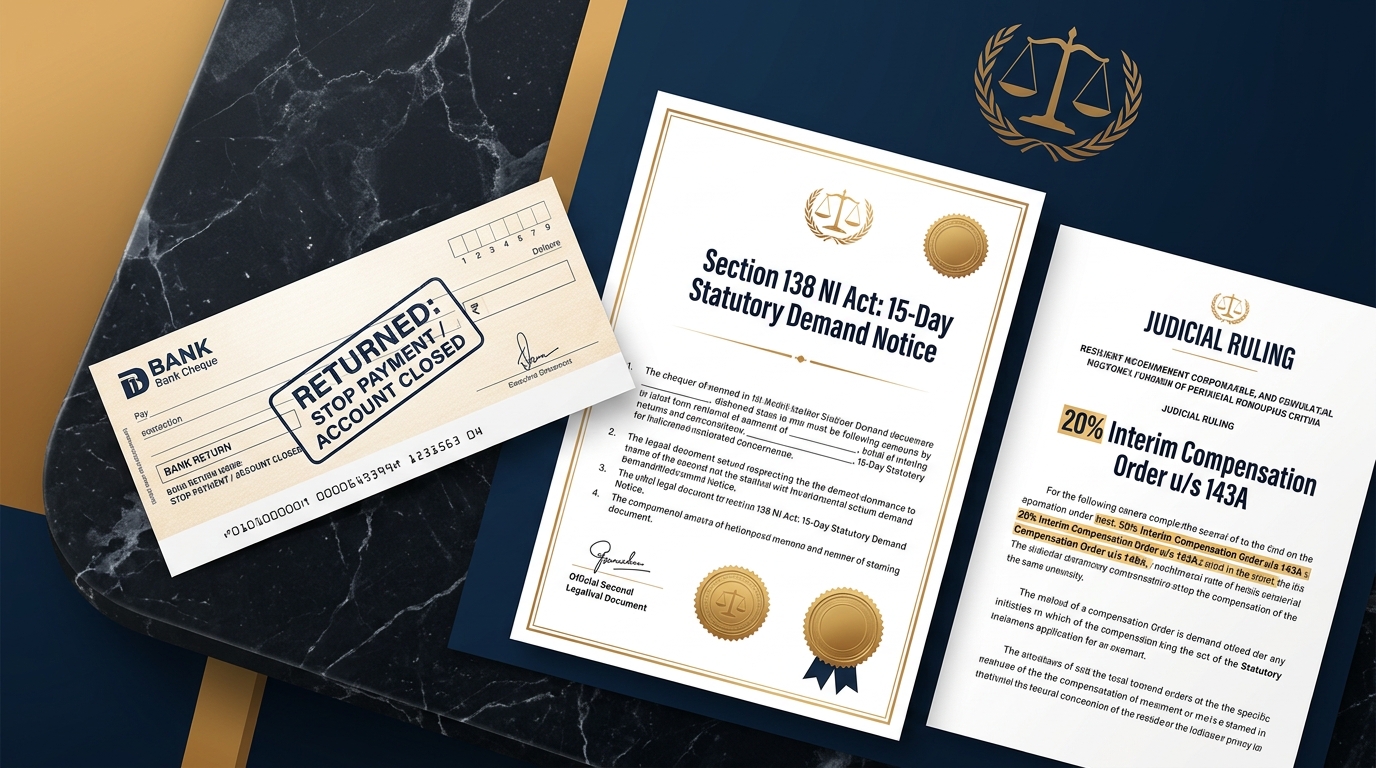
Table of Contents
Table of Contents
Swipe →Lending money to a friend or relative is common across India. You step forward when someone you know faces an urgent cash crunch, a medical crisis, or a business shortfall. You transfer funds through your bank account or provide financial assistance in good faith. To reassure you, your friend hands you a signed bank cheque. They tell you that the cheque serves as security or guarantees full repayment on a promised future date.
When the repayment deadline passes without payment, you deposit the cheque in your bank account. Days later, your bank sends you a cold shock. The cheque returns dishonoured. The bank return memo displays alarming remarks such as "Account Closed," "Stop Payment," or "Funds Insufficient." When you confront your friend, their warm tone vanishes. They claim that the cheque was merely a blank security instrument. They argue that you cannot take legal action because the loan was informal or given in cash. They might even boast that closing their bank account shields them from court prosecution.
Every single one of these debtor arguments is legally false under Indian law. The Supreme Court of India has established that closing an account or issuing stop payment instructions does not shield a drawer from criminal liability. Furthermore, holding a signed security cheque gives you powerful statutory leverage under the Negotiable Instruments Act, 1881. You do not have to endure financial loss in silence. This guide explains how to dismantle debtor excuses, execute the strict statutory notice timeline, secure twenty percent interim cash recovery under Section 143A, and run parallel criminal and civil proceedings to recover your money in full.
The Cheque Dishonour Crisis in Personal Lending
Informal loans between friends and relatives carry emotional trust that bad borrowers exploit. When a professional bank issues a commercial loan, it secures signed loan agreements, mortgages real estate, and monitors credit ratings. In a friendly loan, personal relationships take the place of formal institutional safeguards. Lenders often rely entirely on a handed-over cheque as their primary financial protection.
When financial trouble strikes, dishonest borrowers deploy predictable tactics to evade their legal obligations:
- The Blank Security Instrument Trap: The borrower admits signing the cheque but claims they never authorised you to fill in the date or the loan amount.
- The Deliberate Bank Account Closure: The borrower closes their bank account before the cheque deposit date, believing this administrative action destroys your legal remedy.
- The Stop Payment Instruction: The borrower contacts their bank branch to stop clearance, falsely alleging loss or dispute of the instrument.
- The Income Tax Fiction: The borrower claims that any cash loan exceeding twenty thousand rupees violates Section 269SS of the Income Tax Act, 1961, making the debt legally unrecoverable.
Many online legal portals provide generic, outdated summaries that repeat old myths. They tell creditors that security cheques cannot stand in court or that closing an account prevents criminal complaints under Section 138. That advice is completely wrong. Indian jurisprudence treats a dishonoured cheque as a serious statutory offense. By mastering the governing laws, you can turn a dishonoured cheque into an immediate recovery weapon.
Why Account Closed and Stop Payment Trigger Section 138
Borrowers often believe they can outsmart Section 138 of the Negotiable Instruments Act, 1881 by avoiding a simple "Funds Insufficient" stamp. They rush to their bank branch and instruct the manager to stop payment. Alternatively, they close the bank account entirely before you deposit the cheque. They assume that if the bank memo does not read "insufficient funds," criminal courts cannot touch them.
The Supreme Court of India crushed this technical evasion through two historic, binding precedents that govern every court in India.
The Genus and Species Rule in NEPC Micon
In the landmark ruling of NEPC Micon Ltd. v. Magma Leasing Ltd. (1999) 4 SCC 253, the Supreme Court addressed whether a cheque returned with the remark "Account Closed" attracts Section 138. The dishonest drawer argued that an account closure is not an insufficiency of funds.
The Supreme Court rejected that dishonest argument completely. The Court ruled that the expression "amount of money standing to the credit of that account is insufficient" is the genus. Specific bank memo remarks such as "account closed," "payment stopped," and "refer to drawer" are merely species of that genus. When a person closes an account after issuing a cheque, the balance in that account becomes nil. A nil balance is the ultimate form of insufficient funds. Therefore, closing an account constitutes an immediate criminal offense under Section 138.
Deliberate Stop Payment Under Modi Cements
In another decisive judgment, Modi Cements Ltd. v. Kuchil Kumar Nandi (1998) 3 SCC 249, the Supreme Court examined drawers who instruct banks to "Stop Payment." The Court held that issuing a stop payment instruction does not insulate the drawer from criminal prosecution under Section 138 of the NI Act.
The Court held that permitting a drawer to escape liability through a stop payment notice would destroy the entire commercial credibility of negotiable instruments. Once a cheque is delivered, the drawer cannot unilaterally cancel their legal liability by writing a stop payment letter to their bank. When the cheque returns with a "Stop Payment" bank return memo, Section 138 is triggered instantly. The burden shifts entirely to the drawer to prove in court that there was no existing debt.
Busting the Blank Security Cheque Legal Defense
The most common defense raised by friends who default on personal loans is the "blank security cheque" plea. When your advocate serves a legal demand notice, the borrower often sends a hostile reply. They claim: "I gave that cheque only as security. It was blank. You filled in the amount and date without my permission, which amounts to forgery."
Under established Indian law, this defense collapses as soon as it reaches a magistrate court.
The Landmark Authority of Bir Singh v. Mukesh Kumar
In the authoritative verdict of Bir Singh v. Mukesh Kumar (2019) 4 SCC 197, a three-judge bench of the Supreme Court resolved this issue permanently. The Court laid down clear legal rules that protect creditors:
- Implied Authority to Fill Blanks: Under Section 20 of the Negotiable Instruments Act, 1881, when a person signs and hands over an incomplete or blank negotiable instrument, they grant implied statutory authority to the holder to complete the details and fill in the amount due.
- Validity of Security Cheques: A cheque issued as security matures into an enforceable instrument the moment the underlying loan or financial liability becomes due and remains unpaid.
- Irrelevance of Handwriting: The fact that the handwriting on the body of the cheque differs from the signature of the drawer does not invalidate the instrument. Even if the lender fills in the date and rupee amount, the cheque remains completely valid.
- Personal Relationships Do Not Dilute Law: The Supreme Court held that friendship, family ties, or fiduciary relationships between the parties do not dilute the strict statutory presumptions of the NI Act.
Statutory Presumption of Debt Under Section 139
Under Section 118 and Section 139 of the Negotiable Instruments Act, 1881, the law creates a mandatory legal presumption in favor of the cheque holder. Once the drawer admits their signature on the cheque, the court must presume that the cheque was issued for the discharge of a legally enforceable debt or liability.
The burden of proof does not rest on you to prove the debt from scratch during initial hearings. Instead, the burden rests entirely on the borrower to rebut this presumption through solid, cogent defense evidence. A casual statement or verbal denial is useless. Unless the borrower produces documented proof of repayment, the court will hold them guilty of a criminal offense.
The Section 269SS Cash Loan Myth in Cheque Bounce Cases
When friendly loans involve cash payments, defaulting borrowers frequently try to intimidate lenders with income tax laws. Section 269SS of the Income Tax Act, 1961 prohibits taking or accepting loans or deposits in cash exceeding twenty thousand rupees. Section 271D imposes an equal monetary penalty on persons who take loans in cash above this limit.
Borrowers often claim: "You gave me fifty thousand or two lakh rupees in cash. That violates Section 269SS. Therefore, your loan is illegal black money and cannot be a legally enforceable debt under Section 138."
Income Tax Penalty vs Enforceable Civil Debt
The Supreme Court of India has firmly debunked this defense in multiple historic decisions, culminating in Sanjabij Tari v. Kishore S. Borcar. The Court ruled that an infraction of the Income Tax Act belongs strictly to tax assessment authorities. It does not destroy the legal validity of the underlying civil transaction or shield a criminal drawer under Section 138 of the NI Act.
The legal distinction is simple and decisive:
- Fiscal Penalty: Accepting cash above twenty thousand rupees might attract scrutiny or penalty proceedings under Section 271D by the Income Tax Department if investigated.
- Commercial Debt Validity: A breach of Section 269SS does not make the loan agreement void under the Indian Contract Act, 1872. The cash received by the borrower remains an enforceable civil debt.
- Maintainability of Cheque Complaint: A criminal complaint under Section 138 remains fully maintainable for cheques issued to repay cash friendly loans. Borrowers cannot escape criminal punishment by pointing fingers at tax rules.
Financial Capacity and Evidence Standards in 2026
While the borrower cannot invalidate the debt under Section 269SS, they may attempt to question your financial capacity to lend cash. In Tedhi Singh v. Narayan Dass Sham Rao (2022), the Supreme Court clarified that a complainant is not required to prove their financial capacity in the initial complaint. Only if the accused raises a probable defense during cross-examination does the complainant need to show their source of funds.
To keep your case unshakeable, always gather supporting proofs. Bank withdrawal slips, cash ledger entries, family savings records, and WhatsApp chat acknowledgments establish your source of funds. If you need clarity on your electronic records, review how to recover money lent to a friend without proof on formal stamp paper.
Visual Dispute Resolution & Recovery Framework
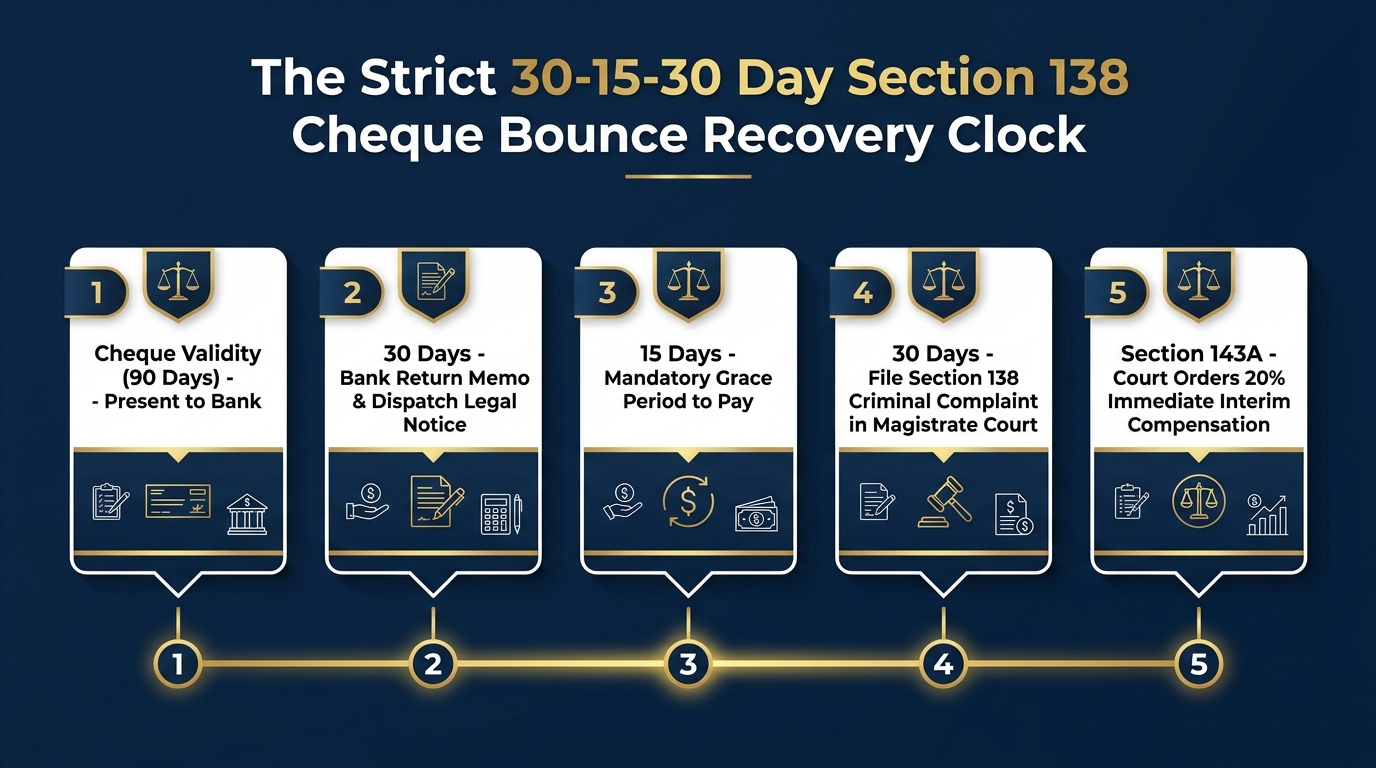
The Strict 30-15-30 Day Section 138 Statutory Clock
Section 138 of the Negotiable Instruments Act is a strict statutory machine. Its deadlines are rigid and non-negotiable. Missing a single deadline by even twenty-four hours can extinguish your right to pursue criminal prosecution against the borrower. You must understand and execute the classic 30-15-30 statutory countdown timeline.
The table below provides a precision breakdown of the statutory clock governing cheque bounce recovery:
| Statutory Stage | Governing Law | Trigger Event & Action Required | Strict Legal Deadline | Fatal Risk If Missed |
|---|---|---|---|---|
| Cheque Validity | RBI Circular / Section 138 NI Act | Present cheque to bank branch for clearance | Within 3 months (90 days) from date on cheque | Cheque expires; cannot present again |
| Bank Return Memo | Section 138(a) NI Act | Bank issues memo stating Account Closed or Stop Payment | Day Zero of the recovery clock | Must collect physical stamped return memo |
| Legal Demand Notice | Section 138(b) NI Act | Serve formal advocate demand notice via Speed Post | Strictly within 30 days of receiving memo | Criminal remedy under Section 138 permanently lost |
| Debtor Cure Window | Section 138(c) NI Act | Borrower receives notice and gets statutory grace period | 15 days from date notice is delivered | Filing court case before 15 days is premature and dismissed |
| Cause of Action | Section 142(1)(b) NI Act | Borrower fails to pay full cheque sum within 15 days | Day 16 after notice delivery | The criminal offense is completed by operation of law |
| Court Complaint Filing | Section 142(1)(b) NI Act | File formal complaint before Judicial Magistrate / MM | Strictly within 30 days after the 15-day cure window | Complaint barred by limitation unless condoned |
| Interim Relief Application | Section 143A NI Act | File application for 20% interim cash deposit | At framing of notice or plea of not guilty | Delays immediate monetary recovery during trial |
Understanding this countdown protects your legal rights. Let us examine the three crucial statutory stages in detail.
The 30-Day Bank Return Memo Notice Window
The recovery clock begins ticking the moment your bank issues the Bank Return Memo. Under Section 138(b), you have exactly thirty calendar days from the date of receiving this memo to issue a formal written demand notice. You must dispatch this notice via Registered Post with Acknowledgment Due (RPAD) or Speed Post, as well as email and WhatsApp.
Do not wait until the twenty-ninth day. If you delay, tracking postal receipts or curing postal defects becomes stressful. Make sure you use a vetted cheque bounce legal notice format and timeline to prevent typographical errors that dishonest debtors use to challenge service.
The 15-Day Debtor Cure Period
Once the legal demand notice is delivered to the borrower, Section 138(c) grants them a mandatory fifteen-day grace period. This period allows the drawer to arrange the funds and clear the debt without facing criminal charges. You cannot file a criminal case during these fifteen days. Any complaint filed before the expiry of the fifteenth day is legally premature and will be dismissed by the magistrate.
Under Section 27 of the General Clauses Act, 1897, when a notice is properly addressed and dispatched via Speed Post to the correct address, service is deemed complete upon delivery. If the borrower refuses to accept the post or deliberately avoids delivery, the Supreme Court has ruled in C.C. Alavi Haji v. Palapetty Muhammed (2007) that service is deemed complete on the date of postal refusal.
The 30-Day Magistrate Filing Window
If the fifteenth day expires and the borrower has not paid the full cheque amount, the criminal offense under Section 138 is legally complete on Day 16. You now have a strict thirty-day window under Section 142(1)(b) to file a formal criminal complaint before the competent Judicial Magistrate of First Class (JMFC) or Metropolitan Magistrate (MM).
Under Section 142(2) of the NI Act, the court having territorial jurisdiction is the court where your bank account is maintained. This legal reform protects creditors. You can file the criminal case right in your home city where you deposited the cheque. You do not have to travel to the debtor distant home town to fight the case.
Claiming 20 Percent Interim Recovery Under Section 143A
One of the greatest reforms in Indian cheque bounce litigation was the insertion of Section 143A into the Negotiable Instruments Act. Prior to this amendment, dishonest borrowers dragged cases for years through frequent trial adjournments. Section 143A stripped away this delay tactic by granting magistrates the power to award immediate interim monetary relief to the complainant.
How Section 143A Accelerates Money Recovery
Under Section 143A, in any trial under Section 138, the court may order the drawer of the cheque to pay interim compensation to the complainant. This order can be passed in a summary trial or summons case where the accused pleads not guilty, or upon the framing of charges.
The statutory features of Section 143A are highly beneficial for lenders:
- Up to Twenty Percent Deposit: The court can direct the borrower to deposit up to twenty percent of the total cheque face value directly to you or in the court registry.
- Strict Sixty-Day Deadline: The borrower must pay this interim compensation within sixty days from the date of the court order. The court may extend this period by a maximum of thirty days upon showing sufficient cause.
- Immediate Cash Relief: You receive real financial liquidity while the criminal trial progresses, preventing the borrower from using your money interest-free.
- Psychological Pressure: Defaulting friends who believed they could drag the case for years suddenly face an immediate cash outflow within sixty days of their first court appearance.
Enforcing Deposit via Section 421 of the CrPC
What happens if the borrower refuses to deposit the twenty percent interim compensation ordered by the magistrate? Section 143A(5) provides teeth to the court order. It states that interim compensation may be recovered as if it were a fine under Section 421 of the Code of Criminal Procedure, 1973 (now corresponding to Section 461 of the Bharatiya Nagarik Suraksha Sanhita, 2023).
Under these enforcement provisions, the magistrate can issue an immediate warrant for the attachment and sale of the borrower movable and immovable property. The court can also issue a warrant to the District Collector to recover the amount as arrears of land revenue. This power ensures that court orders cannot be ignored.
Dual Recovery Strategy: Order 37 Civil Suit Plus Criminal Case
The biggest strategic mistake lenders make is relying solely on a Section 138 criminal complaint. While Section 138 creates immense pressure through the threat of a two-year prison sentence and criminal conviction, it is primarily a punitive proceeding. To recover your money with maximum speed, you must execute a Dual Recovery Strategy: simultaneous criminal prosecution under Section 138 NI Act and a civil summary suit under Order XXXVII (Order 37) of the Code of Civil Procedure, 1908.
The Supreme Court has repeatedly confirmed that criminal proceedings under Section 138 and civil suits for recovery operate in completely independent spheres. Filing one does not bar the other. In fact, pursuing both simultaneously forces over eighty percent of defaulting borrowers to negotiate an out-of-court settlement.
The table below compares the concrete financial recovery potential of a dual-track legal action for a defaulted Rs 6,50,000 friendly loan cheque:
| Recovery Claim Component | Legal Basis & Statutory Provision | Disputed Rupee Sum | Interim & Final Enforcement Mechanism | Expected Resolution Window |
|---|---|---|---|---|
| Principal Dishonoured Cheque | Section 138 Negotiable Instruments Act | Rs 6,50,000 | Criminal conviction; up to 2x cheque fine (Rs 13,00,000) | Summons in 20-40 days |
| Section 143A Interim Relief | Section 143A(1) NI Act (20% face value) | Rs 1,30,000 | Mandatory deposit within 60 days via Section 421 CrPC warrant | Order in 60-90 days |
| Pre-Suit Statutory Interest | Section 80 NI Act / Section 3 Interest Act | Rs 1,17,000 | 18% per annum statutory interest from date of dishonour | Awarded in Order 37 Decree |
| Civil Summary Debt Decree | Order XXXVII Code of Civil Procedure | Rs 6,50,000 | Summary money decree; denies baseless leave to defend | Decree in 90-180 days |
| Asset Attachment (IBJ) | Order XXXVIII Rule 5 CPC | Full claim value | Freezes debtor bank accounts and attaches personal vehicles | Interim order in 14-21 days |
| Legal & Counsel Costs | Section 35 Code of Civil Procedure | Rs 35,000 | Taxed litigation costs ordered against the debtor | Recoverable upon execution |
| Total Enforceable Recovery Sum | Dual Criminal & Civil Claims | Rs 8,02,000 Net Due | Garnishee Order & Non-Bailable Arrest Warrant | Settlement in 30-90 days |
As this calculation proves, a defaulting borrower who tries to cheat you out of Rs 6.5 lakh faces an escalating financial liability exceeding Rs 8 lakh. In addition, they face potential double fines of Rs 13 lakh in criminal court, immediate asset freeze in civil court, and a criminal record that ruins their passport and professional career.
Why Dual Filing Forces Fast Settlements
When you file only a civil suit, the borrower tries to delay the proceedings. When you file only a criminal case, the borrower may gamble on trial delays. But when you strike on both fronts simultaneously, their defense collapses:
- No Contradictory Defenses: Anything the borrower says in their civil leave-to-defend application can be used against them in the criminal trial as an admission of signature or debt.
- Freezing Liquid Assets: Under Order 38 Rule 5 of the CPC, your advocate can apply for Attachment Before Judgment. If the borrower attempts to sell their car or property, the civil court freezes their assets immediately.
- Non-Bailable Warrants: If the borrower skips criminal court summons, the magistrate issues Non-Bailable Warrants (NBW). Local police will arrest the borrower and bring them to court.
- Clean Exit via Compounding: Under Section 147 of the NI Act, cheque bounce offenses are compoundable. Once the borrower realises they cannot win, they will rush to pay your entire claim in cash or RTGS to withdraw the criminal case.
For extensive details on civil deadlines, review the time limit to file money recovery case in India across various jurisdictions.
Step-by-Step Playbook to Enforce Cheque Bounce Recovery
Recovering money from a bounced friendly loan cheque requires systematic execution. Follow this battle-tested five-phase legal recovery playbook:
Phase 1: Secure Bank Memo and Preserve Cheque
The moment your bank notifies you of the cheque bounce, visit your branch immediately. Collect the original dishonoured cheque along with the original Bank Return Memo bearing the official bank stamp and date. Inspect the return memo to confirm the exact reason code, whether "Account Closed," "Stop Payment," or "Insufficient Funds." Ensure you safeguard the original physical documents in a secure folder, as trial courts require original instruments at the time of evidence.
Phase 2: Issue Statutory 15-Day Demand Notice
Do not waste precious time calling or pleading with the defaulting friend. Instruct an experienced recovery advocate to draft and dispatch a formal statutory demand notice under Section 138(b) of the NI Act. The notice must specify the cheque number, date, amount, bank memo remarks, and underlying friendly loan history. It must grant the borrower exactly fifteen days from receipt to pay the full amount.
Dispatch the notice via Speed Post with tracking and simultaneously transmit it via registered email and WhatsApp. You must dispatch your statutory Section 138 demand notice within 30 days of receiving the bank memo to keep your criminal remedy alive. If you have not yet sent a formal communication, you can also send a tailored legal notice for recovery of friendly loan to demand payment.
Phase 3: File Section 138 Criminal Complaint
If the fifteen-day cure period passes without full payment, have your advocate draft the criminal complaint. File the complaint within thirty days before the Metropolitan Magistrate or Judicial Magistrate having jurisdiction over your bank branch. Attach the original cheque, bank return memo, copy of the legal notice, postal tracking report showing delivery, and your sworn preliminary evidence affidavit under Section 145 of the NI Act. The magistrate will examine the documents and issue criminal summons to the borrower.
Phase 4: Institute Order 37 Civil Summary Suit
Simultaneously with your criminal complaint, file a Summary Suit under Order XXXVII of the CPC in the competent Civil Court. Base your claim on the dishonoured cheque and bank records as a liquidated commercial demand. Because the cheque constitutes a written contract for payment, the borrower has no automatic right to defend. They must file an appearance within ten days of summons service. Unless they show a substantial bona fide defense, the civil court will refuse leave to defend and pass an immediate money decree.
Phase 5: Secure 20 Percent Interim Relief and Attachment
At the first substantive hearing in the magistrate court, file an interim application under Section 143A of the NI Act. Demand an immediate court order directing the accused to deposit twenty percent of the cheque face value within sixty days. In the civil court, move an application under Order 38 Rule 5 to attach the debtor bank accounts or movable property before judgment. This pincer movement blocks the debtor assets and forces an out-of-court settlement.
A dishonoured cheque is not the end of your money recovery hopes. It is the beginning of a decisive legal process that puts you in total control. Indian law gives you formidable statutory weapons to hold dishonest friends accountable. Explore our specialised friendly loan recovery services, understand the end-to-end money recovery court case process in India, and partner with LegalRecovery to reclaim every single rupee you are rightfully owed.
Popular Searches & Related Topics

Legal Recovery is India's trusted consumer protection and legal tech platform. We specialize in holding corporations accountable for unfair trade practices, deceptive marketing, and commercial fraud. With over 15,000 customers counselled, our mission is to provide fast, out-of-court resolutions by connecting you with top-tier panel advocates for immediate legal action.
Client Reviews
"A childhood friend borrowed Rs 6,00,000 and gave me a cheque that bounced with the remark 'Account Closed'. He smirked and claimed I could do nothing. LegalRecovery cited the NEPC Micon Supreme Court ruling in an aggressive 15-day statutory notice. Within 12 days, he arranged a demand draft for Rs 4,00,000 and cleared the rest before court filing."
Siddharth Malhotra (New Delhi)
"When my relative's Rs 4,50,000 cheque bounced with 'Stop Payment', he claimed it was an undated security cheque. Team LegalRecovery invoked Bir Singh v. Mukesh Kumar and filed an application under Section 143A for 20% interim recovery. Seeing the court order an immediate Rs 90,000 deposit, he settled the entire Rs 4.5 lakh principal plus interest."
Kavitha Sundaram (Chennai)
"I gave a friendly cash loan of Rs 3,00,000 to a business acquaintance who later claimed the loan was invalid under Section 269SS of the Income Tax Act. LegalRecovery shattered his argument using the latest Supreme Court rulings and instituted an Order 37 summary suit alongside Section 138. The dual pressure forced him to clear the full debt in three weeks."
Manish Agrawal (Ahmedabad)
"The 30-15-30 statutory countdown framework from LegalRecovery saved my case. My advocate dispatched the notice via Speed Post on Day 8, tracked delivery, and filed the Section 138 complaint immediately after the 15-day grace window lapsed. The magistrate issued summons on the first date itself."
Rohan Varma (Mumbai)
"Professional, razor-sharp, and results-driven. LegalRecovery handled my Rs 8,50,000 bounced cheque case with flawless precision. Their dual-track strategy combining Order 38 asset attachment with Section 138 criminal summons got my frozen funds recovered without a multi-year trial."
Gurpreet Singh (Chandigarh)
Frequently Asked Questions
Related Articles
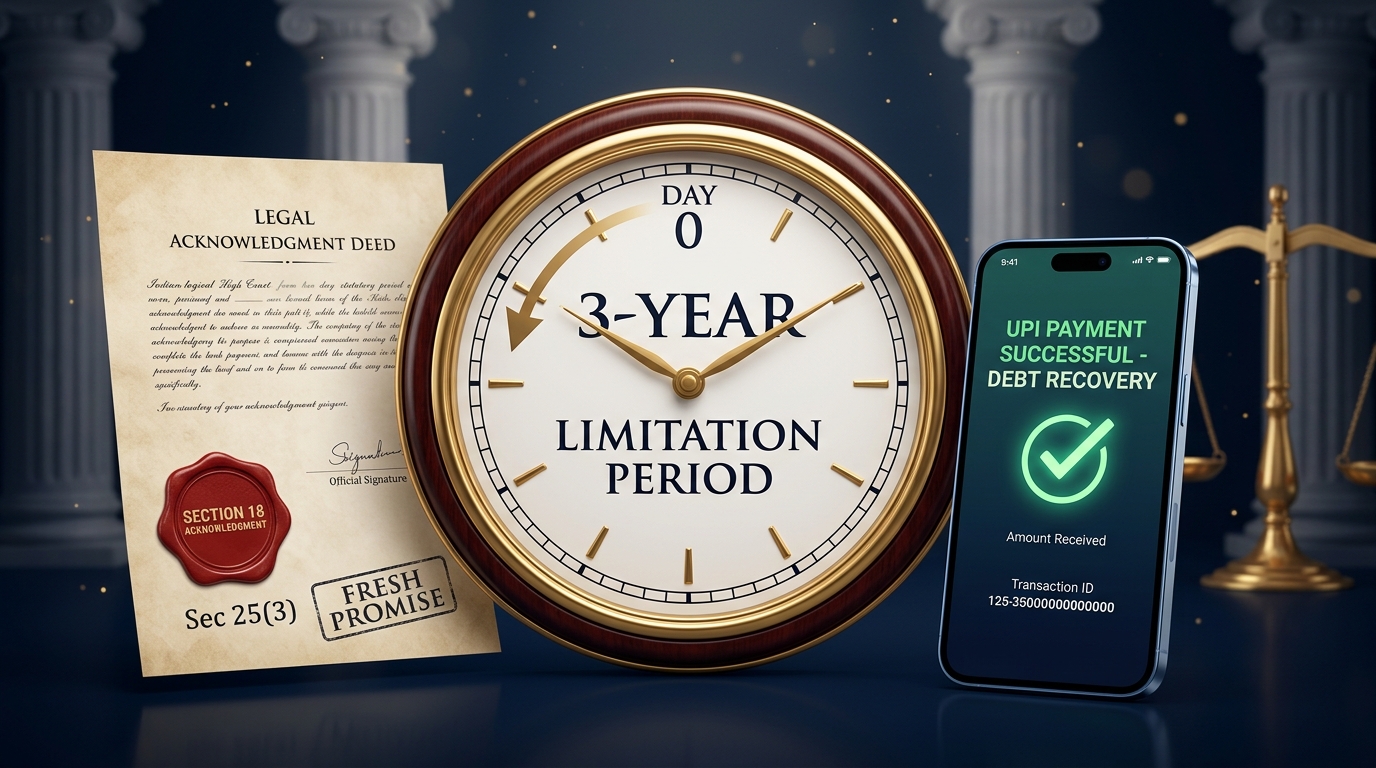
Money Lent Over 3 Years Ago? Reset the Limitation Clock via UPI
how to recover money after 3 years limitation period india, section 18 limitation act whatsapp acknowledgment, section 19 limitation act part payment via upi, section 25 3 contract act time barred debt promise, time limit to file money recovery case in india, can i recover loan given 4 years ago, extending limitation period friendly loan india, order 37 summary suit limitation reset, section 63 bharatiya sakshya adhiniyam electronic evidence, cheque bounce time barred debt dinesh chokshi, upi token payment resets 3 year clock, legal notice to preserve limitation period, reviving time barred loan under contract act, friendly loan recovery legal notice
Read Article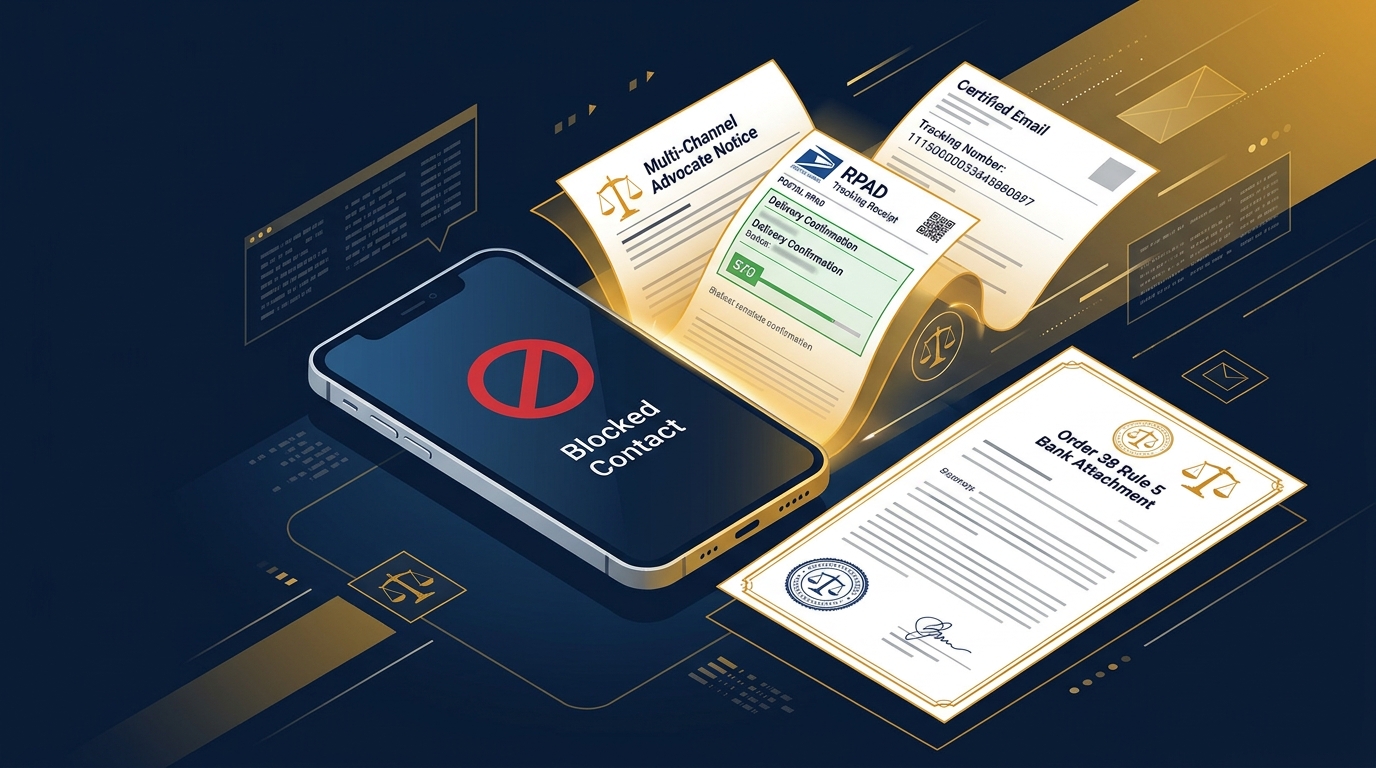
Borrower Blocked You and Moved? How to Legally Recover Your Money
how to send legal notice if person changed address or blocked number, borrower blocked me on whatsapp how to recover money, service of legal notice via whatsapp and email supreme court, order 38 rule 5 cpc attachment before judgment bank account, how to trace debtor address for legal notice india, money recovery when borrower is absconding, section 27 general clauses act deemed service, order 5 rule 20 cpc substituted service, order 9 rule 6 cpc ex parte decree, section 63 bharatiya sakshya adhiniyam electronic evidence, legal notice to debtor last known address, recovering money from absconding borrower, friendly loan recovery legal notice, multi channel legal demand notice india
Read Article
How to Recover Money Lent to a Friend via UPI or GPay (2026)
recover money from friend sent via upi without agreement, how to recover money from friend legally in india, gpay transaction proof for money recovery case, section 63 bharatiya sakshya adhiniyam whatsapp evidence, legal notice to friend for money recovery, friendly loan recovery without promissory note, section 70 indian contract act non gratuitous transfer, upi utr number evidence civil recovery, order 37 cpc summary suit friendly loan, admissions trap legal notice strategy, section 18 limitation act acknowledgment of debt
Read Article
How to Recover Unpaid Salary & FNF from a Shutting Down Startup
startup not paying salary due to funding issues, can directors be held liable for unpaid employee salary, nclt operational creditor employee salary recovery, legal notice to startup founders for unpaid fnf, summary suit for unpaid salary and fnf, recover unpaid salary and fnf from shutting down startup, section 14a epf act director liability, section 276b income tax act tds default, section 33c2 industrial disputes act revenue recovery certificate, order 37 cpc liquidated salary debt, first mover liquidity strategy startup shutdown
Read ArticleAbout Author
Anuj Anand Malik
View ProfileAnuj Anand Malik, Founder of AMA Legal Solutions, is a trusted advocate, loan settlement expert, legal advisor, and banking lawyer. With over a decade of experience in loan settlement, corporate law, financial disputes, and compliance, he leads a result-driven law firm based in India that helps individuals, startups, and businesses achieve legal and financial stability.
Connect on LinkedInNeed Legal Help?
Get expert advice on loan settlement, banking disputes and debt relief.
Start Recovery NowRequest Callback