Money Lent Over 3 Years Ago? Reset the Limitation Clock via UPI
how to recover money after 3 years limitation period india, section 18 limitation act whatsapp acknowledgment, section 19 limitation act part payment via upi, section 25 3 contract act time barred debt promise, time limit to file money recovery case in india, can i recover loan given 4 years ago, extending limitation period friendly loan india, order 37 summary suit limitation reset, section 63 bharatiya sakshya adhiniyam electronic evidence, cheque bounce time barred debt dinesh chokshi, upi token payment resets 3 year clock, legal notice to preserve limitation period, reviving time barred loan under contract act, friendly loan recovery legal notice

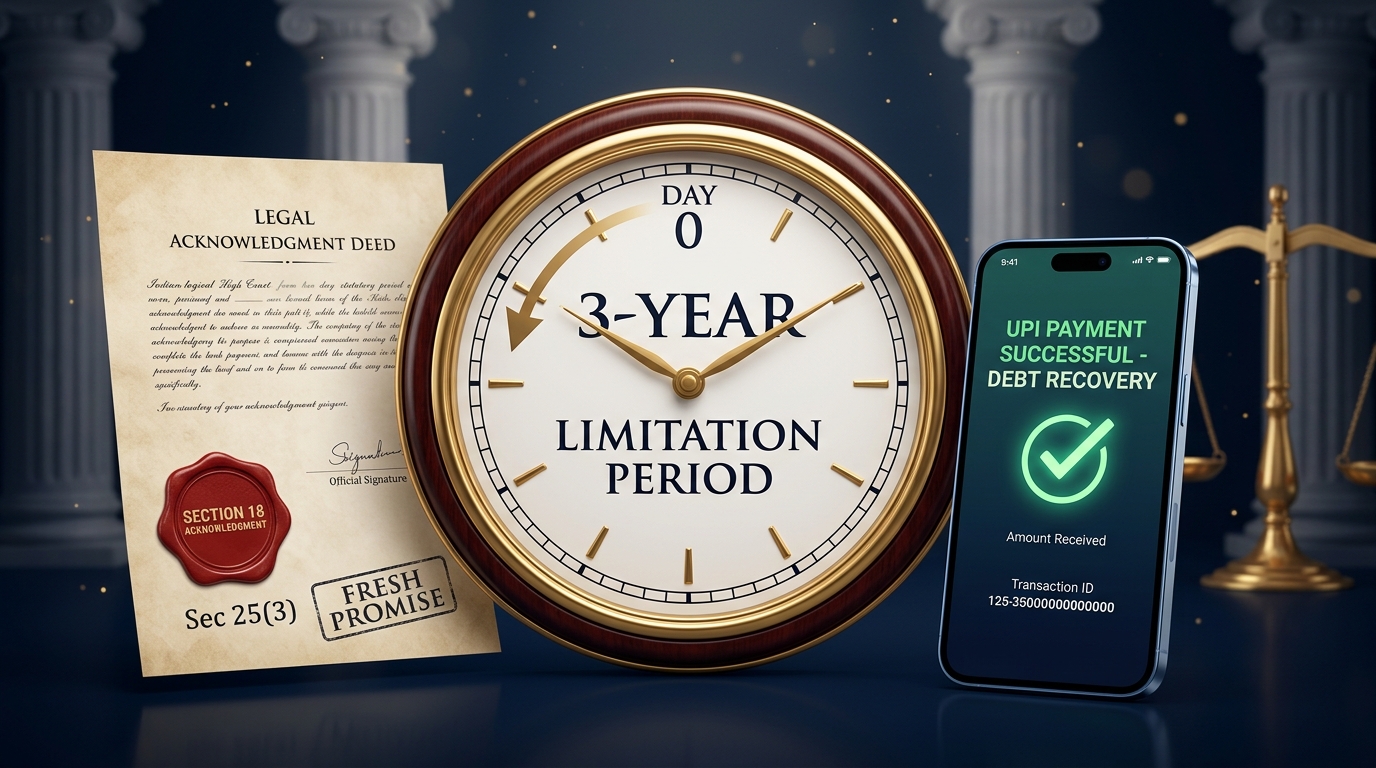
Table of Contents
Table of Contents
Swipe →Lending money to a close friend, colleague, or relative is common across India. You step forward when someone you trust faces a medical emergency, a business cash crunch, or an urgent family need. You transfer funds through your bank account or digital payment apps in good faith. You expect the borrower to honour their word and return the money within a few months.
Instead, months turn into years. The borrower offers repeated excuses. They promise to clear the balance once their festival bonus arrives, when their property sells, or after their next client payment clears. Before you realise what is happening, thirty months or even three full years slip away. When you consult acquaintances, they often give you discouraging advice. They claim that once three years pass, Indian law treats the debt as time-barred. They tell you that your hard-earned money is lost forever and that civil courts will dismiss your claim.
That pessimistic advice is legally incomplete and often completely wrong. The Limitation Act, 1963 and the Indian Contract Act, 1872 contain powerful statutory mechanisms designed to protect diligent creditors. Under Indian law, the limitation clock is not an immovable barrier. A simple electronic acknowledgment, a token payment through UPI, or a fresh written promise can legally reset or revive your claim. This guide explains how Section 18, Section 19, and Section 25(3) operate, providing clear legal strategies to recover every rupee you lent.
The 3-Year Limitation Trap in Personal and Friendly Loans
To protect your legal rights, you must understand how Indian courts calculate the time limit for recovering money. The primary law governing these timelines is the Limitation Act, 1963. Under Section 3 of the Limitation Act, courts have a mandatory duty to dismiss any suit instituted after the prescribed period of limitation. This rule applies even if the defendant fails to raise the limitation defense in their written statement.
Many creditors assume that the law gives them unlimited time to recover personal loans. That assumption is dangerous. When you lend money to an individual without a formal mortgage or registered debenture, the baseline limitation period is strictly three years. However, identifying the exact day when that three-year clock starts ticking requires careful statutory analysis.
Article 19 vs Article 113: When Does the 3-Year Clock Start?
The Schedule to the Limitation Act contains specific articles that determine the trigger date for financial claims:
- Article 19 of the Schedule: Governs suits for money payable for money lent. The limitation period is three years, running from the exact date when the loan was made. If you transferred funds on 15 November 2022 without fixing a future repayment date, the baseline limitation period expires on 14 November 2025.
- Article 20 of the Schedule: Applies to loans made under an agreement that the sum shall be payable on demand. The three-year period is computed from the date when the demand is made.
- Article 21 of the Schedule: Governs money deposited under an agreement that it shall be payable on demand. The three-year period begins when the depositor makes a formal demand for repayment.
- Article 113 (The Residual Article): Applies to any suit for which no specific period of limitation is provided elsewhere in the Schedule. The limitation period is three years from the date when the right to sue accrues. This occurs when the borrower explicitly refuses to repay on an agreed maturity date.
Understanding these trigger dates is critical. If you wait past the three-year mark without taking legal steps, the borrower will plead that the debt is time-barred. For a comprehensive overview of statutory deadlines across Indian jurisdictions, review the time limit to file a money recovery case in India.
The Common Myth That Informal Loans Cannot Be Enforced
Another widespread myth is that friendly loans given without formal stamp paper contracts are unenforceable in court. Borrowers exploit this misconception to avoid repaying their debts. They tell creditors that a bank transfer or oral promise carries no legal weight in civil litigation.
This claim has no foundation in Indian contract jurisprudence. Under the Indian Contract Act, 1872, an oral agreement backed by lawful consideration is a valid, enforceable contract. When you transfer funds through bank account transfers, RTGS, NEFT, or UPI, your bank statement provides unshakeable primary evidence of money paid. If you need clarity on enforcing informal transactions, learn how to recover money lent to a friend without proof on stamp paper.
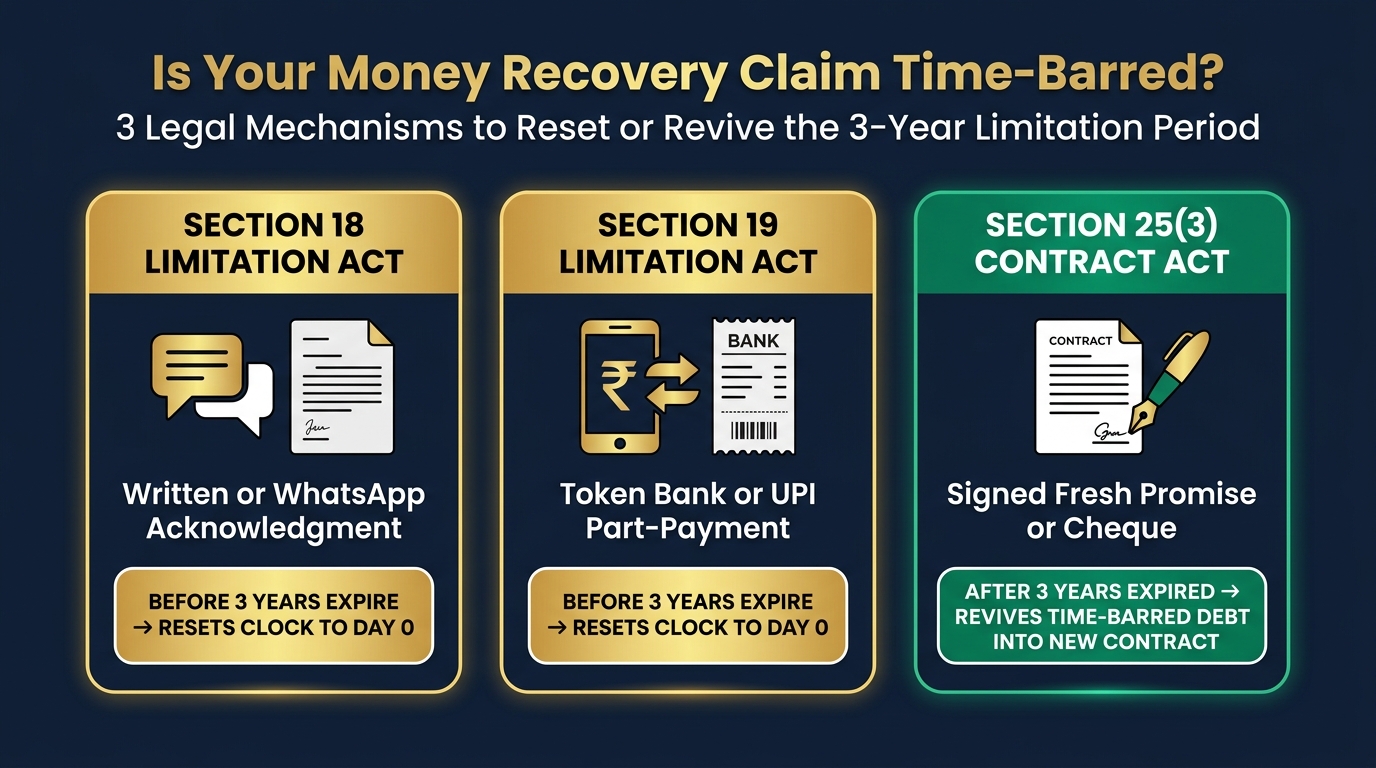
Section 18 Limitation Act: Resetting Clock via Written Admission
What happens when two years have passed and the borrower still owes you money? You do not have to rush into court immediately if you obtain a valid statutory acknowledgment. Section 18 of the Limitation Act, 1963 provides the first major legal mechanism to reset the limitation clock.
Section 18(1) states that where, before the expiration of the prescribed period for a suit, an acknowledgment of liability in respect of a property or right has been made in writing signed by the party against whom the right is claimed, a fresh period of limitation shall be computed from the time when the acknowledgment was so signed.
The legal effect of Section 18 is extraordinary. It does not merely extend the remaining days of your original three-year window. Instead, it cancels the elapsed time and starts a brand new three-year limitation period from the date of the acknowledgment. If you lent money on 1 January 2023, the original three-year clock would end on 31 December 2025. If the borrower gives you a written acknowledgment on 15 October 2025, Day Zero begins on 15 October 2025. Your limitation period now extends until 14 October 2028.
WhatsApp Chats as Legal Acknowledgment Under BSA Section 63
In modern personal and business lending, physical ink-on-paper letters are rare. Friends and colleagues communicate primarily through WhatsApp messages, text SMS, and emails. Can a digital chat message qualify as a written acknowledgment under Section 18?
The answer under Indian law is an emphatic yes. Under Section 4 and Section 65B of the Information Technology Act, 2000, electronic records satisfy the legal requirement of writing. Furthermore, under Section 63 of the Bharatiya Sakshya Adhiniyam, 2023 (BSA), electronic records printed or stored on optical or magnetic media are admissible as primary electronic evidence in court.
The Supreme Court of India and various High Courts have affirmed that a clear admission of debt sent via WhatsApp or email qualifies as a signed writing under Section 18. When the message originates from the borrower registered mobile number, the law treats it as an authorized electronic signature. For an in-depth evidentiary breakdown, see can WhatsApp chat be used as evidence in a money recovery case under current evidentiary standards.
The M/s Airen and Associates Rule on Partial Acknowledgment
While digital chats are admissible, the text of the message must satisfy strict legal standards. The admission of liability must be conscious, unequivocal, and refer to an existing debt. Casual or non-committal statements do not qualify as an acknowledgment of debt under Section 18.
Consider the difference between these two messages:
- Ineffective Statement: "Let us meet next week and discuss our past accounts." This text does not acknowledge an existing liability. It merely proposes a meeting and fails to extend limitation.
- Effective Statutory Acknowledgment: "I know I owe you Rs 5,00,000 for the personal loan. Please give me until Diwali, and I will clear the balance." This message explicitly admits the debt and resets the three-year clock.
Furthermore, in the landmark verdict of M/s. Airen and Associates v. M/s. Sanmar Engineering Services Limited (2025), the Supreme Court of India laid down a crucial limitation principle. The Court held that an acknowledgment of a partial liability extends limitation only for the specific sum acknowledged, rather than the entire disputed claim. Therefore, when seeking an acknowledgment, ensure the borrower explicitly confirms the full outstanding principal balance.
Section 19 Limitation Act: Why a Token UPI Payment Starts Day Zero
What if the borrower is reluctant to send a detailed written admission of their debt? You have an even simpler and more potent weapon under Section 19 of the Limitation Act, 1963. Under this provision, a small financial payment made towards the debt resets the three-year limitation clock entirely.
Section 19 provides that where payment on account of a debt or of interest on a legacy is made before the expiration of the prescribed period by the person liable to pay, a fresh period of limitation shall be computed from the time when the payment was made. The proviso to Section 19 requires that an acknowledgment of the payment must appear in the handwriting of, or in a writing signed by, the person making the payment.
In the digital banking era, Unified Payments Interface (UPI) transfers fulfill both requirements of Section 19 with complete evidentiary certainty. When a borrower transfers funds via Google Pay, PhonePe, Paytm, or BHIM, the digital ecosystem captures every detail required by law.
Token UPI Transfers and the Section 19 Writing Requirement
Many creditors wonder whether a small payment can reset the clock for a large loan. Suppose a friend borrowed Rs 7,50,000 from you thirty-four months ago. The three-year limitation deadline is only two months away. You contact the friend and ask for any small sum they can spare today.
The friend transfers Rs 500 or Rs 1,000 to your bank account via UPI. In the UPI payment remarks field, they enter "loan part pay" or "towards old loan." Alternatively, they send a quick WhatsApp message stating: "Transferred Rs 500 token today. Will clear the rest next month."
That single transaction legally triggers Section 19 of the Limitation Act:
- Payment on Account of Debt: The Rs 500 transfer constitutes part-payment towards the principal debt before the three-year period expires.
- Satisfying the Proviso: The electronic bank ledger and the digital transaction remark generated by the payer satisfy the requirement of a signed writing under the Information Technology Act.
- The Clock Resets to Day Zero: A fresh three-year limitation period begins on the exact date of that Rs 500 UPI transfer. You gain another thirty-six months of legal protection to recover the remaining Rs 7,49,500.
Why Bank Credit SMS and Ledger Entries Satisfy Section 19
Under Section 34 of the Indian Evidence Act, 1872 (now Section 28 of the Bharatiya Sakshya Adhiniyam, 2023), electronic records of banks kept in the ordinary course of business are admissible in evidence. The Reserve Bank of India regulated National Payments Corporation of India (NPCI) network logs every transaction with a unique 12-digit UPI Reference Number (RRN).
A debtor cannot dispute a UPI transfer made from their linked bank account. The electronic trail proves the identity of the payer, the date of payment, and the destination account. When paired with a contemporaneous chat acknowledging the loan, Section 19 creates an unshakeable shield against any limitation defense.
Visual Dispute Resolution & Recovery Framework
Section 25(3) Contract Act: Reviving a Debt After 3 Years Pass
What happens if you did not obtain a written acknowledgment under Section 18 or a part-payment under Section 19 within three years? Suppose forty months have passed since you lent the money. Can you still recover your funds?
This is where most creditors lose hope. Section 18 and Section 19 contain an unbending statutory condition: the acknowledgment or payment must occur before the expiration of the prescribed period. Once the three-year clock runs out, an ordinary acknowledgment cannot reset the Limitation Act clock. The original legal remedy to file a suit on the initial loan is barred by limitation.
However, the Indian Contract Act, 1872 provides a powerful statutory bridge known as Section 25(3). This provision allows parties to legally revive a time-barred debt into a brand new, enforceable contract.
Written Promise to Pay: Contract Act Exception to Zero Consideration
Under Section 25 of the Indian Contract Act, the general rule of contract law is that an agreement made without consideration is void (nudum pactum). If you ask someone to pay you money without providing fresh consideration, the promise is normally unenforceable in court.
Section 25(3) creates a deliberate statutory exception to this rule. It provides that an agreement made without consideration is valid if:
- It is a promise made in writing.
- It is signed by the person to be charged therewith, or by their authorized agent.
- The promise is to pay wholly or in part a debt of which the creditor might have enforced payment but for the law of limitation of suits.
Under Section 25(3), the moral obligation to repay an honest debt serves as lawful statutory consideration. The debtor signs a fresh promise to pay an old, time-barred debt. That written promise creates a brand new contract between the parties. A fresh cause of action arises on the date the new agreement is signed, giving you a fresh three-year limitation period from that new date.
Revival Versus Extension: Key Differences Creditors Must Know
Creditors must understand the fundamental legal distinction between extending limitation and reviving a time-barred debt. Mixing up these concepts in legal notices or court plaints can prove fatal to your recovery suit.
The table below provides a comprehensive comparison of the four statutory mechanisms available to creditors under Indian law:
| Legal Mechanism | Governing Statute | Required Timing Window | Mandatory Statutory Conditions | Legal Effect on Debt | Leading Judicial Precedent |
|---|---|---|---|---|---|
| Written Acknowledgment | Section 18, Limitation Act, 1963 | Strictly BEFORE the 3-year limitation period expires | Signed writing or verified electronic record admitting existing debt | Resets the clock back to Day 0; fresh 3-year limitation period commences | Asset Reconstruction Co. v. Bishal Jaiswal (2021) |
| Part-Payment on Account | Section 19, Limitation Act, 1963 | Strictly BEFORE the 3-year limitation period expires | Part-payment of debt with signed writing or UPI digital transaction record | Resets the clock back to Day 0 from the exact date of payment | Sant Lal Mahton v. Kamla Prasad (Supreme Court) |
| Fresh Promise to Pay | Section 25(3), Indian Contract Act, 1872 | AFTER the 3-year limitation period has already expired | Express written promise signed by debtor to pay time-barred sum | Revives debt into a brand new enforceable contract with fresh 3-year limitation | Bala Constructions v. State of Bihar |
| Cheque for Old Debt | Section 138 NI Act read with Section 25(3) | AFTER the 3-year limitation period has already expired | Debtor signs and issues a bank cheque to clear old debt | Converts time-barred debt into enforceable liability; bounce triggers criminal case | Dinesh B. Chokshi v. Rahul Vasudeo Bhatt (Bombay HC) |
As this matrix demonstrates, the law does not leave creditors helpless. If three years have not yet passed, use Section 18 or Section 19 to reset the clock. If three years have already lapsed, focus on securing a fresh written promise under Section 25(3) or obtaining a bank cheque from the debtor.
The Cheque Bounce Masterstroke for Time-Barred Debt Recovery
One of the most effective strategies to recover an old, time-barred debt involves obtaining a signed bank cheque from the debtor. When an old friend admits their delay, they may agree to issue a cheque dated for a future month as reassurance. What happens if that cheque subsequently bounces upon presentation?
Defaulting borrowers frequently raise a clever technical defense. They argue that under the Explanation to Section 138 of the Negotiable Instruments Act, 1881, the bounced cheque must be for the discharge of a "legally enforceable debt or other liability." They claim that because the underlying loan was given more than three years ago, the debt was time-barred. Therefore, they argue that dishonour of the cheque cannot attract criminal liability under Section 138.
The Dinesh Chokshi Precedent: Cheques for Time-Barred Liabilities
This dishonest borrower defense was permanently dismantled by the Bombay High Court in the landmark Division Bench decision of Dinesh B. Chokshi v. Rahul Vasudeo Bhatt (2012), authored by Justice A.S. Oka. The Court resolved this critical legal issue by connecting the Negotiable Instruments Act with the Indian Contract Act.
The High Court established three decisive legal principles:
- A Cheque is a Written Promise: A bank cheque is an unconditional order in writing signed by the drawer to pay a specified sum of money. Therefore, when a debtor signs and delivers a cheque for an old debt, that instrument fulfills every requirement of a written promise under Section 25(3) of the Indian Contract Act.
- Revival into Enforceable Liability: By operation of Section 25(3), the time-barred debt is instantly revived into a valid, lawful contract. As a result, the sum represented by the cheque becomes a legally enforceable debt on the date the cheque is issued.
- Criminal Prosecution is Fully Maintainable: If that cheque bounces with remarks such as "Funds Insufficient," "Account Closed," or "Stop Payment," the payee can prosecute the drawer under Section 138 of the NI Act. The debtor cannot hide behind the original limitation period.
The Supreme Court of India reinforced this principle in A.V. Murthy v. B.S. Nagabasavanna (2002). The Court held that a criminal complaint under Section 138 cannot be quashed merely because the underlying loan was advanced beyond three years, as the issuance of a cheque raises a statutory presumption of debt under Section 139. If you hold a dishonoured instrument, execute the strict statutory notice process using our vetted cheque bounce legal notice format and timeline.
Dual Order 37 Civil Suit and Section 138 Criminal Action
When a debtor gives you a cheque or written promise for an old loan, you gain immense strategic leverage. You do not have to choose between a slow civil suit and a criminal complaint. You can pursue both remedies simultaneously.
Under Indian civil procedure, a dishonoured cheque or written acknowledgment allows you to institute a Summary Suit under Order XXXVII (Order 37) of the Code of Civil Procedure, 1908. Unlike ordinary civil suits that drag for years, Order 37 places the burden on the defendant. The borrower has no automatic right to defend the case. Within ten days of receiving court summons, the borrower must apply for leave to defend. Unless they present a substantial, bona fide defense, the civil court will refuse leave and pass an immediate money decree.
Simultaneously, under Section 143A of the Negotiable Instruments Act, the criminal court can order the borrower to deposit up to twenty percent of the cheque amount as interim compensation within sixty days. Defaulting borrowers who face simultaneous asset attachment in civil court and a two-year prison sentence in criminal court settle their debts quickly.
Step-by-Step Tactical Playbook to Reset and Enforce Your Claim
Recovering personal loans that are nearing or past the three-year limitation threshold requires tactical precision. Do not confront the borrower aggressively without first securing your legal documentation. Follow this step-by-step recovery playbook to preserve your rights and recover your capital.
Phase 1: Audit Your Limitation Calendar
Begin by assembling every financial document connected to the loan. Review your bank account statements, UPI payment receipts, and WhatsApp message logs. Identify the exact date when the money was transferred. Calculate the number of months and days that have elapsed since disbursement.
If less than thirty-four months have passed, your loan remains within the baseline limitation window. You can easily reset the clock to Day Zero using Section 18 or Section 19. If more than thirty-six months have passed, your focus must shift immediately to securing a Section 25(3) written promise or a bank cheque.
Phase 2: Secure a Limitation-Resetting UPI Payment or Chat
If your claim is nearing the three-year mark, maintain a friendly and constructive tone with the borrower. Do not threaten police complaints or legal notices prematurely. Instead, ask for a small token transfer to help with an immediate personal expense.
Request the borrower to send Rs 500 or Rs 1,000 via UPI. When they transfer the funds, send a polite follow-up message on WhatsApp: "Thanks for sending the Rs 500 token today towards your loan of Rs 5,00,000. When can you arrange the remaining balance?" Once the borrower replies confirming the arrangement, you have established both a Section 19 part-payment and a Section 18 written acknowledgment. Your limitation clock is officially reset for three more years.
Phase 3: Secure a Section 25(3) Debt Revival Agreement
If the loan has already crossed the three-year mark, propose a formal repayment plan. Approach the borrower with a restructured installment schedule. Offer to waive interest charges if they agree to pay the principal in three or four installments.
Draft a simple settlement agreement or repayment undertaking. Ensure the document includes an explicit clause: "The borrower acknowledges the earlier friendly loan of Rs 6,00,000 and hereby undertakes and promises to pay the said sum in agreed installments under Section 25(3) of the Indian Contract Act, 1872." Once the borrower signs this undertaking, the time-barred debt is fully revived.
Phase 4: Calculate Your Enforceable Monetary Claim
Before issuing a formal demand, compute the total financial value of your claim. In addition to the unpaid principal, Indian law permits creditors to claim statutory interest. Under Section 3 of the Interest Act, 1978 and Section 80 of the Negotiable Instruments Act, courts award interest at eighteen percent per annum on commercial and liquidated money debts.
The table below provides a concrete rupee recovery calculation model for a defaulted Rs 7,50,000 friendly loan reset via a token UPI transfer:
| Claim Component | Governing Statutory Provision | Rupee Valuation | Enforcement Mechanism | Recovery Likelihood |
|---|---|---|---|---|
| Principal Loan Amount | Original Transfer / Bank Statement Evidence | Rs 7,50,000 | Civil Summary Suit under Order XXXVII CPC | 100% enforceable |
| Less: Token UPI Payment | Section 19 Limitation Act Part-Payment | - Rs 500 | Deducted from principal; resets limitation clock | Credit acknowledged |
| Net Principal Due | Recomputed Balance Under Fresh Limitation | Rs 7,49,500 | Actionable civil claim with fresh 3-year window | Primary recovery target |
| Pre-Suit Statutory Interest | Section 80 NI Act / Section 3 Interest Act (18% p.a.) | Rs 1,34,910 | Claimed in legal notice and awarded in decree | Statutory discretion |
| Section 143A Interim Relief | Section 143A NI Act (if cheque issued & bounced) | Rs 1,49,900 | Mandatory deposit within 60 days via warrant | Immediate cash relief |
| Advocate Notice & Legal Costs | Section 35 Code of Civil Procedure | Rs 25,000 | Taxed litigation costs ordered against debtor | Recoverable on execution |
| Total Enforceable Recovery Sum | Principal, Statutory Interest & Legal Costs | Rs 9,09,410 | Bank Account Attachment & Execution Warrant | Full claim potential |
As this calculation shows, an unpaid friendly loan of Rs 7,50,000 expands into an enforceable legal claim exceeding Rs 9,00,000 once statutory interest and legal costs are added. Defaulting borrowers quickly realize that delay costs them substantial money.
Phase 5: Issue Advocate Legal Notice and Initiate Court Action
If the borrower fails to clear the debt after resetting the limitation clock, stop personal negotiations immediately. Instruct an experienced recovery advocate to draft and dispatch a formal legal demand notice. The notice must set out the loan history, the dates of electronic acknowledgment or UPI part-payment, and demand full payment within fifteen days.
You must send a limitation-preserving legal notice today via Speed Post with tracking to prevent any further delay. You can also utilize our specialized legal notice for recovery of friendly loan services to ensure your demand meets all statutory standards.
If the borrower does not settle within the notice window, proceed directly to court. File an Order 37 summary suit in the civil court having territorial jurisdiction over your residence. If a cheque was dishonoured, file a parallel Section 138 criminal complaint before the Judicial Magistrate. Review the end-to-end money recovery court case process in India and partner with our dedicated friendly loan recovery services to reclaim your funds with confidence.
Popular Searches & Related Topics

Legal Recovery is India's trusted consumer protection and legal tech platform. We specialize in holding corporations accountable for unfair trade practices, deceptive marketing, and commercial fraud. With over 15,000 customers counselled, our mission is to provide fast, out-of-court resolutions by connecting you with top-tier panel advocates for immediate legal action.
Client Reviews
"I had lent Rs 8,50,000 to an ex-colleague in 2022. By mid-2025, I was terrified that the 3-year limitation would lapse. LegalRecovery advised me to request a Rs 1,000 token UPI payment with specific chat remarks. That reset the clock under Section 19. When the borrower defaulted again, LegalRecovery filed an Order 37 summary suit and secured full recovery within 4 months."
Rajesh Nair (Bengaluru)
"My family loan of Rs 5,20,000 was 40 months old, and local lawyers told me it was time-barred. Team LegalRecovery drafted a formal restructuring undertaking under Section 25(3) of the Contract Act. The borrower signed the document, creating a fresh enforceable contract. We recovered the principal plus interest without endless litigation."
Ananya Sengupta (Kolkata)
"A childhood friend gave me a cheque for a 4-year-old loan of Rs 6,00,000, which bounced immediately. He thought I could not file a case because the loan was old. LegalRecovery cited Dinesh B. Chokshi and issued an aggressive Section 138 notice. Seeing the threat of criminal prosecution, he settled the entire sum in two installments."
Vikramaditya Rathore (Jaipur)
"Brilliant legal strategy. When my friend paid Rs 500 on Google Pay at the 33-month mark, LegalRecovery preserved the digital bank logs and WhatsApp confirmation. They used Section 19 to defeat the limitation defense in civil court. I received my full Rs 4,00,000 principal plus 18% statutory interest."
Sneha Kulkarni (Pune)
"Outstanding knowledge of Indian commercial laws. LegalRecovery saved my Rs 11,00,000 friendly bridge loan. Their legal notice cited Section 18 electronic acknowledgments and forced the debtor to sign a repayment settlement before court summons were served. Highly recommended for personal loan recovery."
Hardeep Dhillon (Ludhiana)
Frequently Asked Questions
Related Articles
How to Recover Money Lent to a Friend via UPI or GPay (2026)
recover money from friend sent via upi without agreement, how to recover money from friend legally in india, gpay transaction proof for money recovery case, section 63 bharatiya sakshya adhiniyam whatsapp evidence, legal notice to friend for money recovery, friendly loan recovery without promissory note, section 70 indian contract act non gratuitous transfer, upi utr number evidence civil recovery, order 37 cpc summary suit friendly loan, admissions trap legal notice strategy, section 18 limitation act acknowledgment of debt
Read Article
Borrower Blocked You and Moved? How to Legally Recover Your Money
how to send legal notice if person changed address or blocked number, borrower blocked me on whatsapp how to recover money, service of legal notice via whatsapp and email supreme court, order 38 rule 5 cpc attachment before judgment bank account, how to trace debtor address for legal notice india, money recovery when borrower is absconding, section 27 general clauses act deemed service, order 5 rule 20 cpc substituted service, order 9 rule 6 cpc ex parte decree, section 63 bharatiya sakshya adhiniyam electronic evidence, legal notice to debtor last known address, recovering money from absconding borrower, friendly loan recovery legal notice, multi channel legal demand notice india
Read Article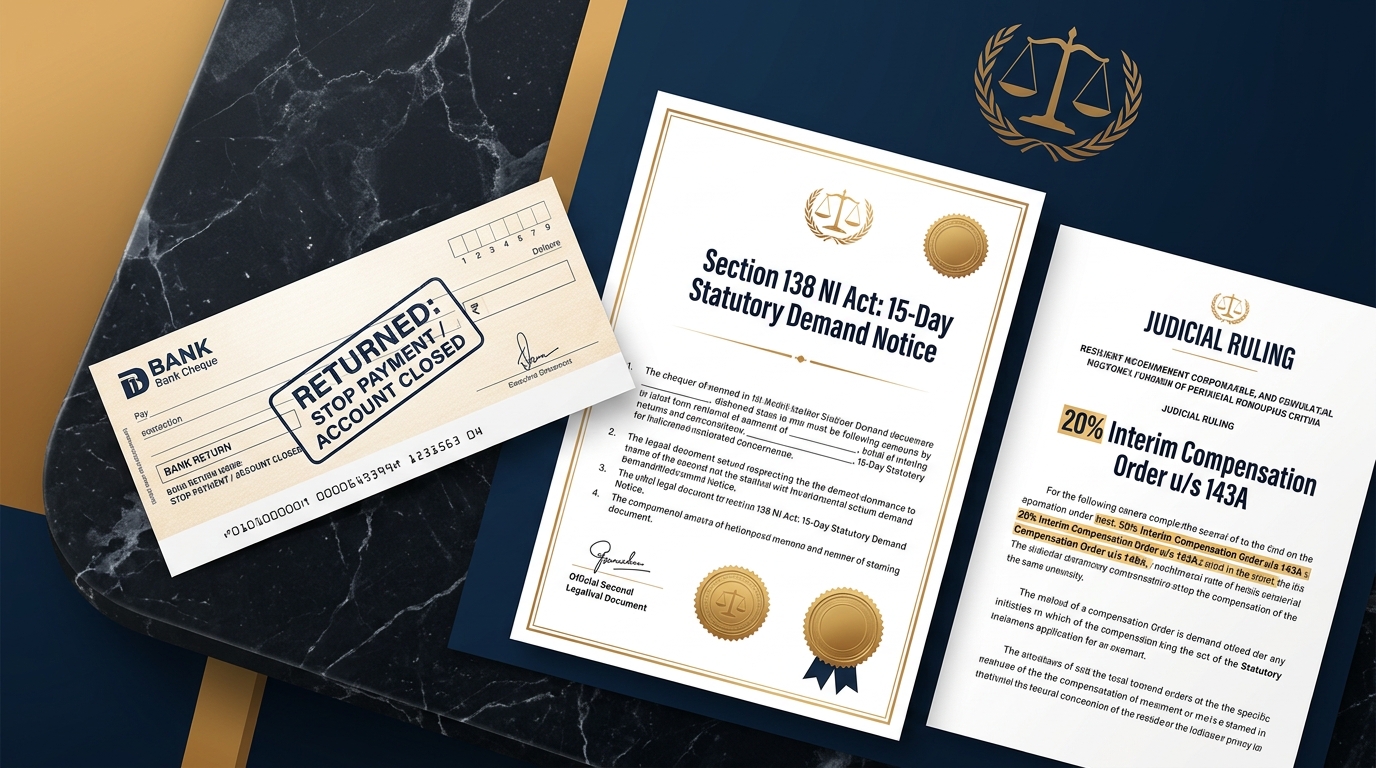
Friend Cheque Bounced (Account Closed or Stop Payment)? Legal Action
friendly loan cheque bounce money recovery, cheque bounce due to account closed section 138, stop payment cheque bounce friendly loan, section 143a ni act 20 percent interim compensation, cash friendly loan above 20000 cheque bounce defense, legal notice for cheque bounce money recovery, section 138 ni act 30 days notice timeline, bir singh v mukesh kumar blank security cheque, section 139 statutory presumption debt, order 37 cpc summary suit cheque bounce, section 269ss income tax cash loan defense, 15 days demand notice cheque bounce, section 143a 60 days payment deadline, dual criminal and civil money recovery
Read Article
How Can I Get Back Money Someone Owes Me in India?
If a friend or relative keeps delaying repayment, learn what proof to preserve, how to make a demand, and when to act.
Read ArticleAbout Author
Anuj Anand Malik
View ProfileAnuj Anand Malik, Founder of AMA Legal Solutions, is a trusted advocate, loan settlement expert, legal advisor, and banking lawyer. With over a decade of experience in loan settlement, corporate law, financial disputes, and compliance, he leads a result-driven law firm based in India that helps individuals, startups, and businesses achieve legal and financial stability.
Connect on LinkedInNeed Legal Help?
Get expert advice on loan settlement, banking disputes and debt relief.
Start Recovery NowRequest Callback