How Can I Get Back Money Someone Owes Me in India?
If a friend or relative keeps delaying repayment, learn what proof to preserve, how to make a demand, and when to act.

Table of Contents
Table of Contents
Swipe →When someone you trusted keeps saying “I’ll pay you next week,” it can feel awkward to ask again and frightening to think about legal action. You do not have to choose between endless reminders and an immediate court case. Start by gathering proof, making one clear written demand, and checking the deadline for a claim. This guide walks you through those steps and explains what to do if the person still does not pay.
First, work out what you are trying to recover
A loan to a friend or relative is different from a payment for work or goods. If you lent someone money personally, the usual legal route is a civil claim for repayment. You can pursue that route even if the borrower never gave you a cheque. The practical questions are: How much did you lend, when did you lend it, what did you agree about repayment, and what can you prove?
Write down the history while it is fresh. For example: “I transferred ₹40,000 on 12 March for a personal loan. They said they would return it by 30 April. On 10 May, they messaged that they needed another month.” Keep the dates and wording accurate. If there was no agreed repayment date, do not invent one; tell a lawyer exactly what was and was not agreed.
You may feel that repeatedly broken promises must be a police matter. Usually, late repayment alone does not establish a crime. A police complaint may be appropriate if evidence points to deception from the outset or dishonest misuse of property entrusted to the person. Those are different issues from a borrower who took a genuine loan and later failed to repay. Depending on the facts, cheating and criminal breach of trust fall under sections 318 and 316 of the Bharatiya Nyaya Sanhita, 2023. Do not threaten someone with arrest simply to force payment.
If this is a personal loan, keep your efforts focused on recovering money lent to a friend or relative, rather than following advice intended for an unrelated type of dispute.
Is your proof good enough if nothing was signed?
Many people lend money without an agreement because asking a friend to sign one feels uncomfortable. That does not mean you have no options. It does mean you should preserve everything that shows why the money changed hands, not just evidence that it changed hands.
A bank or UPI record can show a transfer. On its own, it may not show whether the payment was a loan, a gift, or repayment of something else. A message saying “I will return the ₹40,000 you lent me by June” helps connect the transfer to the promise to repay. Even messages sent after the transfer may help establish what both people understood.
What to keep | What it may help establish | What to check now |
|---|---|---|
Bank or UPI statement, transaction ID, cash receipt | How much was paid and when | Match each payment to the correct person and date. |
Agreement, promissory note, messages or emails | That the payment was a loan and what repayment terms were discussed | Save the full conversation, not only a favourable screenshot. |
Requests for extensions or part-payment records | What the borrower later said or paid | Preserve dates and exact wording; do not assume every message changes a legal deadline. |
Cheque, bank-return memo, delivery records | A separate cheque-bounce claim and its timetable | Note the bank-return date immediately. |
Download statements, export relevant chats where possible, and keep the original messages on your device. If you paid cash, look for contemporaneous messages, a receipt, or an acknowledgment of the amount. Be honest about gaps in the record. A lawyer can assess a claim with imperfect proof, but cannot safely build one around details you are unsure of. For a closer look at recovery without a written agreement, start with the transfer and work outward to the surrounding conversation.
WhatsApp can be useful evidence, particularly where the other person identifies the amount and agrees it must be returned. Keep the complete thread and avoid editing screenshots. A message that merely says “I’ll sort it out” is less clear than one that identifies the loan. If chats are your main proof, read more about using WhatsApp messages in a money-recovery case before deciding what to rely on.
Check the time limit before sending another reminder
When someone has delayed for years, this is the step to take first. A civil case can become harder or unavailable because the legal filing period has expired, even if you still have proof that the money is owed. Do not assume that every promise to “pay soon” gives you another three years.
Under Articles 19 and 21 of the Limitation Act, 1963, a suit for money lent generally has a three-year limit from the date of the loan, including a loan described as payable on demand. Other types of transactions can have different starting points. The date you first became angry, sent a reminder, or decided to take action is not necessarily the date from which time runs. If you made several loans, record each payment separately.
There are important qualifications. A written acknowledgment of the debt, signed by the borrower before the existing limitation period expires, can start a fresh period under section 18 of the Limitation Act. A legal notice you send does not, by itself, restart the clock. If the period has already expired, section 25(3) of the Indian Contract Act, 1872 may make a fresh, signed written promise to pay enforceable. Whether a particular message or document meets the legal requirements needs individual advice.
For example, if you lent money nearly three years ago, a polite demand is sensible, but waiting several more months for a reply could be costly. Gather the loan date, any signed document, and every relevant acknowledgment, then speak to a lawyer promptly. The time-limit guide for money-recovery cases can help you frame the right questions; it cannot replace checking your own dates.
Visual Dispute Resolution & Recovery Framework
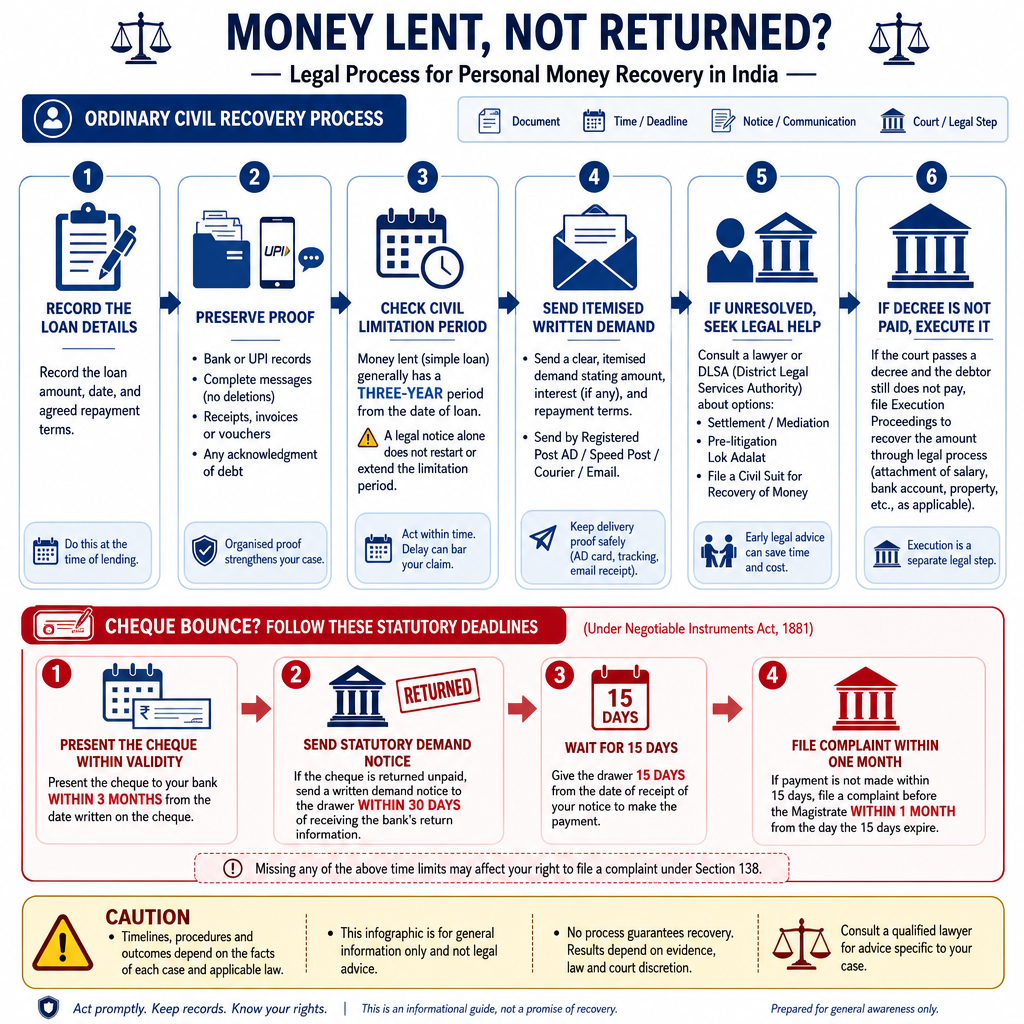
Make one clear demand that the borrower can act on
Repeated calls often produce repeated excuses. A calm written demand creates a clear record and gives the other person a practical chance to settle. It need not be aggressive. Its job is to remove uncertainty about the amount, the basis of the claim, and what happens next.
What should your message say?
State your name and the borrower’s name, the amount you lent, the date and method of payment, and the repayment terms you actually agreed. Mention any part-payments and show how you calculated the outstanding balance. Ask for payment through a traceable method, give the details needed to pay, and set a reasonable response date. For an ordinary demand, people often choose 7 to 15 days; that is a practical choice, not a guaranteed legal deadline. Keep a copy and proof that the demand was delivered.
If you are open to instalments, say so without accepting an indefinite “when I can” arrangement. Ask for a signed acknowledgment of the debt and a dated payment plan stating the amount of each instalment and how it will be paid. Have a lawyer check any proposed document if limitation is close or disputed. Part-payments should go through a traceable channel, with records preserved.
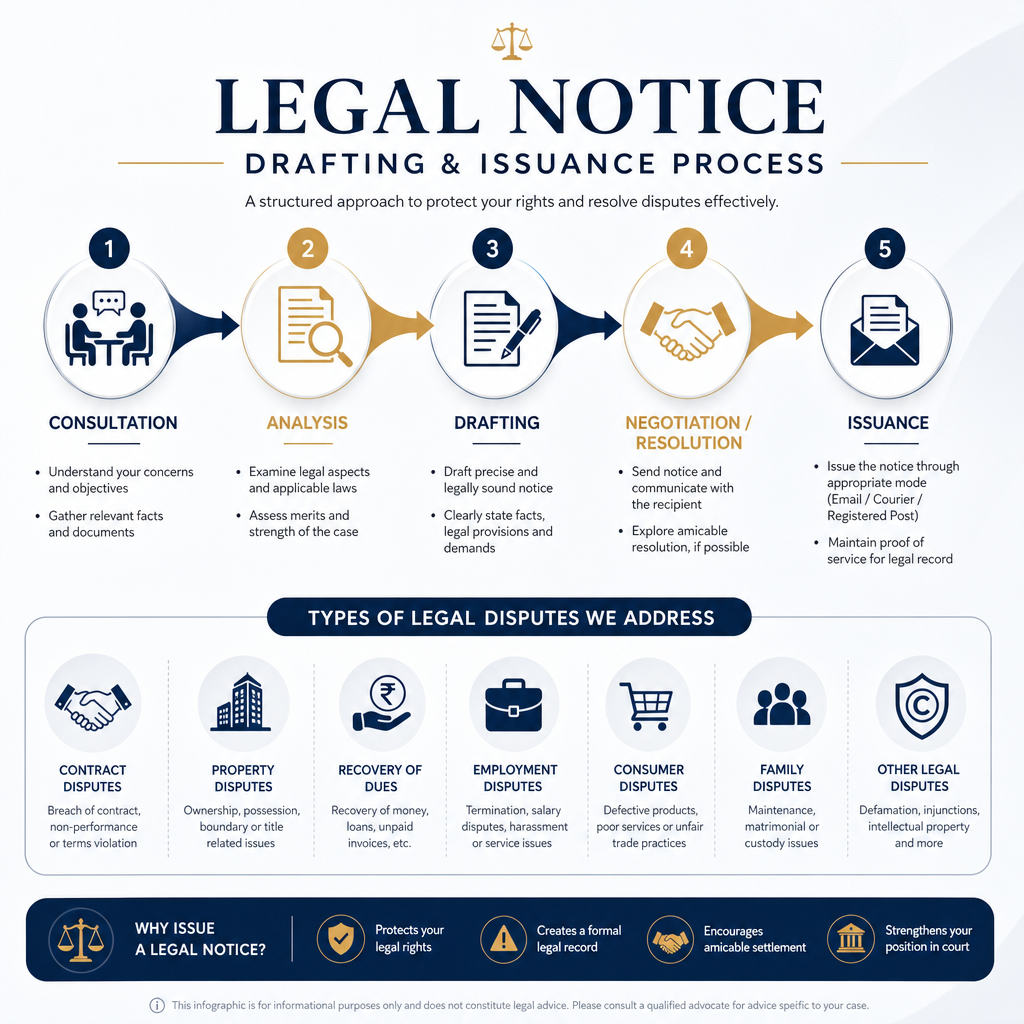
A professionally drafted legal notice can be the next step when a simple demand is ignored or the facts are contested. It sets out the claim formally and can invite settlement before litigation. It does not automatically recover the money, prove your case, or pause the filing deadline. You can review what a money-recovery legal notice does before paying for one.
If you want help sending it
LegalRecovery handles personal money-recovery matters online, with pricing starting at ₹1,499 as a flat fee. Its process begins with submitting your case online and having legal experts review it. They then draft and dispatch a notice by registered post, followed by multi-channel follow-up and escalation aimed at resolution. You can review how LegalRecovery’s process works if managing the notice and follow-ups yourself feels daunting. Online case management means you need not visit a court to use the platform; it is not a promise that any later court proceedings will require no participation or that recovery is guaranteed.
What can you do if they ignore the demand?
Silence after a notice is frustrating, but it does not leave you without a route forward. Your choices depend mainly on the evidence, the amount, the time remaining to file, and whether the borrower is willing to discuss a settlement.
Try settlement without losing sight of the deadline
You can approach your District Legal Services Authority (DLSA) about a pre-litigation Lok Adalat. A Lok Adalat charges no court fee and may help both sides reach a recorded settlement. It cannot impose a settlement when one side refuses to agree. If an agreement is reached, its award is enforceable as a civil decree. This can be attractive when the person accepts they owe you money but needs a workable payment schedule.
Do not let settlement talks run on indefinitely. If the filing deadline is approaching, ask a lawyer about filing in time while you consider your options. A notice or an invitation to settle does not safely substitute for a case filed within limitation.
Ask which civil suit fits your documents
The Indian Contract Act, 1872 recognises obligations to perform promises and provides for compensation for breach under sections 37 and 73. For qualifying claims for a fixed sum based on a written contract or promissory note, Order XXXVII of the Code of Civil Procedure offers a summary-suit procedure. Otherwise, an ordinary civil money-recovery suit may be appropriate. Your lawyer can advise which court and procedure fit your documents; some courts accept filings through the eCourts e-filing portal.
A court decree is a legal win, but it is not the same as money reaching your account. If the person still does not pay, you may need execution proceedings under Order XXI of the Code of Civil Procedure to recover against available assets. That extra stage matters when deciding the cost and effort of litigation. The civil money-recovery suit guide explains the route in more detail.
Did they give you a cheque that bounced?
A bounced repayment cheque needs faster action than an ordinary unpaid-loan reminder. If the cheque was issued for a legally enforceable debt, section 138 of the Negotiable Instruments Act, 1881 may provide a separate complaint route. Do not use an informal 7-to-15-day demand timetable in place of its statutory steps.
Step | Deadline or action | Keep this proof |
|---|---|---|
Present the cheque | Within its validity, normally three months | Cheque details and deposit record |
Bank returns it unpaid | Note when you receive the bank’s return information | Return memo and bank communication |
Send the statutory written demand | Within 30 days of receiving return information | Notice, dispatch record and delivery evidence |
Allow time to pay | 15 days from the borrower’s receipt of the notice | Receipt or delivery information |
File the complaint if unpaid | Within the section 142 one-month period after the cause of action arises | Complete dated file for your lawyer |
Because the dates and proof of receipt matter, seek advice as soon as the bank tells you the cheque has bounced. The court may order interim compensation of up to 20% under section 143A, but that is discretionary, not an automatic payment. The Act asks courts to endeavour to finish these trials within six months; it does not guarantee that you will be paid within six months. You can check the cheque-bounce notice timeline alongside your bank documents.
Do not assume a cash loan is automatically impossible to pursue through this route. In September 2025, the Supreme Court held in Sanjabij Tari v. Kishore S. Borcar that a cash loan above ₹20,000 was not automatically an unenforceable debt for cheque-dishonour purposes merely because it breached a cash-loan tax restriction. You would still need to prove your own legally enforceable debt and meet the cheque-case deadlines.
Your next steps, without trying to do everything today
Start with a small, manageable list. You do not need a perfect legal file before asking for help, but you do need the dates and documents you already have.
Today: Write a one-page timeline with the loan date, amount, agreed terms, reminders, part-payments, and any cheque-return date. Save your statements and full message threads.
Next: Check whether the civil limitation period or a cheque-bounce deadline may be close. If it might be, consult a lawyer before waiting for another promise.
Then: Send a calm, itemised written demand and keep proof of delivery. If the borrower proposes instalments, get a dated, signed arrangement and record every payment.
If nothing changes: Ask a lawyer or the DLSA about settlement or a civil case. If a cheque bounced, follow the statutory notice and complaint timetable instead of treating it as an ordinary reminder.
There is no honest way to promise a repayment date. Some people settle after a clear demand; contested cases and enforcement can take much longer. What you can control is preserving proof, checking the deadline, and taking the next appropriate step before more time passes. You can be firm about money you are owed without threatening, publicly shaming, or turning a difficult personal situation into a needless confrontation.
Popular Searches & Related Topics

Legal Recovery is India's trusted consumer protection and legal tech platform. We specialize in holding corporations accountable for unfair trade practices, deceptive marketing, and commercial fraud. With over 15,000 customers counselled, our mission is to provide fast, out-of-court resolutions by connecting you with top-tier panel advocates for immediate legal action.
Client Reviews
"I had lent money to a friend and was unsure how to put my request in writing. LegalRecovery reviewed the details, prepared a clear notice, and kept me updated on dispatch and follow-up. The conversation became more focused after the notice, and we agreed on a repayment schedule."
Ananya Sharma
"I appreciated the straightforward process for my personal loan recovery matter. The team explained what documents could help, drafted the notice professionally, and shared the delivery details. I received a response from the borrower and was able to discuss repayment without repeated arguments."
Rahul Mehta
"I had messages and UPI records but no signed loan agreement. LegalRecovery helped me organise the information and prepare a formal demand. The communication was professional, and the borrower agreed to make payments in instalments. I found the updates useful throughout."
Priya Nair
"After several unanswered reminders about money I had lent to a relative, I used LegalRecovery for a legal notice and follow-up. The process was handled online, and I was given clear information about the next steps. The notice helped open a practical settlement discussion."
Vikram Desai
Frequently Asked Questions
Related Articles
About Author
Team LegalRecovery
View ProfileTeam LegalRecovery is a dedicated team of legal and financial professionals specializing in loan settlement, banking disputes, debt relief, and corporate compliance. We are committed to helping clients achieve debt freedom and business stability through expert strategic advisory.
Connect on LinkedInNeed Legal Help?
Get expert advice on loan settlement, banking disputes and debt relief.
Start Recovery NowRequest Callback