Section 43B(h) & MSME 45-Day Invoice Recovery Legal Notice (2026)
section 43bh msme invoice recovery legal notice, recover money from unpaid business invoice, msme 45 days payment rule legal notice format, section 16 msmed act 3x rbi compound interest calculator, how to force corporate buyer to pay unpaid invoice, form msme 1 MCA reporting unpaid vendor invoice, section 22 msmed act statutory disclosure, delayed payment to micro and small enterprise recovery, msme payment recovery legal notice, b2b commercial debt recovery india, udyam registration invoice payment enforcement, corporate buyer unpaid invoice legal action

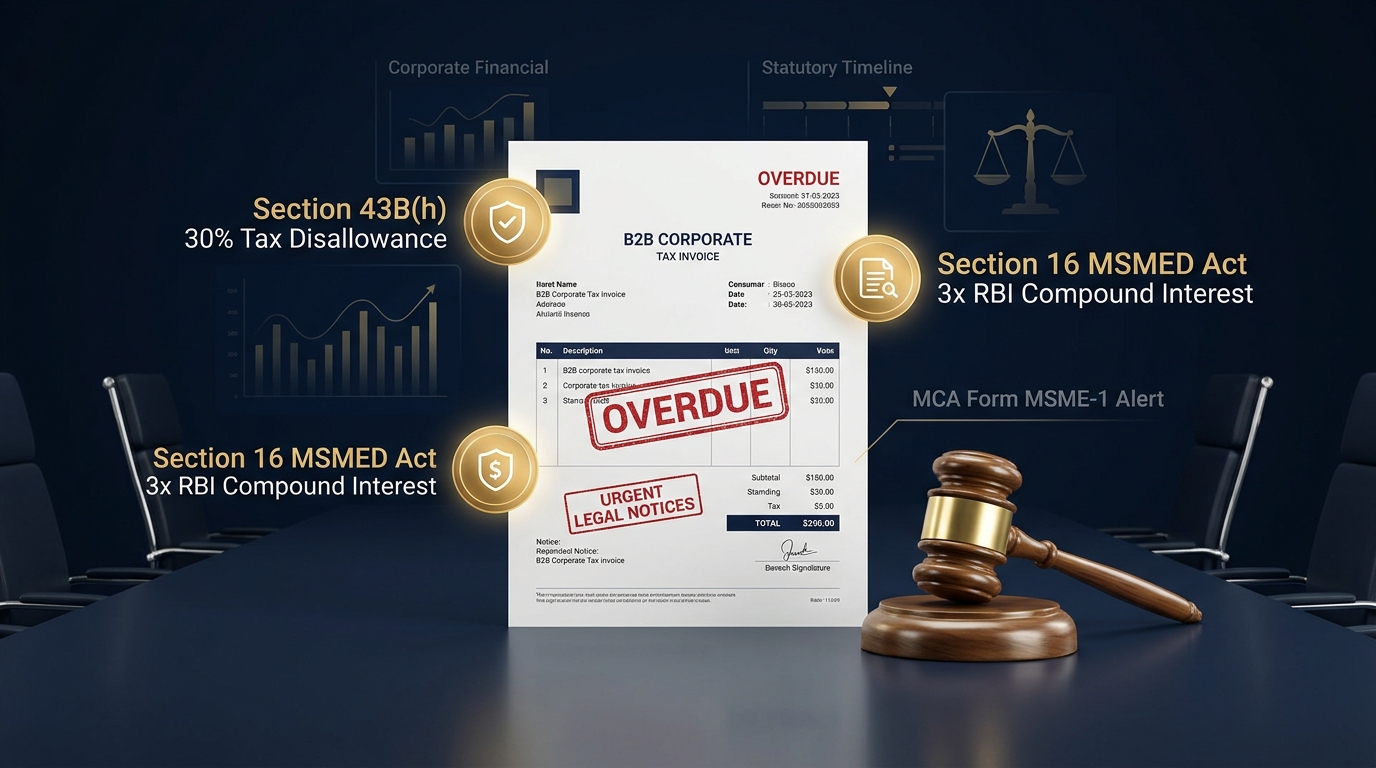
Table of Contents
Table of Contents
Swipe →Unpaid business invoices are the biggest threat to small businesses across India. Micro and small enterprise owners deliver goods on time. They provide high-quality services to large corporate buyers. Yet, when the time comes to settle the bill, buyers drag their feet. Corporate finance teams hold payments for 90, 120, or even 180 days. They treat small vendor invoices as interest-free working capital credit.
For years, small suppliers felt powerless against large corporate clients. If an MSME vendor complained too aggressively, the buyer threatened to cancel future orders. If the vendor stayed silent, their cash flow dried up. Many small enterprises struggle to pay monthly employee salaries and GST dues while waiting for corporate clients to clear dues. Friendly emails, WhatsApp reminders, and phone calls rarely produce results once a buyer decides to delay.
The legal landscape in India has seen a major shift. The combination of Section 43B(h) of the Income Tax Act, 1961 and Chapter V of the MSMED Act, 2006 has created a powerful debt recovery tool. Indian law no longer allows corporate buyers to delay vendor payments without severe financial punishment. When a buyer delays payments beyond legal limits, they face immediate income tax tax block, heavy compound interest, and mandatory public audit reporting.
Most chartered accountant blogs analyze Section 43B(h) from the buyer tax-compliance viewpoint. This guide looks at the statute from the creditor perspective. We explain how MSME suppliers can use Section 43B(h) and Section 16 of the MSMED Act as aggressive collection weapons. You will learn how serving a structured formal legal demand notice copied to the buyer CFO and legal auditor forces immediate invoice clearance.
The MSME Cash Flow Crisis: How Big Buyers Delay Vendor Invoices
Cash flow is the lifeblood of every micro and small business. When corporate buyers withhold payments, suppliers face severe daily disruption. Understanding why buyers delay payments helps vendors deploy the right legal pressure.
Corporate buyers rarely delay payments because they lack funds. In most cases, invoice withholding is a calculated treasury strategy. Corporate finance teams actively preserve their own liquid cash by stretching vendor credit cycles.
The gap of Power Between MSME Suppliers and Corporate Buyers
Large corporate buyers often exploit their market position when dealing with small suppliers. They impose one-sided purchase orders with extended credit terms. It is common to see purchase orders demanding 60, 90, or 120 days credit.
Small suppliers often sign these unfair contracts because they need business volume. When 90 days pass, the buyer accounts department invents minor excuses. They claim invoice errors, missing delivery challans, or pending internal approvals. Small vendors waste valuable team hours chasing accounts payable clerks. This structural power gap leaves small suppliers with severe working capital deficits.
Why Routine Payment Reminders and Friendly Emails Fail to Work
Most MSME owners rely on friendly follow-up emails and phone calls to collect overdue invoices. While polite communication is appropriate during the first few days of credit, it quickly becomes harmful once an invoice is legally overdue.
Corporate accounts teams receive dozens of vendor follow-up emails every day. They prioritize payments based on risk and official urgency. A polite email from a vendor carries zero financial risk for the corporate buyer. The buyer CFO knows that ignoring an email carries no penalty. To get paid fast, an unpaid vendor must elevate the invoice from an ordinary commercial dispute into an urgent corporate tax and audit risk. If you are struggling with unpaid commercial invoices, our specialized B2B vendor payment recovery services provide the legal muscle needed to command immediate attention.
Section 43B(h) Income Tax tax block: The Direct Tax Hammer
The Finance Act, 2023 introduced clause (h) into Section 43B of the Income Tax Act, 1961. This legal amendment transformed business invoice recovery in India. Under the new Income-tax Act framework, this rule continues with full force under Section 37(2)(g).
Section 43B(h) was enacted with a clear public policy objective. The Central Government recognized that delayed payments destroy small businesses. The section provides that any sum payable by a taxpayer to a micro or small enterprise beyond the time limit specified in Section 15 of the MSMED Act will be disallowed as an expense in that financial year.
The 15-Day and 45-Day Payment Deadlines Explained Clearly
Section 43B(h) links directly to Section 15 of the Micro, Small and Medium Enterprises Development (MSMED) Act, 2006. Section 15 lays down strict legal credit periods that override private agreements:
- Where There Is No Written Agreement: The buyer must make payment within 15 days from the date of delivery of goods or rendering of services.
- Where There Is a Written Agreement: The agreed credit period cannot exceed 45 days from the date of delivery or acceptance.
This 45-day legal cap is absolute and non-negotiable. Even if the buyer purchase order states 60, 90, or 120 days credit, that clause is void under Section 15 of the MSMED Act. The law caps the credit period at exactly 45 days. Any payment delayed beyond 45 days constitutes an automatic legal default.
No Year-End Grace Period: Why Actual Payment Before March 31 Matters
Business owners and corporate accountants must understand a critical difference regarding Section 43B(h). Under the general provisions of Section 43B, certain expenses such as GST, employee provident fund, and bank interest can be claimed as tax deductions if paid before the tax return filing deadline under Section 139(1).
Section 43B(h) contains no such relaxation. The proviso allowing payment up to the ITR filing date specifically excludes clause (h). If a corporate buyer fails to pay an active micro or small supplier within the 15-day or 45-day window falling within the financial year, the entire invoice amount is disallowed for that tax year. The deduction is deferred until the financial year in which the payment is actually made.
Direct Financial Impact: 30 Percent Corporate Tax Hit on Default
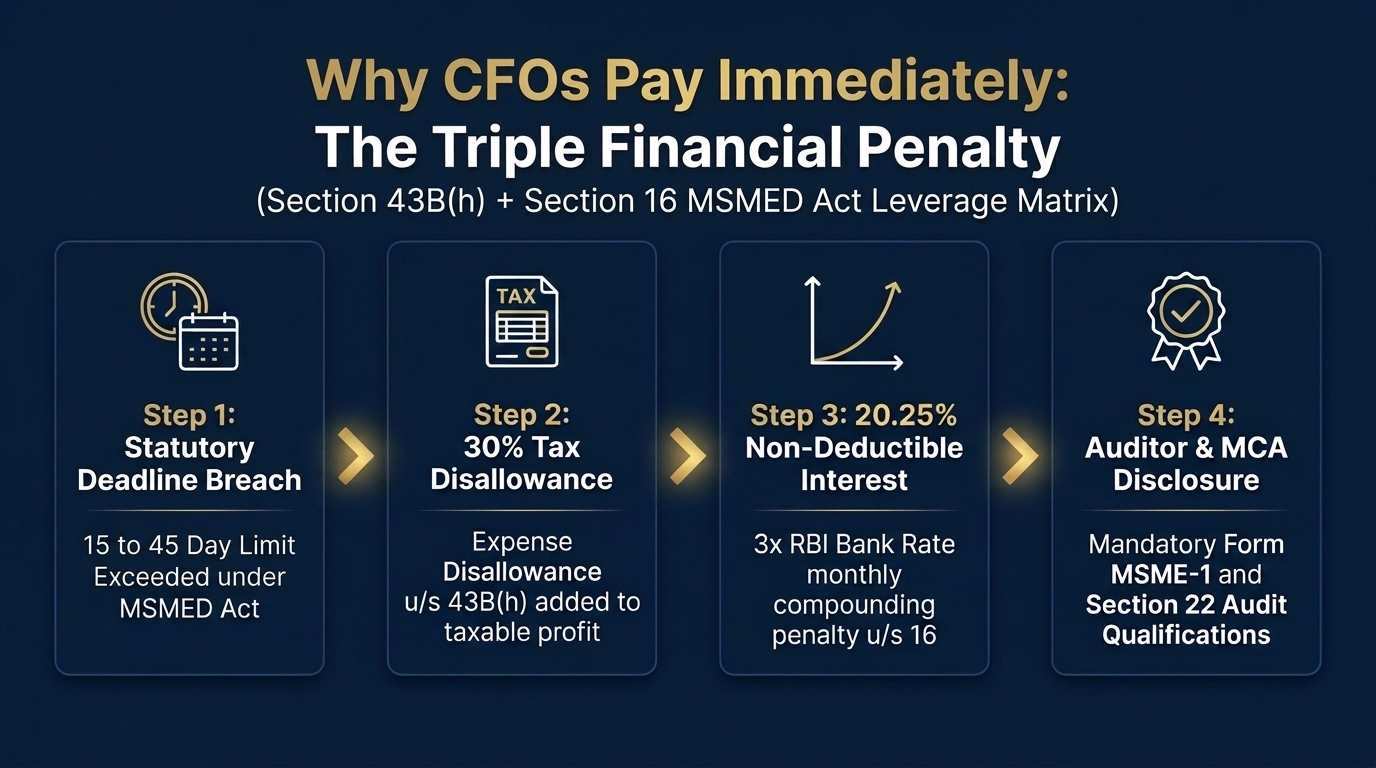
What happens when an invoice is disallowed under Section 43B(h)? The disallowed invoice amount is added back to the buyer taxable business profits. This addition triggers an immediate corporate tax liability.
Most Indian corporate entities pay income tax at effective rates between 25.17 percent and 34.94 percent, including applicable surcharge and education cess. If a corporate buyer withholds a ₹10,00,000 invoice payable to an MSME supplier past March 31, their taxable income increases by ₹10,00,000. The buyer must pay approximately ₹3,12,000 in immediate cash income tax to the government. When a supplier sends a legal notice threatening Section 43B(h) tax tax block, the buyer CFO realizes that holding the invoice costs more than paying it.
Section 16 MSMED Act: Compulsory 3x RBI Monthly Compound Interest
While Section 43B(h) imposes a tax tax block penalty, Section 16 of the MSMED Act, 2006 provides direct financial compensation to the unpaid supplier. Section 16 is one of the most stringent penal interest provisions in Indian commercial law.
The statute recognizes that small suppliers incur heavy bank finance costs when buyers default. Section 16 shifts this financial burden entirely onto the defaulting buyer.
legal Non-Obstante Override of Unfair Contract Terms
Section 16 of the MSMED Act mandates that any buyer who fails to make payment within the legal timeline under Section 15 is liable to pay compound interest with monthly rests. The legal interest rate is fixed at exactly three times the Bank Rate notified by the Reserve Bank of India.
As of 2026, the RBI Bank Rate stands at 6.75 percent. Three times the RBI Bank Rate equals an annual interest rate of 20.25 percent. Furthermore, this interest compounds every single month. Section 16 begins with a powerful non-obstante clause: "Notwithstanding anything contained in any agreement between the buyer and a supplier..."
This wording means that private contract terms cannot dilute your legal rights. Even if the buyer standard contract states that late payments will carry zero interest or only 12 percent simple interest, courts strike down those clauses. The Supreme Court of India in Gujarat State Civil Supplies Corporation Ltd. v. Mahakali Foods Pvt. Ltd. (2023) affirmed that the MSMED Act is a special legislation that completely overrides general contract terms and arbitration agreements.
Section 23 MSMED Act: Interest Is Strictly Non-Deductible for Tax
The financial pain for the defaulting buyer does not stop at the 20.25 percent compound interest rate. Section 23 of the MSMED Act delivers another devastating financial blow.
Section 23 explicitly provides that the amount of interest payable or paid by any buyer under Section 16 shall not be allowed as a deduction in computing taxable income under the Income Tax Act, 1961. Unlike ordinary business interest paid to banks or NBFCs, MSME penal interest cannot reduce the buyer tax liability. Every rupee of Section 16 compound interest must be paid out of the buyer post-tax profits. This double penalty makes invoice withholding financially disastrous for any corporate finance department.
Visual Dispute Resolution & Recovery Framework
Section 22 MSMED Act & MCA Form MSME-1: Board-Level Disclosures
Beyond direct tax and compound interest, corporate buyers face strict legal disclosure duties under company law. These disclosure rules expose defaulting buyers to formal audits, ROC scrutiny, and personal penalties on directors.
Unpaid suppliers can use these legal reporting duties to elevate payment defaults directly to the board of directors and legal auditors.
Mandatory Reporting in Audited Balance Sheets and Form 3CD
Under Section 22 of the MSMED Act, any buyer required to have their accounts audited under any law must furnish specific disclosures in their annual financial statements:
- The principal amount and interest due thereon remaining unpaid to any supplier at the end of each accounting year.
- The amount of interest paid by the buyer under Section 16, along with the payment amounts made beyond the appointed day.
- The amount of interest due and payable for the period of delay in making payment.
- The amount of interest accrued and remaining unpaid at the end of each accounting year.
In addition, the buyer legal auditor must report all overdue MSME payments under Clause 22 of Tax Audit Form 3CD. If a corporate buyer conceals overdue vendor dues, the legal auditor risks professional penal action from the National Financial Reporting Authority (NFRA) and ICAI. Pointing out this mandatory disclosure in your legal demand notice forces the buyer finance team to take immediate notice.
Personal Liability on Corporate Directors Under Section 405 MCA
Corporate disclosure rules are further enforced by the Ministry of Corporate Affairs (MCA). Under the Companies (Specified Companies) Order read with Section 405 of the Companies Act, 2013, all specified companies must file Form MSME-1 half-yearly with the Registrar of Companies (ROC).
Form MSME-1 requires companies to disclose the name of every micro and small vendor whose payment is delayed beyond 45 days, the amount due, and the specific reason for delay. The half-yearly filing due dates are strictly enforced:
- For the half-year period April to September: Due on or before 31 October.
- For the half-year period October to March: Due on or before 30 April.
Failing to file Form MSME-1 or filing false details carries heavy legal penalties under Section 405(4) of the Companies Act, 2013. The company is penalized ₹20,000, plus an ongoing penalty of ₹1,000 per day for every day the default continues. More importantly, every director and officer in default faces an identical personal penalty of ₹20,000 plus ₹1,000 per day, up to a maximum legal cap of ₹3,00,000 each. Copying your legal notice to the company directors alerts them to their personal legal exposure.
Concrete Rupee Audit Matrix: The True Cost of Withholding ₹10 Lakh
To demonstrate the overwhelming financial leverage created by Section 43B(h) and the MSMED Act, examine this concrete rupee calculation. The table below models the exact financial penalty on a corporate buyer withholding a ₹10,00,000 invoice from a registered Micro or Small supplier across 6-month and 12-month delay horizons:
| Financial & Legal Penalty Component | Governing Statute & Basis | 6-Month Default Cost (INR) | 12-Month Default Cost (INR) | Buyer Strategic Impact |
|---|---|---|---|---|
| Invoice Principal Dues | Section 15 MSMED Act & Sale of Goods Act | ₹10,00,000 | ₹10,00,000 | Legally undisputed commercial debt payable to supplier |
| Section 43B(h) Income Tax tax block | 30% Corporate Tax + 4% Cess on Disallowed Expense | ₹3,12,000 | ₹3,12,000 | Immediate cash outflow to Income Tax Department on 31 March |
| Section 16 MSMED Penal Interest | 3x RBI Bank Rate (20.25% p.a. Compounding Monthly) | ₹1,05,862 | ₹2,22,238 | Mandatory legal compound interest payable directly to vendor |
| Tax Loss on Disallowed Interest | Section 23 MSMED Act (Non-Deductible Business Cost) | ₹33,029 | ₹69,338 | Interest cannot be written off against corporate taxable revenue |
| MCA Form MSME-1 Non-Compliance Penalty | Section 405(4) Companies Act (Company + Directors) | ₹40,000 | ₹1,20,000 | Personal financial adjudication by ROC on directors and CFO |
| legal Audit red flag & Legal Costs | Section 22 MSMED Act & Form 3CD Clause 22 | ₹25,000 | ₹50,000 | Auditor red flag damages buyer corporate credit score |
| Total Financial Burden on Defaulting Buyer | Cumulative Cost of Withholding Payment | ₹15,15,891 | ₹17,73,576 | Holding a ₹10 Lakh invoice costs the buyer up to ₹7.73 Lakh extra! |
This rupee audit demonstrates why corporate CFOs settle immediately once a proper legal notice is served. By delaying a ₹10 Lakh invoice for 12 months, the buyer saves nothing. In fact, they lose over ₹7.73 Lakh in additional taxes, non-deductible interest, and official penalties. Settling the supplier invoice is the only rational financial decision.
legal Legal Forum Matrix: MSME Invoice Recovery methods
Unpaid suppliers have multiple legal routes to recover business debts in India. Selecting the right legal forum depends on the dispute size, speed required, and nature of the debtor. The comparison table below evaluates the primary recovery tools available under Indian law:
| Recovery Tool & Forum | Governing Statute | Key Evidentiary Requirements | Average Resolution Window | Recovery Pressure & Settlement Rate |
|---|---|---|---|---|
| Formal Section 43B(h) Advocate Notice | Section 43B(h) IT Act & Section 16 MSMED Act | Tax invoice, delivery challan, active Udyam registration | 7 to 15 Days | Very High (82% settle formal to avoid tax and audit hit) |
| MSME Samadhaan Facilitation Council (MSEFC) | Section 18 MSMED Act, 2006 | Online Udyam filing, purchase order, three unpaid invoices | 90 to 180 Days | High (legal conciliation followed by binding arbitral award) |
| Commercial Summary Suit (Order 37 CPC) | Order XXXVII CPC & Commercial Courts Act, 2015 | Signed contract, ledger confirmation, bank statements | 4 to 8 Months | Very High (Debtor must obtain court leave to defend; asset freeze) |
| NCLT Corporate Insolvency (IBC Section 9) | Insolvency and Bankruptcy Code, 2016 | Minimum ₹1 Crore debt, Form 3 demand notice, no pre-existing dispute | 6 to 12 Months | Severe (Threatens management loss of corporate entity; high threshold) |
| Criminal Complaint for Fraud & Cheating | Section 318 Bharatiya Nyaya Sanhita, 2023 | Proof of fraudulent inducement from inception, fake cheques | 3 to 9 Months | Moderate to High (Police inquiry creates immediate personal distress) |
| Writ Petition for Government PSU Dues | Article 226 Constitution of India | Admitted public tender dues, completion certificates, PSU delay | 2 to 5 Months | High (High Court directs government department or PSU to clear funds) |
For most commercial invoices below ₹1 Crore, a formal Advocate Notice combined with an MSEFC claim provides the fastest recovery timeline. To understand how the government dispute portal operates, review our complete analysis of MSME Samadhaan portal delayed payment recovery procedures.
How to Draft and Serve a CFO-Level Section 43B(h) Legal Demand Notice
Serving a generic legal notice written by a general practitioner will not create maximum corporate leverage. Corporate legal teams easily brush aside vague notices. To force an immediate settlement, your legal notice must be structured as a formal corporate audit and tax compliance warning.
A high-impact recovery notice must be drafted by experienced commercial recovery advocates. Follow this four-step execution protocol.
Step 1: Audit Invoices, Delivery Challans, and Udyam Certificates
Before issuing a legal notice, conduct a strict legal audit of your supporting documents. Corporate buyers often look for minor technical defects to justify payment delays. Gather the following records:
- Active Udyam Registration Certificate: Ensure your enterprise was actively registered as a Micro or Small enterprise before the date of goods supply or service delivery. Medium enterprises cannot claim Section 43B(h) protection.
- Accepted Purchase Orders and Work Contracts: Compile all signed contracts, approved quotations, or email purchase confirmations.
- Proof of Delivery: Obtain signed delivery challans, transporter consignment notes, or digital acceptance emails. Under Section 2(b) of the MSMED Act, the legal clock starts on the date of physical delivery.
- Tax Invoices Stamping Udyam Details: Verify that your tax invoices clearly display your 19-digit Udyam Registration Number and legal payment terms.
To inspect standard formats and necessary legal clauses, examine our detailed guide on unpaid invoice recovery legal notice format requirements.
Step 2: Calculate Compounded Interest and legal Tax Exposure
Your legal demand notice must not simply ask for the principal invoice amount. It must set out the precise legal penalties facing the buyer:
- Calculate compound interest under Section 16 of the MSMED Act at three times the RBI Bank Rate (20.25 percent per annum) compounding with monthly rests from day 16 or day 46.
- State the exact income tax tax block amount under Section 43B(h) that the buyer must add back to taxable income if payment is not cleared immediately.
- Cite the non-deductibility of interest under Section 23 of the MSMED Act.
- Highlight the mandatory Form MSME-1 filing requirement and director penalty risks under Section 405 of the Companies Act, 2013.
Step 3: Multi-Channel Dispatch to Directors, CFO, and Auditors
Delivery strategy is the secret to rapid corporate recovery. If you send a legal notice only to the company registered office, it often languishes in the mailroom. A high-impact notice must reach the key financial decision-makers at once.
Your advocate should dispatch the legal demand notice through multiple verified channels:
- Physical Speed Post with Acknowledgment Due: Deliver physical copies to the company registered office, corporate daily office, and the personal residential addresses of the Managing Director and Chief Financial Officer.
- legal Auditor Copy: Send a formal copy marked to the company legal Audit Firm. legal auditors are legally bound to review third-party dispute communications during their audit reviews.
- Official Corporate Email: Transmit high-resolution scanned PDF copies to the MD, CFO, and accounts payable email addresses with read receipts.
- Instant Digital Delivery: Deliver the legal notice via advocate WhatsApp to senior executive phone numbers.
To initiate this hard-hitting process today, you can easily send a CFO-level Section 43B(h) + MSMED recovery notice through our verified legal recovery platform.
Step 4: Escalation to MSME Samadhaan and Commercial Summary Suit
Give the defaulting buyer a strict 15-day cure period in the legal demand notice. In over 80 percent of cases, corporate finance heads release funds or initiate settlement discussions within this 15-day window to prevent audit exposure.
If the buyer fails to pay within 15 days, execute immediate escalation. File an online petition on the MSME Samadhaan portal to trigger legal conciliation before the Micro and Small Enterprise Facilitation Council (MSEFC). If conciliation fails, the Council initiates legal arbitration under the Arbitration and Conciliation Act, 1996, leading to an enforceable arbitral award. If the buyer attempts to challenge the award in court, Section 19 of the MSMED Act forces them to pre-deposit 75 percent of the awarded sum upfront.
At the same time, your legal team can file a commercial summary suit under Order 37 of the Code of Civil Procedure in the competent Commercial Court. Review the full money recovery court case process in India to understand how civil courts enforce speedy commercial decrees.
Remember that commercial debt claims are subject to legal limitation rules. Under the Limitation Act, 1963, a creditor has strictly three years from the invoice due date to initiate formal recovery actions. Review the time limit to file a money recovery case in India to ensure your claim remains fully enforceable.
To learn the practical formalities of serving corporate notices, read our comprehensive advisory on how to send legal notice to company for non payment. When facing stubborn corporate debtors, our general legal notice for money recovery protocols ensure that your business never walks away from hard-earned capital.
Popular Searches & Related Topics

Legal Recovery is India's trusted consumer protection and legal tech platform. We specialize in holding corporations accountable for unfair trade practices, deceptive marketing, and commercial fraud. With over 15,000 customers counselled, our mission is to provide fast, out-of-court resolutions by connecting you with top-tier panel advocates for immediate legal action.
Client Reviews
"We supply automotive precision components to Tier-1 auto manufacturers. A major corporate client withheld ₹18.5 Lakhs across three invoices for 110 days. Team LegalRecovery drafted a lethal pre-litigation legal notice invoking Section 43B(h) tax disallowance and Section 16 MSMED compound interest, copied directly to their CFO and statutory auditor. The client cleared the entire principal plus statutory interest within 8 days."
Vikramaditya Singhania (Faridabad)
"Outstanding B2B commercial debt recovery. A mid-sized tech firm held our software integration invoices worth ₹12 Lakhs for over 4 months with zero responses to our emails. LegalRecovery audited our Udyam registration, calculated the 20.25% monthly compounding interest, and served a formal notice warning of Form MSME-1 ROC penalties. Their finance director called us within 48 hours to execute a full NEFT settlement."
Pooja Hegde (Bengaluru)
"Most lawyers we consulted wanted to file a lengthy civil suit that would take years. LegalRecovery understood the power of direct tax and MCA leverage. Their advocate notice citing Section 43B(h) and Section 22 MSMED Act put immediate pressure on the buyer board of directors. We recovered ₹24 Lakhs of pending industrial chemical supplies without setting foot inside a courtroom."
Rajeshwar Rao (Hyderabad)
"Exceptional commercial legal service for MSMEs. We were facing severe liquidity issues because a textile conglomerate delayed our fabric supply payments past the 45-day mark. The multi-channel legal notice served by LegalRecovery broke their internal stalling tactics instantly. The debtor finance team settled 100% of our principal dues before the tax year closed."
Manish Chawla (Ahmedabad)
"If you are an MSME vendor chasing corporate payments in India, LegalRecovery is the only team you need. They transformed our overdue commercial invoices into urgent tax and compliance liabilities for the buyer. Their concrete rupee calculation table in the legal notice terrified the debtor accounts head. Fast, transparent, and completely professional."
Deepak Nambiar (Chennai)
Frequently Asked Questions
Related Articles
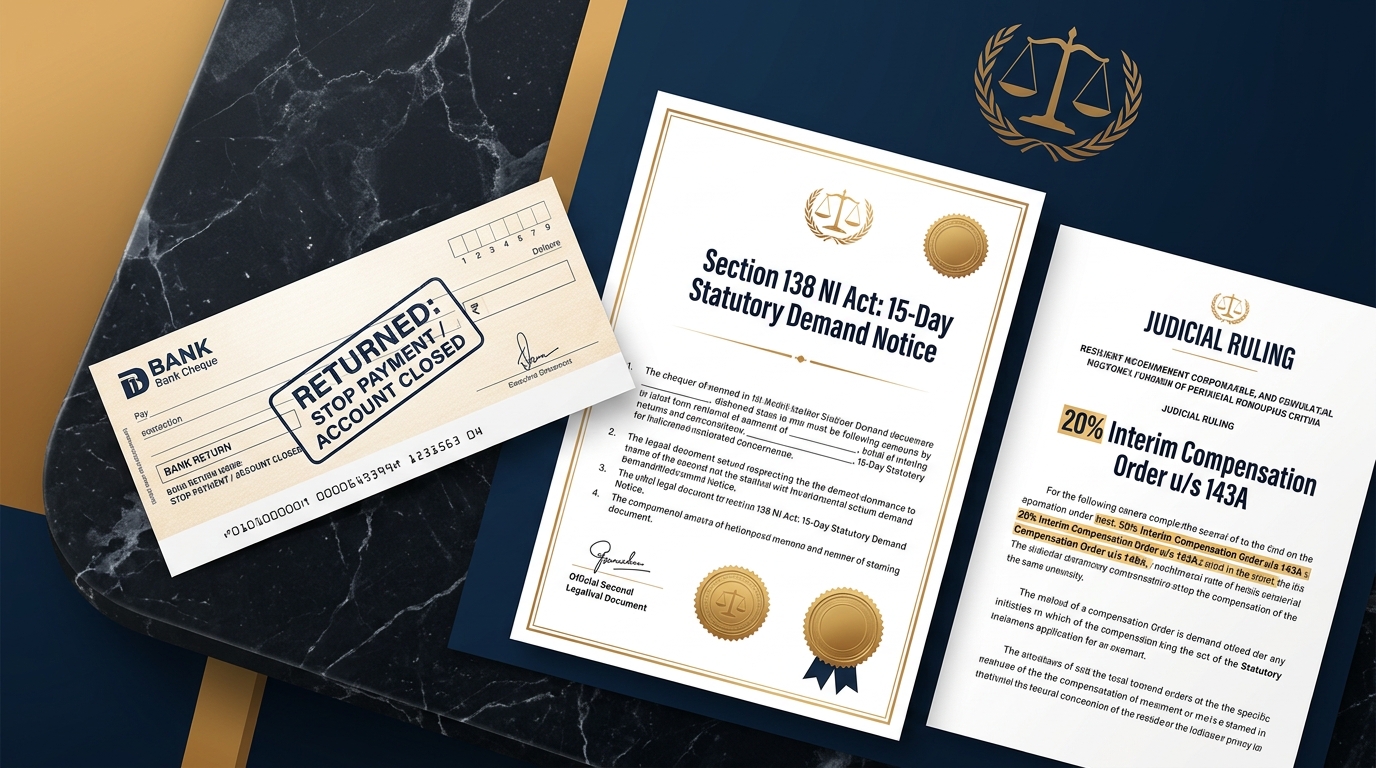
Friend Cheque Bounced (Account Closed or Stop Payment)? Legal Action
friendly loan cheque bounce money recovery, cheque bounce due to account closed section 138, stop payment cheque bounce friendly loan, section 143a ni act 20 percent interim compensation, cash friendly loan above 20000 cheque bounce defense, legal notice for cheque bounce money recovery, section 138 ni act 30 days notice timeline, bir singh v mukesh kumar blank security cheque, section 139 statutory presumption debt, order 37 cpc summary suit cheque bounce, section 269ss income tax cash loan defense, 15 days demand notice cheque bounce, section 143a 60 days payment deadline, dual criminal and civil money recovery
Read Article
Ex-Flatmate Left Without Paying Rent or Deposit? Legal Recovery
recover rent and security deposit from flatmate india, flatmate not returning security deposit share, roommate left without paying rent legal notice, splitwise proof in legal notice money recovery, joint tenancy contribution recovery india, how to recover money from roommate legally, section 69 contract act rent reimbursement, section 43 contract act contribution, section 72 unjust enrichment flatmate deposit, section 316 bns criminal breach of trust tenant deposit, lead tenant pocketed deposit refund legal action, order 38 rule 5 bank attachment flatmate debt
Read Article
How to Recover an Unpaid Invoice from a Client in India
Learn what to include in a payment demand, what evidence to keep, and when an eligible MSE can use the ODR route.
Read Article
HR Threatening Absconding Tag to Block FNF? Legal Remedies (2026)
hr threatening absconding tag to forfeit fnf, absconding notice from employer reply format, can employer forfeit fnf for absconding, employer threatening bad bgv to hold salary, how to remove absconding status and recover fnf, legal notice against employer for false absconding allegation, dk yadav jma industries deemed abandonment domestic inquiry, section 73 indian contract act notice pay deduction, doctrine of compelled self publication abhijit mishra wipro, nasscom nsr dispute resolution false absconding, payment of wages act earned wages protection, criminal defamation section 356 bns employer threat
Read ArticleAbout Author
Anuj Anand Malik
View ProfileAnuj Anand Malik, Founder of AMA Legal Solutions, is a trusted advocate, loan settlement expert, legal advisor, and banking lawyer. With over a decade of experience in loan settlement, corporate law, financial disputes, and compliance, he leads a result-driven law firm based in India that helps individuals, startups, and businesses achieve legal and financial stability.
Connect on LinkedInNeed Legal Help?
Get expert advice on loan settlement, banking disputes and debt relief.
Start Recovery NowRequest Callback