HR Threatening Absconding Tag to Block FNF? Legal Remedies (2026)
hr threatening absconding tag to forfeit fnf, absconding notice from employer reply format, can employer forfeit fnf for absconding, employer threatening bad bgv to hold salary, how to remove absconding status and recover fnf, legal notice against employer for false absconding allegation, dk yadav jma industries deemed abandonment domestic inquiry, section 73 indian contract act notice pay deduction, doctrine of compelled self publication abhijit mishra wipro, nasscom nsr dispute resolution false absconding, payment of wages act earned wages protection, criminal defamation section 356 bns employer threat

Table of Contents
Table of Contents
Swipe →You send a formal resignation email to your manager. You copy the human resources team. You offer to serve your notice period or buy out your days. You also share handovers of all your work. Instead of a smooth exit, you face anger and threats. Your manager rejects your resignation on the company portal. The human resources team stops replying to your messages. When your last working day arrives or you take sick leave, a harsh email lands in your inbox. The company brands you as an absconding employee.
The harassment does not stop with a harsh letter. HR managers threaten you over phone calls. They claim they will mark you as absconding on your permanent record. They threaten to ruin your Background Verification with your next employer. They threaten to blacklist your name on the NASSCOM NSR database. Worst of all, they claim that your Full and Final settlement is forfeited. They withhold your earned salary, leave encashment, bonus, and relieving letter.
Thousands of Indian software engineers, sales leaders, and corporate staff face this threat every month. Most employees panic. They fear losing their new job offer. They give up months of earned pay in silence. You must know one core legal truth. A company cannot brand you absconding when you sent clear resignation emails. Under Indian law and Supreme Court rulings, manufacturing an absconding tag to steal wages is illegal. You have strong legal rights to stop BGV threats, clear your record, and recover all your money.
The Manufactured Absconding Trap: How Companies Blackmail Exiting Staff
Many companies in India use the absconding tag as a weapon of fear. They use it to stop staff from leaving. They also use it to hold back unpaid wages. When an employee resigns, managers often face project deadlines. Instead of hiring replacements, they create a false dispute. They try to trap the employee with bad records.
This manufactured absconding trap follows a familiar corporate pattern:
- Rejecting Resignation Letters: HR claims that resignation needs management approval. That claim is false. Under Indian contract law, resignation is your personal right. An employer cannot force you to work against your will.
- Refusing Leave and Notice Buyout: The company refuses to adjust your earned leaves against notice days. If you fall sick and share doctor slips, HR ignores them. They treat genuine medical leave as unauthorized absence.
- Cutting Laptop and Email Access: IT teams revoke your portal access overnight. At the same time, HR writes letters claiming you failed to report for work. They create false absence records on purpose.
- Issuing Threatening Show Cause Letters: The company sends letters giving you 48 hours to report. They draft these letters to build a paper trail for salary forfeiture.
- Blocking BGV and Withholding Pay: When you join your new firm, your old employer blocks your employer holding relieving letter and FNF clearance. They tell BGV agencies that you left without permission.
This trap works only when employees stay silent. Once you invoke Indian statutory protections, the company loses all its leverage.
Genuine Job Abandonment vs Manufactured Absconding After Resignation
To defeat a false absconding claim, you must understand how Indian labor courts define abandonment of service. Indian courts make a clear distinction between a worker who vanishes and an employee who resigns through formal emails.
Genuine job abandonment means an employee disappears with zero communication. The worker stops coming to office. They submit no leave form. They answer no phone calls. They reply to no emails. The employer has no idea where the worker is or why they left. In that rare case, the worker shows a clear intent to abandon their job.
Manufactured absconding is totally different. In this case, you are in active email contact with the company. You sent a resignation letter. You offered handover files. You shared medical notes or offered notice buyout pay. The employer knows your email and your phone number. They know your reasons. Labeling an employee absconding in this situation is a deliberate fraud.
The 3 Crucial Evidentiary Differences Indian Courts Recognize
When labor commissioners and judges look at absconding disputes, they check three vital pieces of evidence:
- Intent to Resign vs Intent to Abandon: Indian law calls this Animus Derelinquendi. When you tender a resignation email, you express a clear intent to end your job contract under agreed terms. You do not run away. A formal resignation letter disproves any intent to abandon work.
- Record of Ongoing Written Messages: If you replied to emails or sent doctor certificates, you were never missing. A worker who stays in touch cannot be labeled untraceable. Written proof of your replies destroys the absconding tag.
- Bad Faith and Obstruction by the Employer: Courts check if the employer caused the problem. Did HR cut off your laptop access? Did they reject your medical leave? An employer cannot block you from working and then call you absconding.
Showing these three facts turns the case against the company. It changes the matter from alleged employee absence into unlawful employer salary theft.
Concrete Financial Impact & Unlawful Salary Forfeiture Matrix
When a company marks an employee as absconding, the financial loss is heavy. Employers hold back earned monthly pay, leave encashment, bonus, and statutory gratuity. They claim the worker owes them money for unserved notice days.
Take an example of a team lead earning Rs 1,60,000 gross pay per month. The basic salary is Rs 80,000 per month. The worker serves 15 days of notice and offers to buy out the remaining 45 days. The table below shows the false claim by the firm versus the true legal calculation:
| Financial Payroll Component | Company False Claim | True Statutory Calculation | Disputed Rupee Amount | Employer Legal Risk |
|---|---|---|---|---|
| Earned Salary (30 Worked Days) | Forfeited as penalty for absconding | Mandatory payment under Payment of Wages Act | Rs 1,60,000 | Payment of Wages Act damages up to 10 times wages |
| Notice Shortfall (45 Days) | Gross salary deduction of Rs 2,40,000 | Basic salary offset only (Rs 1,20,000 max) | Rs 1,20,000 illegal grab | Section 74 Contract Act: actual loss proof required |
| Privilege Leave (24 Days) | Cancelled due to disciplinary action | Mandatory encashment at basic pay rate | Rs 64,000 | State Shops and Establishments Act penalty |
| Accrued Gratuity (4.8 Years) | Forfeited for breach of job contract | Section 4(6) Gratuity Act: strictly protected | Rs 2,21,538 | Payment of Gratuity Act: 10% interest plus jail term |
| Statutory Bonus & Variable Pay | Removed from payroll records | Mandatory payment under Payment of Bonus Act | Rs 85,000 | Labour department inspection and fine |
| Total Recovery Claim | Employee allegedly owes Rs 80,000 | Employer owes net Rs 4,10,538 | Rs 4,10,538 Net Due | Labour recovery order with 18% annual interest |
As this table shows, the company tries to turn a Rs 4.1 lakh debt into an employee liability. They invent deductions to avoid paying your dues. Through our proven how to recover Full and Final settlement from employer service, we strike down these fake charges and force full payment.
DK Yadav Precedent: Why Automatic Absconding Tags Are Unconstitutional
Human resources teams often quote company handbooks. They claim that missing work for 8 or 10 days leads to automatic termination. They say the employee lost their job by default. What HR will never tell you is that the Supreme Court of India banned automatic termination rules decades ago.
In the historic case of D.K. Yadav v. J.M.A. Industries Ltd. (1993 3 SCC 259), the Supreme Court struck down automatic abandonment clauses. The company in that case struck a worker off the muster rolls after eight days of absence. The company held no inquiry. The Supreme Court ruled that the termination was illegal. The court ordered full back wages and reinstatement.
The Supreme Court established three fundamental rules that protect every employee in India:
- No Automatic Job Loss: No contract or handbook rule can end an employee job automatically. Even if a contract has an abandonment clause, that clause cannot bypass the law of the land.
- Mandatory Domestic Inquiry: An employer cannot brand a worker absconding without a formal inquiry. Management must issue a chargesheet. They must give the employee a fair chance to present their defense. Striking a name off company records without an inquiry is completely void.
- Right to Livelihood Under Article 21: Article 21 of the Constitution of India guarantees the right to life. The Supreme Court ruled that this right includes the right to livelihood. Any corporate action that takes away your livelihood must be fair, just, and reasonable under Article 14. An arbitrary absconding tag violates your constitutional rights.
Principles of Natural Justice Under Articles 14 and 21
The ruling in *D.K. Yadav* rests on the rule of Audi Alteram Partem. That rule means no person can be condemned unheard. When an employer marks you absconding without an inquiry, they break this basic rule. They act as accuser and judge at the same time.
The Supreme Court affirmed this rule in Novartis India Ltd. v. State of West Bengal (2009). The court held that absence from work is a simple matter of conduct. It does not mean the employee gave up their job. The company must prove misconduct through an inquiry before it can stop pay or issue termination letters. If your employer held no inquiry, their absconding tag is legally invalid.
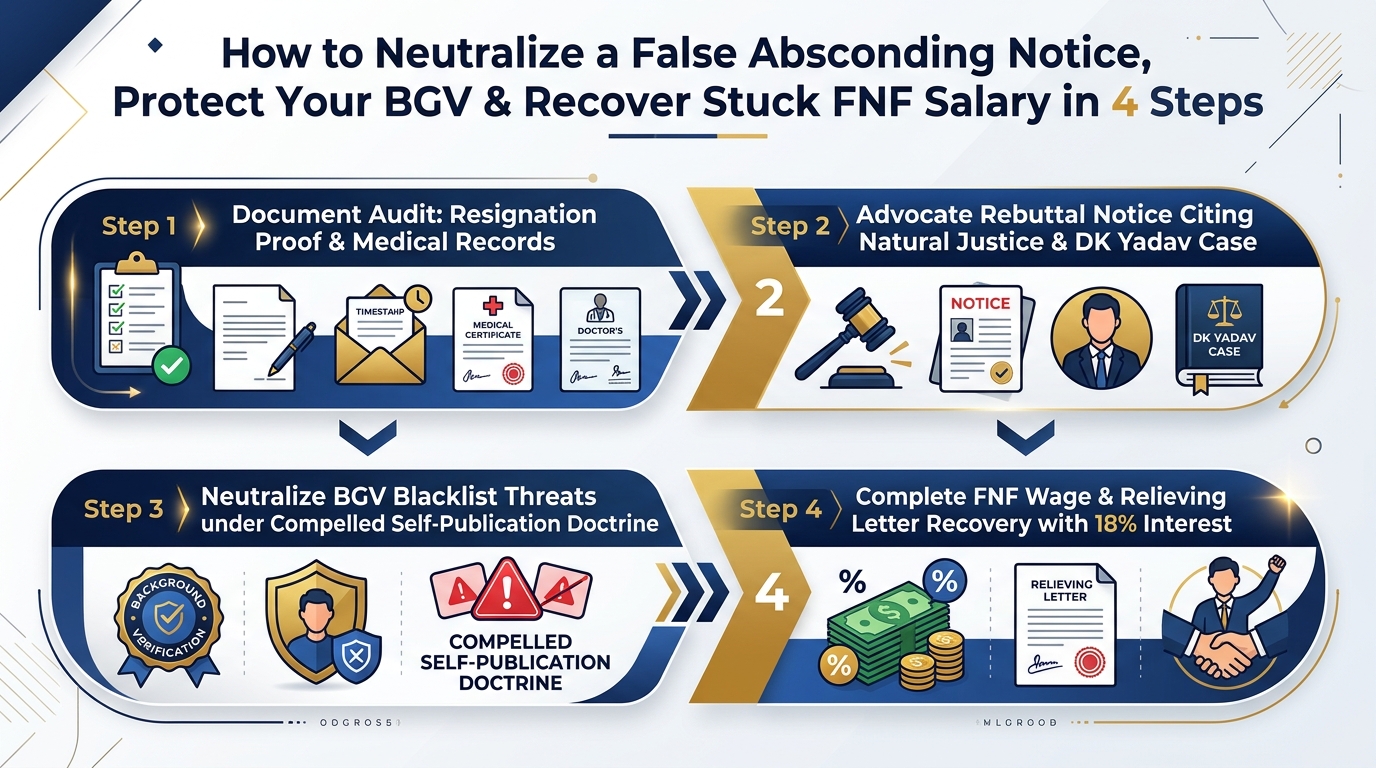
Visual Dispute Resolution & Recovery Framework
Doctrine of Compelled Self-Publication & BGV Defamation Liability
The biggest threat HR uses is damaging your background check. HR managers say they will give bad feedback to BGV verification agencies like First Advantage, AuthBridge, or HireRight. They threaten to mark you as terminated for absconding on the NASSCOM NSR portal. They know this threat can cause your next employer to withdraw your job offer.
For many years, employers thought they could escape legal liability for this conduct. They claimed that writing remarks on internal letters was private. They claimed that private communication was not defamation under Indian law. In 2025, the High Court of Delhi closed this loophole completely.
In the landmark case of Abhijit Mishra v. Wipro Limited (CS(OS) 31/2021), the Delhi High Court adopted the Doctrine of Compelled Self-Publication into Indian law. The court examined a case where an employer put defamatory remarks in an exit letter. The company argued that it never shared the letter with the public.
The Delhi High Court rejected the company defense with clear words:
- Employers Know Exit Papers Are Shared: The court held that employers know job seekers must show exit letters to new employers. Background verification is a standard part of corporate hiring in India.
- Constructive Publication by Employer: When a company puts a false absconding remark on an exit paper, it forces the employee to show that remark to new employers. The law treats this as direct publication by the company itself.
- Malice Destroys All Privilege: Employers often claim that BGV feedback has qualified privilege. The court ruled that bad faith and malice destroy that defense. Giving false negative feedback out of spite is civil defamation and tortious interference with employment.
Abhijit Mishra v Wipro: Ending Bad BGV and NSR Blackmail
The *Abhijit Mishra* ruling gives you immense power against HR threats. If an employer marks you absconding on NSR or gives bad BGV reports without an inquiry, they face heavy damages. Under Indian tort law and Section 356 of the Bharatiya Nyaya Sanhita, 2023 (BNS), spreading false marks about a worker leads to civil damage suits and criminal prosecution.
When our advocates send a demand notice citing the *Abhijit Mishra* precedent, corporate legal teams take notice. Top executives know that fighting a multi-crore defamation case over an FNF dispute will harm their business. They order HR to retract the bad tag, clear the BGV file, and issue clean exit letters.
Section 73 Contract Act: Why Employers Cannot Forfeit Earned Salary
Another common excuse from HR is the notice period rule. Companies claim that if you leave early, they can keep your earned pay. They treat earned salary as a penalty fund. That practice violates Indian contract law.
Employment contracts are subject to the Indian Contract Act, 1872. When an employee leaves before serving full notice, the legal remedy is governed by Section 73 and Section 74:
- Section 73 (Proof of Actual Loss): Under Section 73, an employer can only claim compensation for real financial losses caused by the early exit. The company cannot guess or invent losses. They must prove actual monetary harm. If the company suffered no real loss, they cannot claim damages.
- Section 74 (Penalties Are Unlawful): In landmark cases like Kailash Nath Associates v. DDA (2015), the Supreme Court held that notice buyout clauses are upper limits, not automatic rewards. An employer cannot charge a punitive amount. Forfeiting earned pay for days worked is an unlawful penalty.
- Payment of Wages Act Rules: Under Section 7(2) of the Payment of Wages Act, 1936, an employer can only deduct wages for the actual days an employee missed work. The law bans withholding pay for days already worked.
Your earned salary is your private property under Article 300A of the Constitution. Once you work your shift, your right to that wage is absolute. The employer cannot seize your money to cover notice claims. If your company held your pay, serve an immediate legal notice for Full and Final settlement delay to get your money back.
Statutory Forum, Authority Powers & Legal Recourse Matrix
If your employer refuses to clear your record and holds your FNF, you have strong legal forums ready to act. You do not need to spend years in slow civil courts. The table below outlines each statutory authority, its legal powers, and how fast it resolves claims:
| Statutory Forum | Governing Law | Evidentiary Trigger | Authority Powers & Sanctions | Resolution Timeline |
|---|---|---|---|---|
| Labour Commissioner Office | Payment of Wages Act & Industrial Disputes Act | Unpaid salary and leave encashment past 30 days | Summons directors and orders payment with 10x penalty damages | First hearing in 14 to 21 days |
| Shops & Establishments Inspector | State Shops & Commercial Establishments Act | Withheld service certificate and unpaid overtime pay | Imposes daily fines and can suspend business trade license | Notice issued in 7 to 14 days |
| Civil Court (Summary Suit) | Order XXXVII Code of Civil Procedure | Written job contract and admitted payslip arrears | Passes money decree without long trial unless dues deposited | Mediation within 30 to 60 days |
| High Court / Civil Court for Defamation | Law of Torts & Doctrine of Compelled Publication | False BGV reports, defamatory NSR tag, cancelled job offer | Awards heavy monetary damages and issues injunction orders | Interim stay in 15 to 30 days |
| Police Station / Judicial Magistrate | Section 316 & Section 356 Bharatiya Nyaya Sanhita | Dishonest wage withholding and criminal defamation threats | Registers FIR for criminal breach of trust and defamation | Summons creates settlement in 7 days |
Using these forums together creates massive pressure on company leadership. Defaulting employers quickly realize that settling your dues is their only sensible option.
The 5-Point Legal Rebuttal Protocol That Neutralizes BGV Threats
If HR sends you an absconding letter or threatens your BGV, you must take quick action. Do not trade angry WhatsApp chats or make phone calls. You need a formal written record. Follow our 5-point legal rebuttal protocol right away:
- Send a Written Rebuttal Within 48 Hours: Never ignore an absconding notice. Reply formally in writing. State clearly that you reject the absconding tag. Attach your resignation email, handover files, and medical certificates. Confirm that you are ready for formal exit clearance.
- Cite the DK Yadav Supreme Court Ruling: State that labeling you absconding without an inquiry breaks the Supreme Court ruling in D.K. Yadav v. J.M.A. Industries Ltd.. Remind the company that automatic termination clauses are void under Indian law.
- Warn Management Against BGV Defamation: Quote the Delhi High Court judgment in Abhijit Mishra v. Wipro Limited. Warn HR that any negative BGV report or NSR remark will trigger a civil defamation suit for Rs 50 lakh along with criminal action under Section 356 BNS.
- Demand an Itemized FNF Settlement Sheet: Demand full release of your earned salary, leave encashment, bonus, and gratuity. Remind the company that notice period deductions cannot exceed basic salary under Section 73 of the Contract Act.
- Serve a Formal Advocate Demand Notice: If the company does not withdraw the notice within 7 days, take the next step. Engage our legal team to send an advocate reply and FNF recovery notice directly to company directors and legal heads.
This 5-point plan shifts the pressure back to the employer. It forces company directors to look at the legal risks and resolve your dispute quickly.
Statutory Escalation: How to Compel Immediate FNF and Clean Relieving
When an employer receives a formal notice from an advocate, their attitude changes fast. They realize that you know your rights under *D.K. Yadav* and *Abhijit Mishra*. They see that hollow HR threats will not work.
Our legal recovery service helps you achieve three critical results:
- Complete Withdrawal of Absconding Remarks: We make the employer withdraw the absconding tag in writing. We ensure your exit is recorded as a voluntary resignation in good standing.
- Clean Relieving Letter and Service Records: We secure an unconditional relieving letter and experience certificate. If an employer still delays, we take swift employer withholding relieving letter legal action.
- Full Recovery of Earned Pay with Interest: We recover every rupee of your earned pay, leave encashment, and terminal dues with interest. You can use our full and final settlement recovery service to start your claim right now.
You worked hard for your career and your reputation. You do not have to let an unfair employer ruin your record or keep your wages. Use the law to stand up for yourself. Reach out to our legal team for complete recovery of salary and employment dues and protect your future today.
Popular Searches & Related Topics

Legal Recovery is India's trusted consumer protection and legal tech platform. We specialize in holding corporations accountable for unfair trade practices, deceptive marketing, and commercial fraud. With over 15,000 customers counselled, our mission is to provide fast, out-of-court resolutions by connecting you with top-tier panel advocates for immediate legal action.
Client Reviews
"I resigned from an IT services firm with 30 days notice instead of 90 days due to a medical emergency. HR rejected my doctor certificates, labelled me absconding, and threatened to blacklist my NSR while withholding Rs 3.8 lakh FNF. LegalRecovery served an ironclad Advocate Rebuttal citing the DK Yadav and Abhijit Mishra rulings. Within 8 days, HR withdrew the tag, issued my clean relieving letter, and transferred my full FNF."
Vikramaditya Rao (Bengaluru)
"My startup founder blocked my Slack access and sent an absconding show cause notice after I submitted my resignation email, forfeiting two months of earned pay. LegalRecovery drafted a sharp 5-point legal response and served a statutory demand notice. The management realized their personal director liability and settled my entire salary dues of Rs 3,15,000 via RTGS in under two weeks."
Priyanka Saxena (Gurugram)
"HR threatened to give negative BGV feedback to my new employer and forfeit my 4.5 years of accrued gratuity by falsely claiming I absconded. LegalRecovery intervened with a powerful notice warning of Section 356 BNS criminal defamation and Gratuity Act prosecution. The HR director immediately called me, cleared my BGV verification unconditionally, and paid my complete terminal dues."
Anand Sundaram (Chennai)
"When I resigned to escape workplace harassment, the company marked me absconding and withheld my salary and leave encashment worth Rs 2.4 lakh. With LegalRecovery, we filed a complaint before the Labour Commissioner and issued an advocate notice. Faced with heavy statutory penalties, the employer retracted the absconding letter and released every single rupee."
Sneha Mukherjee (Kolkata)
"I was terrified that a false absconding remark would destroy my career BGV for a top fintech job. LegalRecovery handled the entire legal pushback with supreme confidence. Their legal notice forced the former employer to issue a clean service certificate and settle my stuck FNF of Rs 4,20,000 with statutory interest. Highly recommended for any professional facing toxic HR blackmail."
Kunal Deshmukh (Pune)
Frequently Asked Questions
Related Articles
Employer Deducted TDS & PF But Not Deposited? How to Recover (2026)
employer deducted tds and pf but not deposited recovery, company deducted tds not showing in 26as legal notice, employer not depositing pf deducted from salary, income tax notice due to employer not depositing tds, fnf tds deducted but form 16 not given, section 276b income tax act employer tds default, recover unremitted pf and fnf salary, section 205 income tax act cbdt circular, epfigms complaint employer not depositing epf, section 316 bns criminal breach of trust salary deduction
Read Article
How to Defend Rs 2L-5L Training Bond & Recover Withheld FNF (2026)
employment bond recovery legal notice defense, employer holding fnf for training bond, is employment bond legal in india for freshers, how to recover fnf without paying bond amount, section 74 contract act employment bond, company demanding cheque for training bond recovery
Read Article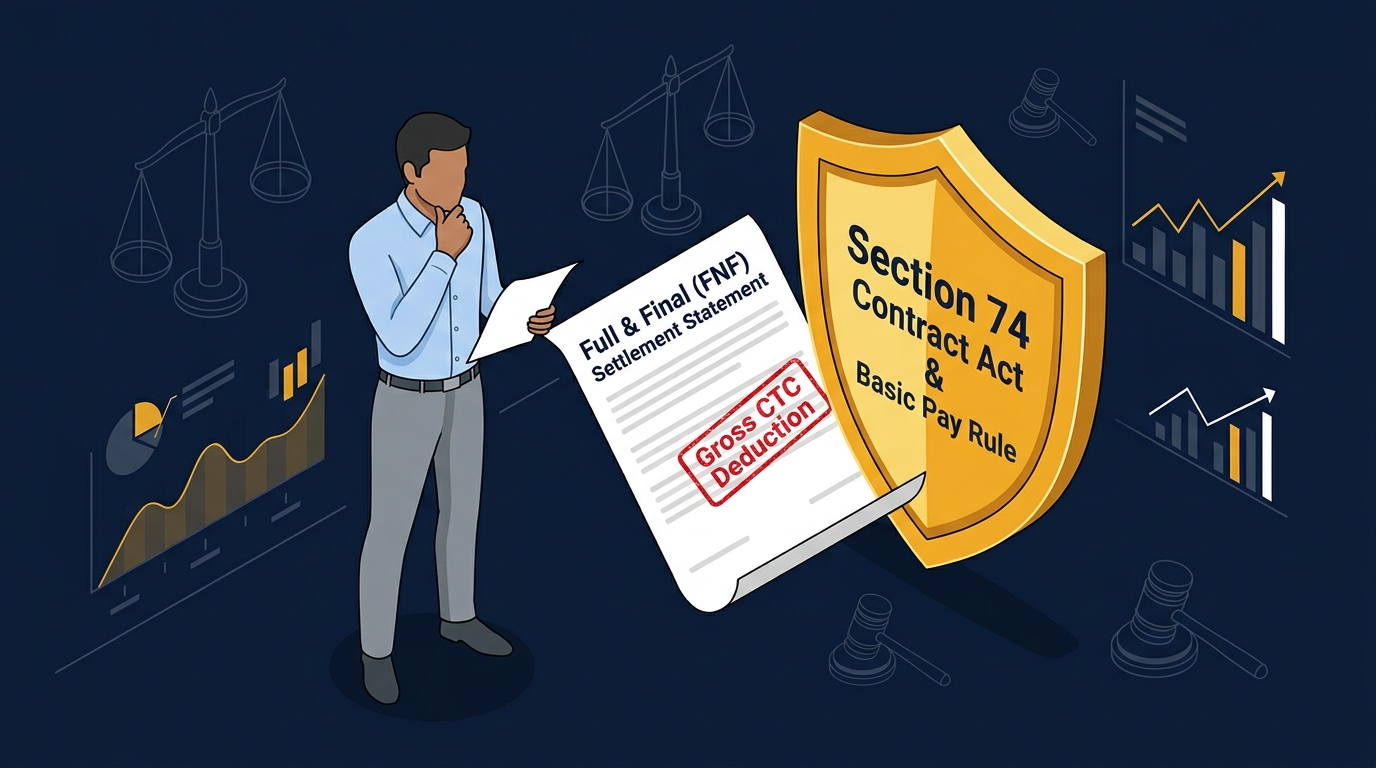
Notice Period Recovery on Gross CTC vs Basic Pay in FNF (2026)
notice period recovery on basic or gross salary in fnf, negative fnf settlement recovery legal notice, illegal notice period buyout deduction in fnf, can employer deduct variable pay in fnf, fnf settlement recovery india, recover withheld variable bonus after resignation
Read Article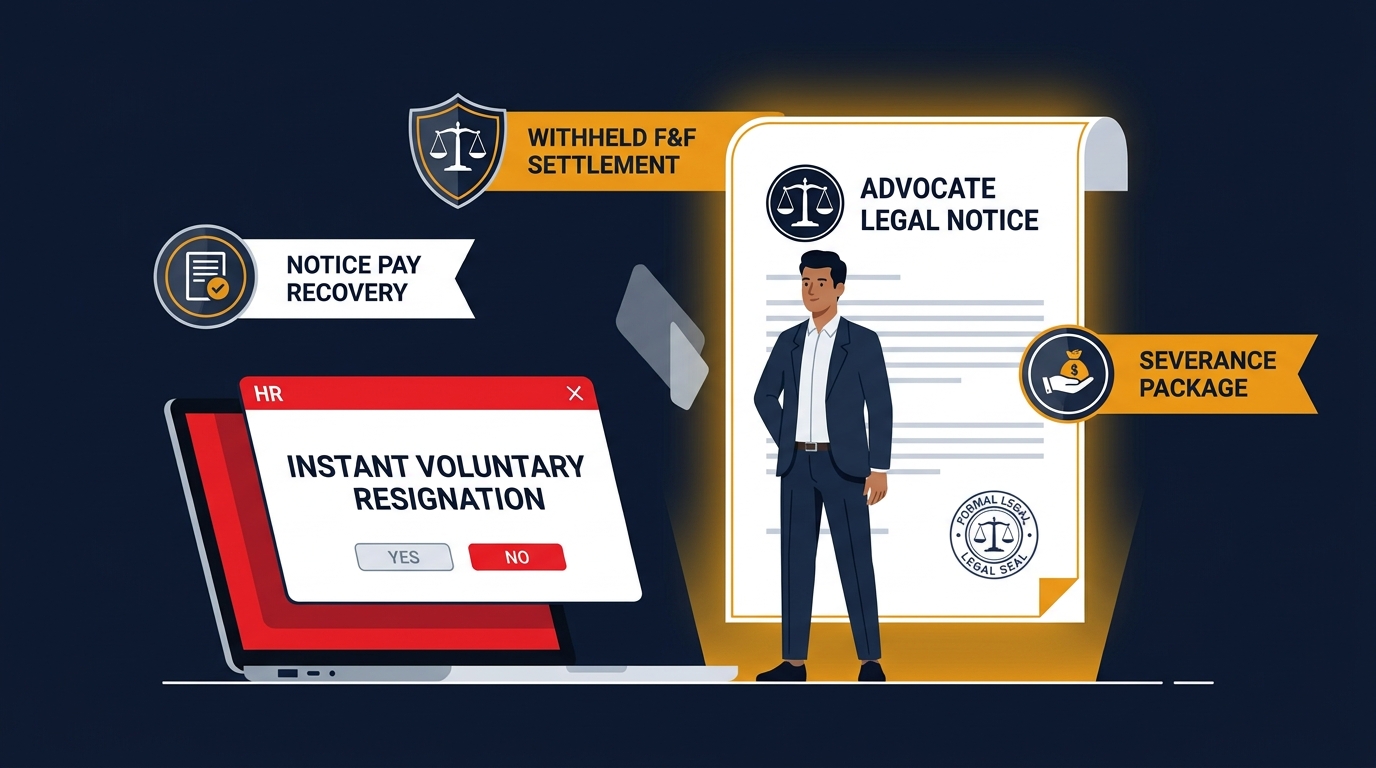
Forced to Resign in Layoffs? How to Recover Severance & FNF (2026)
forced resignation fnf and severance pay recovery, forced resignation during layoff legal notice india, pip termination without notice pay recovery, how to claim severance pay in india, illegal termination fnf settlement recovery, company forcing to resign without notice period pay, section 25F retrenchment compensation it sector, section 15 16 indian contract act duress resignation, bogus pip forced resignation legal notice, recover notice pay after forced resignation
Read ArticleAbout Author
Anuj Anand Malik
View ProfileAnuj Anand Malik, Founder of AMA Legal Solutions, is a trusted advocate, loan settlement expert, legal advisor, and banking lawyer. With over a decade of experience in loan settlement, corporate law, financial disputes, and compliance, he leads a result-driven law firm based in India that helps individuals, startups, and businesses achieve legal and financial stability.
Connect on LinkedInNeed Legal Help?
Get expert advice on loan settlement, banking disputes and debt relief.
Start Recovery NowRequest Callback