How to Defend Rs 2L-5L Training Bond & Recover Withheld FNF (2026)
employment bond recovery legal notice defense, employer holding fnf for training bond, is employment bond legal in india for freshers, how to recover fnf without paying bond amount, section 74 contract act employment bond, company demanding cheque for training bond recovery

Table of Contents
Table of Contents
Swipe →Leaving a job should be a proud step in your career. Yet many Indian professionals face a sudden demand from HR for a Rs 2 Lakh to Rs 5 Lakh training bond. Companies in IT, edtech, and consulting often put strict bond terms into job offers. When an employee resigns, HR uses the bond to create fear. They freeze your Full and Final (FNF) settlement. They hold your earned salary. They refuse to issue your relieving letter and experience certificate. Some even threaten to deposit your blank security cheque under Section 138 of the Negotiable Instruments Act.
If you face this pressure today, take heart. Indian law does not permit bonded labor. Companies cannot invent fake training costs to trap workers or confiscate earned wages. Under Section 27 and Section 74 of the Indian Contract Act, 1872, employment bonds are strictly conditional. An employer cannot recover money unless they prove real, out-of-pocket financial loss in court. This 2026 legal guide shows you how to defend your rights, defeat fake bond claims, stop security cheque threats, and recover 100% of your withheld FNF settlement.
The Truth About Employment Training Bonds in India (2026 Legal Reality)
Company recruiters often claim that an employment bond is absolute. They tell freshers that signing a bond removes their right to resign. That claim is false under Indian law. No private contract can take away your basic legal rights. You always have the right to resign from your job.
In Indian courts, a service bond is treated as an agreement with a liquidated damages clause. The Supreme Court of India and various High Courts have set clear rules for these agreements:
- Right to Resign: Every worker has the legal right to resign by giving contractual notice. An employer cannot force you to work against your will. Forced labor is barred by the Constitution of India.
- Restraint of Trade Is Void: Under Section 27 of the Indian Contract Act, 1872, any clause that stops you from working elsewhere is void. A bond cannot lock you to one company.
- Proof of Actual Loss Is Mandatory: Under Section 74 of the Contract Act, a company cannot simply demand the bond figure. They can only recover reasonable compensation for actual financial loss proved with bills.
- No Penalty Clauses Allowed: A bond clause meant to punish or scare an employee is a penalty. Indian courts strike down penalty clauses as unlawful.
When HR withholds your earned pay or exit papers over an invalid bond, you can take prompt legal action. Learn how to take charge of your exit dues in our guide on how to recover Full and Final settlement from employer without endless court delays.
Routine On-the-Job Training vs Certified External Training Under Law
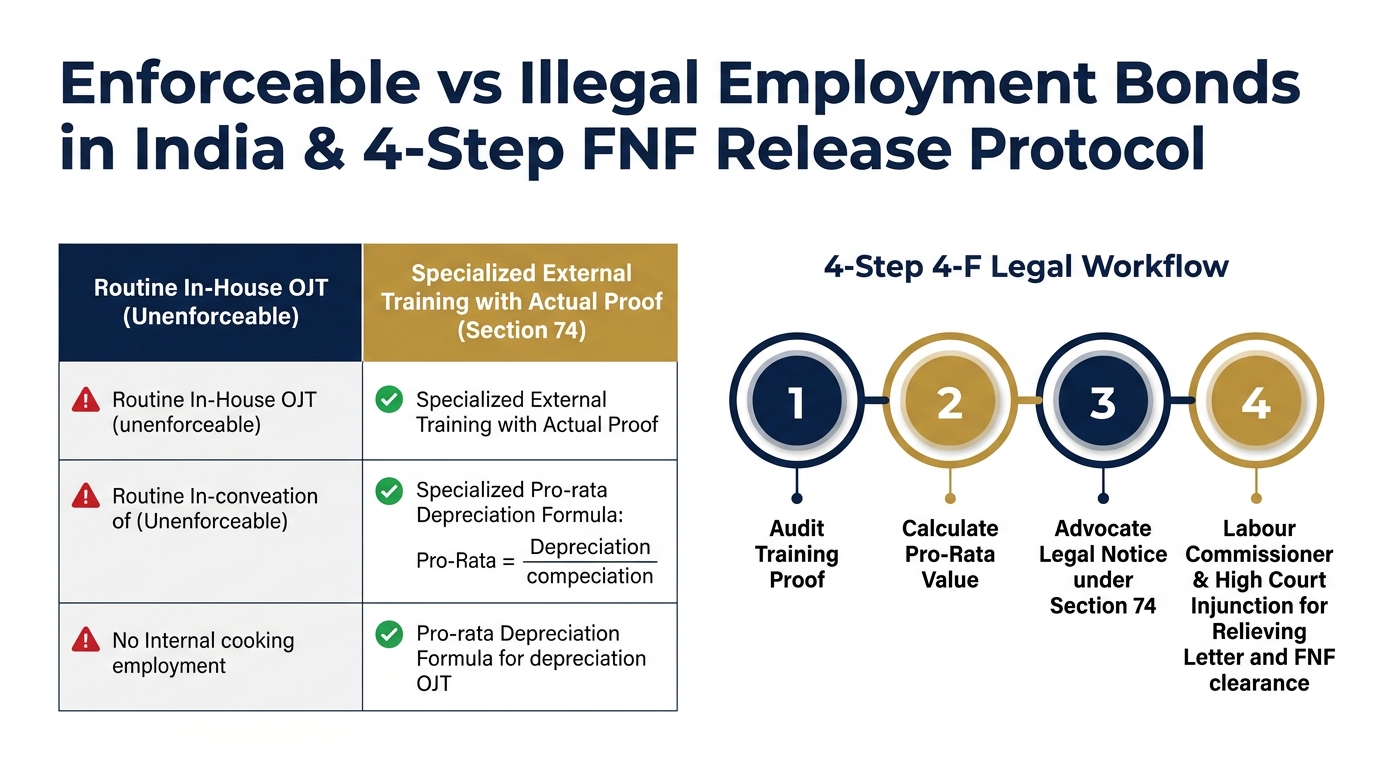
The main question in any bond dispute is simple: did the company provide real training, or just regular job onboarding? In most cases, companies try to recover money for routine work guidance.
The Landmark Sicpa India Ruling on Routine Business Shadowing
The key ruling on this point comes from the Delhi High Court in M/s. Sicpa India Limited v. Shri Manas Pratim Deb. In that case, the company sent an executive on business trips to Switzerland and Singapore. They made him sign bonds worth Rs 2,00,000 each. The firm claimed these overseas trips were advanced corporate training. When the employee quit early, the company sued him for the full bond money.
The Delhi High Court dismissed the suit. The court held that ordinary business travel and routine project shadowing do not count as specialized training under Section 74. The court ruled that normal operating costs cannot be shifted to an employee. To claim training costs, an employer must prove that the worker gained distinct, certified skills beyond daily job tasks.
The Toshniwal Brothers Principle of Actual Vouchered Expenditure
In contrast, the Madras High Court in Toshniwal Brothers (Pvt.) Ltd. v. E. Eswarprasad dealt with a case where an engineer received formal technical training at substantial company cost. The court held that an employer can seek compensation only when it proves real spending. The employer must show third-party bills, tuition fee receipts, and travel costs paid exclusively for that employee.
Internal training by senior peers, recorded company videos, and routine project trials cost the company zero extra cash. Therefore, routine internal knowledge transfer cannot support a damages claim under Section 74.
Mandatory Pro-Rata Depreciation Across the Service Period
Even if an employer pays an outside institute for real training, they cannot demand the entire bond sum upon early exit. Indian courts apply a pro-rata formula. The company gains value from your skills while you work there. For instance, suppose you served 18 months of a 24-month bond. The company already enjoyed 75% of your service. Any lawful recovery is strictly capped at the remaining 25% balance.
Real Rupee Math: Defeating a Rs 3 Lakh Fake Bond Demand in FNF
Let us look at a typical 2026 workplace case. An IT engineer joins a firm at an annual CTC of Rs 6,00,000 (Monthly Basic Pay: Rs 25,000; Monthly Gross: Rs 50,000). The firm forces the engineer to sign a Rs 3,00,000 training bond for 24 months and takes an undated security cheque.
The engineer resigns after serving 16 months. The firm only provided two weeks of basic slide shows and internal shadowing. At exit, HR withholds 45 days of worked pay (Rs 75,000), cancels 20 days of earned leave pay (Rs 16,666), and demands the full bond amount.
| FNF & Bond Financial Item | Company HR Demand Math | Lawful Statutory Audit (Section 74) | Governing Legal Rule & Court Precedent |
|---|---|---|---|
| 1. Earned Salary for 45 Days Worked | Held by HR (Rs 0 Paid) | + Rs 75,000 (Full Credit) | Payment of Wages Act (Earned wages cannot be seized by HR) |
| 2. Earned Leave Encashment (20 Days) | Forfeited by HR (Rs 0 Paid) | + Rs 16,666 (Full Credit) | State Shops and Establishments Act mandatory leave encashment rule |
| 3. Internal Training Bond Demand | - Rs 3,00,000 (Arbitrary Penalty) | Rs 0 (Completely Disallowed) | Sicpa India Precedent (Routine internal OJT is zero loss under Section 74) |
| 4. External Certified Course Cost | Rs 0 Actually Spent | Rs 0 (No Bills Produced) | Toshniwal Brothers Rule (Strict proof of actual third-party payment required) |
| 5. 18% GST Added on Bond Penalty | - Rs 54,000 (Illegal GST Demand) | Rs 0 (100% Removed) | CBIC Circular No. 178/10/2022-GST (Zero GST on notice pay or bond buyout) |
| 6. Final Net Settlement Payable | - Rs 3,54,000 (HR demands employee pay) | + Rs 91,666 (Company must pay employee) | Net Financial Swing of Rs 4,45,666 in Employee Favor |
As this calculation shows, applying statutory law turns a fake corporate demand of Rs 3,54,000 into a real recovery of Rs 91,666 owed directly to you. An employer who cuts notice pay on gross salary or adds illegal tax charges violates central rules. For detailed math on exit deductions, read our guide on notice period recovery on basic vs gross salary in FNF.
Why Security Cheques Demanded by HR Fail Under Section 138 NI Act
Many Indian companies demand blank security cheques from freshers during joining. When an employee resigns, HR threatens to deposit the cheque for Rs 2 Lakh to Rs 5 Lakh. They threaten criminal action under Section 138 of the Negotiable Instruments Act, 1881. This threat causes sharp anxiety, but it fails under the law when handled early.
Absence of Crystallized Debt at the Time of Resignation
To file a case under Section 138, the complainant must prove that the cheque was issued for a legally enforceable debt. A claim for breaking a training bond does not create an automatic debt. An employment bond is merely an unproven damages claim under contract law.
Unless the company proves actual financial loss before a civil court, no legal debt exists on the date the cheque is banked. The Supreme Court has repeatedly held that an unadjudicated claim for damages is not a debt under Section 138. If HR writes a huge bond sum onto your blank security cheque, they are misusing the instrument.
Misuse of Blank Security Cheques and Supreme Court Precedents
The Supreme Court in cases like Sripati Singh v. State of Jharkhand and Sunil Todi v. State of Gujarat held that security cheques can attract Section 138 only when an actual debt matures. That rule applies to business loans, commercial supplies, and financial defaults. In an employment bond, no money was ever lent to you. You can easily prove in court that the cheque was taken as a blank security document when you joined the company.
Immediate Steps: Bank Stop Payment and Written Revocation Notice
If HR threatens to deposit your security cheque, take these two protective steps right away:
- Instruct Your Bank for Stop Payment: Submit a written letter or net-banking request to your bank for a Stop Payment on that cheque number. State clearly that the cheque was taken as an employment security document and is disputed.
- Serve a Written Cheque Revocation Notice: Send a formal email to HR stating that the security cheque was taken without consideration and is now revoked. Put the company on notice that depositing an unauthorized cheque constitutes criminal breach of trust.
These actions protect your bank account and create solid proof that shields you from criminal liability. If your employer still delays your exit documents, you can initiate employer withholding relieving letter legal action through legal channels.
Visual Dispute Resolution & Recovery Framework
Statutory Matrix: Laws That Protect Employees Against Bond Extortion
Human resources departments often count on employees not knowing their rights. In truth, Indian labor laws provide strong protections against corporate pressure. The table below summarizes the key legal forums and remedies available to you.
| Indian Legal Forum & Statute | Scope of Legal Protection | Remedy & Penalty on Defaulting Employer |
|---|---|---|
| Section 27, Indian Contract Act, 1872 | Applies to all clauses that restrict trade or career movement | Declares any clause that blocks your right to work completely void in court. |
| Section 74, Indian Contract Act, 1872 | Governs liquidated damages and breach of service contracts | Bars arbitrary fines. Mandates strict proof of actual out-of-pocket training costs. |
| Section 138, Negotiable Instruments Act | Protects cheque drawers against misuse of security instruments | Dismisses cases where a cheque was banked for an unproven damages claim. |
| State Shops & Establishments Acts | Covers IT firms, offices, startups, and consulting agencies | Labour Officer issues direct summons to company directors for withheld FNF pay. |
| Payment of Wages Act, 1936 (Section 15) | Bars illegal deductions from earned employee wages | Enforces release of held pay plus compensation up to 10 times the deducted sum. |
| Industrial Disputes Act, 1947 | Bans unfair labor practices by management against employees | Treats holding exit papers and pay for bond demands as an unfair labor practice. |
| Order 37, Code of Civil Procedure, 1908 | Summary suit for fast recovery of unpaid salary and dues | Requires employer to deposit disputed funds in court before defending the suit. |
Understanding these statutes helps you stand firm against unlawful HR demands. When an employer withholds your earnings, learn how to recover unpaid salary legally through formal legal representation.
Withholding Relieving Letters and Certificates: Constitutional Violations
The most unfair tactic in bond disputes is HR holding back your relieving letter, experience certificate, and academic records. Employers know that your new company needs exit documents for background checks. They use this leverage to force you to pay fake bond charges.
Article 21 and Article 19: The Fundamental Right to Livelihood
The Constitution of India protects your Right to Livelihood under Article 21 and your right to practice any trade under Article 19(1)(g). High Courts across India have ruled that an employer cannot hold service papers hostage over a money dispute. A relieving letter is simply proof of your service period. Denying that letter to hurt your new job violates your basic constitutional rights.
Section 27 Contract Act: Voiding Post-Employment Servitude
Trying to stop an employee from joining another firm by withholding exit papers is an indirect restraint of trade under Section 27 of the Contract Act. Indian courts do not accept post-job non-compete rules or corporate blacklists. Once you resign and finish handover, your duty to the company ends.
Criminal Misappropriation and Coercion Under Indian Law
Holding your original degrees or identity cards is an offense under criminal law. Your degrees remain your private property. Keeping them is unlawful retention and criminal breach under the law. Furthermore, threatening your career to make you pay bond money amounts to coercion under Section 15 of the Contract Act.
If your company refuses to release your exit documentation, serve an advocate demand notice without delay. Read our guide on employer holding relieving letter and FNF settlement to see the legal steps available to you.
4-Step Advocate Counter-Strategy to Break the Bond and Recover FNF
Beating an illegal training bond demand requires a calm, firm legal plan. Sending polite emails to HR rarely works because company policies are built to protect corporate cash. Follow this four-step strategy to defend your rights and recover your money.
Step 1: Audit Training Records and Demand Invoices Under RTI or Notice
Start by gathering all records from your employment. Save your offer letter, bond paper, training schedule, and project emails. Note down the exact number of months you worked. When HR demands bond money, do not agree to pay anything verbally.
Send an email demanding itemized, written proof of training costs. Ask for copies of third-party bills, course fee receipts, and external trainer invoices paid just for you. If the company only gave you routine internal onboarding, their inability to show bills destroys their claim.
Step 2: Calculate the Pro-Rata Offset Against Withheld Wages
Next, build a clear financial ledger. Add up every rupee the company owes you. This includes your held salary, leave encashment, and any unpaid bonuses. Even if the firm paid for real training, apply the pro-rata formula to prove that your unpaid wages cover any lawful cost.
Step 3: Serve an Advocate Legal Reply and FNF Counter-Notice
Do not wait for the firm to sue you or deposit your cheque. Take the lead by having an advocate send a formal Legal Reply and Counter-Notice. A notice on a law firm letterhead changes everything. It moves the matter from an HR desk to the company legal team, who know the litigation risks.
Your legal reply accomplishes four key goals:
- It rejects the bond demand under Section 27 and Section 74 of the Contract Act.
- It formally revokes any security cheque or written undertaking given at joining.
- It demands your relieving letter, experience certificate, and Form 16 within 7 days.
- It files a firm counter-claim for your held salary with 18% annual interest.
You can easily send a legal reply or recovery notice online through our platform for delivery via Speed Post, email, and WhatsApp.
Step 4: Escalate to the Labour Commissioner and SAMADHAN Portal
If the company fails to respond within the 7-day notice period, escalate the dispute to the labor authorities. File a complaint on the central government SAMADHAN Portal (samadhan.labour.gov.in) or with your local Shops and Establishments Inspector. The Labour Officer will issue a summons to company directors for conciliation.
Because companies face heavy penalties for withholding wages, corporate legal teams settle most bond disputes at this stage. They release your pay and exit papers rather than face labor court inquiries. For details on legal timeframes, check the time limit to file a money recovery case in India.
Reclaim Your Career Freedom and Withheld Earnings Today
You worked hard to build your employer's business. You do not owe thousands of rupees in artificial fines for moving forward in your career. Holding your hard-earned pay and service papers to enforce an unproven bond is unlawful across India.
Take charge of your career today. Start your Full and Final settlement recovery and send a formal legal notice for Full and Final settlement delay through LegalRecovery. Our experienced legal team will defend you against invalid bond demands and help you recover every rupee you earned.
Popular Searches & Related Topics

Legal Recovery is India's trusted consumer protection and legal tech platform. We specialize in holding corporations accountable for unfair trade practices, deceptive marketing, and commercial fraud. With over 15,000 customers counselled, our mission is to provide fast, out-of-court resolutions by connecting you with top-tier panel advocates for immediate legal action.
Client Reviews
"My IT employer in Electronic City demanded Rs 2.5 Lakh for a 2-year fresher bond. They held my 45-day salary and relieving letter. LegalRecovery sent a strong notice demanding training bills under Section 74. The company dropped the bond claim in 10 days and paid my full FNF of Rs 88,000."
Aditya Kulkarni (Bengaluru)
"HR threatened to deposit my security cheque of Rs 3 Lakh when I resigned at 14 months. LegalRecovery helped me issue a bank stop payment and served a notice citing the Sicpa India case. HR returned my uncashed cheque and gave my relieving letter without taking any money."
Sneha Ramachandran (Chennai)
"A software firm withheld my relieving letter and Rs 1.10 Lakh in salary over internal training costs. The legal reply from LegalRecovery showed that recorded video training does not qualify as special training under the law. The company cleared all my dues in two weeks."
Manish Agarwal (Noida)
"When I left my startup job for a better role, the founders demanded Rs 4 Lakh for an onboarding trip. LegalRecovery replied with case law proving business trips are not training. The founders backed down and settled my pending salary right away."
Tanvi Saxena (Pune)
"LegalRecovery turned an aggressive Rs 2 Lakh bond threat into a full FNF recovery of Rs 94,500. Their command of Section 74 and Labour Officer rules gave me total confidence during a stressful job switch."
Harshavardhan Rao (Hyderabad)
Frequently Asked Questions
Related Articles

About Author
Team LegalRecovery
View ProfileTeam LegalRecovery is a dedicated team of legal and financial professionals specializing in loan settlement, banking disputes, debt relief, and corporate compliance. We are committed to helping clients achieve debt freedom and business stability through expert strategic advisory.
Connect on LinkedInNeed Legal Help?
Get expert advice on loan settlement, banking disputes and debt relief.
Start Recovery NowRequest Callback