Notice Period Recovery on Gross CTC vs Basic Pay in FNF (2026)
notice period recovery on basic or gross salary in fnf, negative fnf settlement recovery legal notice, illegal notice period buyout deduction in fnf, can employer deduct variable pay in fnf, fnf settlement recovery india, recover withheld variable bonus after resignation
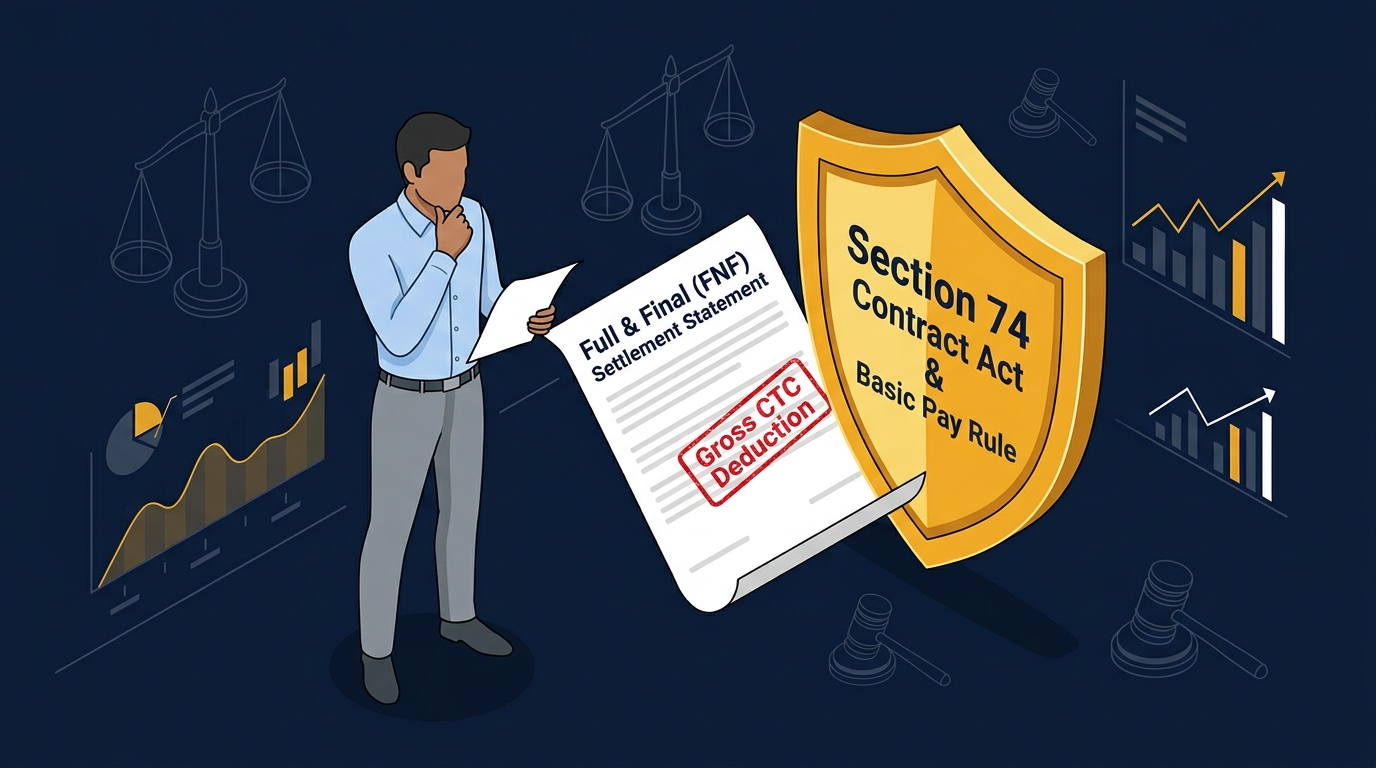
Table of Contents
Table of Contents
Swipe →Receiving a Full and Final (FNF) Settlement Statement after weeks of waiting, only to see that HR has wiped out your held salary and generated a Negative FNF, is one of the most common workplace disputes in India. Across IT services, banking, consulting, pharma, and startup hubs in Bengaluru, Gurugram, Hyderabad, Pune, Mumbai, and Noida, payroll teams often inflate exit deductions. They do this by calculating notice period recovery on Gross CTC instead of Basic Salary. Many companies also add illegal 18% GST charges, refuse to credit Earned Leave (EL/PL) encashment at gross rates, and forfeit earned quarterly variable pay.
If your former employer has cut your FNF payout or is holding your Relieving Letter hostage behind an inflated notice period buyout, you do not have to accept their unilateral math. Under Section 7 to Section 13 of the Payment of Wages Act, 1936, Section 73 and Section 74 of the Indian Contract Act, 1872, and CBIC Circular No. 178/10/2022-GST, arbitrary payroll penalties and Gross CTC recoveries are legally flawed. This 2026 legal recovery guide explains the exact statutory law, provides a rupee-by-rupee calculation table, and shows you how to send a legal notice for Full and Final settlement delay to recover 100% of your rightful dues within 7 to 15 days.
Why HR Calculates Notice Buyout on Gross CTC (And Why It Fails)
When an employee resigns and requests an early relieving date, such as serving 30 days out of a 60-day or 90-day notice period, the appointment letter usually asks for 'salary in lieu of notice'. However, a major legal conflict arises over how 'salary' is defined for those unserved days. To keep more cash, many corporate payroll teams apply an unfair double standard during the exit process.
First, when the employee owes notice period buyout to the company, HR calculates the daily recovery rate using Total Gross Salary or Total CTC. That inflated base includes House Rent Allowance (HRA), Special Allowance, Conveyance, Employer Provident Fund (EPF) contribution, Gratuity provisioning, and Group Medical Insurance premiums. Second, when the company owes Leave Encashment or Notice Pay to the same employee, HR switches the formula and pays strictly on Basic Salary, which is only 35% to 40% of Gross CTC.
Under Indian contract law and labour court rulings, this one-sided calculation fails legal scrutiny on four strong grounds:
- The Contra Proferentem Rule in Employment Contracts: Appointment letters are standard contracts drafted solely by the employer. If the exit clause states 'one, two, or three months salary in lieu of notice' without specifying whether 'salary' means Basic Pay or Gross Pay, courts interpret the ambiguity against the employer. The deduction must be limited to Basic Salary.
- Non-Wage CTC Overheads Can Never Be Deducted: Even if an offer letter explicitly mentions 'Gross Salary in lieu of notice', an employer can never legally deduct CTC overheads. Items like the Employer's 12% EPF share, Gratuity accrual (4.81%), ESIC, or annual health insurance premiums for unserved days are not wages paid to you. The company never spent that money for the days after your exit, so deducting it is pure unjust enrichment.
- Section 74 of the Indian Contract Act, 1872: A notice period buyout clause is a liquidated damages clause governed by Section 74 of the Indian Contract Act. The Supreme Court of India holds that when a contract sets a fixed sum for breach, the company can only claim reasonable compensation for actual loss proved. If you were on the bench, or if you completed your full project handover before leaving, the company suffered zero financial loss.
- Parity Between Notice Recovery and Leave Encashment: Under principles of equity enforced by Labour Commissioners, a company cannot price one calendar day at Rs 4,000 when deducting an unserved notice day while pricing that same employee's Earned Leave day at Rs 1,500 in the same FNF statement. If your employer is refusing to release your documents over this dispute, read our guide on employer holding relieving letter and FNF settlement.
Real Rupee Math: Turning a Negative FNF Into a Rs 1.14L Payout
Let us look at how payroll teams build a false negative FNF. Consider a 2026 case of a Senior Software Engineer earning a monthly Gross CTC of Rs 1,20,000 (Monthly Basic Pay: Rs 45,000; Monthly In-Hand Salary: Rs 96,000) with a 90-day notice period. The employee serves 45 days of notice (whose salary is held by HR during exit), has 30 days of Earned Leave, is owed Rs 45,000 in completed Q3 Variable Pay, and asks for a buyout of the remaining 45 unserved notice days.
| FNF Statement Item | HR's Inflated 'Negative FNF' Math | Lawful Statutory Audit (Advocate Math) | Legal Rule Applied |
|---|---|---|---|
| 1. Held Salary for 45 Days Worked | + Rs 1,44,000 (Credited) | + Rs 1,44,000 (Credited) | Earned wages under Payment of Wages Act & Code on Wages |
| 2. Notice Buyout (45 Days Shortfall) | - Rs 1,80,000 (Charged on Rs 1.20L CTC) | - Rs 67,500 (Charged on Rs 45,000 Basic) | Ambiguous clause restricted to Basic; CTC overheads barred u/s 74 Contract Act |
| 3. 18% GST Added on Buyout | - Rs 32,400 (Illegal GST surcharge) | Rs 0 (100% Removed) | CBIC Circular No. 178/10/2022-GST (Zero GST on notice pay recovery) |
| 4. Earned Leave Encashment (30 Days) | + Rs 20,400 (Capped & cut on Basic) | + Rs 45,000 (Full 30 days credited) | State Shops and Establishments Act mandatory leave encashment rule |
| 5. Completed Q3 Variable Bonus | Rs 0 (Forfeited by HR) | + Rs 45,000 (100% Payable) | Section 70 Contract Act (Earned pay for completed quarter cannot be forfeited) |
| 6. Statutory TDS on Net Payout | Rs 0 | - Rs 52,500 (Deposited in Form 26AS) | Section 192 Income Tax Act (Tax credit reflected in PAN) |
| FINAL NET FNF BALANCE | - Rs 48,000 (HR asks employee to pay!) | + Rs 1,14,000 (Company must pay employee!) | Net Recovery Swing of Rs 1,62,000 in Employee's Favor |
As this table proves, a line-by-line legal audit turns an intimidating HR demand email asking you to pay Rs 48,000 into an enforceable legal claim where the employer must pay you Rs 1,14,000. You can use this exact framework to recover Full and Final settlement from your employer without protracted court battles.
Top 5 Illegal Deductions in Indian FNF Statements (2026 Audit)
1. Charging 18% GST on Notice Period Recovery (Barred by CBIC)
For years, several corporations added 18% Goods and Services Tax (GST) on top of notice period buyout deductions. They claimed that permitting an employee to exit early was a taxable service of 'tolerating an act' under the CGST Act, 2017. However, the Ministry of Finance (CBIC) issued Circular No. 178/10/2022-GST, which settled the law across India:
- Forfeiture of salary or recovery of notice pay from an employee leaving early is not consideration for any supply of service by the employer.
- Such recovery is only a contractual penalty deterrence, meaning 0% GST applies to notice period recovery or bond buyouts.
Despite this clear central government rule, many IT companies, BPOs, and staffing agencies still deduct 18% GST in 2026. Pointing out CBIC Circular No. 178/10/2022-GST in a legal notice for salary recovery forces the company's finance team to immediately reverse the 18% tax cut.
2. Forfeiting Earned Variable Pay, Commissions, or Quarterly Bonuses
HR teams frequently point to a policy line stating: 'The employee must be active on the rolls and not serving notice on the date of bonus payout.' Courts allow companies to attach active-service conditions to purely discretionary gift bonuses. However, performance-linked variable pay, sales commissions, and quarterly billability bonuses that are part of your promised CTC are treated as deferred wages once you complete the target period.
Suppose you worked the entire April to June quarter, met 100% of your KRA targets, and resigned in July. The company has already billed the client and pocketed the profit from your work. Refusing to pay that earned variable pay in your FNF simply because payroll processes bonuses in September violates Section 70 of the Indian Contract Act, 1872. When an employee performs work lawfully and not gratuitously, the company enjoying the benefit must make full payment.
3. Refusing Leave Offset While Pricing Leave Encashment at Basic Pay
Imagine you have 30 Earned Leaves (EL) in your portal and a 30-day notice shortfall. If HR refuses to adjust those 30 leaves against your notice period and instead deducts 30 notice days at Rs 3,500 per day (Gross Pay) = Rs 1,05,000, while encashing your 30 Earned Leaves at Rs 1,200 per day (Basic Pay) = Rs 36,000, the employer has created an unfair Rs 69,000 gap for the exact same 30 days. Under State Shops and Establishments Acts in Karnataka, Maharashtra, Delhi, Telangana, and Tamil Nadu, accumulated privilege or earned leave must be encashed at the full statutory wage rate upon exit.
4. Deducting Buyout After Manager Approved Early Release by Email
During exit discussions, project managers or HR partners often write on email or Teams: 'Since your handover is complete and you are between projects, we can release you this Friday.' The employee leaves in good faith, only to find a 60-day notice recovery deducted from their FNF a month later. Under Section 63 of the Indian Contract Act, 1872 and the rule of Promissory Estoppel, once management approves an early release date without clearly stating a monetary buyout condition in writing, the company waives its right to deduct notice pay.
5. Arbitrary IT Laptop Damage, Training Cost, or Client Penalty Cuts
Under Section 7 and Section 10 of the Payment of Wages Act, 1936, an employer cannot deduct arbitrary amounts from your FNF for minor laptop wear, normal battery aging, or vague 'client transition delays'. Before making any damage deduction, the company must issue a formal written Show Cause Notice, prove willful negligence by the employee, and limit the cut to the actual vouchered repair invoice. Similarly, if your employer has deducted tax and PF from your final salary without depositing it with the government, you can send an unpaid salary and PF not deposited legal notice to hold the directors personally accountable.
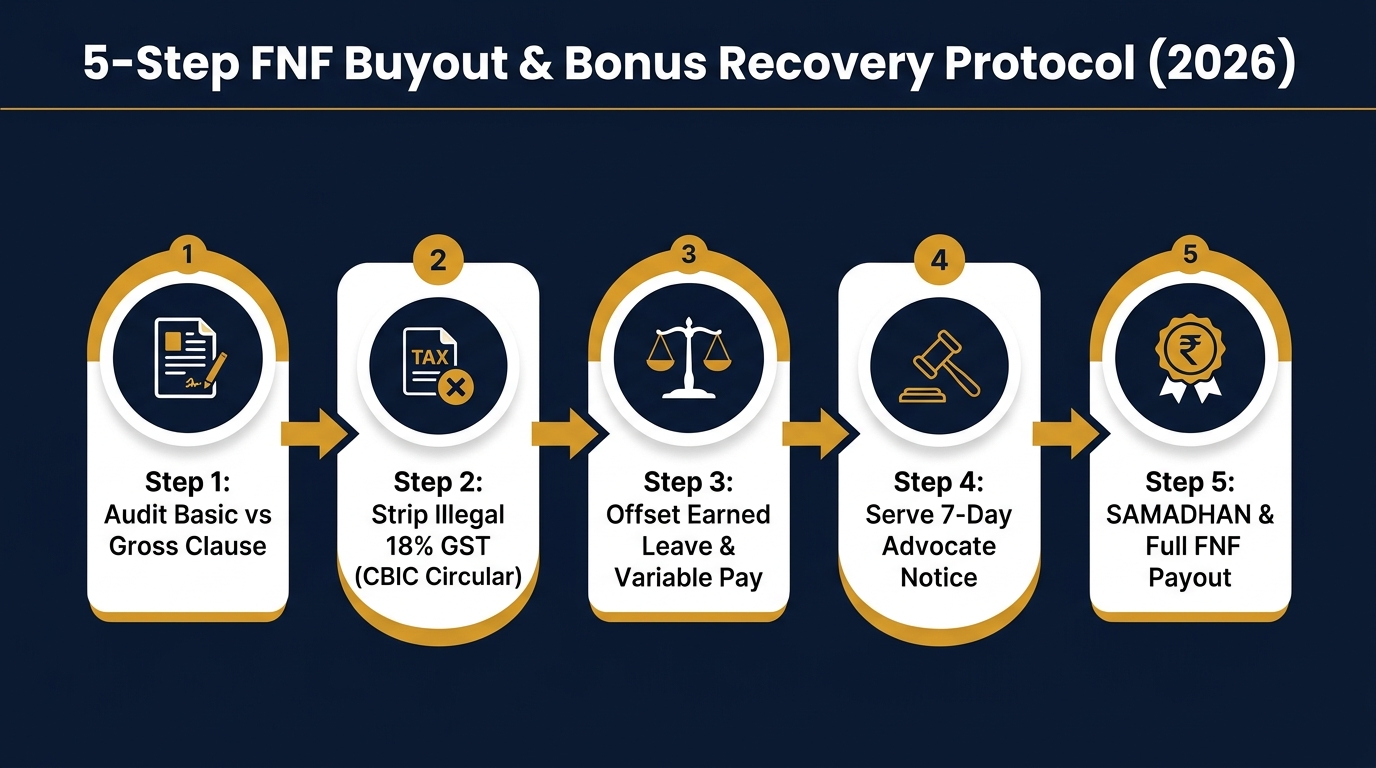
Visual Dispute Resolution & Recovery Framework
Statutory Laws That Force Employers to Settle FNF Claims Fast
When you send a polite reminder email to an HR helpdesk, your ticket sits in a queue because junior HR executives have no authority to override payroll software rules. In contrast, when an Advocate Legal Notice is served on the Company's Registered Office, Managing Director, CHRO, and CFO, the legal department steps in immediately because of strict statutory penalties:
| Indian Labour & Civil Statute | Employees Covered | Legal Power & Penalty on Defaulting Employer |
|---|---|---|
| Payment of Wages Act, 1936 (Sections 7 to 13 & 15) | Employees covered under statutory wage ceilings & Shops Act extensions | Bans unauthorized wage cuts. Section 15 allows the Authority to award up to 10 times the illegally deducted sum as penalty compensation. |
| Code on Wages, 2019 (Section 17 & Section 18) | All white-collar, tech, managerial, and operational employees | Mandates full wage settlement within 2 working days of resignation or exit, and caps permissible deductions at 50% of monthly wages. |
| State Shops & Establishments Acts (KA, MH, DL, TS, TN) | All IT, startup, corporate office, banking, and consulting employees | Covers commercial offices regardless of job title. Empowers the Labour Officer to summon directors for withheld FNF pay and leave encashment. |
| Section 73 & Section 74, Indian Contract Act, 1872 | All private-sector employees under employment contracts | Strikes down penal buyout clauses on Gross CTC where the company cannot prove actual financial loss from the early exit. |
| Order 37, Code of Civil Procedure, 1908 (Summary Suit) | Employees holding appointment letters, payslips & FNF sheets | Fast-track civil summary suit where the employer has no automatic right to defend unless they satisfy strict court conditions. |
How to Challenge a Negative FNF When Forced to Resign or Laid Off
A particularly harsh practice seen in 2026 tech and startup layoffs occurs when HR calls an employee into a meeting, pressures them to submit an immediate 'voluntary resignation' on the portal, and then either withholds severance pay or deducts notice pay for improper handover. If you were pushed out during a layoff or Performance Improvement Plan (PIP), the company cannot treat your exit as a voluntary resignation to deny you notice pay. In fact, when an employer initiates the separation, the employer must pay YOU 30 to 90 days of full notice pay! Read our detailed guide on wrongful termination and unpaid salary legal notice and startup laid off without paying salary to claim your full contractual notice pay.
5-Step Action Plan to Recover Your FNF Deductions in 7 to 15 Days
Step 1: Never Sign a Blanket 'No-Dues Waiver' Without Recording Protest
Many exit portals on Darwinbox, Workday, Keka, or Zoho People block you from viewing your FNF sheet or downloading your Relieving Letter until you click 'I accept the full and final settlement'. If you are forced to click accept so your new employer's Background Verification (BGV) does not fail, send an email to HR within 30 minutes stating: 'I have clicked accept on the portal strictly under financial duress to obtain my relieving letter. I dispute the Gross CTC notice deduction and reserve my legal right to recover the balance.' Under Supreme Court law, a waiver signed under economic compulsion cannot block your statutory wage claim.
Step 2: Collect Your 4 Key Exit Proof Documents
Before sending your legal notice, save local copies of these four records outside your company email:
- Appointment Letter & CTC Breakup Sheet: Highlight the exact text of the Notice Period and Termination clause.
- Last 3 Months' Salary Slips: Show your exact monthly Basic Pay, HRA, Special Allowance, and accrued leave balance.
- Handover & Asset Clearance Proofs: Save screenshots of your manager's handover approval email, IT laptop return receipt, and any chat approving early release.
- The Disputed FNF Calculation Sheet: Keep the PDF or email showing the inflated Gross CTC deduction, 18% GST charge, or missing variable bonus.
Step 3: Serve an Advocate Legal Notice With a 7-Day Recalculation Table
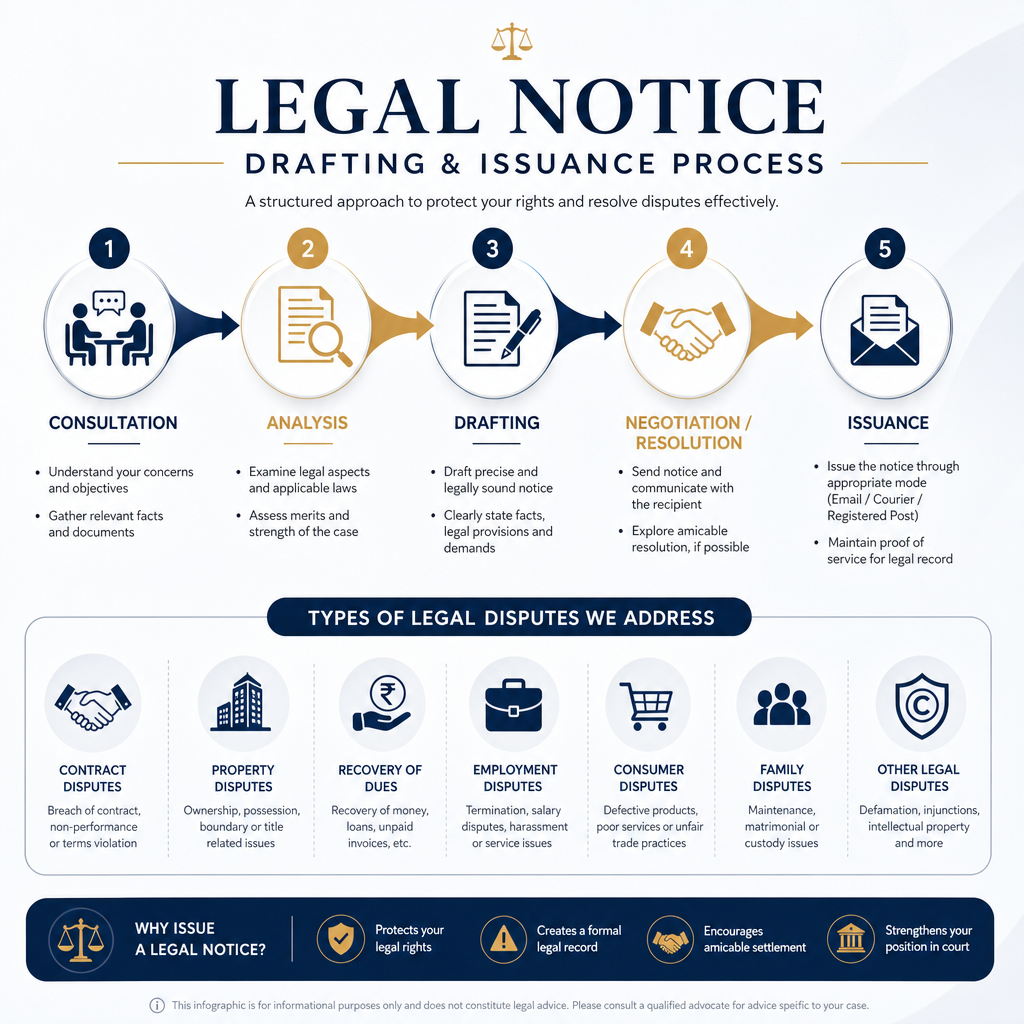
Stop sending emotional follow-up emails that HR ignores. Instead, start your FNF money recovery online by serving a formal Advocate Legal Notice via Speed Post, email, and WhatsApp to the company's Directors, CHRO, and Head of Payroll. A strong FNF recovery notice includes:
- A clear recalculation table comparing HR's illegal Gross CTC math against the lawful Basic Salary formula.
- Direct citations of Section 74 of the Indian Contract Act, Section 7 of the Payment of Wages Act, and CBIC Circular No. 178/10/2022-GST.
- A firm 7-day deadline to transfer the corrected FNF balance along with 18% per annum interest, plus your clean Relieving Letter, Experience Certificate, and Form 16.
- Warning that non-payment within 7 days will lead to immediate escalation on the Ministry of Labour SAMADHAN Portal, before the Shops and Establishments Inspector, and a civil Order 37 Summary Suit.
Step 4: Escalate on the SAMADHAN Portal & Labour Commissioner
In more than 75% of employee FNF disputes handled through LegalRecovery, the company's legal and finance teams recalculate the FNF sheet and wire the held salary within 7 to 14 days of receiving the Advocate Notice. Paying an advocate to defend an illegal Gross CTC or GST deduction before the Labour Commissioner costs the company far more than settling your claim. If the employer still delays past the 7-day notice window, your legal notice acts as the foundation to file an online claim on the central SAMADHAN Portal (`samadhan.labour.gov.in`), triggering an official conciliation notice to the company directors.
Step 5: Verify Your Form 16 and EPFO Service Exit Date
When the company settles your revised FNF amount, ensure two final compliance steps are completed in writing. First, verify that any TDS deducted from your positive FNF payout is deposited against your PAN in Form 26AS and AIS. Second, ensure that HR marks your accurate 'Date of Exit' in the EPFO Unified Portal without any false adverse remarks, allowing smooth PF transfer to your new employer.
Recover Your Rightful FNF Settlement Today
You worked hard for every rupee of your salary, leave balance, and performance bonus. Do not let an unfair payroll formula turn your hard work into a fake 'Negative FNF' or rob you of your earned pay. Check the time limit to file a money recovery case in India and send a legal notice for Full and Final settlement delay through LegalRecovery today to force a fast, transparent, and lawful recalculation of your Full and Final settlement.
Popular Searches & Related Topics

Legal Recovery is India's trusted consumer protection and legal tech platform. We specialize in holding corporations accountable for unfair trade practices, deceptive marketing, and commercial fraud. With over 15,000 customers counselled, our mission is to provide fast, out-of-court resolutions by connecting you with top-tier panel advocates for immediate legal action.
Client Reviews
"My IT services company in Whitefield sent me a negative FNF demanding Rs 64,000 after deducting 45 days of notice buyout on my total CTC plus 18% GST. LegalRecovery drafted a sharp legal notice citing CBIC Circular 178/10/2022-GST and Basic Pay buyout rules. Within 8 days, payroll reversed the deduction and credited Rs 92,400 to my bank account along with my relieving letter."
Siddharth Nair (Bengaluru)
"HR held my last month salary and forfeited Rs 1.15 Lakh of my Q3 performance variable pay claiming I was not active on the payout date even though I completed the entire quarter. After LegalRecovery served a legal notice to the CHRO and Directors, they released my full variable payout and FNF in 11 days."
Priyanka Deshmukh (Pune)
"My employer calculated my 30-day notice shortfall on Gross CTC including employer PF and insurance while encashing my 28 Privilege Leaves on Basic salary. The advocate notice from LegalRecovery exposed this double standard and got Rs 78,500 refunded into my final settlement."
Rohan Khanna (Gurugram)
"When I had to join my new company early due to a medical emergency at home, my previous employer froze my FNF of Rs 1,42,000. LegalRecovery handled the legal notice and negotiation professionally, and I received the entire settlement without going to court."
Ananya Iyer (Hyderabad)
"Best platform for employee FNF recovery. Instead of generic templates, their notice included an exact rupee-by-rupee audit of my payslip, Basic vs Gross buyout clause, and leave encashment. HR settled within a week of receiving the Speed Post and email notice."
Vikramaditya Sen (Mumbai)
Frequently Asked Questions
Related Articles

About Author
Team LegalRecovery
View ProfileTeam LegalRecovery is a dedicated team of legal and financial professionals specializing in loan settlement, banking disputes, debt relief, and corporate compliance. We are committed to helping clients achieve debt freedom and business stability through expert strategic advisory.
Connect on LinkedInNeed Legal Help?
Get expert advice on loan settlement, banking disputes and debt relief.
Start Recovery NowRequest Callback