How to Recover an Unpaid Invoice from a Client in India
Learn what to include in a payment demand, what evidence to keep, and when an eligible MSE can use the ODR route.
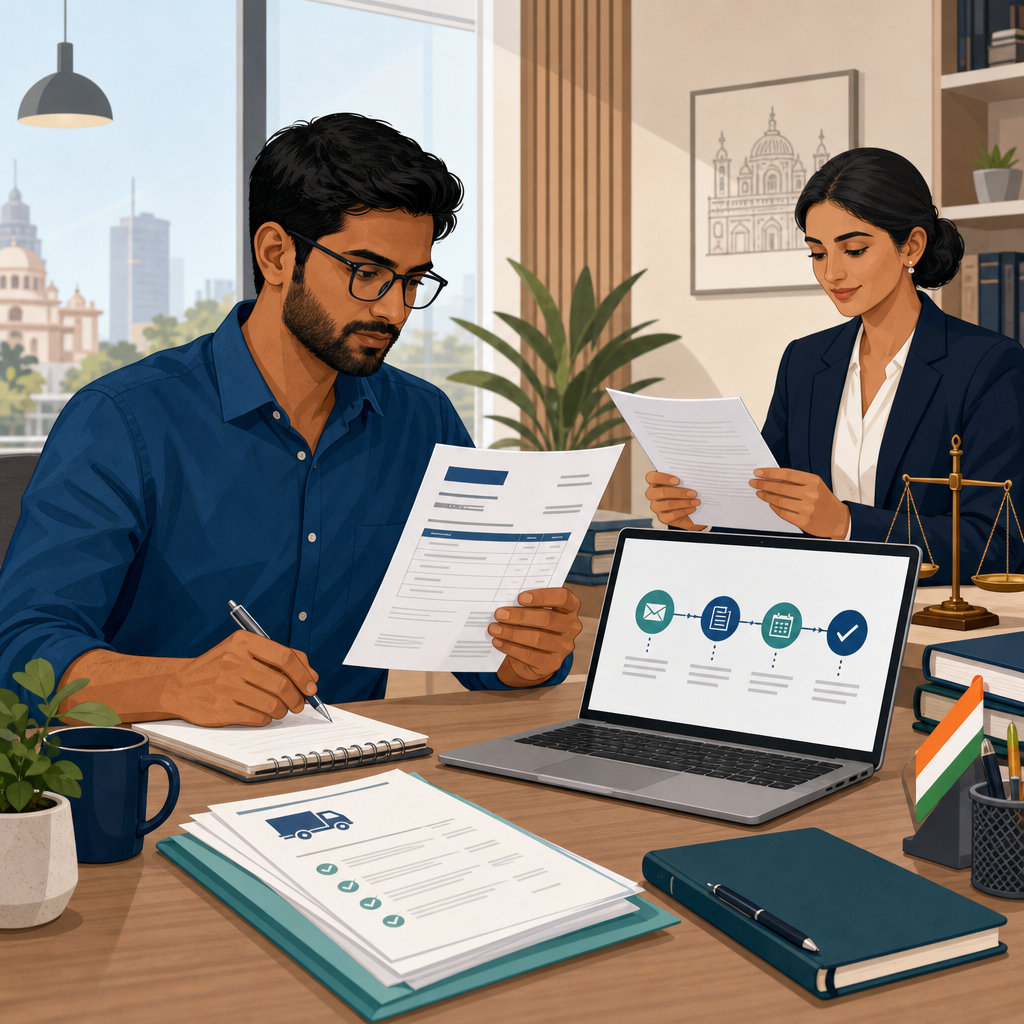
Table of Contents
Table of Contents
Swipe →You finished the work, sent the invoice, and expected to be paid. Instead, you are hearing “accounts is processing it,” getting new objections, or receiving no reply at all. That is stressful, especially when you have your own bills and people to pay. You do not need to jump straight into a court case. Start by checking exactly what is owed, gathering proof of the work, and sending a clear payment demand. This guide explains how to do that, what a legal notice should say, and which recovery route may fit your situation in India.
First, work out what the client actually owes you
An unpaid invoice is not always a simple question of “they have not paid.” The client may say the work was incomplete, the goods were rejected, or a part-payment was already made. Before you demand a figure, make sure you can explain it line by line. A precise account is harder to dismiss and easier to use if you later need formal help.
Reconcile the account before sending another reminder
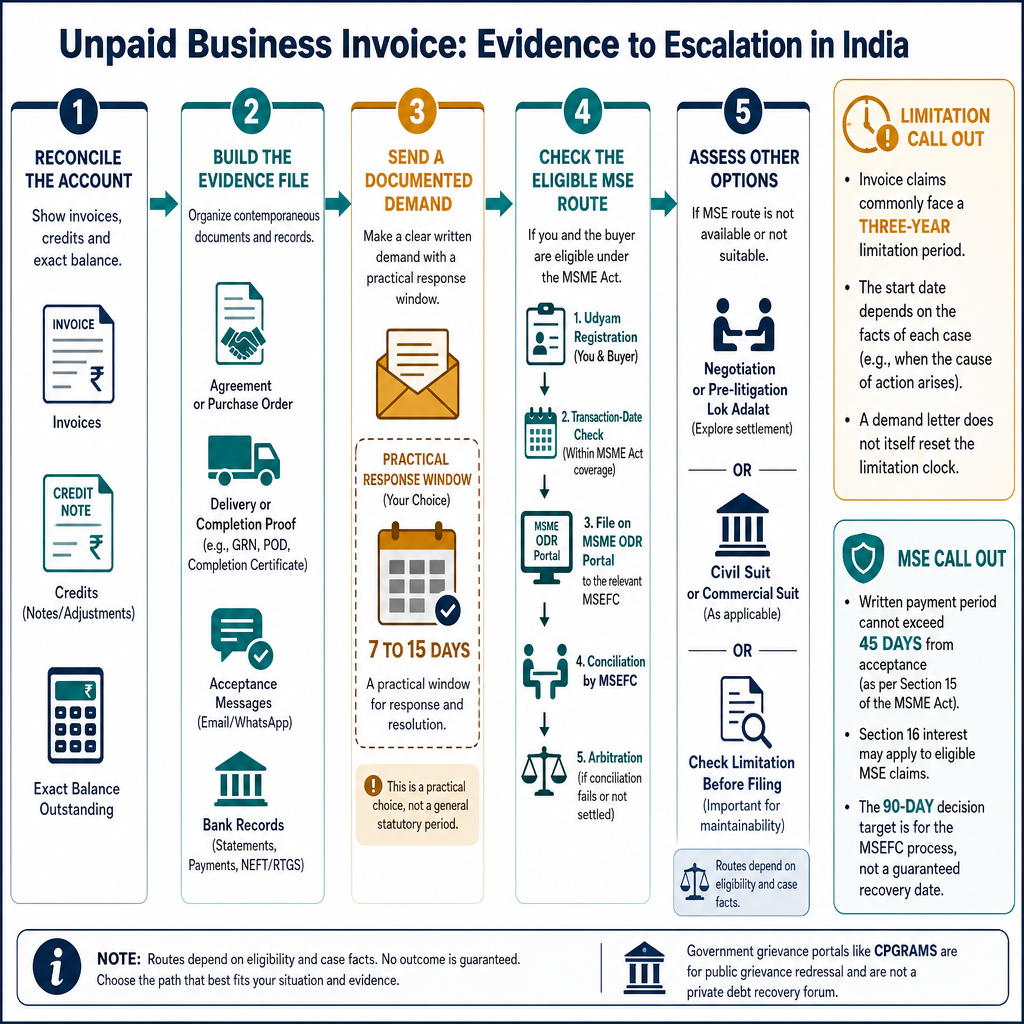
Put the purchase order or agreed scope beside every invoice. Check the payment terms, due dates, credit notes, deductions you accepted, and amounts received in your bank account. If several invoices are outstanding, list them separately rather than sending one unexplained total. Keep GST details consistent with your records. Do not claim contractual interest unless the agreement provides for it, or a law applicable to your claim supports it.
If the client raises a quality complaint, ask them to identify the specific deliverable, defect, and date of objection in writing. You can respond without accepting an inaccurate complaint. Where only part of the work is disputed, request payment of the undisputed balance now. That keeps a genuine disagreement about one item from becoming an excuse to withhold everything.
Does the kind of work you did change your options?
Yes. A designer or consultant may need to show that the agreed files or services were delivered. A goods supplier may rely on delivery challans and receipt records. A contractor may need completion records and messages approving milestones. The recovery steps are similar, but the strongest proof differs. LegalRecovery’s guidance for freelancer and client payments and vendor and invoice recovery addresses these two common situations.
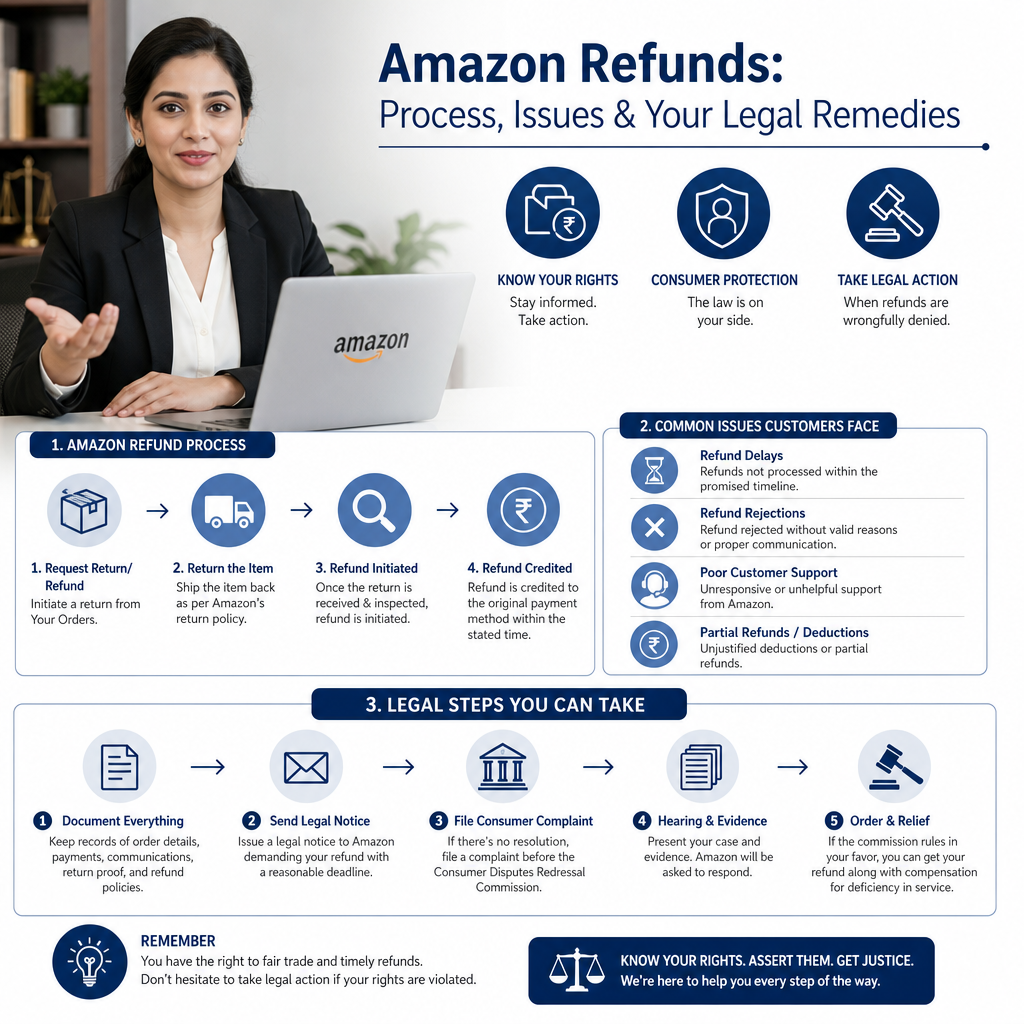
Do not assume a consumer complaint is the right shortcut. When you are a supplier asking a business client to pay your invoice, you are generally pursuing a business debt, not complaining as a consumer who bought goods or services.
Build a proof file that tells the whole story
You do not need a perfect contract to begin organising your claim. You do need a clear trail showing what was agreed, what you supplied, when payment became due, and what remains unpaid. Collect the records now, while messages and files are still easy to find. For a closer look at proving freelance work, see this payment-recovery evidence checklist.
What to keep | What it helps show |
|---|---|
Signed agreement, accepted quotation, purchase order and payment terms | The scope, price, buyer and agreed payment date |
Invoices, GST details, ledger, credit notes and bank statements | Each amount billed, adjustments made and balance due |
Delivery challans, service records, submitted files and milestone reports | That goods arrived or work was completed |
Acceptance emails, messages, reminders, objections and your replies | How the client responded and whether a dispute was raised |
Notice, postal tracking, delivery confirmation and sent email | What you demanded and whether it reached the client |
Udyam registration and registration date, if claiming as an MSE | Whether the special delayed-payment route may apply |
Save original emails, chats, attachments and electronic files rather than relying only on screenshots. If copies of electronic records are used in proceedings, section 63 of the Bharatiya Sakshya Adhiniyam, 2023 governs their admissibility and the associated certificate. A lawyer can help prepare that material when needed. For now, your task is simpler: preserve the originals and avoid editing the record.
Make a short chronology too. For example: quotation accepted on one date, work delivered on another, invoice sent, payment due, reminder sent, client response received. If a conversation happened by phone, follow up with a factual email summarising what was discussed. A tidy file makes your demand clearer and helps you assess any settlement offer without guessing.
What should your unpaid-invoice legal notice say?
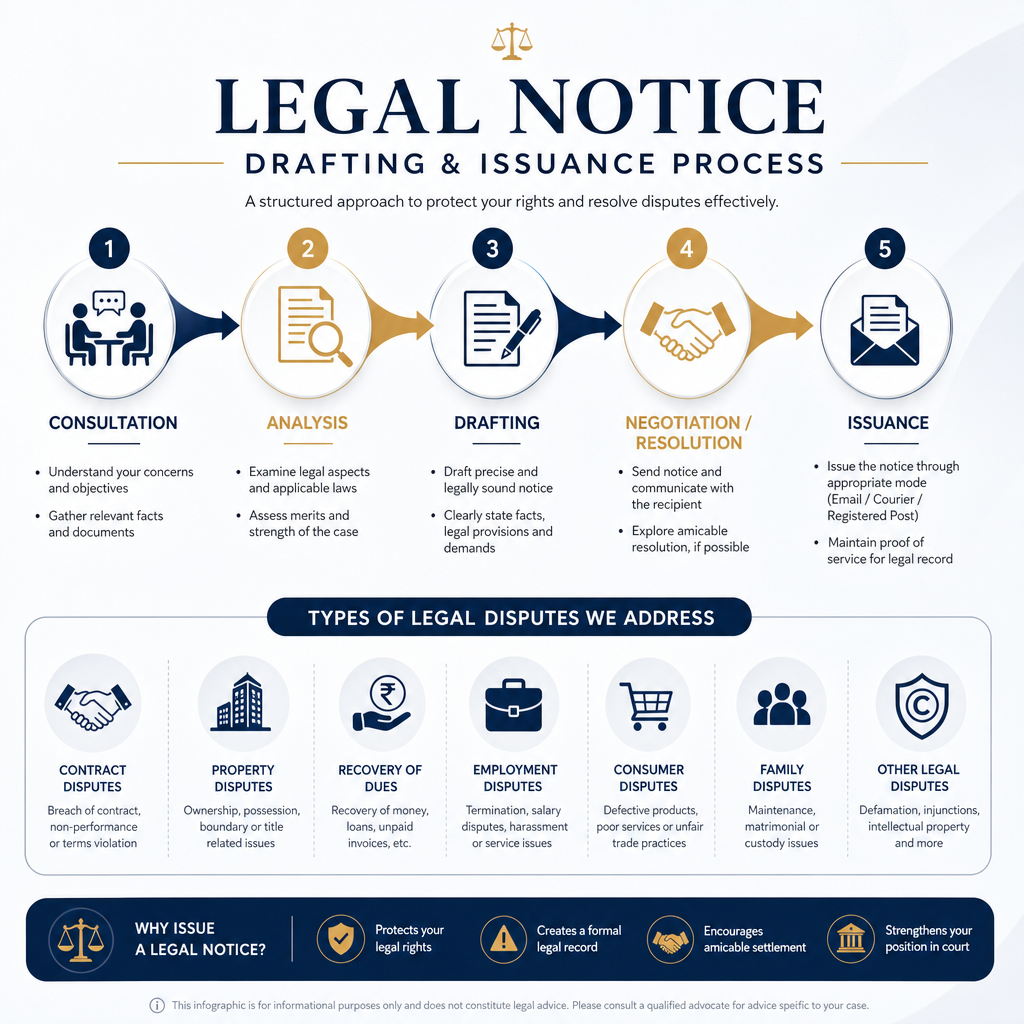
If polite reminders have gone nowhere, a dated legal notice gives the client a final, specific opportunity to pay or explain the dispute. It is a formal demand, not a guarantee of payment and not a court order. Its value is that it sets out your position, identifies the proof, and creates a documented point from which to decide your next move.
Include the details the client can check
Identify both parties: use the correct business names and the client’s contractual or registered address.
Identify the transaction: refer to the agreement or purchase order, the work or goods supplied, and each unpaid invoice number and date.
Show the calculation: state the invoice amounts, payments or credits received, and the exact balance. Explain any interest claimed and its basis.
Refer to delivery and objections: say when performance was completed and address any specific dispute already raised.
Ask for a clear action: give payment details, a response address and a definite deadline. A 7-to-15-day response period is often a practical choice, not a general statutory notice period.
State the next step calmly: say you may consider the appropriate recovery proceedings if the matter is not resolved.
Send the notice to the address specified in the contract or the client’s registered address by trackable post, and also email it to the contact used for the transaction. Save the postal receipt, tracking result, email and any reply. A WhatsApp reminder can be useful supporting evidence, but do not rely on an untraceable message as your only proof that a formal demand was delivered. If you want help checking the wording, use a legal notice drafting checklist before dispatch.
Keep the demand firm, not exaggerated
It is tempting to add every inconvenience the delay has caused. Focus instead on amounts you can support. Do not describe an ordinary payment dispute as a crime just to create pressure. If the client has a genuine objection, ask for written particulars and propose a way to resolve it while requesting the undisputed amount. A measured notice leaves room for payment without weakening your claim.
Visual Dispute Resolution & Recovery Framework
Can you send a notice online, and what happens next?
You can prepare and arrange dispatch remotely; the important part is accuracy and proof of delivery. LegalRecovery offers an online legal notice process for unpaid business payments. You submit the case, legal experts review it, a professional notice is drafted and sent by registered post, and the team follows up and helps assess escalation. Its online case management means you do not need a court visit to use the notice service. If a dispute later reaches a court, separate procedural requirements may apply.
LegalRecovery’s flat-fee pricing starts at ₹1,499. Check what your particular case requires and what is included before proceeding. You can also send a demand yourself or engage a lawyer directly. Whichever route you choose, give the person preparing it your complete account, including awkward facts such as a disputed milestone or a part-payment. Leaving those out can make a notice less useful.
Once the deadline passes, record whether the client paid, proposed a date, disputed the claim, or stayed silent. If they promise instalments, get the amount and dates in writing and track each payment. If they allege defects, ask for evidence and consider whether a negotiated reduction is commercially sensible. If they ignore you, do not send the same vague reminder for months. Decide promptly which forum fits your claim, because a notice by itself does not stop the limitation clock.
Are you eligible for the MSE delayed-payment route?
If your business is an eligible micro or small enterprise, you may have stronger statutory payment rights than an ordinary contractual claim provides. Check your status and the dates of registration, agreement and supply before relying on them. Registration obtained later does not retrospectively bring earlier contracts and supplies under this special route.
Under sections 15 to 18 of the Micro, Small and Medium Enterprises Development Act, 2006, an agreed written payment period cannot exceed 45 days from acceptance. Without an agreed period, payment must be made before the “appointed day,” which is the day following 15 days from acceptance. Section 16 provides monthly-compounded interest at three times the RBI-notified bank rate for delayed payment. These rules are worth checking carefully against the acceptance date and the terms of your particular transaction.
Where does an eligible MSE file now?
An eligible MSE can refer a delayed-payment dispute to the relevant state or Union Territory Micro and Small Enterprises Facilitation Council, or MSEFC. The route begins with conciliation; if that fails, the dispute may proceed to arbitration. The MSME Ministry says new delayed-payment cases have been filed through the MSME ODR portal, odr.msme.gov.in, since 15 October 2025. MSME Samadhaan remains relevant for information and existing cases. A notice and an MSEFC reference serve different purposes; this comparison of an MSME claim and a legal notice can help you understand the distinction.
The Act says a reference should be decided within 90 days, but treat that as a statutory target, not a promised payment date. If a buyer challenges an MSEFC award, section 19 generally requires a deposit of 75% of the awarded amount. Do not delay filing in the hope that discussions alone will settle everything. In July 2025, the Supreme Court held in Sonali Power Equipments that even a time-barred MSE claim may enter conciliation, but limitation applies if it moves to arbitration. Early action remains the safer choice.
There may also be a useful point for a documented discussion with an MSE buyer: from 1 April 2024, section 43B(h) of the Income-tax Act generally defers the buyer’s deduction for an overdue MSE payment until it is actually paid. That tax consequence is not an extra amount automatically payable to you.
If the notice is ignored, which route fits your claim?
There is no single complaint desk for every unpaid invoice. The right next step depends on whether you qualify as an MSE, whether the buyer will negotiate, the amount involved, and the terms of your agreement. These are alternatives to assess, not offices where you should file the same claim indiscriminately.
Your situation | Practical next step | Important limit |
|---|---|---|
Eligible MSE with delayed payment | Assess a reference through the MSME ODR portal to the relevant MSEFC. | Check registration and transaction dates; do not assume the 90-day target guarantees recovery. |
Buyer is willing to settle | Ask the District Legal Services Authority about pre-litigation Lok Adalat. | It depends on settlement; a Lok Adalat settlement award is binding. |
Ordinary business debt requiring a suit | Discuss the appropriate civil or commercial court with a lawyer. | Forum, procedure and evidence depend on the claim. eCourts e-filing is available where adopted. |
Government buyer with an administrative grievance | Consider CPGRAMS for the service-delivery grievance. | It cannot give you a private debt decree and excludes court-related or sub judice matters. |
For suppliers outside the special MSE route, section 73 of the Indian Contract Act, 1872 addresses compensation for breach. A civil money-recovery suit may be available. Some fixed debts arising from written contracts may qualify for a summary suit under Order XXXVII, rule 1 of the Code of Civil Procedure, 1908; an invoice alone does not mean your case automatically qualifies. This civil recovery guide explains the basic route.
For a commercial dispute of at least ₹3 lakh, the Commercial Courts Act, 2015 may apply. Section 12A generally requires pre-institution mediation before a suit unless urgent interim relief is sought. You can ask the district legal services authority about that process. Its three-month target may be extended by two months with consent, but it is not a guaranteed settlement date.
How long do you have to act?
Waiting feels reasonable when a client keeps saying payment is “coming next week.” The risk is that invoice claims commonly face a three-year limitation period, and the starting date depends on the legal basis and facts of the claim. A qualifying signed acknowledgment can begin a fresh limitation period under section 18 of the Limitation Act, 1963. Your own demand letter does not reset the clock. If an older invoice is involved, get advice on the dates now rather than assuming another reminder buys time. See this guide to money-recovery time limits for further context.
A dishonoured cheque needs particular attention. If the client gave you a cheque that bounced, section 138 of the Negotiable Instruments Act, 1881 has separate strict steps, including sending a written demand within 30 days of receiving the bank’s dishonour information and allowing 15 days after the client receives it to pay. An ordinary 7-to-15-day invoice notice should not be used as a substitute without checking those requirements immediately.
Your next move can be manageable: reconcile the balance today, save the agreement and delivery proof, send a precise demand, and set a date to assess the reply. Payment might follow a notice, or you may need negotiation, an MSEFC reference, mediation or a suit. None has a guaranteed recovery time. What you can control is the quality of your records and how quickly you act. If you would rather have help managing the notice and follow-up remotely, you can review LegalRecovery’s five-step process and decide whether it suits your claim.
Popular Searches & Related Topics

Legal Recovery is India's trusted consumer protection and legal tech platform. We specialize in holding corporations accountable for unfair trade practices, deceptive marketing, and commercial fraud. With over 15,000 customers counselled, our mission is to provide fast, out-of-court resolutions by connecting you with top-tier panel advocates for immediate legal action.
Client Reviews
"A client had left several design invoices unpaid despite repeated reminders. LegalRecovery helped organise the invoice details and prepare a clear legal notice. The follow-up was professional, and the client agreed to pay the outstanding amount. I appreciated having a documented process and realistic guidance."
Aarav Mehta
"I was waiting on payment for completed consulting work and was unsure how to make a formal demand. LegalRecovery explained what records to provide and handled the notice process remotely. The client responded after receiving it, and we agreed on a payment schedule in writing."
Priya Nair
"Our small business had an overdue supplier invoice that was being pushed between the client's departments. LegalRecovery helped us present the invoice, delivery proof and balance clearly in a legal notice. Communication was timely, and the client settled the outstanding bill after follow-up."
Rohan Kulkarni
"I had completed a freelance project but had not received the final payment. LegalRecovery helped me understand which messages and delivery records to share, then arranged a professional notice. The client replied and paid the agreed outstanding amount. The process felt clear and respectful."
Sneha Iyer
Frequently Asked Questions
Related Articles
About Author
Team LegalRecovery
View ProfileTeam LegalRecovery is a dedicated team of legal and financial professionals specializing in loan settlement, banking disputes, debt relief, and corporate compliance. We are committed to helping clients achieve debt freedom and business stability through expert strategic advisory.
Connect on LinkedInNeed Legal Help?
Get expert advice on loan settlement, banking disputes and debt relief.
Start Recovery NowRequest Callback