How to Recover Money Owed to You in India
The right next step depends on why the money is owed, who owes it and which forum can hear your claim.

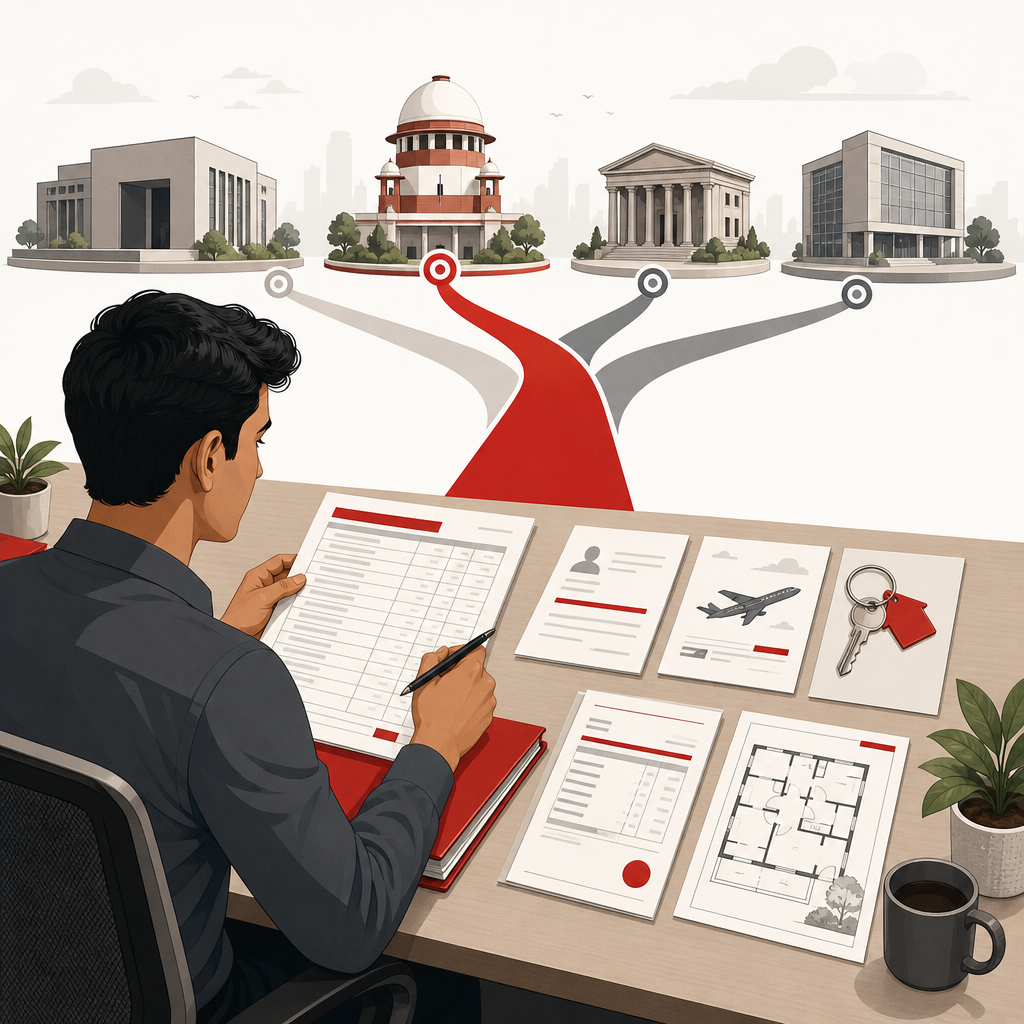
Table of Contents
Table of Contents
Swipe →Recover Your Debt Legally: Why Taking Legal Action Matters
Recovering money that someone owes you can become a frustrating experience, particularly when repeated reminders, phone calls and personal requests fail to produce results. Whether you have lent money to a friend, supplied goods to a business, completed professional work without receiving payment, or are waiting for an outstanding invoice, an unpaid debt can affect your financial stability.
The right approach is to recover your debt legally through a structured legal process rather than relying on repeated informal requests or unlawful recovery methods.
In India, creditors have several legal remedies to recover outstanding money. Depending on the nature of the transaction, available evidence and circumstances of the default, these remedies may include an advocate-drafted legal notice, a civil money recovery suit, a summary suit, proceedings under the Negotiable Instruments Act, 1881, or other applicable statutory remedies.
LegalRecovery.in, powered by AMA Legal Solutions, helps individuals and businesses take the first formal step towards recovering their outstanding money through professionally prepared, advocate-reviewed legal notices.
If someone owes you money, you do not necessarily have to accept indefinite delays. Understanding your legal rights and taking timely action can help protect your financial interests.
What Does It Mean to Recover Your Debt Legally?
Legal debt recovery refers to the process of claiming money owed by an individual, company, business partner, customer, tenant or other party through legally recognised procedures.
A debt may arise from several transactions, including:
Personal loans given to friends, relatives or acquaintances.
Outstanding business payments and commercial invoices.
Unpaid salary, professional fees and employment dues.
Pending vendor, contractor and freelancer payments.
Unreturned rental security deposits.
Unpaid amounts under written agreements.
Money due under dishonoured cheques.
Refunds arising from cancelled services or contractual breaches.
When a person or organisation fails to fulfil its payment obligations, the creditor may initiate appropriate legal action after examining the agreement, payment records, correspondence and applicable limitation period.
The objective of legal debt recovery is to establish the liability, formally demand payment and pursue the remedies available under Indian law.
How to Recover Your Debt Legally in India
The legal process depends on the nature of the outstanding amount. However, a structured recovery approach generally involves the following steps.
1. Collect Evidence of the Outstanding Debt
Before initiating legal proceedings, collect documents that establish the transaction and the amount payable.
Important supporting documents may include:
Loan agreements and written undertakings.
Bank statements and UPI transaction records.
NEFT, RTGS and IMPS payment confirmations.
Invoices, purchase orders and delivery receipts.
Emails, WhatsApp conversations and payment acknowledgements.
Cheques and cheque return memos.
Employment agreements and salary records.
Rent agreements and security deposit receipts.
Even where there is no formally executed loan agreement, bank transfers, written acknowledgements and other admissible evidence may help establish a monetary claim.
2. Send a Legal Notice for Recovery of Money
A legal notice is a formal written demand sent to the defaulting party through an advocate.
It communicates the underlying transaction, the outstanding amount, the basis of the payment obligation and the action that may follow if the recipient fails to comply.
A properly drafted money recovery legal notice generally contains:
Complete details of the creditor and debtor.
Background and chronology of the transaction.
Details of the outstanding principal amount.
Applicable contractual interest, where legally recoverable.
Supporting facts and relevant legal provisions.
A reasonable deadline for payment.
The proposed legal remedies in case of non-compliance.
A legal notice provides an opportunity to resolve the dispute before litigation and creates a formal record of the demand.
Important: A legal notice does not automatically guarantee repayment, constitute a court decree or extend the limitation period for filing a recovery claim.
3. Initiate a Money Recovery Suit
If the recipient refuses to pay despite receiving a legal notice, a creditor may consider filing a civil money recovery suit before the competent court.
The appropriate procedure depends on the amount claimed, the nature of the transaction, territorial and pecuniary jurisdiction, and supporting documents.
A recovery suit may seek:
Recovery of the outstanding principal.
Contractually or legally recoverable interest.
Litigation costs, where allowed.
Other appropriate reliefs recognised under law.
The court examines the evidence and the parties' respective claims before deciding the matter.
4. Consider a Summary Suit Under Order XXXVII CPC
Where the claim falls within the categories specified under Order XXXVII of the Code of Civil Procedure, 1908, a creditor may consider the summary suit procedure.
This procedure is relevant to specified claims arising from written contracts, negotiable instruments and certain liquidated monetary demands.
Unlike an ordinary civil suit, a defendant in a summary suit generally needs the court's permission, known as leave to defend, to contest the claim.
However, Order XXXVII is not available for every unpaid debt. The transaction and documentary evidence must satisfy the applicable legal requirements.
5. Explore Other Applicable Legal Remedies
Depending on the facts, other statutory remedies may also be available.
For example:
Section 138, Negotiable Instruments Act, 1881: Provides a statutory remedy for qualifying cheque dishonour cases, subject to strict notice and filing requirements.
Micro, Small and Medium Enterprises Development Act, 2006: Eligible micro and small enterprises may pursue delayed-payment remedies under Sections 15 to 18.
Consumer Protection Act, 2019: Appropriate consumer disputes may be pursued before the competent Consumer Commission.
Indian Contract Act, 1872: Contractual remedies may be available for breach of payment obligations, including compensation under Section 73 where applicable.
Selecting the correct legal remedy is important because different claims have different procedural requirements and limitation periods.
Types of Debts You Can Recover Through Legal Action
Not every debt originates from a bank loan. Many individuals and businesses struggle to recover money arising from everyday financial and commercial transactions.
Here are some common situations where legal recovery assistance may be useful.
1. Recover Money Lent to a Friend or Relative
Lending money to someone you trust does not eliminate your legal right to seek repayment.
If the borrower refuses to return the money, bank transfer records, UPI receipts, written acknowledgements and relevant communications may help support your claim.
A lawyer can examine the available evidence and prepare a suitable legal notice demanding repayment.
2. Recover Outstanding Business Payments
Delayed business payments can affect cash flow, vendor relationships and daily operations.
Businesses that have supplied products, completed projects or delivered services without receiving payment may consider sending a commercial legal notice.
Relevant evidence includes invoices, purchase orders, delivery confirmations, work completion records and payment correspondence.
3. Recover Unpaid Salary and Employment Dues
Employees may face delays or refusals in receiving earned salary, incentives, reimbursements, notice-period pay or full-and-final settlement amounts.
Depending on the employment relationship and applicable labour legislation, employees may have remedies before the relevant labour authority, tribunal or court.
A properly documented legal demand can help formally communicate the unpaid dues to the employer.
4. Recover Rental Security Deposits
Landlords sometimes delay or refuse to return security deposits after a tenant vacates a property.
If the deposit is contractually refundable and the landlord has no valid basis for withholding it, the tenant may pursue appropriate legal remedies.
The rent agreement, payment proof, possession handover records and communications are useful supporting documents.
5. Recover Money from a Business Partner
Disputes involving business partners may arise from unpaid contributions, contractual obligations, profit-sharing arrangements or misappropriation allegations.
The appropriate remedy depends on the partnership structure, contractual documents and actual nature of the dispute.
A legal review helps determine whether a civil recovery claim, contractual remedy or another proceeding is appropriate.
6. Recover Money Through a Cheque Bounce Case
When a cheque issued towards a legally enforceable debt or liability is dishonoured, the payee may be entitled to initiate proceedings under Section 138 of the Negotiable Instruments Act, 1881, provided the statutory conditions are satisfied.
The prescribed timeline for issuing the demand notice is generally 30 days from receiving information about cheque dishonour from the bank. The drawer then has 15 days from receipt of the notice to make payment.
Strict statutory deadlines apply to filing the complaint thereafter.
Important Indian Laws Governing Debt Recovery
Understanding the applicable law helps creditors select an appropriate recovery strategy.
Legislation | Relevant provision | Purpose |
|---|---|---|
Code of Civil Procedure, 1908 | Order XXXVII | Summary suits for specified monetary claims |
Negotiable Instruments Act, 1881 | Section 138 | Cheque dishonour proceedings |
Indian Contract Act, 1872 | Sections 73–74 | Compensation for breach of contract |
Limitation Act, 1963 | Article 19 and other applicable articles | Limitation periods for monetary claims |
MSMED Act, 2006 | Sections 15–18 | Delayed payment remedies for eligible MSMEs |
Consumer Protection Act, 2019 | Applicable complaint provisions | Consumer dispute redressal |
The limitation period for many ordinary money recovery claims is three years, but the applicable starting point and limitation article depend on the nature of the claim. A written acknowledgement or qualifying part-payment may affect limitation under Sections 18 and 19 of the Limitation Act, 1963, subject to statutory conditions.
Creditors should not delay legal consultation merely because they are repeatedly promised repayment.
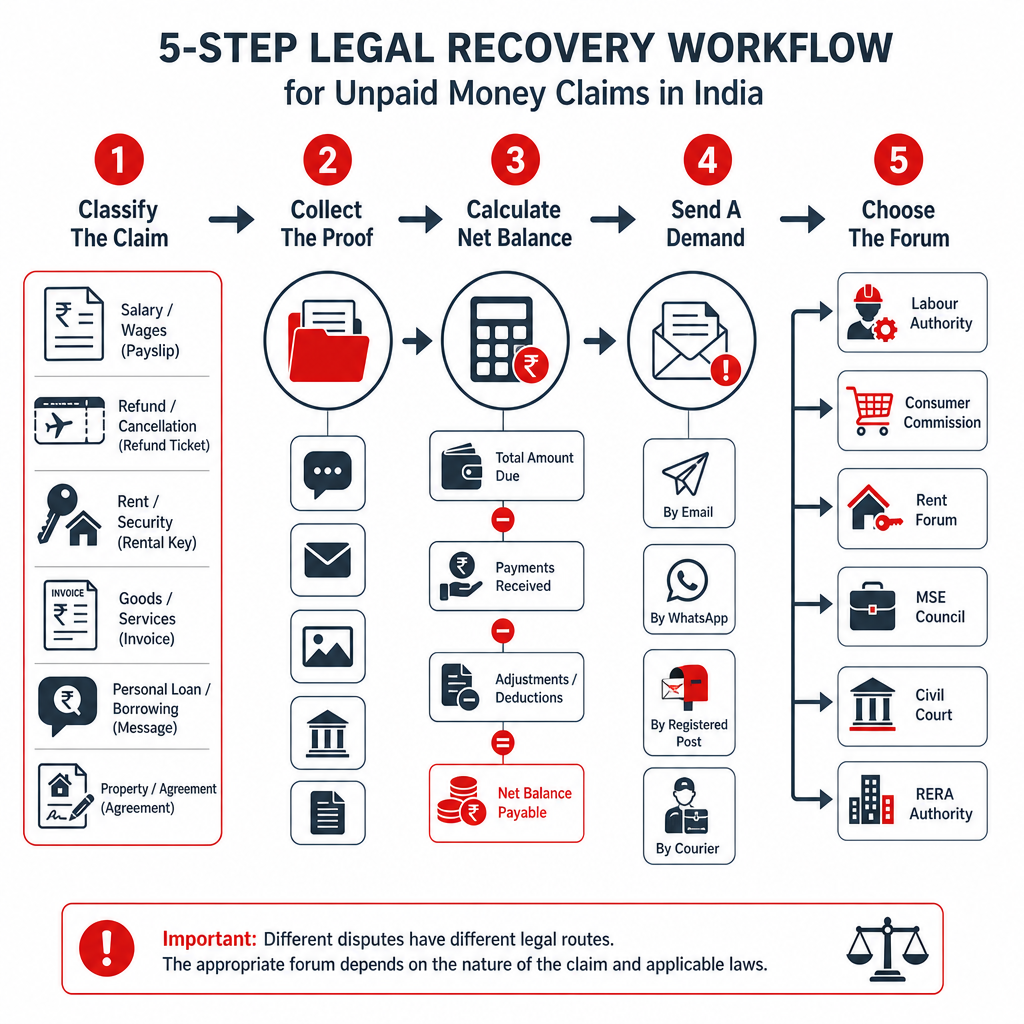
Visual Dispute Resolution & Recovery Framework
Why Should You Send a Legal Notice Before Filing a Recovery Case?
A legal notice is often a useful first step in resolving a payment dispute.
Its advantages include:
Formal communication: It communicates the creditor's demand through a structured legal document.
Clear payment demand: It identifies the amount claimed and the factual basis of the liability.
Opportunity for settlement: It gives the recipient an opportunity to resolve the dispute without immediately proceeding to litigation.
Documentary record: It preserves evidence that a formal demand was made and records the response, if any.
Legal preparation: It helps organise the facts and documents before deciding on further proceedings.
A legal notice is not compulsory in every ordinary civil money recovery case. However, certain statutory proceedings, including those under Section 138 of the Negotiable Instruments Act, require compliance with specific notice requirements.
How LegalRecovery.in Helps You Recover Your Money
LegalRecovery.in is an online legal notice and recovery assistance platform powered by AMA Legal Solutions.
It is designed to make the initial legal recovery process more accessible to individuals and businesses who are dealing with unpaid amounts.
Instead of navigating the drafting process independently, users can submit their dispute details and supporting documents online for legal review.
Our Legal Recovery Process
Step 1: Submit Your Case Details
Provide the details of the person or organisation from whom you want to recover money. Upload available documents, payment records and supporting evidence.
Step 2: Advocate Review
The submitted information and documents are reviewed by an advocate to assess the facts and prepare an appropriate legal notice.
Step 3: Legal Notice Drafting and Dispatch
The notice is prepared based on the dispute and applicable legal provisions, subject to advocate review and approval, and sent through the available delivery channels.
Step 4: Track Your Legal Notice
Monitor the status of your notice and available delivery updates through the platform.
Step 5: Consider Further Legal Remedies
If the recipient does not respond or refuses to pay, you may explore further legal assistance, including negotiation or appropriate proceedings through separately engaged legal representation.
Why Choose LegalRecovery.in?
Affordable legal assistance: Legal notice services start at ₹999 under the applicable plan.
Advocate-reviewed notices: Legal documents undergo advocate review before approval.
Digital process: Submit case details and supporting documents online.
Transparent pricing: A clearly stated flat-fee model without a commission on the recovered amount.
Powered by AMA Legal Solutions: Supported by a legal practice specialising in banking, finance and other legal services.
Accessible across India: Initiate your legal notice process without needing to visit a lawyer's office for the initial online submission.
The standard ₹999 plan covers one case, one opposing party, three legal notices and one police complaint draft, subject to the platform's applicable terms and eligibility review. A police complaint draft is not a substitute for a police investigation or a guarantee of criminal action.
LegalRecovery.in facilitates legal notice drafting and dispatch. Money recovery, settlement and court outcomes are not guaranteed. Court representation and additional litigation services require separate engagement.
Documents Required to Initiate Legal Debt Recovery
The documents required depend on the type of dispute. However, the following information can help an advocate assess a claim:
Full name and contact details of the debtor.
Residential or registered business address, where available.
Amount outstanding and date on which payment became due.
Bank transfer or UPI transaction proof.
Loan agreement, contract or invoice, if available.
Relevant emails, WhatsApp messages and payment acknowledgements.
Previous payment reminders and responses.
Cheque details and bank return memo, where applicable.
Providing accurate information and genuine documents helps ensure that the legal notice reflects the actual transaction.
Frequently Asked Questions About Legal Debt Recovery in India
1. How can I recover my debt legally in India?
You can begin by collecting transaction records and other supporting evidence, assessing the applicable limitation period and sending an advocate-drafted legal notice. If the debtor does not pay, you may consider a civil recovery suit or another remedy applicable to your transaction.
2. Can I recover money without a written agreement?
Yes. A written agreement is not essential for every monetary claim. Bank transfers, UPI records, written acknowledgements, emails, messages and other admissible evidence may establish the transaction and liability. The legal position depends on the facts and applicable law.
3. Is sending a legal notice compulsory before filing a money recovery suit?
No. An advocate's legal notice is not a universal mandatory prerequisite for an ordinary civil money recovery suit. However, certain statutory proceedings require notices within prescribed timelines, such as cheque dishonour proceedings under Section 138 of the Negotiable Instruments Act.
4. How long does debt recovery take in India?
The timeline depends on the debtor's response, the nature of the claim, the quality of evidence and the legal forum involved. Some disputes may be resolved after a legal notice, while contested court proceedings can take substantially longer.
5. Can I recover money lent to a friend through legal action?
Yes. You may pursue a legally maintainable claim for repayment if you can establish the loan and the borrower's liability. Bank transfers, payment acknowledgements and written communications can be useful evidence.
6. What is the limitation period for recovering money in India?
Many ordinary money recovery claims have a three-year limitation period, but the applicable article and date from which limitation begins depend on the nature of the debt. Do not assume that sending a legal notice extends the limitation period.
7. Can I send a legal notice online?
Yes. You can initiate the legal notice process online by submitting your dispute details and supporting documents. LegalRecovery.in provides an online facility for advocate-reviewed legal notice drafting and dispatch.
8. How much does a legal notice for money recovery cost?
Legal notice charges depend on the lawyer, complexity of the dispute and services included. LegalRecovery.in offers a standard online plan starting at ₹999, subject to its applicable terms and scope.
9. What happens if someone ignores a legal notice?
Ignoring a legal notice does not automatically establish liability or result in a court decree. However, the creditor may consider appropriate legal proceedings based on the available evidence, applicable law and limitation period.
10. Can a business recover unpaid invoices legally?
Yes. A business may pursue outstanding invoices through contractual recovery remedies, civil proceedings and, where applicable, the MSMED Act, 2006. Eligible micro and small enterprises may use the statutory delayed-payment mechanism under Sections 15–18.
11. Can I recover money without visiting a lawyer's office?
You can initiate the legal notice drafting process online through LegalRecovery.in. Whether physical attendance or court representation is subsequently required depends on the nature of the dispute and the further legal proceedings.
12. Does sending a legal notice guarantee recovery of money?
No. A legal notice is a formal demand and an opportunity for resolution. It cannot compel payment by itself or guarantee a settlement. Further legal proceedings may be required.
Conclusion: Take the Right Legal Step to Recover Your Debt
Unpaid money should not become an indefinite financial burden. Whether you are an individual waiting for repayment, an employee seeking outstanding salary, a freelancer chasing an invoice or a business dealing with delayed payments, Indian law provides remedies for legally enforceable monetary claims.
The key is to act promptly, preserve relevant evidence, identify the correct legal remedy and avoid missing statutory limitation periods.
Recover your debt legally with LegalRecovery.in. Get your documents reviewed, initiate an advocate-reviewed legal notice and take the first formal step towards resolving your outstanding payment dispute.
Start Your Legal Recovery Today
Someone owes you money. You have waited long enough.
Visit https://www.legalrecovery.in/ and initiate your legal notice process online.
LegalRecovery.in – Recover Your Money. Know Your Rights. Take Legal Action.
Disclaimer: This article is for general informational purposes and does not constitute legal advice. The appropriate remedy depends on the facts, documents, applicable legislation and limitation period. LegalRecovery.in provides services within the scope stated in its terms and conditions. No recovery or litigation outcome is guaranteed.
Popular Searches & Related Topics

Legal Recovery is India's trusted consumer protection and legal tech platform. We specialize in holding corporations accountable for unfair trade practices, deceptive marketing, and commercial fraud. With over 15,000 customers counselled, our mission is to provide fast, out-of-court resolutions by connecting you with top-tier panel advocates for immediate legal action.
Client Reviews
"My previous employer had held back my final salary and described part of it as a notice-period adjustment. LegalRecovery helped me organise my payslips, resignation emails and bank credits into a clear demand. The notice set out the amount I was claiming and the records behind it, and the employer responded with a payment plan."
Ananya Mehta
"After cancelling a flight, I was offered a credit shell and could not get a clear answer about the refundable charges. LegalRecovery helped me put the booking details, cancellation record and fare breakup into a formal notice. The airline followed up on the refund, and I appreciated having a proper record of the request."
Rohit Kulkarni
"My PG owner was withholding my security deposit and citing repairs without sharing a proper breakdown. LegalRecovery helped me prepare a notice using the lease, handover messages and move-out photos, with the deductions set out separately. The owner replied with the calculation and returned the agreed balance."
Priya Nair
"A client had not paid my final freelance invoice even though the work had been accepted. LegalRecovery helped me arrange the project messages, acceptance email, invoice and part-payment details into a focused demand. The client responded after receiving it and cleared the outstanding amount."
Karan Bansal
Frequently Asked Questions
Related Articles
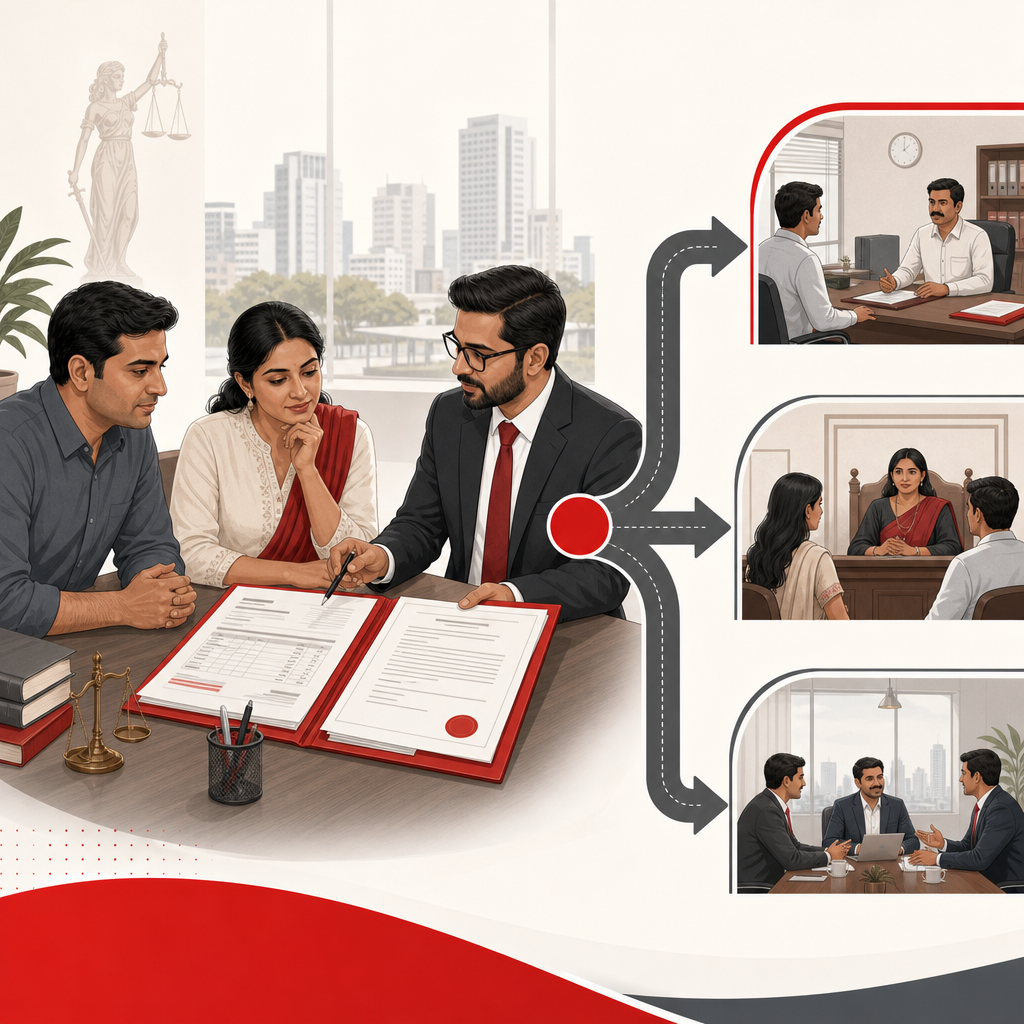
Best Legal Recovery Services in India: How to Choose in 2027
The right service depends on who owes you money, what proves the claim and which forum can act.
Read Article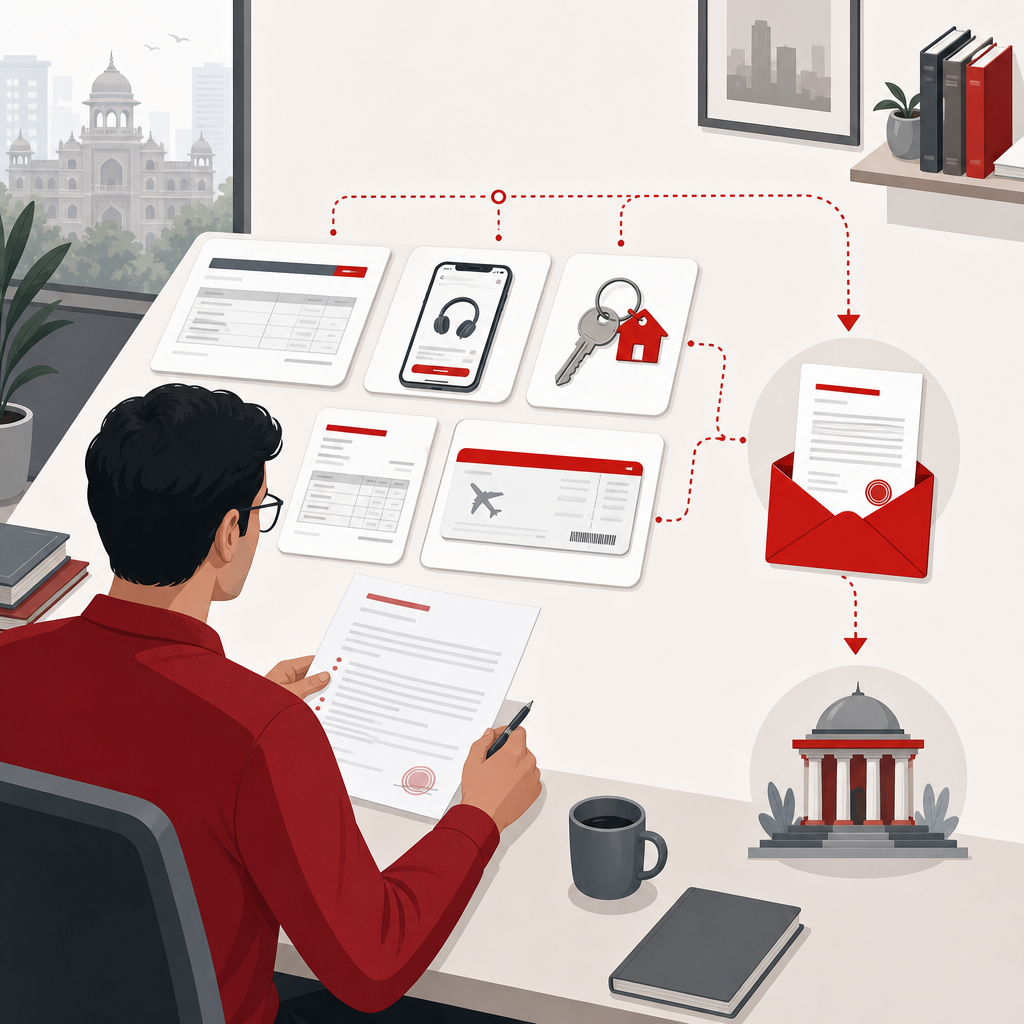
What Is the Best Platform to Recover Money in India in 2027?
There is no one-size-fits-all route: match your claim to the right notice service, government portal or forum.
Read Article
How a Money Recovery Lawyer in India Can Help You Recover Money
The right process depends on who owes you money, what proves it, and which forum can order repayment.
Read Article
Money Not Returned? 7 Ways to Recover It in India (2026)
From unpaid personal loans and salary dues to deposits and refunds, find the right next step and evidence to keep.
Read ArticleAbout Author
Anuj Anand Malik
View ProfileAnuj Anand Malik, Founder of AMA Legal Solutions, is a trusted advocate, loan settlement expert, legal advisor, and banking lawyer. With over a decade of experience in loan settlement, corporate law, financial disputes, and compliance, he leads a result-driven law firm based in India that helps individuals, startups, and businesses achieve legal and financial stability.
Connect on LinkedInNeed Legal Help?
Get expert advice on loan settlement, banking disputes and debt relief.
Start Recovery NowRequest Callback