What Is the Best Platform to Recover Money in India in 2027?
There is no one-size-fits-all route: match your claim to the right notice service, government portal or forum.

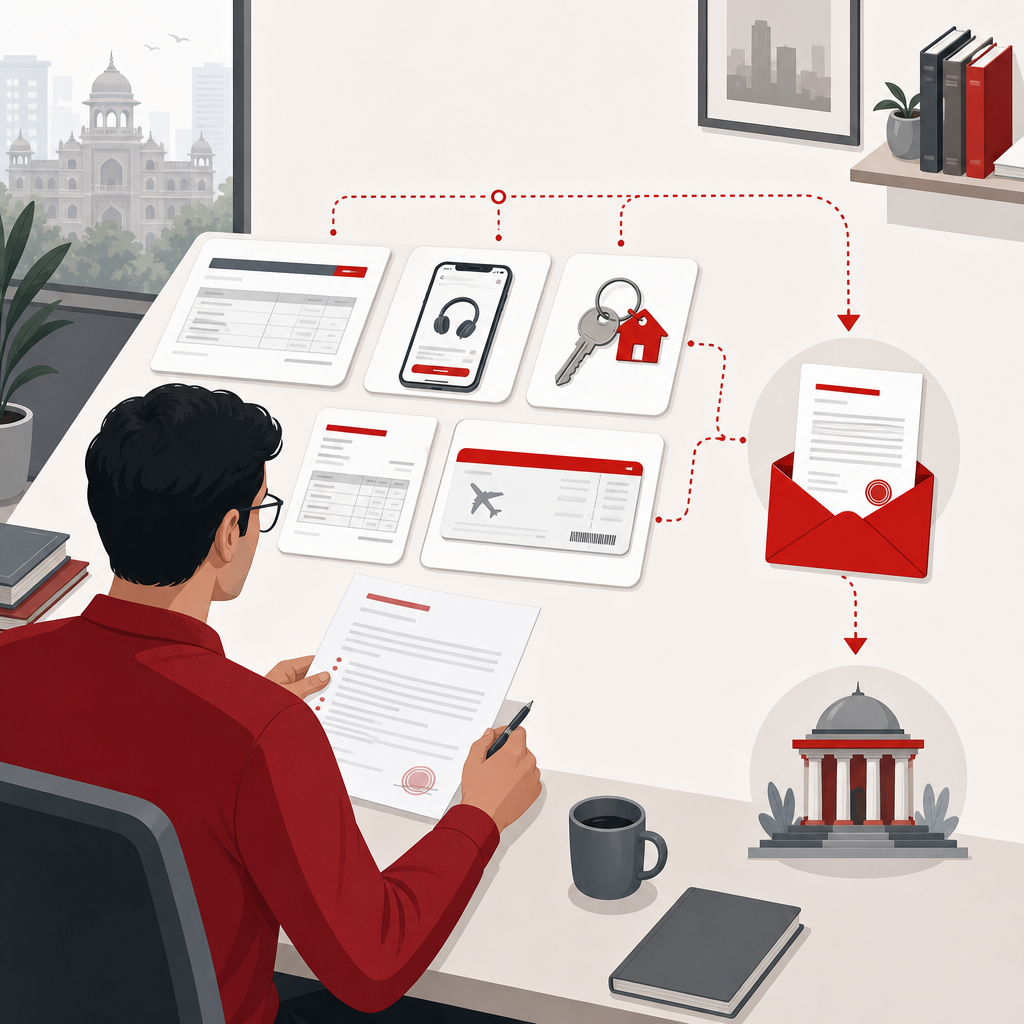
Table of Contents
Table of Contents
Swipe →There is no single best platform to recover money in India in 2027. An unpaid salary claim may need a wage authority; a missing flight refund may begin with the airline and AirSewa. A notice service can help with either, but it cannot decide either dispute. The better question is: who owes you the money, how much is due, when did it become due, and which authority can act if the first request fails? This guide helps you choose a route using developments verified through November 9, 2026. Recheck the rules and portal instructions when you actually file in 2027.
“Best platform” depends on what you need it to do
Search results often put legal-notice services, complaint portals and courts under the same “money recovery platform” label. They do different jobs. Choosing the wrong kind can leave you with a polished complaint that has gone to someone with no power to resolve it.
A notice service starts a focused demand
A useful legal notice identifies the person or business responsible, explains the transaction, calculates the amount, sets a reasonable response deadline and names the likely next step. It can prompt payment when the other side is avoiding emails but would rather settle than defend a formal claim. It is not a payment order, and sending one does not guarantee recovery or stop a limitation clock.
A grievance portal records and routes a complaint
Portals such as the National Consumer Helpline (NCH), AirSewa and the Labour Ministry’s SAMADHAN serve different sectors. They can provide a structured way to raise a grievance, seek a response or reach the relevant machinery. Do not assume that every portal can issue an enforceable decision. Save the acknowledgement number and the response you receive: both may help at the next stage.
A forum can determine the dispute
Depending on the claim, that forum might be a wage-claim authority, consumer commission, Micro and Small Enterprises Facilitation Council, state real-estate regulator or civil court. These routes involve eligibility rules, filing requirements and evidence. The practical strategy is often to make a precise demand first, use the relevant grievance channel where helpful, then file in the forum that can decide your particular claim.
Match the route to the money you are owed
The same ₹80,000 can represent unpaid wages, a builder booking refund or a loan to a relative. The amount alone does not determine the platform. The underlying relationship does. The matrix covers eight common claim categories; its first-contact column is a starting point, not a compulsory step for every case.
Claim type | Useful first contact or platform | Escalation forum | Key eligibility or deadline check |
|---|---|---|---|
Unpaid salary and employment dues | Employer or HR; a calculated notice; labour SAMADHAN for an employment grievance | Appropriate wage-claim authority for qualifying wage claims, or another applicable employment forum | Separate earned wages from disputed deductions or CTC items; check the three-year wage-claim period and the responsible government authority |
Consumer refunds and complaints | Seller or service provider; NCH on 1915 or consumerhelpline.gov.in | Consumer commission through e-Jagriti | Check consumer status, the usual two-year filing period and jurisdiction based on consideration paid |
Security deposits and rental recoveries | Landlord or PG operator; request an itemised deduction statement | Forum under the applicable state tenancy framework or a civil court | Check the lease, state law, local forum and limitation; there is no nationwide deposit-refund portal |
Freelancer and client payments | Client accounts team; invoice-by-invoice demand | MSE Facilitation Council through MSME Samadhaan if eligible; otherwise the appropriate civil or commercial forum | Check micro/small-enterprise eligibility, registration timing, acceptance and invoice due dates |
Personal money lent to friends or relatives | Borrower; written demand supported by transfer and repayment records | Civil money claim; a separate cheque-dishonour route may apply | Establish that it was a loan, not a gift; check limitation and any cheque-notice deadline |
Airline and travel recoveries | Airline, hotel or booking provider; AirSewa for airline grievances | NCH and, where appropriate, consumer commission | Identify who cancelled, the fare terms, refund method and the applicable airline-refund timeline |
Vendor and invoice recoveries | Buyer or marketplace; reconciled invoices and payment demand | MSE Facilitation Council if eligible; otherwise appropriate civil or commercial forum | Check PO and delivery acceptance, MSE status, and whether commercial-court rules apply |
Property and builder disputes | Promoter; project-specific demand against the allotment terms | Project state or UT the applicable legal framework authority, or an appropriate consumer forum | Check project coverage, possession commitment, state rules and the relief sought |
Two boundaries prevent expensive detours. A freelancer chasing a client’s invoice is ordinarily pursuing a payment claim, not filing a consumer complaint because the client consumed their work. Likewise, transferring ₹50,000 to a friend does not make the lender a consumer. Conversely, a person seeking a refund for a defective product or an undelivered paid service may have a consumer route even if the seller calls it a “billing issue.”
The evidence also changes with the relationship. For salary and full-and-final dues, keep payslips, attendance and the employer’s deduction explanation. For consumer refunds, keep the invoice, return terms and promised refund date. If a landlord says your ₹40,000 deposit was spent on painting, the move-in photos, handover messages and an itemised bill matter more than a generic demand; see the route for rental deposit recovery.
Match an unpaid freelancer invoice to its purchase order, deliverables, acceptance messages and part-payments. For money lent to a friend, bank or UPI records show the transfer, while chats about repayment help show why it was made. A booking reference and cancellation history shape an airline or travel claim; reconciled POs and delivery records shape vendor dues. In a builder dispute, compare the allotment agreement with the promised possession date and actual project status.
What a notice, portal and deciding forum can actually achieve
Suppose HR says your ₹1.2 lakh final settlement is “on hold for clearance.” A notice should ask which equipment remains unreturned, which deduction is claimed and what wages have already been earned. It may resolve a genuine records mix-up. If HR still refuses to pay qualifying wages, however, the next step is the appropriate statutory authority, not a second, louder notice.
For an online purchase, NCH can be a useful pre-litigation escalation. The government reported that it facilitated over ₹105 crore in refunds across 35 sectors between April 25, 2025 and July 31, 2026. That shows complaints can produce results; it does not mean NCH decides every disputed claim or that any individual refund is assured. If the seller continues to deny liability, a consumer commission can consider the complaint and grant applicable relief.
A vendor owed ₹4 lakh faces another distinction. A tailored demand might get the buyer to confirm an undisputed balance. If the buyer alleges defective delivery, someone may need to determine what was accepted and payable. An eligible micro or small enterprise may take a delayed-payment dispute to the MSE Facilitation Council; another supplier may need a civil or commercial claim. A private platform can organise and escalate the case, but it cannot confer MSE eligibility or make a contested invoice enforceable by itself.
Keep proof that each step occurred. Send a notice to the correct legal entity and address, retain its registered-post receipt and delivery record, and preserve email or WhatsApp copies where used. Those digital messages are useful supporting records, but do not assume one delivery method satisfies every special statutory notice requirement. Record the date, response and payment offered before deciding whether settlement is better than filing.
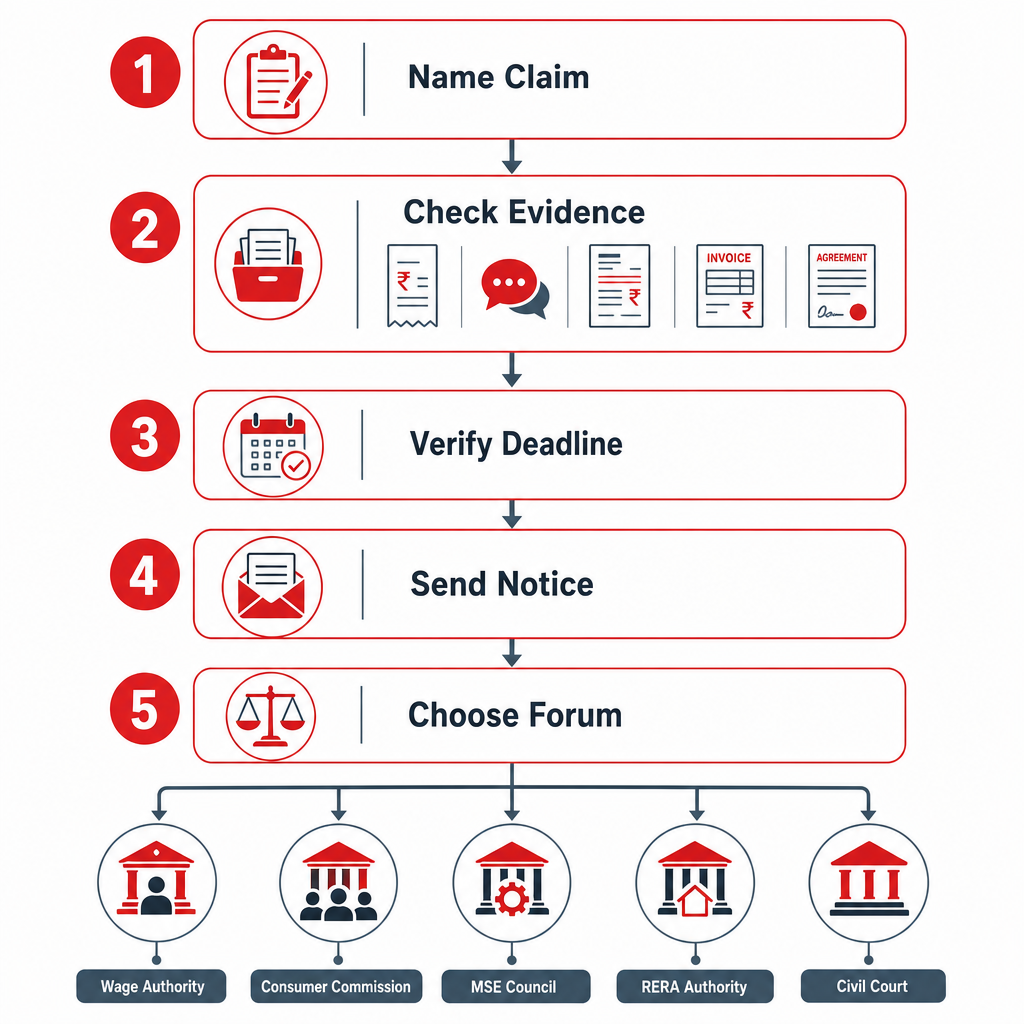
Visual Dispute Resolution & Recovery Framework
Changes from 2025-26 that affect a 2027 choice
Some familiar advice online was written before important changes. Use the following watchlist as a planning aid, not as a substitute for checking the live rule and portal page on filing day.
Rule or portal development | Claims affected | Practical effect on route selection | What to recheck before filing in 2027 |
|---|---|---|---|
Four labour codes took effect on November 21, 2025 | Employment dues | Code on Wages payment and wage-claim provisions matter when the sum is legally “wages” | Applicable central or state rules, the correct authority and whether each claimed component qualifies |
e-Jagriti launched on January 1, 2025 | Consumer and eligible travel complaints | Provides the online route for consumer-commission filing rather than older fragmented filing systems | Current registration, document, fee and hearing instructions |
DGCA refund requirements dated February 24, 2026 | Airline-ticket refunds | Airline responsibility remains important even for agent or portal bookings; refund method and timing need scrutiny | Current DGCA requirements, booking terms and whether the claim concerns airline or passenger cancellation |
Consumer commission limits under the 2021 jurisdiction rules | Consumer complaints, including eligible travel and housing claims | Commission level turns on consideration paid, not the compensation requested | Whether the thresholds have changed and which commission has territorial jurisdiction |
The Code on Wages, 2019, section 17 requires monthly wages to be paid by the seventh day of the following month and wages due on resignation or termination within two working days. Section 45 provides a claim before an authority appointed by the appropriate government, generally within three years. Compensation of up to ten times the determined claim is possible, but discretionary. A disputed bonus or every line of “CTC” does not automatically become a statutory wage: identify the exact component before choosing this route.
For flights, distinguish an airline cancellation from your own change of plans. Under the DGCA’s February 24, 2026 requirements, credit-card refunds are to be made within seven days and refunds for agent or portal bookings within 14 working days, with responsibility resting with the airline. Applicable statutory taxes and airport fees remain refundable even on a non-refundable fare, and a credit shell cannot be imposed by default. Ask for the fare breakdown and the refund back to the appropriate payment method before escalating to AirSewa.
Check the clock, the amount and eligibility before filing
Consumer claims: the price paid controls the commission
Under the Consumer Protection Act, 2019 and the 2021 jurisdiction rules, a District Commission hears complaints where the consideration paid is up to ₹50 lakh; the State Commission covers above ₹50 lakh to ₹2 crore; the National Commission covers above ₹2 crore. Asking for ₹60 lakh in compensation does not move a complaint about a ₹25,000 purchase to the State Commission. Section 69 generally gives two years from the cause of action to file, although delay may be condoned for sufficient cause. For an appropriate District Commission complaint, section 34 also permits filing where the complainant resides or personally works for gain.
Business invoices: MSE status changes the available remedy
The MSMED Act’s delayed-payment route is for eligible micro and small enterprises, not every freelancer, supplier or medium enterprise. Sections 15-17 govern payment and interest: an agreed payment period cannot exceed 45 days from acceptance, and delayed sums attract monthly-compounded interest at three times the RBI bank rate. Check Udyam status and its timing, the buyer’s acceptance or deemed acceptance, and the actual due date before invoking the MSE Facilitation Council through MSME Samadhaan. For a qualifying commercial suit of at least ₹3 lakh, section 12A of the Commercial Courts Act generally requires pre-institution mediation unless urgent interim relief is sought.
Private claims: a reminder is not a reset button
Rental deposits and personal loans need their own limitation analysis, including when repayment became due and the applicable claim type. Under sections 18-19 of the Limitation Act, a timely written acknowledgment or qualifying part-payment can matter; an unanswered notice or casual promise does not automatically start time afresh. If a repayment cheque is dishonoured, section 138 of the Negotiable Instruments Act has a separate, strict sequence: demand within 30 days of receiving dishonour information, followed by 15 days after receipt of the notice for payment. Do not wait for a general recovery-platform follow-up to manage that clock.
Builder claims require a different eligibility check. For a covered project, section 18 of the applicable statutory regulations; sections 31 and 71 deal with complaints and compensation adjudication. File with the authority for the project’s state or UT and check its rules for the applicable interest rate. Consumer relief may also be available, but plan the claim and forum rather than expecting two recoveries for the same loss.
How to judge a paid recovery platform
Before paying, ask the provider to explain why this respondent and this route fit your case. A good review of a ₹65,000 withheld rental deposit will ask for the lease and deduction evidence. A good review of an unpaid salary demand will distinguish wages from a contested notice-period adjustment. A provider that sends the same template for both has not solved the difficult part.
Claim calculation: Does it separate principal, supportable interest, deductions and disputed amounts, rather than inventing a round figure?
Deadline check: Does it flag limitation, special notice periods and eligibility before drafting?
Delivery and records: Will you receive the final notice, dispatch proof and a clear record of responses?
Escalation: Does it name the likely authority or forum if payment does not arrive, without suggesting that a notice itself compels payment?
Price and promise: Are the fee, included follow-ups and any later filing costs clear? Treat “guaranteed recovery” as a warning sign.
For example, LegalRecovery’s online process starts with case submission and expert review, then a professionally drafted notice dispatched by registered post, followed by multi-channel follow-up and escalation. Its stated starting price is a ₹1,499 flat fee. Online case management can spare you an initial office visit; “no court visits” should not be read as a promise that no later forum proceeding or attendance will ever be needed. Confirm what the quoted fee covers and who handles any subsequent filing.
A practical decision path for your 2027 claim
Name the relationship: Employee, consumer, tenant, lender, supplier, traveller or homebuyer? This identifies the likely legal route more reliably than the amount alone.
Write one dated calculation: State what was paid or earned, what came back, what remains due and when payment was promised. Attach records that answer the other side’s likely objection.
Check the fast-moving rules: Verify the current portal procedure, state-specific requirements, eligibility, territorial forum and filing deadline. For salary, MSE and builder claims, check the authority relevant to your establishment, enterprise or project.
Choose the smallest useful next step: Request payment or an itemised explanation, use a tailored notice where appropriate, and use a sector grievance portal if it fits. If the response is inadequate, file with a body empowered to decide the claim.
The best platform is therefore not necessarily the one with the strongest recovery claim on its website. It is the one that gets your evidence to the right respondent first and gives you an honest path to the right forum next, before a deadline quietly passes.
Popular Searches & Related Topics

Legal Recovery is India's trusted consumer protection and legal tech platform. We specialize in holding corporations accountable for unfair trade practices, deceptive marketing, and commercial fraud. With over 15,000 customers counselled, our mission is to provide fast, out-of-court resolutions by connecting you with top-tier panel advocates for immediate legal action.
Client Reviews
"My employer kept my final salary pending and only referred to a vague clearance issue. LegalRecovery helped me set out the unpaid amount and ask for a specific explanation of the deduction. The notice and follow-up were clear, and I appreciated that they explained the appropriate wage-claim route instead of promising a guaranteed result."
Ananya Deshmukh
"A travel portal kept saying my cancelled flight refund was being processed, but the money had not reached my account. LegalRecovery helped organise the booking, cancellation and payment records and sent a focused demand. I received a clear update on what to try next if the airline or portal did not resolve it."
Rohit Menon
"My client had not paid two freelance invoices and was questioning whether the work had been accepted. LegalRecovery helped me present the invoices alongside the delivery emails and acceptance messages. The notice was specific, and the team explained that the MSE route depends on eligibility rather than assuming every freelancer can use it."
Meera Kulkarni
"My landlord proposed keeping most of my security deposit for painting without giving an itemised account. LegalRecovery helped me organise the lease, payment proof, handover photos and messages into a clear demand. I valued the practical explanation of the possible next route under the applicable local rules."
Siddharth Rao
Frequently Asked Questions
Related Articles
Best Legal Recovery Services in India: How to Choose in 2027
The right service depends on who owes you money, what proves the claim and which forum can act.
Read Article
Money Not Returned? 7 Ways to Recover It in India (2026)
From unpaid personal loans and salary dues to deposits and refunds, find the right next step and evidence to keep.
Read Article
How to Send a Money Recovery Legal Notice in India (2027)
What to include, how to deliver it, what it may cost, and what to do if the recipient does not pay.
Read Article
How a Money Recovery Lawyer in India Can Help You Recover Money
The right process depends on who owes you money, what proves it, and which forum can order repayment.
Read ArticleAbout Author
Anuj Anand Malik
View ProfileAnuj Anand Malik, Founder of AMA Legal Solutions, is a trusted advocate, loan settlement expert, legal advisor, and banking lawyer. With over a decade of experience in loan settlement, corporate law, financial disputes, and compliance, he leads a result-driven law firm based in India that helps individuals, startups, and businesses achieve legal and financial stability.
Connect on LinkedInNeed Legal Help?
Get expert advice on loan settlement, banking disputes and debt relief.
Start Recovery NowRequest Callback