Money Not Returned? 7 Ways to Recover It in India (2026)
From unpaid personal loans and salary dues to deposits and refunds, find the right next step and evidence to keep.

Table of Contents
Table of Contents
Swipe →If someone has your money and keeps delaying, it can feel as though you have only two choices: keep asking or give up. You have more options than that. The right step depends on why you paid, what was promised, and what proof you have. This guide will help you identify the route that fits your situation, make a clear demand, and know when to escalate without spending money on the wrong kind of case.
First, work out what the payment was for
A bank transfer proves that money moved. It does not, on its own, prove that a friend agreed to repay a loan or that a business owes you a refund. Before sending a notice or filing a complaint, write one sentence explaining why the money is due: “I lent ₹20,000, repayable by 1 June,” or “I paid ₹25,000 for a course that was never provided.” That sentence is the centre of your claim.
If your money is stuck because... | Your likely starting point | Most useful proof |
|---|---|---|
A friend has not repaid a personal loan | Written demand, then settlement or civil recovery | Transfer record and messages showing it was a loan |
A landlord has kept your rental deposit | Demand an explanation and refund, then consider civil recovery | Agreement, deposit receipt, handover record and deduction details |
An employer has withheld salary | Written demand, followed by advice on the appropriate employment remedy | Offer letter, payslips, attendance and final-settlement correspondence |
A seller has not supplied paid goods or services | Business complaint, then the consumer route if eligible | Order terms, invoice, payment proof and refund requests |
A UPI transfer failed or you were scammed | Report the transaction promptly; use the payment or fraud route as applicable | Transaction ID, status, messages and complaint number |
Gather the full record now: statements, UPI reference numbers, agreements, receipts, invoices, booking terms and messages about when repayment or delivery was due. Export complete conversations rather than relying on a cropped screenshot. Keep originals, and save every complaint number and delivery receipt. For a personal loan, the key question is often whether your chats show a promise to repay, not merely a request for money. You can read more about recovering money lent to a friend.
Do not let an argument about the amount stop you from organising the facts. If a landlord says ₹8,000 was deducted from your ₹50,000 deposit, ask for the itemised basis and supporting records. If your salary is short, calculate the specific unpaid period. A precise claim gives the other person a fair chance to respond and makes any later complaint easier to understand. Separate what you can prove from what you suspect.
Ways 1 and 2: Ask clearly, then try a structured settlement
1. Send a documented demand
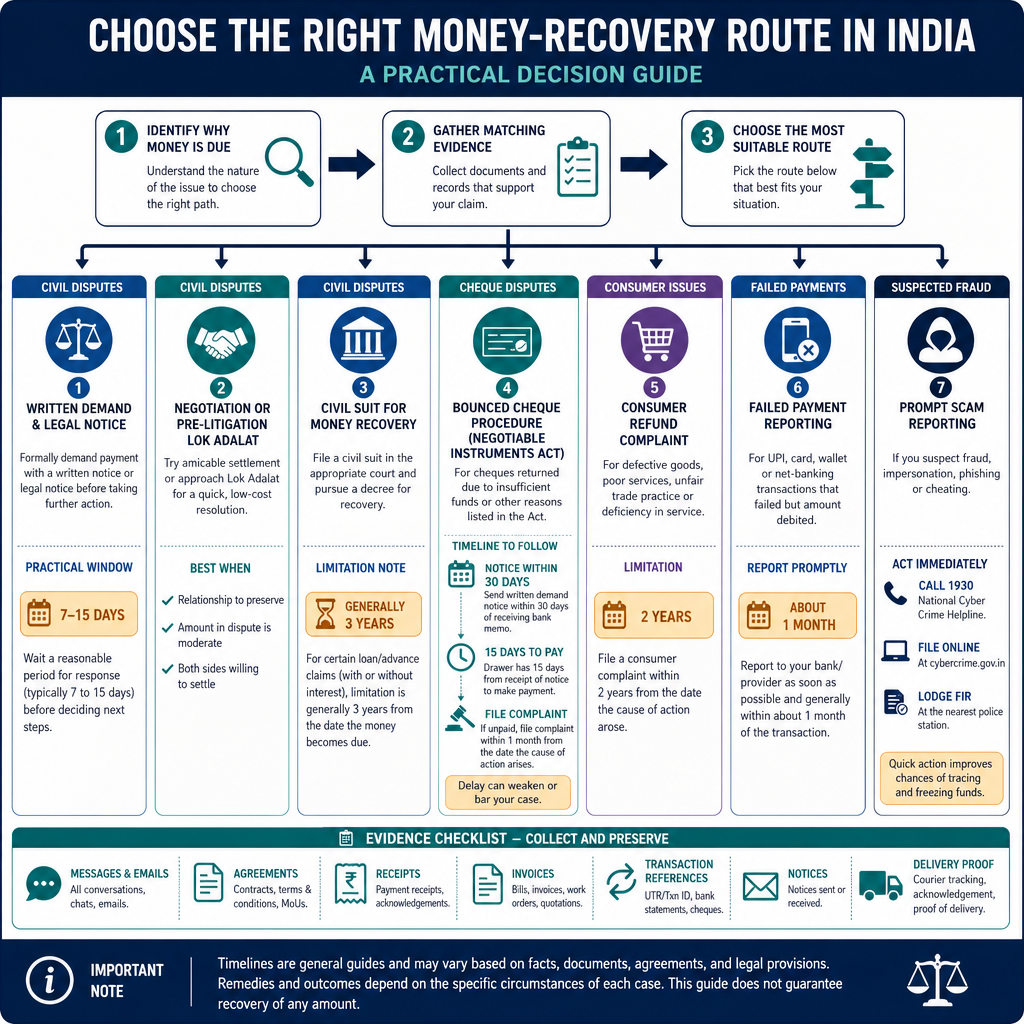
If you have been chasing someone through calls and vague promises, move the conversation into writing. Send a dated email or message stating the amount, why it is payable, when it became due, where payment should be made, and a reasonable deadline. Attach or refer to the relevant invoice, deposit receipt or earlier repayment message. Keep your tone firm and factual; you do not need threats to make a serious demand.
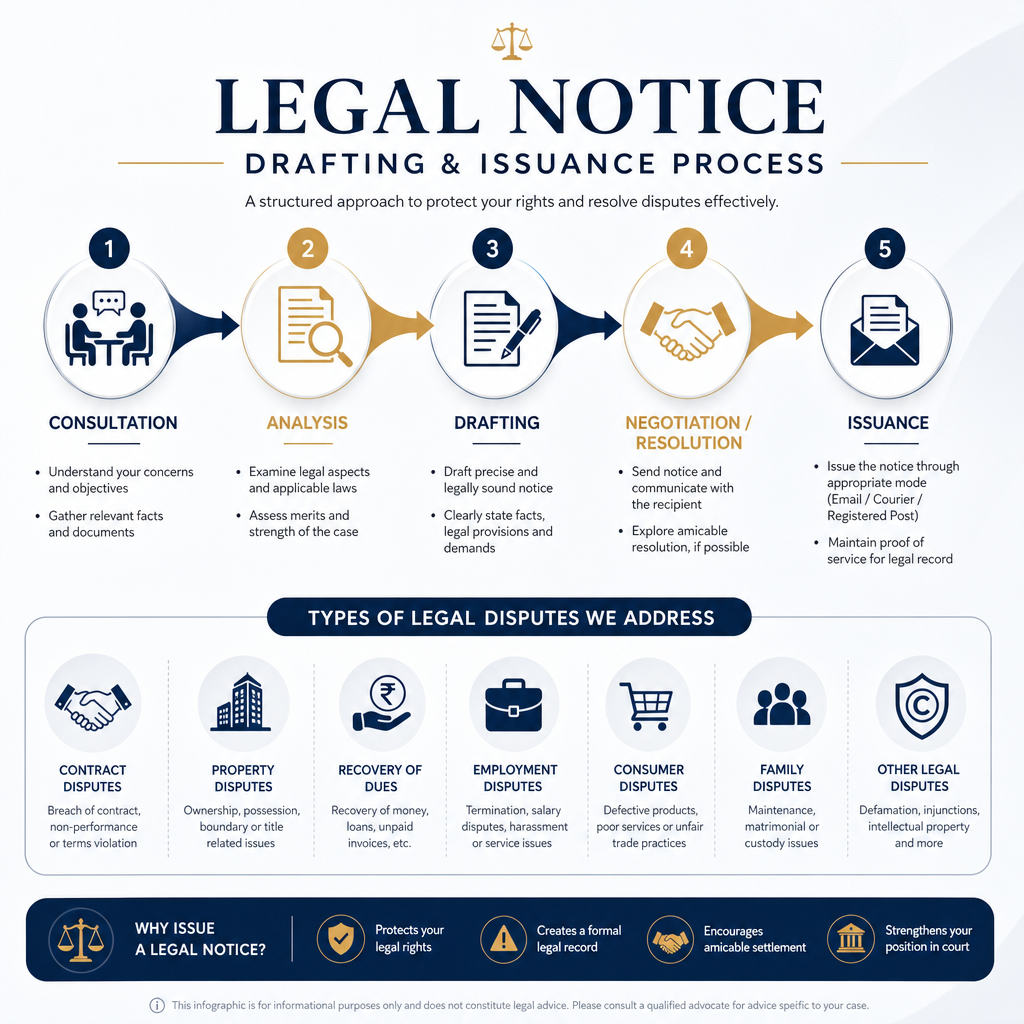
If that is ignored, a professionally drafted legal notice can set out your claim and the next step you may take. Send it by traceable post and email, and preserve dispatch and delivery proof. A seven- to 15-day response window is a practical choice for many ordinary debts, not a statutory deadline. A notice may prompt payment or a genuine explanation, but it neither guarantees recovery nor automatically extends your time to sue. This guide to money-recovery notices explains what the notice should establish.
For a deposit dispute, include the date you vacated, what you returned, and any deductions you contest. For withheld salary, identify the unpaid months or final-settlement items. Those details matter more than an aggressive template. If you need situation-specific help, see the steps for rental deposit recovery or unpaid employment dues.
2. Negotiate, or ask about Lok Adalat
Some people cannot pay everything at once but will agree to instalments. If you accept that, put the total admitted amount, each payment date, payment method and consequences of a missed instalment in writing. Record every payment received. Avoid treating “I’ll pay soon” as a settlement when neither the amount nor the date is clear.
If direct talks stall, ask your District Legal Services Authority whether your dispute can be referred to a pre-litigation Lok Adalat. Money-recovery disputes can be settled there without a court fee. It works through agreement, not a decision imposed after a full trial; if the parties settle, the award is binding like a civil-court decree. You can check the process through the National Legal Services Authority. Do not sign away a balance you are still owed unless the written settlement accurately reflects what you have agreed.
Ways 3 and 4: Use the civil route, or act quickly on a bounced cheque
3. Consider a civil recovery suit
When a personal loan, deposit or contractual advance remains unpaid despite a clear demand, a civil claim may be the appropriate next step. A lawyer can assess the agreement, proof, amount, applicable court and costs before filing. The Indian Contract Act, 1872, including section 73 on loss caused by breach of contract, and the Code of Civil Procedure, 1908, may be relevant. Your claim still has to establish why repayment is legally due.
Some fixed-debt claims based on qualifying written contracts or promissory notes may use the summary procedure under Order XXXVII of the Code of Civil Procedure. It is not available merely because payment was made digitally. An informal loan supported by chats may still be recoverable, but its procedure depends on the documents and facts.
Check the filing deadline early. Under Articles 19 and 21 of the Limitation Act, 1963, suits for certain loans generally have three years from the date the loan was made, including a loan described as payable “on demand.” Other claims can start running from a different date. A qualifying signed written acknowledgment made before limitation expires can start a fresh period under section 18; another unanswered reminder cannot. If your transaction is old, seek advice promptly rather than assuming a new notice resets the clock. This money-recovery time-limit guide helps you identify the issue to check.
Salary disputes may have remedies under employment law rather than a straightforward personal-loan suit. Likewise, a seller withholding a consumer refund may be better addressed through a Consumer Commission. Choosing the forum that fits your dispute is more useful than filing every kind of case at once.
4. Follow the special timeline if a repayment cheque bounces
A bounced cheque changes what you must do next, so do not leave the bank’s return memo in a drawer. If the cheque was issued towards a legally enforceable debt, section 138 of the Negotiable Instruments Act, 1881, may allow a complaint. The law provides a presumption in favour of the cheque holder, but the drawer can rebut it; a cheque alone does not make every disputed amount recoverable.
Within 30 days of receiving information that the cheque was dishonoured, send the statutory written payment demand.
Allow the drawer 15 days after receiving the notice to pay.
If payment is not made, generally file the complaint within one month after that 15-day period expires.
Keep the cheque copy, return memo, notice and proof of delivery. Sections 138, 139 and 142 govern important parts of this process. The precise dates matter, so get advice immediately if a deadline is close. A cheque-bounce timeline can help you organise the documents before speaking to a lawyer.
Visual Dispute Resolution & Recovery Framework
Way 5: Take an unpaid refund to the consumer system
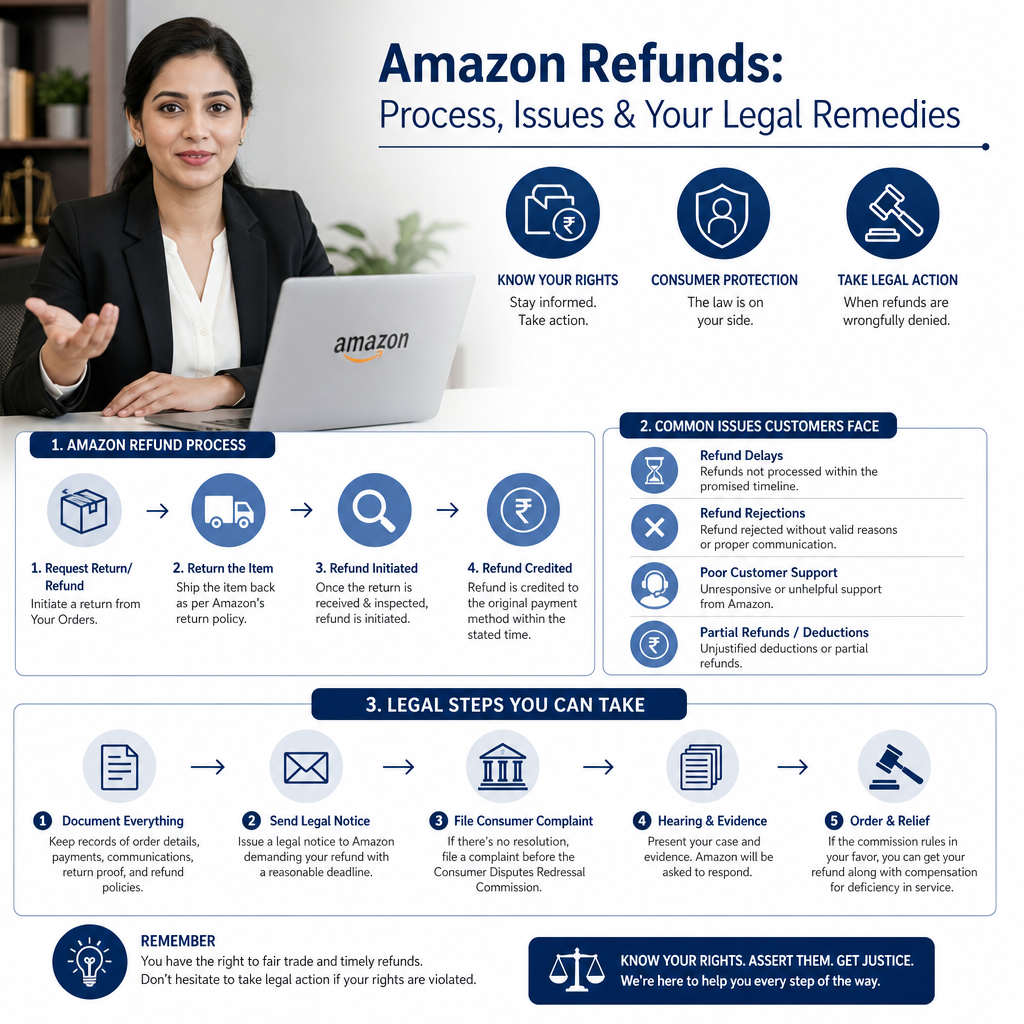
Paid for a course that never started, or an item that never arrived? Start with the business: send your order details, explain what was promised and ask for a refund by a stated date. If its response goes nowhere, the consumer route may fit. It is meant for disputes such as undelivered goods, deficient paid services and unjustified business refund refusals, not an ordinary loan to a friend.
Register a grievance with the National Consumer Helpline online or by calling 1915. Keep the grievance number and any response. If unresolved, you can file a case with the appropriate Consumer Commission through e-Jagriti, which launched in January 2025 and brought earlier consumer-case systems together. If you need help mapping out the documents, see this consumer refund recovery overview.
Sections 35 and 39 of the Consumer Protection Act, 2019, cover filing a complaint and the relief a commission can order, including repayment where justified. Section 69 usually gives two years to file, though the relevant starting point and any request to excuse delay need attention. District Commissions generally hear cases where the consideration paid does not exceed ₹50 lakh. Keep your invoice, advertised promise, delivery or service records, refund policy, complaint history and proof of payment together.
This route has helped real consumers, but allow for uncertainty. The government reported that the Helpline facilitated ₹27.61 crore in refunds across 49,333 refund grievances between April 25 and October 31, 2025. That does not predict the result of your complaint. The Act asks commissions to endeavour to decide cases within three months after the other party receives notice, or five months where testing is required. Those are aims, not guaranteed completion dates.
Ways 6 and 7: Distinguish a failed payment from fraud
6. Escalate a failed UPI payment through the payment system
Check the transaction status before deciding what went wrong. If money was debited but a UPI transfer did not reach the beneficiary, or a merchant payment was not confirmed, report it immediately to the bank or payment provider. Save the transaction ID, screenshot showing its status, complaint number and response.
RBI’s failed-transaction rules distinguish a transfer not credited to the beneficiary, for which the reversal timeline is T+1, from a merchant payment without confirmation, for which it is T+5. Specified delays attract ₹100 per day. If the provider’s answer is unsatisfactory, or you receive no response after 30 days, you can use the free RBI Integrated Ombudsman portal at cms.rbi.org.in.
There is an important boundary: these reversal rules do not undo a successfully completed transfer because the recipient later refuses to return your money. If the payment succeeded and a friend owes you repayment, use the demand and recovery routes instead.
7. Report an actual scam immediately
If someone deceived you into sending money online, speed matters more than drafting the perfect notice. Call 1930, report the incident at cybercrime.gov.in, and alert the bank or payment provider. Preserve the transaction reference, the recipient details available to you, advertisements, chats and any link or account used in the scam. Reporting quickly improves the chance of action, but does not guarantee that the money can be stopped or returned.
Where evidence shows deception used to obtain money, section 318(4) of the Bharatiya Nyaya Sanhita, 2023, may apply. Section 316 may apply to dishonest misuse of property that was entrusted to someone. A broken repayment promise alone does not prove either offence. The Supreme Court’s 2024 decision in Radheyshyam v. State of Rajasthan reinforces the distinction between a civil dispute and criminal conduct. Describe the facts honestly when reporting; do not assume an FIR replaces a civil recovery claim.
What should you do this week?
You do not have to choose between doing nothing and filing a case tomorrow. Start with the least costly step that protects your position, while checking whether any deadline is near.
Today: Write down the amount owed, why it is owed, the date it became due and the other party’s correct contact details. Save complete payment and conversation records.
Next: Send a specific written demand. If you receive an explanation or instalment proposal, get the terms in writing before relying on them.
If ignored: Consider a traceable legal notice and the route that matches your claim: settlement, a civil suit, a cheque complaint or a consumer case. A failed transaction or suspected scam calls for prompt reporting instead.
Before waiting longer: Check limitation and any special notice deadline. Put the next action date in your calendar.
A demand can sometimes lead to payment within days; court proceedings can take much longer. If a notice receives no reply, that is not the end of your options. Review the evidence, likely costs and deadline before deciding what to do after a notice is ignored.
If preparing and following up on a notice feels difficult, LegalRecovery offers an online process for matters such as personal loans, salary dues, rental deposits and consumer refunds. You submit your case, legal experts review it, a professional notice is drafted and dispatched by registered post, and the team follows up and escalates as appropriate. Pricing starts at a ₹1,499 flat fee. Its case management is online, so you do not need a court visit for that service; if you later choose to litigate, court requirements are a separate matter. You can see how LegalRecovery’s process works before deciding whether it suits you.
Most importantly, match the action to the problem. A clear record and a timely, well-directed demand give you a practical starting point. From there, you can decide whether an agreement is possible or whether it is time to use the formal route available for your claim.
Popular Searches & Related Topics

Legal Recovery is India's trusted consumer protection and legal tech platform. We specialize in holding corporations accountable for unfair trade practices, deceptive marketing, and commercial fraud. With over 15,000 customers counselled, our mission is to provide fast, out-of-court resolutions by connecting you with top-tier panel advocates for immediate legal action.
Client Reviews
"My previous employer had not cleared part of my final settlement despite several reminders. LegalRecovery helped organise my records and sent a clear legal notice. The follow-up was professional, and the company resolved the outstanding amount without me having to manage the notice process on my own."
Ananya Sharma
"My landlord was holding back my security deposit after I moved out. LegalRecovery helped me set out the deposit, handover details, and disputed deductions in a formal notice. I appreciated the clear updates and practical guidance while we worked toward a resolution."
Rahul Mehta
"A client had left several freelance invoices unpaid, and informal follow-ups were getting nowhere. LegalRecovery reviewed my invoice and message records and prepared a professional demand. The process was straightforward, and the client agreed to a payment plan that was put in writing."
Priya Nair
"I was waiting for a refund for a service that was not provided as promised. LegalRecovery helped me organise the payment proof and refund correspondence, then sent a formal notice. I was pleased with the timely communication and the resolution reached with the business."
Vikram Singh
Frequently Asked Questions
Related Articles
About Author
Team LegalRecovery
View ProfileTeam LegalRecovery is a dedicated team of legal and financial professionals specializing in loan settlement, banking disputes, debt relief, and corporate compliance. We are committed to helping clients achieve debt freedom and business stability through expert strategic advisory.
Connect on LinkedInNeed Legal Help?
Get expert advice on loan settlement, banking disputes and debt relief.
Start Recovery NowRequest Callback