Best Legal Recovery Services in India: How to Choose in 2027
The right service depends on who owes you money, what proves the claim and which forum can act.

Table of Contents
Table of Contents
Swipe →There is no single best legal recovery service for every unpaid amount in India. A landlord withholding a security deposit does not automatically create a consumer complaint. A freelancer with an unpaid invoice cannot automatically use the MSME route. In both cases, the service that helps most is the one that checks the agreement, the evidence and the correct forum before sending a demand. A legal notice records what you are asking for and why. It is not a court order or a promise that the money will arrive.
This 2027 guide reflects the law and available escalation routes checked as of November 10, 2026. It concerns money owed to individuals and businesses. “Best” means best suited to your claim, not the provider with the boldest recovery guarantee.
Best for which claim? Start with the money and the person who owes it
Two people can be owed the same ₹80,000 and need entirely different help. An employee may need a wages claim against the employer. A customer seeking a refund may need a complaint against the seller or service provider. The first test for any recovery service is whether it can name the liable party and explain the likely route, rather than treating every file as a notice-writing job.
Dispute type | Common obstacle or defence | Evidence to prioritise | Potential forum or escalation route | Key eligibility or timing check |
|---|---|---|---|---|
Employment dues | HR cites a full-and-final adjustment or unreturned equipment. | Appointment terms, payslips, attendance, bank credits and handover proof. | Competent labour claims authority for qualifying wages. | Identify which sums are wages; check the applicable filing period. |
Consumer refunds | Seller relies on a blanket “non-refundable” policy. | Order, payment, promised service, complaint and cancellation record. | National Consumer Helpline, then an eligible consumer complaint. | Check consumer status, consideration paid and limitation. |
Rental deposits | Landlord alleges repairs without invoices or inspection records. | Lease, deposit transfer, exit photos, key handover and deduction list. | Negotiation or an appropriate civil recovery route. | Check the agreement and applicable state tenancy rules. |
Freelancer invoices | Client says approval is pending or work is defective. | Scope, deliverables, acceptance messages, invoices and credits. | Civil or commercial route; MSE Facilitation Council if eligible. | Do not assume every freelancer qualifies under the MSMED Act. |
Personal money owed | Recipient calls the transfer a gift. | Transfer record, repayment messages, agreed date and part-payments. | Settlement, Lok Adalat where suitable, or civil recovery. | Prove a repayable loan and check limitation. |
Travel disputes | Airline blames the booking portal or offers only credit. | PNR, fare breakup, cancellation time and payment method. | Airline, AirSewa and, where appropriate, consumer forum. | Separate airline refund rules from hotel or travel-agent terms. |
Vendor invoices | Buyer alleges defects, missing PO or an unsettled account. | PO, delivery and acceptance proof, ledger, invoices and GST records. | Eligible MSE Council claim or civil/commercial recovery. | Check supplier eligibility, each due date and credits. |
Builder or property claims | Promoter cites a revised possession date or buyer default. | Agreement, receipts, project registration and possession records. | Relevant state or UT the applicable legal framework authority where applicable. | Check project, allottee status and state-specific requirements. |
The distinction matters even within one category. A salary recovery service should separate earned wages from a disputed contractual reimbursement. A consumer refund service should ask who took the payment, who promised the service and whether the purchase qualifies as a consumer transaction. If those questions are skipped, a polished notice may still point in the wrong direction.
Judge the service by its checks, not its recovery promise
Ask what happens before the notice is drafted. A useful provider should be able to explain its review in terms of your documents and the other side’s likely reply. “We have a high success rate” tells you much less than “Your invoice was partly paid, and the client disputed the final milestone on this date.”
Capability to test | Question to ask before instructing | What a specific answer should identify | Warning sign |
|---|---|---|---|
Debtor identification | Who is legally being asked to pay? | Contracting entity, relevant address and basis of liability. | Only a contact number or brand name is checked. |
Amount and interest | How did you calculate my demand? | Principal minus credits, due dates and interest basis. | A round figure or automatic penalty is added. |
Limitation review | When might my filing deadline run? | Likely cause-of-action date and facts needing verification. | “A notice resets all deadlines.” |
Forum choice | Where could this go if payment is refused? | A route linked to this claim and its eligibility rules. | Every dispute is called a consumer or MSME case. |
Notice tailoring | Which defence will the draft address? | The disputed deduction, defect, cancellation or default. | A generic threat with no document references. |
Next-stage advice | What happens after the response deadline? | Follow-up, negotiation and a realistic filing option. | Payment is presented as inevitable. |
Fee clarity | What does the quoted price include? | Review, drafting, dispatch, follow-up and separate filing costs. | Later-stage charges remain undisclosed. |
No service can guarantee that a debtor will pay, that a claim will be admitted or that a forum will decide in your favour. What it can promise is a documented process: review the file, calculate the claim, send a defensible demand, preserve dispatch records and tell you what the response changes.
Match the evidence to a forum that can actually hear the dispute
Employment, consumer and contractual claims are different lanes
For earned salary, the competent labour authority may be more relevant than a civil demand alone. The authority must still be asked to decide a properly evidenced wages claim. For a defective purchase or failed paid service, an eligible consumer can approach the trader, use the National Consumer Helpline and then consider a consumer complaint. A business-purpose purchase is not automatically a consumer claim; its purpose and the statutory definition need checking.
A rental deposit dispute is ordinarily about the lease and what happened at exit, not automatically about consumer protection. Likewise, a bank transfer to a friend proves that money moved, but not by itself that repayment was promised. Depending on the documents, a qualifying liquidated debt may support an Order XXXVII summary suit under the Code of Civil Procedure; other claims may need ordinary civil proceedings or a negotiated settlement.
Supplier status changes the invoice route
An unpaid freelancer should not be sold an MSME filing merely because they have an invoice. The freelancer payment route depends on the work, contract and supplier’s eligibility. The MSMED Act delayed-payment mechanism is for eligible micro or small suppliers, not medium enterprises or every individual freelancer. If it does not apply, the invoice may still support contractual recovery. For qualifying commercial suits valued at least ₹3 lakh, Section 12A of the Commercial Courts Act generally requires pre-institution mediation unless urgent interim relief is sought.
Property claims need the same care. A delayed flat in a qualifying registered project may belong before that project’s state or UT the applicable legal framework authority. An ordinary landlord’s failure to return a deposit does not become a the applicable legal framework matter because both disputes involve housing.
Visual Dispute Resolution & Recovery Framework
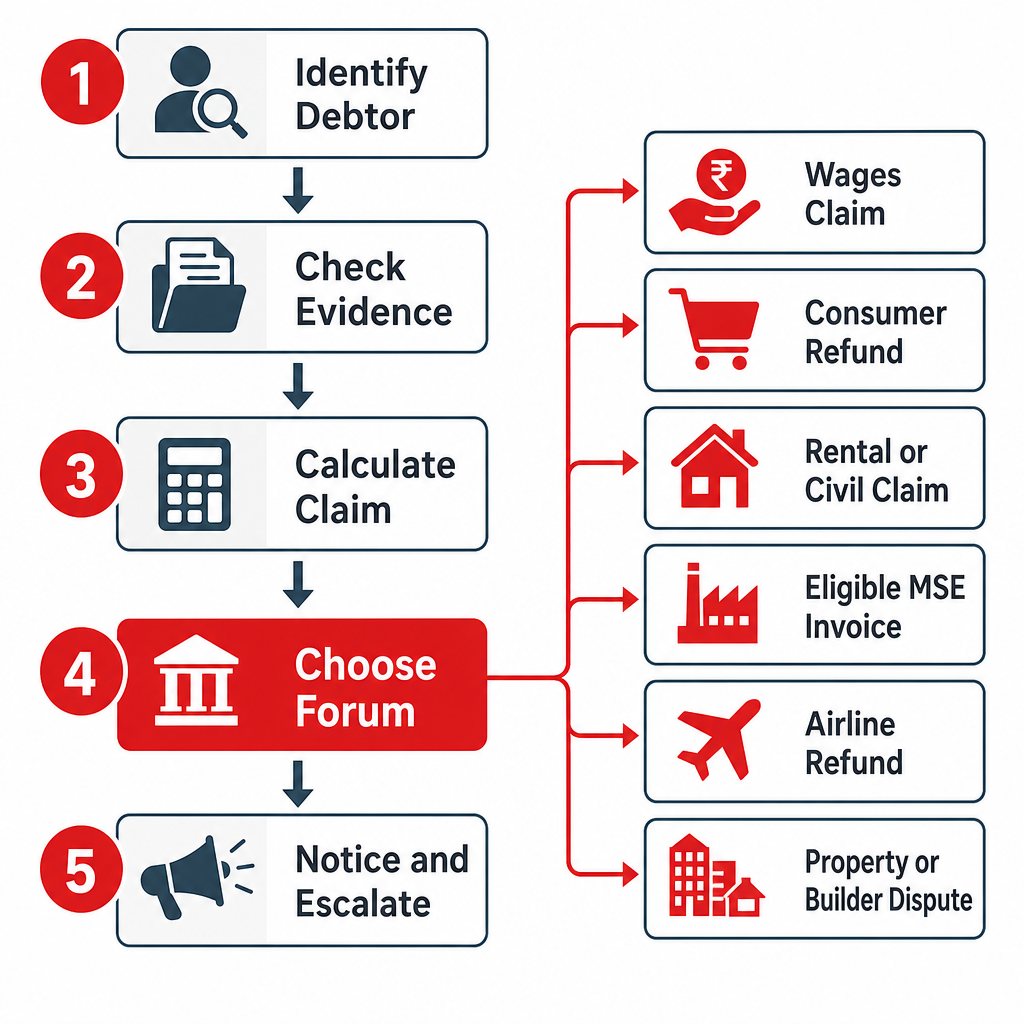
A strong provider checks the arithmetic and the likely defence
The demand should be something the reader, debtor and eventual decision-maker can all follow. Suppose a vendor raised invoices of ₹1,20,000 and ₹60,000, then received ₹30,000. Asking for ₹1,80,000 ignores a real credit; asking for ₹1,50,000 without allocating that credit may leave the due dates and any interest unclear. A vendor invoice review should reconcile each invoice against the ledger, payment receipts, returns and disputed items before naming a total.
Interest needs its own explanation. What clause or statute allows it? From which date, at what rate, and on which unpaid principal? The Contract Act permits recovery for provable breach loss under Section 73, while Section 74 does not make every contractual penalty automatically payable. A service should not paste MSMED interest onto an ineligible invoice, or claim airline disruption compensation simply because a ticket refund is late.
Proof must answer the excuse you expect to hear
For wages, compare payslips, attendance and bank entries against each deduction HR proposes. For a refund, keep the original offer, cancellation record and replies saying why it was refused. For a rental deposit, photograph the property at exit and retain messages about inspection and key handover. For money lent to a friend or relative, pair the transfer with messages acknowledging the loan, a repayment date or part-payment. For a builder claim, place the agreement’s possession promise beside receipts and project records.
A tailored notice can then say, for example, “₹8,000 was deducted for repainting, but no inspection report or invoice was supplied,” rather than merely threatening action over the whole deposit. That specificity gives the recipient a fair chance to resolve the actual disagreement and makes a later filing easier to understand.
Rules worth checking in this 2027 guide
These are the rules checked as of November 10, 2026, not a prediction that they will change in 2027. Before filing, confirm the current text, local procedure and facts of your case.
Wages and consumer complaints
The Code on Wages, 2019 has applicable provisions in force from November 21, 2025. Subject to statutory qualifications, monthly wages are generally due by the seventh day of the following month, and wages following resignation or dismissal within two working days. Section 45 provides a claims authority and a three-year filing period, with possible condonation; compensation can reach up to ten times the claim. Section 59 places the burden of proving payment on the employer. Those provisions make an accurate wage calculation important, but they do not turn every employment-related reimbursement into “wages.”
For eligible consumer complaints, the 2021 jurisdiction rules use consideration paid, not the compensation you request: District Commission up to ₹50 lakh, State Commission above ₹50 lakh to ₹2 crore, and National Commission above ₹2 crore. Section 69 of the Consumer Protection Act generally allows two years from the cause of action, subject to condonation. A service should check both consumer status and timing before suggesting a forum.
Eligible suppliers, airline passengers and allottees
Under Sections 15 to 18 of the MSMED Act, an agreed payment period for an eligible micro or small supplier cannot exceed 45 days from acceptance or deemed acceptance. Late payment attracts monthly-compounded interest at three times the RBI bank rate. The supplier may refer the dispute to the relevant MSE Facilitation Council; a buyer challenging its award generally faces the Section 19 requirement to deposit 75% of the award amount. Eligibility and acceptance dates are central, not paperwork to address later.
For airline ticket refunds, the DGCA refund CAR effective March 26, 2026 makes the airline responsible for refunds on agent or portal bookings, with completion within 14 working days; credit-card refunds are due within seven days. Specified statutory taxes and airport fees remain refundable even on a non-refundable fare or no-show. A credit shell is the passenger’s choice. Compensation for flight disruption is a separate question under the applicable cancellation or delay rules and their exceptions.
For a qualifying builder delay, the applicable legal framework Section 18 distinguishes an allottee who withdraws and seeks refund with prescribed-rate interest from one who stays and seeks interest for delay. Section 31 concerns filing before the authority for the project’s state or UT; Section 71 addresses compensation adjudication. A builder dispute review must check the project, agreement, possession records and state-prescribed rate rather than assume one nationwide figure.
After a notice, escalation should follow the claim
A notice works best when it gives a clear demand, supporting calculation and reasonable opportunity to respond. Keep the signed version, enclosures, registered-post receipt and delivery record. Email or WhatsApp may help document communication, but a provider should not assume that sending a message on one channel satisfies every applicable procedural requirement.
If an employer contests wages, the next step may be the competent labour claims authority; the central SAMADHAN portal is available at samadhan.labour.gov.in for worker claims. An eligible consumer may first try the National Consumer Helpline at consumerhelpline.gov.in or 1915, then use e-Jagriti at e-jagriti.gov.in for a complaint. An eligible micro or small supplier may consider a reference through MSME Samadhaan at samadhaan.msme.gov.in. An airline passenger can escalate from the airline to AirSewa at airsewa.gov.in and, where appropriate, a consumer forum.
Rental deposits, personal loans and ineligible invoice claims may instead call for settlement, a suitable civil recovery proceeding or, in an appropriate case, a District Legal Services Authority or Lok Adalat process. Builder claims may go to the relevant state or UT the applicable legal framework authority. None of these is an automatic next step: a defence, eligibility condition or filing deadline can change the plan.
LegalRecovery offers online case submission, expert review, a drafted notice dispatched by registered post, and follow-up and escalation; its stated starting price is ₹1,499 as a flat fee. Its online process may spare you visits while the notice is prepared, but a later forum proceeding may have its own attendance and cost requirements. Ask which stages the quote actually covers.
Shortlist the provider with four direct questions
Before paying, ask: Who will review my documents and calculation? What will the other side probably argue? What exactly is included in the fee? If the notice is ignored, which forum could hear my claim and what would filing involve? A credible answer should be specific enough to mention your debtor, disputed amount, evidence gaps and likely next step.
Be cautious if a provider promises recovery, proposes the same forum for every dispute or urges you to wait indefinitely for a reply. Informal negotiations can be worthwhile, but a notice does not by itself stop the limitation clock. Check the forum and your possible filing deadline before allowing another round of “we’ll pay next week” to become your entire recovery plan.
Popular Searches & Related Topics

Legal Recovery is India's trusted consumer protection and legal tech platform. We specialize in holding corporations accountable for unfair trade practices, deceptive marketing, and commercial fraud. With over 15,000 customers counselled, our mission is to provide fast, out-of-court resolutions by connecting you with top-tier panel advocates for immediate legal action.
Client Reviews
"Illustrative sample review: My previous employer disputed part of my final salary over an equipment handover. LegalRecovery reviewed my payslips, bank entries and handover messages, explained which amounts could be treated as wages, and prepared a clear notice. I appreciated that they explained the next labour-authority step without promising a guaranteed recovery."
Priya Nair
"Illustrative sample review: A client kept delaying payment for completed design work and claimed approval was pending. LegalRecovery helped organise the scope, delivery emails, invoice and part-payment into a clear demand. The process and follow-up were explained upfront, and the client agreed to a payment schedule after receiving the notice."
Rohan Mehta
"Illustrative sample review: My landlord withheld most of my security deposit and gave no proper breakdown of repair costs. LegalRecovery reviewed my lease, exit photographs and key-handover messages, then drafted a notice identifying the disputed deductions. The communication was professional and helped us resolve the deposit dispute."
Ayesha Khan
"Illustrative sample review: I had cancelled a flight but was offered a credit shell instead of the refund I was seeking. LegalRecovery checked my PNR, fare details, cancellation record and payment method, and helped prepare a focused demand to the airline. I valued the practical guidance on escalation and the distinction between a ticket refund and disruption compensation."
Vikram Deshmukh
Frequently Asked Questions
Related Articles
What Is the Best Platform to Recover Money in India in 2027?
There is no one-size-fits-all route: match your claim to the right notice service, government portal or forum.
Read Article
How a Money Recovery Lawyer in India Can Help You Recover Money
The right process depends on who owes you money, what proves it, and which forum can order repayment.
Read Article
How to Choose the Best Legal Recovery Law Firm in India
The right choice depends on your dispute, evidence, limitation date and the forum your claim belongs in.
Read Article
Money Not Returned? 7 Ways to Recover It in India (2026)
From unpaid personal loans and salary dues to deposits and refunds, find the right next step and evidence to keep.
Read ArticleAbout Author
Anuj Anand Malik
View ProfileAnuj Anand Malik, Founder of AMA Legal Solutions, is a trusted advocate, loan settlement expert, legal advisor, and banking lawyer. With over a decade of experience in loan settlement, corporate law, financial disputes, and compliance, he leads a result-driven law firm based in India that helps individuals, startups, and businesses achieve legal and financial stability.
Connect on LinkedInNeed Legal Help?
Get expert advice on loan settlement, banking disputes and debt relief.
Start Recovery NowRequest Callback