Coaching or EdTech Refusing Fee Refund? How to Cancel NBFC EMIs
coaching institute fee refund legal notice, cancel edtech nbfc emi loan, ccpa guidelines coaching fee refund pro rata, stop auto debit nach edtech course, islamic academy of education unearned fee refund, rbi digital lending cooling off period edtech, tripartite legal notice edtech nbfc, fiitjee allen aakash refund consumer court, cibil score protection edtech dispute, e daakhil complaint coaching fees

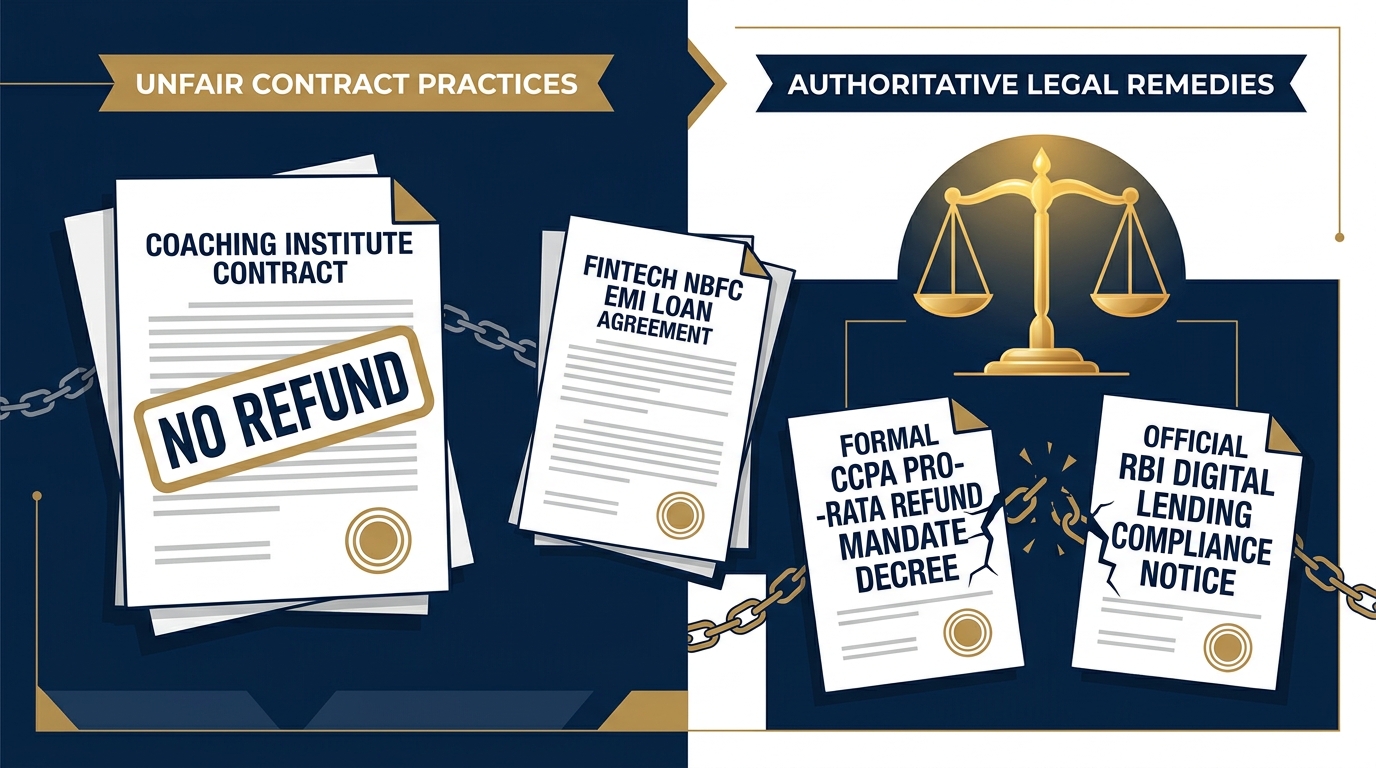
Table of Contents
Table of Contents
Swipe →You or your child joined a coaching center for UPSC, IIT-JEE, NEET, or a coding bootcamp. The sales team said you could pay in easy monthly steps with zero interest. They promised top teachers, small batches, and personal study support. But after a few weeks, the real picture looked very bad. The star teachers never showed up. The videos were old and dull. When you asked to leave and get your money back, the center pointed to a stamp on your admission slip. It stated that fees once paid will never be refunded under any condition.
To make matters worse, your bank account keeps losing money every single month. The sales rep did not set up a normal monthly fee. Instead, they took your PAN card and Aadhaar details to start a personal loan with a finance company or NBFC. The finance firm paid the whole course fee to the coaching center on day one. Now, the finance company pulls monthly EMIs from your bank account through NACH auto-debit. If you stop the payment, recovery agents call your phone, and your CIBIL score drops.
This trap catches thousands of students and parents across India every day. You are paying for a course you do not attend, while the coaching center keeps your cash. But Indian law stands firmly on your side. Under new government guidelines, consumer laws, and RBI rules, blanket no-refund clauses are illegal. You have a clear legal right to get your unearned fees back and cancel the linked loan without hurting your credit score.
The Modern Coaching and EdTech Loan Trap in India
Private coaching hubs in Kota, Delhi, Hyderabad, and Bengaluru, along with online EdTech platforms, run a predatory sales model. They rely on high-pressure sales calls and false promises. Parents believe they are signing up for monthly tuition with an educational school. In truth, they are signing two separate legal contracts at the same time.
This setup works through four calculated steps:
- Deceptive Loan Masking: Sales staff avoid words like loan, interest, or debt. They call it a monthly scholarship pass or a zero-cost EMI plan.
- Instant Upfront Cash Payout: The finance firm sends the entire multi-year fee to the coaching center within 24 hours. The center gets its cash immediately, so it stops caring about teaching quality.
- Strict No-Refund Shields: When a student drops out due to poor teaching or illness, the center hides behind printed terms to deny all refunds.
- Credit Bureau Threats: When parents cancel bank auto-debits, the finance company marks the loan as unpaid. They report negative remarks to CIBIL and send recovery agents to harass the family.
This system traps families between an unhelpful coaching institute and an aggressive finance firm. But under Indian consumer law, you can break both sides of this trap.
Why 'No Refund' Admission Terms Are Legally Void
Coaching centers often claim that their admission receipt is the final word. They tell parents that signing an enrollment form gives up all legal rights. That claim is completely wrong under Indian law.
Ministry of Education 2024 Coaching Guidelines
In January 2024, the Ministry of Education released strict Guidelines for Regulation of Coaching Centres. These rules apply across all states and Union Territories in India. The guidelines state clearly that coaching centers cannot collect full fees for multi-year programs in advance.
If a student leaves a course midway, the center must issue a fair pro-rata refund for the unexpired time. The center must credit this refund within ten days of receiving the exit request. This refund rule also covers hostel charges and mess fees. Centers that break these rules face heavy monetary fines and loss of registration.
Consumer Protection Act: Sections 2(46) and 2(47)
The Consumer Protection Act, 2019 gives consumers strong rights against one-sided contracts. Section 2(46) defines an unfair contract as any agreement that causes a big imbalance between a consumer and a business. Standard admission slips with strict non-refundable terms fall squarely under this definition.
Furthermore, Section 2(47)(viii) classifies refusing to refund money for unrendered or deficient services as an unfair trade practice. When an educational center keeps cash for classes it never taught, it violates the law. If you face similar non-refundable terms in other services, read our guide on gym or club membership refund legal notice.
Section 65 of the Indian Contract Act
Section 65 of the Indian Contract Act, 1872 lays down the rule of restitution. When a contract ends or becomes void, any party who received an advantage must return it. When a student leaves a coaching class, the service relationship ends. The coaching center cannot hold on to advance cash for classes it will never provide. Keeping that money amounts to unjust enrichment.
The Hidden NBFC Course Loan: How You Got Trapped
To win your money back, you must understand the three parties in this financial setup:
- The Student or Parent: The learner receiving tuition and the named borrower on the loan papers.
- The Coaching Institute or EdTech App: The merchant seller delivering the classes.
- The Lending NBFC or Bank: The regulated finance firm providing the loan.
The Deceptive 'Zero Cost EMI' Subscription Pitch
Sales agents know that parents will hesitate to pay ₹1,50,000 upfront. So they pitch a monthly fee of ₹10,000. They ask for an OTP under the excuse of checking admission eligibility. In seconds, that OTP approves a digital loan through fintech partners like Propelld, Liquiloans, Avanse, or Fibe.
The finance company sends the full ₹1,50,000 to the coaching center at once. The parent now owes that money to the lender. When you try to quit the course, the coaching center stalls. They do not want to return that lump sum to the lender. If you are dealing with this issue on major online learning platforms, see our guide on Byjus Unacademy EdTech refund complaint.
Why Calling Customer Care Fails
Most consumers make the mistake of talking to only one party at a time. This never works:
- Talking Only to the Coaching Center: Center staff send delay emails for weeks. Meanwhile, the finance firm keeps taking money from your bank account.
- Calling Only the Finance Firm: Customer care reps say they only funded the loan. They claim they cannot cancel the loan until the coaching center sends the money back.
Both companies pass the blame to each other while your money drains away. You must tackle both entities together through formal legal channels.
RBI Digital Lending Rules: How to Cancel Course Loans
The Reserve Bank of India knows that digital lending apps often mislead consumers. To stop this, the RBI issued strict Digital Lending Guidelines that protect retail borrowers.
Mandatory Key Fact Statement Rules
Under RBI rules, every regulated lender must give the borrower a Key Fact Statement (KFS) before closing the loan. The KFS must show the true Annual Percentage Rate (APR), all fees, the monthly schedule, and complaint details in plain words.
If the sales rep signed you up without showing you the KFS, the loan violates RBI rules. Regulated lenders face strict penalties from the RBI if they disburse merchant loans without verified KFS delivery.
Cooling-Off Period to Cancel Without Fines
The RBI mandates a cooling-off or look-up period for all digital loans. During this window, you have a legal right to exit the loan without paying any prepayment penalty. You only owe the principal and daily interest for the few days the loan was live.
When you cancel a course during this window, the coaching center and the lender must cooperate. The center must send the disbursed funds back to the lender. The lender must close the loan account and issue a No Objection Certificate (NOC) with no penalty fees.
Visual Dispute Resolution & Recovery Framework
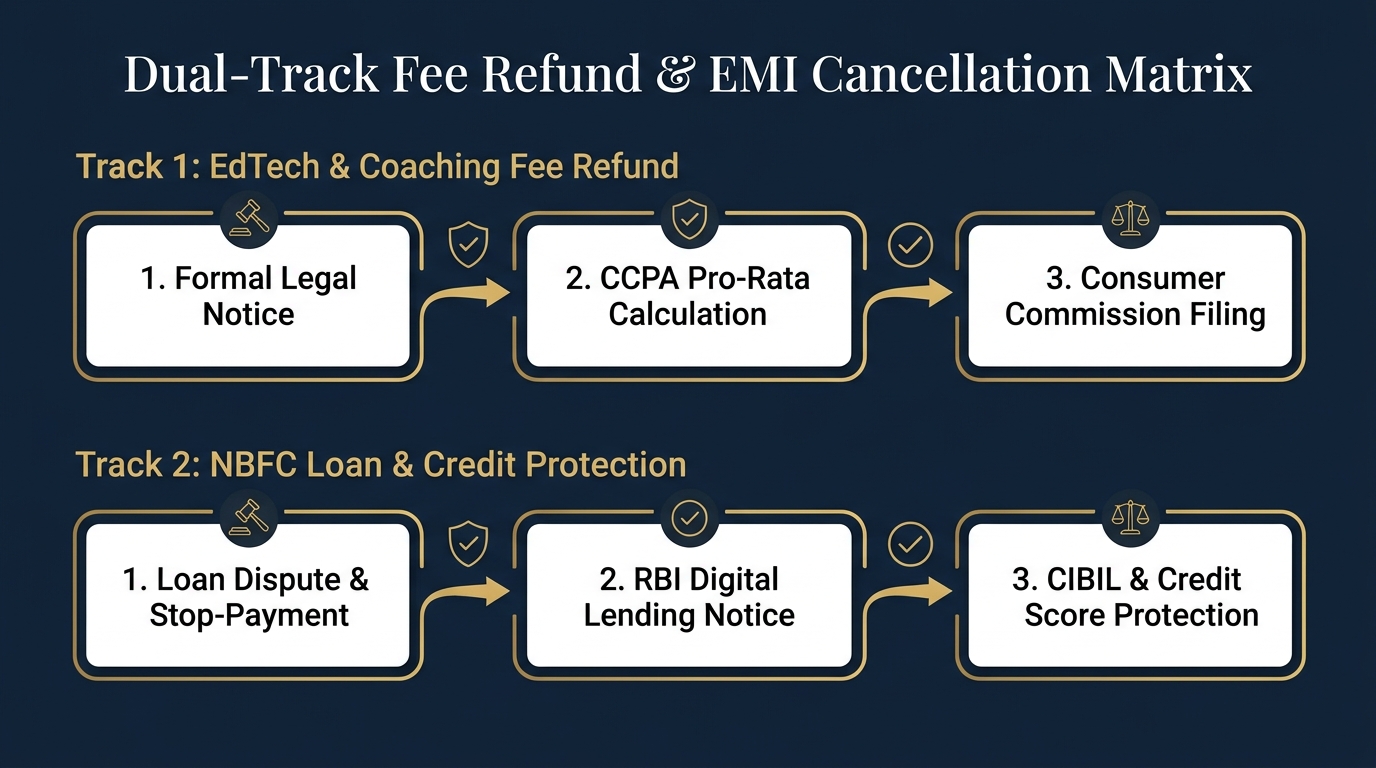
Coaching Fee Refund and Loan Foreclosure Matrix
When demanding a refund and loan exit, you must use exact numbers. Never ask for a general refund. Show the exact days attended, the unearned fee balance, and the net sum needed to clear the loan.
The table below shows a real calculation for a two-year coaching course costing ₹1,44,000, where the student withdrew after 60 days of classes.
| Financial Component | Legal Rule & Calculation | Original Amount | Lawful Settlement & Result |
|---|---|---|---|
| Total Course Fee | Agreed fee for 24 months (730 days) of classes | ₹1,44,000 | Starting contractual tuition price |
| Utilized Tuition Fee | Pro-rata share for 60 attended days (₹197.26 per day) | ₹11,836 | Retained by center for classes actually taught |
| Unearned Advance Fee Balance | MoE 2024 Rules: Pro-rata balance for 670 days | ₹1,32,164 | Must be refunded by center within 10 days |
| Down Payment Paid by Parent | Initial cash paid from bank account at admission | ₹24,000 | Direct cash paid by parent to center |
| Fintech Loan Disbursed | Lump sum paid by NBFC directly to center | ₹1,20,000 | Full loan principal received by center |
| Monthly EMIs Paid by Parent | 2 monthly EMIs of ₹10,000 each paid via NACH | ₹20,000 | Principal paid down by parent during attendance |
| Remaining Loan Balance | Net principal needed to close the NBFC loan | ₹1,00,000 | Total amount needed for loan payoff |
| Direct Payment by Center to NBFC | Center pays NBFC to clear the loan balance | ₹0 | ₹1,00,000 transferred by center to lender |
| Net Cash Refund Paid to Parent | Surplus balance (₹1,32,164 minus ₹1,00,000 loan) | ₹0 | ₹32,164 cash refunded to parent bank account |
As the table proves, the center holds ₹1,32,164 in unearned fees. The center must pay ₹1,00,000 directly to the NBFC to clear the loan. It must also refund ₹32,164 in surplus cash directly to the parent. The student pays only for the sixty days attended, and the loan closes with zero damage to credit scores.
Statutory Escalation Forums for Fees and Course Loans
When coaching centers and lenders refuse to resolve a dispute, you have multiple legal options. The best path depends on whether you want a cash refund, loan closure, credit score repair, or compensation.
The comparison matrix below shows the legal forums and authorities available under Indian law.
| Escalation Forum | Governing Authority | Relevant Law | Target Entity | Typical Timeline | Legal Relief & Remedy |
|---|---|---|---|---|---|
| Center Support Desk | Internal Management | Internal Center Policy | Coaching Center | 3 to 7 Days | Informal rejections; centers claim fees are non-refundable |
| NBFC Nodal Officer | Lender Grievance Cell | RBI Master Directions 2022 | Fintech NBFC | 7 to 15 Days | Loan dispute tag; pauses aggressive recovery phone calls |
| RBI Sachet & CMS Portal | Reserve Bank Ombudsman | RBI Ombudsman Scheme 2021 | Fintech NBFC | 30 to 45 Days | Audit of lender; orders cancellation of unfair loan pacts |
| National Consumer Helpline | Consumer Affairs Ministry | Consumer Protection Act 2019 | Center & NBFC | 15 to 30 Days | Official mediation; nudges centers to issue pro-rata refunds |
| Advocate Tripartite Notice | Legal Counsel Desk | CPA 2019 & Contract Act 1872 | Both Entities | 10 to 15 Days | High settlement rate; full loan closure and cash refund |
| District Consumer Court | Consumer Commission | Section 35 CPA (e-Daakhil) | Both Entities | 3 to 8 Months | Binding order: 100% refund, 9% interest, and damages |
Four Steps to Recover Your Fees and Stop NBFC EMIs
Recovering unearned coaching fees while cancelling a linked loan requires quick action. You must tackle both entities at once. Follow these four practical steps to protect your money and your credit score.
Step 1: Gather Your Course and Loan Records
Clear written evidence is vital for any consumer claim. Before calling the center management, collect your proof:
- Save the original course brochure, syllabus, and ads that promised top teachers and small batch sizes.
- Collect all fee receipts, invoices, and admission forms.
- Find the loan sanction letter, Key Fact Statement (KFS), payment plan, and loan account number from the lender.
- Save all WhatsApp chats, emails, and call logs with sales agents about refund terms and monthly plans.
- Write a dated exit letter stating the exact date you left and the teaching defects that forced you to withdraw.
Step 2: Send a Tripartite Legal Notice
Do not waste weeks arguing with phone support staff who have no power to help you. The most effective step is serving a formal legal notice. You should send a Tripartite Legal Notice to EdTech + NBFC Partner through an advocate.
This formal legal notice achieves two critical goals:
- Demands Immediate Refund from Center: It puts the coaching center on notice under the Ministry of Education 2024 Guidelines. It demands that the center send the unearned tuition balance directly to the lender within 15 days.
- Puts the Loan in Dispute with NBFC: It informs the NBFC Nodal Officer that the service contract has ended. It demands that the lender mark the loan under merchant dispute, stop auto-debits, and refrain from reporting negative marks to credit bureaus.
If your dispute involves a traditional college or university, check our guide on college or coaching fee refund legal notice.
Step 3: Freeze NACH Mandate and Guard Your CIBIL Score
While your legal notice is active, manage your bank mandates carefully. Log in to your net banking portal or visit your bank branch. Submit a written request to stop the specific NACH auto-debit set up by the lender. Attach a copy of your course exit letter and legal notice.
Under RBI rules, banks must honor a customer request to stop automated debits. At the same time, email the NBFC Grievance Officer. State clearly that the course is cancelled and that any attempt to pull funds will be treated as bad-faith recovery. This paper trail stops the lender from calling you a willful defaulter.
Step 4: File an Online Case on e-Daakhil
If the coaching center or lender fails to settle the matter within the 15-day notice period, take legal action. You do not need to visit a court in person. Under the Consumer Protection Act, 2019, you can file a complaint online through the government **e-Daakhil portal** (edaakhil.nic.in).
You can file your case in the District Consumer Commission in your home district. In your petition, ask the court for these remedies:
- A court order directing the coaching center to issue a full pro-rata refund with 9 percent annual interest.
- An order directing the center to pay the remaining loan balance directly to the NBFC to close the loan.
- An order directing the NBFC to close the loan account, issue a No Objection Certificate, and clean up your CIBIL file.
- Substantial financial compensation for mental stress and legal costs under Section 39 of the Act.
To understand court steps and damage awards, read our guides on consumer court complaint for refund and consumer complaint against company. If you are dealing with a large sum, consulting an experienced refund dispute lawyer ensures your case is framed for maximum compensation.
Key Supreme Court and Consumer Court Rulings
Coaching centers often try to scare students by quoting selective legal phrases. Knowing actual Supreme Court and Consumer Commission rulings dismantles their claims immediately.
Islamic Academy of Education Supreme Court Ruling
In the landmark judgment of Islamic Academy of Education v. State of Karnataka (2003) 6 SCC 697, the Supreme Court of India set clear rules on educational fees. The court held that educational institutions cannot charge advance fees for the entire duration of a multi-year program. Centers can collect fees only for one semester or one academic year at a time.
The Supreme Court ruled that collecting advance fees for future years before teaching classes amounts to an illegal capitation fee. The court held that keeping advance money for unrendered education is unjust enrichment. If a student leaves early, keeping fees for future terms is completely unlawful.
FIITJEE v. Harish Soni and the Vacant Seat Rule
Coaching centers frequently cite the National Consumer Commission order in FIITJEE Ltd. v. Harish Soni (Revision Petition No. 2054 of 2013) to reject refunds. In that case, the commission noted that an institute could keep fees if the seat left by the student remained vacant for the rest of the term.
However, coaching centers deliberately hide two crucial legal limits established in later rulings:
- Strict Burden of Proof: The burden of proof rests entirely on the coaching center. The center must produce official attendance registers and admission records to prove that the seat remained truly empty and caused financial loss.
- Deficiency in Service Cancels Defense: Consumer courts have repeatedly held that the vacant seat defense does not apply when the student leaves due to poor teaching. If the center changed promised teachers, failed to provide committed classes, or misled students, the center cannot keep unearned fees.
Under modern Indian law, the Ministry of Education 2024 Guidelines, CCPA rules, and RBI digital lending norms protect students fully. By using your pro-rata refund rights and serving a synchronized tripartite legal notice, you can recover your money and cancel unwanted loan obligations with complete confidence.
Popular Searches & Related Topics

Legal Recovery is India's trusted consumer protection and legal tech platform. We specialize in holding corporations accountable for unfair trade practices, deceptive marketing, and commercial fraud. With over 15,000 customers counselled, our mission is to provide fast, out-of-court resolutions by connecting you with top-tier panel advocates for immediate legal action.
Client Reviews
"My son left a Kota IIT-JEE coaching institute after 3 weeks because the promised senior faculty never taught. The center rejected our refund citing their non-refundable admission receipt. LegalRecovery helped us serve a tripartite legal notice to the institute and the financing NBFC. Within twelve days, the institute remitted the remaining balance to close the loan account."
Sunil K. Deshmukh
"An EdTech sales agent pushed me into a ₹1.1 lakh data science course promising flexible monthly payments. I soon discovered it was a 3rd-party personal loan. The recorded lectures were outdated. When I cancelled, support stopped answering while the NBFC debited EMIs. LegalRecovery stopped the auto-debit and recovered my two advance installments through a formal legal notice."
Pooja V. Nair
"We enrolled our daughter in a two-year medical foundation program and paid ₹1.8 lakh upfront via fintech financing. She shifted schools within two months. The institute kept citing Harish Soni case to block our refund. LegalRecovery issued a sharp notice citing the 2024 Coaching Guidelines and CCPA rules. The institute refunded the unutilized fifteen months directly."
Harpreet Singh Bhasin
"The EdTech company closed operations while my loan with an NBFC partner remained active. Recovery agents started calling my office. LegalRecovery stepped in, escalated the dispute to the RBI Ombudsman under Digital Lending norms, and served a tripartite demand. The loan was marked cancelled and my CIBIL record stayed completely clean."
Arvind M. Chawla
"A UPSC coaching hub in Delhi took ₹1.4 lakh and refused to refund when my health deteriorated after one month. LegalRecovery drafted our e-Daakhil consumer petition and legal notice. The institute settled before the first commission hearing and transferred the full pro-rata refund to my bank account."
Meenakshi Sundaram
Frequently Asked Questions
Related Articles
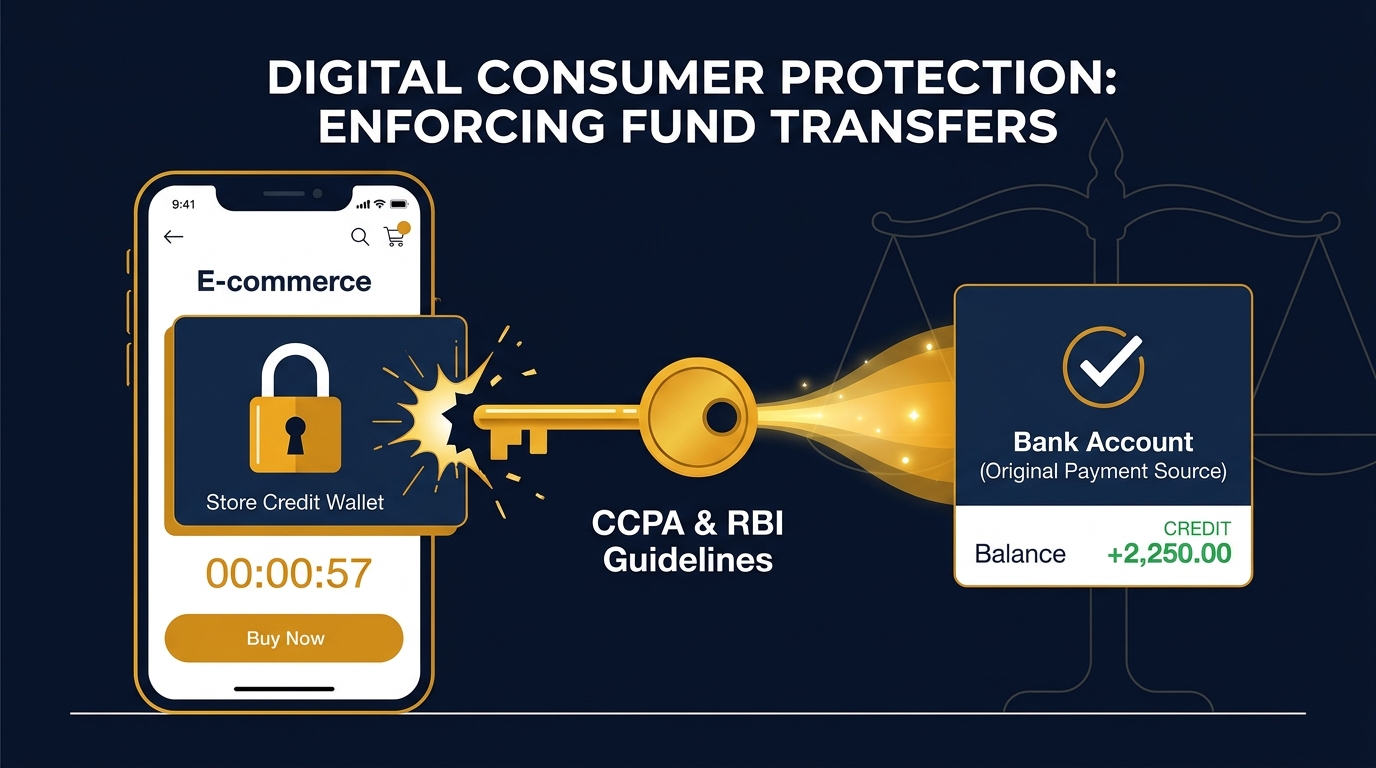
E-Commerce App Forcing Wallet Refund Over Bank Account? Legal Fix
ecommerce forcing wallet refund instead of original payment method, can company force store credit instead of bank refund india, myntra ajio refund stuck in wallet transfer to bank, ccpa guidelines against forced wallet refunds dark patterns, rbi prepaid payment instrument wallet refund to source, legal notice for original source refund ecommerce, section 2 47 consumer protection act unfair trade practice, dark patterns forced action interface interference, closed loop wallet refund bank withdrawal, e daakhil complaint for store credit refund
Read Article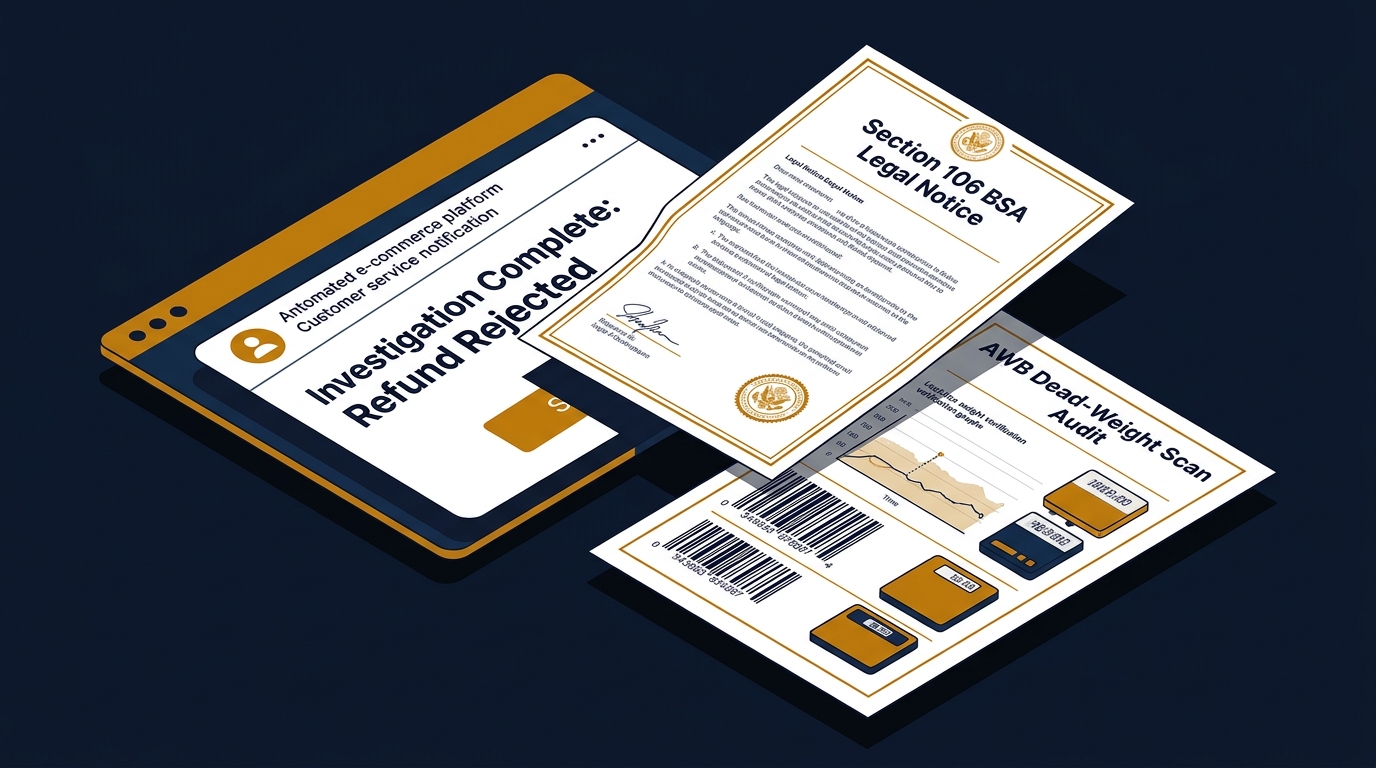
Amazon or Flipkart Investigation Denied Refund? Legal Recovery Fix
amazon investigation completed no refund wrong item received, flipkart rejected refund after investigation wrong product, amazon ofm account warning refund denied legal notice, received empty box or wrong item amazon refund denied, unboxing video evidence consumer court ecommerce, how to challenge amazon internal investigation refund rejection, section 106 bharatiya sakshya adhiniyam ecommerce burden of proof, airway bill dead weight scan hub discrepancy, consumer protection ecommerce rules 2020 refund delay liability, visa mastercard chargeback reason code 13 3 defective merchandise
Read Article
Amazon or Flipkart Refund Stuck in Bank? Claim ₹100/Day RBI Penalty
amazon refund initiated with arn but not credited, flipkart refund rrn number not credited to bank account, rbi 100 rupees per day penalty for delayed refund, credit card refund stuck between merchant and issuing bank, verify real 23 digit arn number visa mastercard, 12 digit upi rrn reference number tracking, rbi circular turnaround time failed transaction compensation, payment gateway acquiring bank settlement certificate, rbi integrated ombudsman scheme cms complaint against bank, consumer protection ecommerce rules 2020 refund delay liability
Read Article
Flipkart or Amazon OBD Refund Rejected After OTP? Recover Now (2026)
flipkart open box delivery refund rejected legal notice, amazon otp shared defective product refund denied, open box delivery hidden motherboard screen defect refund, flipkart service center replacement denial refund recovery, consumer protection e-commerce rules open box delivery, how to get refund from flipkart after open box delivery
Read ArticleAbout Author
Anuj Anand Malik
View ProfileAnuj Anand Malik, Founder of AMA Legal Solutions, is a trusted advocate, loan settlement expert, legal advisor, and banking lawyer. With over a decade of experience in loan settlement, corporate law, financial disputes, and compliance, he leads a result-driven law firm based in India that helps individuals, startups, and businesses achieve legal and financial stability.
Connect on LinkedInNeed Legal Help?
Get expert advice on loan settlement, banking disputes and debt relief.
Start Recovery NowRequest Callback