Amazon or Flipkart Refund Stuck in Bank? Claim ₹100/Day RBI Penalty
amazon refund initiated with arn but not credited, flipkart refund rrn number not credited to bank account, rbi 100 rupees per day penalty for delayed refund, credit card refund stuck between merchant and issuing bank, verify real 23 digit arn number visa mastercard, 12 digit upi rrn reference number tracking, rbi circular turnaround time failed transaction compensation, payment gateway acquiring bank settlement certificate, rbi integrated ombudsman scheme cms complaint against bank, consumer protection ecommerce rules 2020 refund delay liability

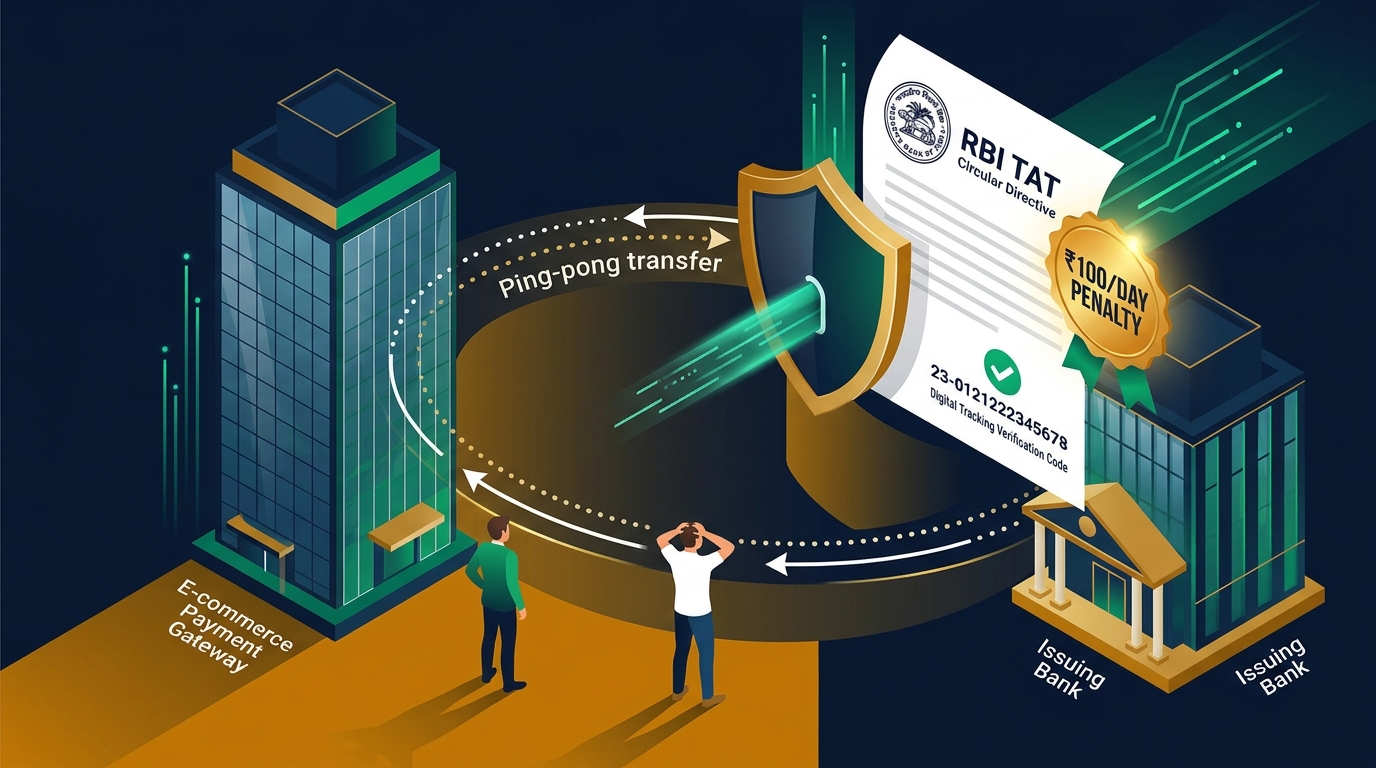
Table of Contents
Table of Contents
Swipe →Few consumer events feel more annoying than returning an item on Amazon or Flipkart and watching your money vanish into digital space. You return a product or cancel an order on the app. Within a few hours, the screen shows that your refund is successful. The app shares an Acquirer Reference Number (ARN) or Retrieval Reference Number (RRN). The shopping portal tells you to wait five to seven business days for your cash to reach your bank.
You wait seven full days, but your bank account balance does not move. You check your credit card app, and no credit appears. You dial your bank helpline to ask about the missing cash. The bank staff checks your account and tells you that no money arrived. They claim the reference number shared by the shop is invalid or not in their records. You contact Amazon or Flipkart again, but their support staff refuses to help. They claim the funds left their system and tell you to talk to your bank. You are now stuck in a classic merchant versus bank refund ping-pong loop.
Most Indian buyers give up after weeks of endless chat messages and unhelpful calls. But under Indian banking rules and consumer laws, you have strong legal rights. In 2026, the Reserve Bank of India (RBI) enforces strict Turn Around Times (TAT) for failed and reversed digital payments. Under RBI Circular DPSS.CO.PD No. 629/02.01.014/2019-20, banks and payment portals must complete your refund within five working days. If they fail, they must pay you a mandatory cash fine of ₹100 per day. This practical guide explains how to audit your reference codes, break the bank deadlock, and recover every rupee with full legal penalties.
The Merchant vs Bank Ping-Pong: Why Refunds Vanish in Transit
To break this frustrating cycle, you must know how online payments move across Indian banks. When you buy goods on a web store, your money does not go straight to the seller. It moves through a chain of digital payment partners. When a refund occurs, the money must return through that exact same multi-party chain in reverse order.
A technical failure at any single point in this chain stops the whole transfer. Yet each support team sees only its own local screen, creating total confusion for the buyer.
The Anatomy of the E-Commerce Refund Chain in India
An online refund in India passes through six separate financial entities in sequence:
- The Buyer (Cardholder or Payer): You, the customer, waiting for the cash credit in your bank account or card balance.
- The Shopping Portal: Amazon India or Flipkart, who approves your order cancel or return request.
- The Payment Gateway: Gateways like Razorpay, Cashfree, PayU, BillDesk, Pine Labs, or Amazon Pay, handling checkout collections.
- The Acquiring Bank: The commercial bank (such as Axis Bank, ICICI Bank, or HDFC Bank) that holds the payment gateway escrow account.
- The Card Network or Switch: Card networks (Visa, Mastercard, RuPay) or the National Payments Corporation of India (NPCI) for UPI transfers.
- The Issuing Bank: Your personal bank (such as SBI, HDFC, Kotak, or ICICI) that issued your card or savings account.
When Amazon or Flipkart marks a refund as initiated, they merely send an electronic file to their payment gateway. The gateway sends it to the acquiring bank, which passes it to the payment card network. The card network routes the credit file to your issuing bank. Finally, your bank must match the batch entry and post the money to your account.
Why Customer Support Blames the Bank While the Bank Denies Receipt
When an online refund goes missing, support staff on both sides rely on standard scripts. In real life, the money gets stuck due to one of three common system errors:
- Merchant Batch Queue Freeze: The shopping app marks the refund as processed, but its internal payout batch failed to execute. The money stays parked in the merchant nodal account. Customer care sees a green tick mark on their CRM and wrongly assumes your bank has the funds.
- Network Clearing Rejection: The acquiring bank sent the refund file, but the card network or NPCI rejected the batch. This happens when card tokens expire, debit cards are blocked, or technical timeouts occur. The funds bounce back into an unallocated pool account.
- Issuing Bank Suspense Account Parking: The funds reached your issuing bank, but the bank software could not map the credit to your card. Instead of alerting you, the bank parks the money in an internal sundry suspense ledger. The phone agent cannot see these internal bank accounts and tells you that nothing arrived.
If you have spent weeks listening to automated bot excuses, you need formal legal action. Serving an Amazon refund not received legal notice compels senior bank nodal officers to trace the payment at once.
Real ARN vs UPI RRN vs Fake Ticket IDs: The Audit Framework
Customer support agents often defuse consumer anger by sharing random reference numbers. In many cases, the number given by support is not an authentic banking code. It is merely an internal helpdesk ticket number. Showing an internal merchant ticket to your local bank branch achieves nothing.
You must know the exact technical format of real banking codes before you challenge your bank.
How to Decode a 23-Digit Visa and Mastercard Acquirer Reference Number
An Acquirer Reference Number (ARN) is a unique tracking code created when a card transaction moves through the payment network. If you paid using a Visa, Mastercard, or RuPay credit or debit card, your refund must generate a real 23-digit ARN.
A genuine card ARN is purely numeric and follows an exact 23-digit structure:
- Digits 1 to 6 (Bank Code): This six-digit prefix marks the acquiring bank that handled the refund. For instance, an entry processed via HDFC Bank acquiring systems features an HDFC bank routing prefix.
- Digits 7 to 10 (Julian Date): This four-digit code shows the day of the year when the bank sent the credit file to the card network.
- Digits 11 to 22 (Sequence Code): A unique twelve-digit serial number created by the network switch to trace the specific transaction batch.
- Digit 23 (Checksum): A single math check digit that confirms the number is valid.
If the number shared by Amazon or Flipkart has letters, dashes, or has fewer than 23 digits, it is not an ARN. It cannot be traced on banking networks.
Verifying a 12-Digit NPCI UPI Retrieval Reference Number
If you paid for your order via UPI (using Google Pay, PhonePe, Paytm, or Amazon Pay UPI), your refund does not use an ARN. Instead, UPI transactions rely on a 12-digit Retrieval Reference Number (RRN).
The 12-digit UPI RRN is created by the National Payments Corporation of India (NPCI) central switch. The first digit shows the year. The next three digits show the Julian day of the year. The final eight digits show the unique sequence number. Any bank officer can enter a valid 12-digit RRN into the NPCI portal and check the transfer status in thirty seconds. If your UPI payment got stuck during checkout, read our guide on failed UPI transaction money stuck in bank recovery.
Spotting Fake Internal Gateway Ticket IDs Masquerading as ARNs
Shopping app chat agents often share internal tracking codes to close support tickets quickly. They send codes like "AMZ_REF_981249" or "FK_RET_0019284". These codes exist only inside the merchant database. They never enter the interbank clearing system.
Another trick is sharing a sixteen-digit internal payment gateway ID from Razorpay or PayU. That code proves the shop talked to its gateway, but it does not prove the money reached your bank. If the merchant refuses to provide a real 23-digit ARN or 12-digit RRN, they have not paid out your refund. Filing a formal Flipkart return refund complaint creates proof of merchant non-compliance.
The RBI Turnaround Time Circular: Mandatory ₹100 Daily Penalty
Many consumers think that delayed refunds are just bad luck. They believe banks and shopping portals can hold their funds for weeks without consequence. This belief is entirely wrong under Indian financial regulations.
The Reserve Bank of India sets strict cash penalties to punish financial bodies that fail to return customer funds on time.
RBI Circular DPSS.CO.PD No. 629 and the T+5 Outer Settlement Limit
On September 20, 2019, the Reserve Bank of India issued a landmark directive on Harmonisation of Turn Around Time (TAT) and customer compensation for failed transactions (Circular DPSS.CO.PD No. 629/02.01.014/2019-20). This rule covers all authorised digital payment systems in India.
For e-commerce merchant payments where an account is debited but the order is cancelled, or where a return is accepted, the circular sets hard limits:
- Card Transactions (E-Commerce): The outer turnaround time for auto-refund is fixed at T + 5 calendar days, where T is the date of order cancel or return approval.
- UPI Merchant Payments: The auto-refund limit is T + 1 day for system failures, and T + 5 days for approved merchant returns.
- IMPS and NetBanking Payments: Reversal must occur within T + 1 day of transaction reconciliation.
Once the T + 5 day window ends, every additional day of delay is a direct breach of RBI rules.
The Suo Motu Rule: Automatic Compensation Without Prior Dispute
Paragraph 4 of the RBI Harmonisation Circular gives Indian consumers a strong legal shield. It mandates that cash compensation must be paid to the customer suo motu. This means the bank or payment gateway must credit the penalty on its own without asking the customer to submit a formal claim.
The statutory fine is set at ₹100 per day of delay beyond the set TAT window. If a shopping refund is delayed by thirty days past the T + 5 limit, the customer has a legal right to the full refund plus ₹3,000 in statutory compensation. The institution at fault must pay this cash fine directly from its own funds.
Card-Not-Present and Payment Aggregator Master Directions in 2026
In 2026, rules for payment gateways are strict. Under the RBI Master Directions on Payment Aggregators and Gateways, all payment gateways work under direct RBI oversight under the Payment and Settlement Systems Act, 2007.
Payment gateways cannot hold customer funds in escrow accounts beyond set settlement dates. If a gateway delays sending a refund to the card network, it is liable to pay the ₹100 per day penalty. Customers can use these RBI master directions to hold both the shopping app and its payment partners accountable before the banking ombudsman.
Visual Dispute Resolution & Recovery Framework
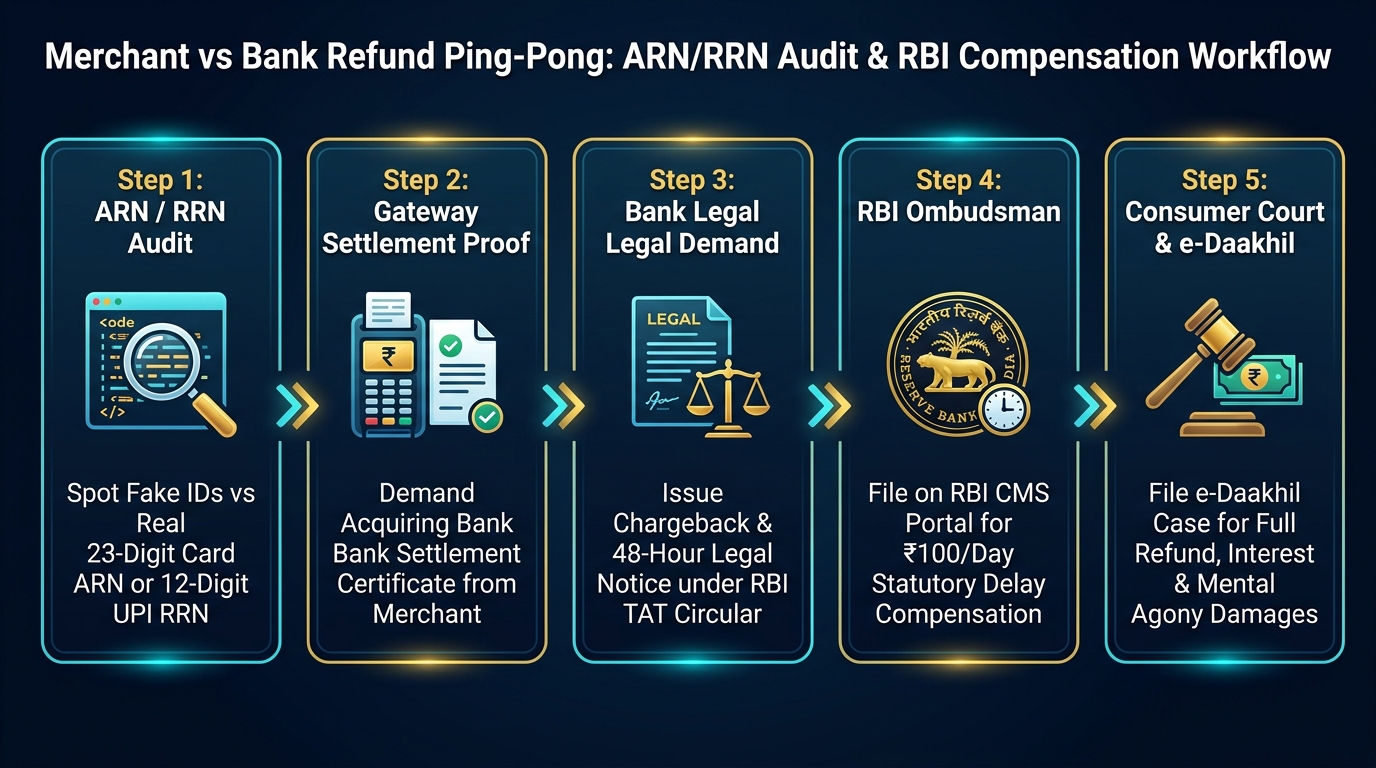
Statutory Verification and Redressal Matrix for Stuck Refunds
To recover your money quickly, you must pick the right legal path for your payment method. Each payment rail uses distinct tracking codes, relies on different network switches, and carries specific legal penalties.
The table below provides a clear comparison of reference formats, settlement rails, and legal redressal options under Indian banking rules:
| Payment Method & Channel | Reference Format & Digits | Network Verification Rail | Responsible Financial Party | Mandated RBI TAT Limit | Statutory Delay Fine | Primary Redressal Forum |
|---|---|---|---|---|---|---|
| Credit or Debit Card (Visa, Mastercard) |
23-digit numeric ARN code | Card Network Switch (Visa Base II or Mastercard IPM) | Merchant Acquiring Bank & Customer Card Bank | T + 5 Days from refund date | ₹100 per day past T + 5 days | Bank Principal Nodal Desk & RBI CMS Portal |
| RuPay Card (Domestic Card Network) |
23-digit numeric Settlement Code | NPCI RuPay Central Clearing and Settlement Rail | Acquiring Bank & RuPay Card Issuing Bank | T + 5 Days from cancel date | ₹100 per day past T + 5 days | NPCI Dispute Desk & Banking Ombudsman |
| UPI Payments (GPay, PhonePe, Paytm) |
12-digit numeric RRN code | NPCI UPI Central Clearing Switch Report | Remitter Bank, Beneficiary Bank & Gateway | T + 1 Day (Failed) / T + 5 Days (Return) | ₹100 per day past TAT limit | UPI App Ombudsman & RBI CMS Portal |
| NetBanking or IMPS (Direct Account Debit) |
12-digit IMPS code or 16-digit UTR | RBI NEFT Rail or NPCI IMPS Clearing Network | Merchant Gateway Escrow Bank & Payer Bank | T + 1 Day for account reversal | ₹100 per day past T + 1 day | Bank Grievance Desk & RBI Ombudsman |
| Digital Store Wallets (Amazon Pay, Flipkart Wallet) |
Alphanumeric Internal Wallet ID | Shopping App Prepaid Payment Ledger | Marketplace Wallet Operating Entity | T + 1 Day for wallet credit | Statutory Interest & Consumer Damages | National Consumer Helpline & Consumer Court |
Using this table helps you find out exactly which firm holds your cash. Once you know which party is at fault, you can skip junior chat agents and contact senior legal officers directly.
Concrete Rupee Compensation Matrix: Calculating ₹100/Day Dues
When e-commerce platforms delay refunds, they hope customers will accept a late credit without asking for interest. But under RBI rules, financial compensation is an absolute legal right. Putting exact rupee calculations into your written notice often forces fast settlements.
The financial matrix below shows five real recovery examples, explaining how statutory penalties and legal interest add up over time:
| E-Commerce Purchase Case | Withheld Refund Sum | Days Delayed Past T+5 | RBI Fine Due (@ ₹100/Day) | Interest & Harassment Damages Claimed | Total Legally Recoverable Sum | Settlement Speed via Notice |
|---|---|---|---|---|---|---|
| Case 1: Phone Return on Flipkart (Courier took phone; refund unpaid) |
₹18,500 | 25 Days past TAT | ₹2,500 (25 days x ₹100) |
₹5,000 (Service deficiency damages) |
₹26,000 | 7 to 10 Days via Legal Notice |
| Case 2: Laptop Cancel on Amazon (High-value credit card charge) |
₹62,000 | 45 Days past TAT | ₹4,500 (45 days x ₹100) |
₹15,000 (Card interest loss & mental agony) |
₹81,500 | 14 Days via RBI CMS Portal |
| Case 3: Festive Clothes Return (Paid via Google Pay UPI) |
₹4,800 | 30 Days past TAT | ₹3,000 (30 days x ₹100) |
₹2,500 (Consumer grievance claim) |
₹10,300 | 5 Days via Bank Nodal Notice |
| Case 4: Smart TV Return Lost in Transit (Shop claimed return unverified) |
₹34,990 | 60 Days past TAT | ₹6,000 (60 days x ₹100) |
₹25,000 (Consumer Court damages claim) |
₹65,990 | 20 to 30 Days via e-Daakhil |
| Case 5: Home Appliance Flash Sale (Payment debited but order failed) |
₹12,500 | 18 Days past TAT | ₹1,800 (18 days x ₹100) |
₹3,500 (Unfair trade practice damages) |
₹17,800 | 7 Days via Card Chargeback |
As these numbers show, a delayed refund is not a minor slip. It is a growing financial debt for the defaulting bank or shopping platform. Putting these exact rupee sums in a formal legal notice ends merchant delay tactics.
Consumer Protection Rules 2020: Piercing Marketplace Safe Harbors
When consumers demand their money, Amazon and Flipkart legal teams often rely on a standard defense. They claim they are neutral tech platforms under Section 79 of the Information Technology Act, 2000. They argue that third-party sellers or payment gateways are solely at fault for the lost cash. Under modern consumer law, this safe harbor defense fails completely.
Indian consumer courts hold digital shopping portals strictly responsible for payment failures inside their apps.
Rule 5(10) and Rule 6(3): Joint Liability of Platforms and Sellers
The Ministry of Consumer Affairs notified the Consumer Protection (E-Commerce) Rules, 2020 to end marketplace evasiveness. These rules set binding legal duties for every online portal operating in India:
- Rule 5(10) - Mandatory Refund Timelines: Every e-commerce entity must process all payments for accepted refunds within a reasonable time, or within timelines set by the Reserve Bank of India. If the RBI sets a five-day limit, the shopping app must make sure the buyer receives the cash within that exact period.
- Rule 6(3) - Seller Return Rules: Third-party sellers on digital shopping apps cannot refuse returns or delay refunds for defective, damaged, or delayed goods. The shopping portal is legally bound to enforce this rule against its sellers.
When a shopping portal approves an order cancellation, the legal duty to deliver the refund rests directly upon the portal management.
Why E-Commerce Platforms Cannot Hide Behind Intermediary Status
The National Consumer Disputes Redressal Commission (NCDRC) and State Commissions have repeatedly stripped shopping portals of intermediary protection in refund disputes. Judges note that portals collect fees on sales, take customer money in their own payment gateways, and run return delivery fleets. They cannot claim to be neutral conduits when a customer refund goes missing.
Holding back customer funds while claiming the bank has the money is an Unfair Trade Practice under Section 2(47) and a Deficiency in Service under Section 2(11) of the Consumer Protection Act, 2019. Consumer courts regularly grant large compensation awards for mental agony alongside full refund repayments. If a seller acts deceptively, sending an e-commerce fraud refund legal notice protects your legal rights.
4-Step Recovery Playbook: Reclaiming Your Refund and RBI Penalty
Recovering your money from big corporations requires clear, steady legal pressure. Making endless phone calls to outsourced support teams will not fix a technical payment block. You must follow a proven four-step legal playbook designed to force senior managers to step in.
Follow this exact chronological protocol to secure your refund and statutory compensation:
Step 1: Auditing Your Reference Number and Demanding Settlement Proof
Before you start legal steps, build written proof of all transaction facts:
- Send an email to support asking for the official 23-digit ARN (for card payments) or 12-digit RRN (for UPI payments).
- Ask for an official Payment Gateway Settlement Certificate showing the acquiring bank name, batch ID, and the exact time of transfer.
- If support shares an internal 8-to-10 digit order code, reply in writing: "This code is an internal merchant ticket. Under RBI Circular DPSS.CO.PD No. 629/2019-20, please share the genuine 23-digit card ARN or 12-digit UPI RRN within 24 hours."
Save every email and chat transcript to prove merchant delay before the banking ombudsman.
Step 2: Serving a 48-Hour Bank Notice and Raising a Chargeback
Once you have the 23-digit ARN or 12-digit RRN, write to your card issuing bank. Do not waste time at local bank branches where staff may not know how clearing batches work. Write directly to the bank Principal Nodal Officer (PNO):
- Send an email to the PNO with your bank statement, order bill, and the ARN confirmation from the shopping app.
- Ask the bank chargeback team to check their internal clearing suspense account and general ledger records.
- Demand that the bank file a card chargeback under reason code "Credit Not Processed / Refund Not Received" through the Visa, Mastercard, or RuPay network.
- Give a firm 48-hour deadline to credit the cash or provide an official network rejection note. Warn the bank of its duty to pay ₹100 per day under RBI rules.
To hire seasoned legal counsel, you can send a Joint Legal Notice to Merchant & Bank Nodal Officer through our legal recovery team.
Step 3: Escalating to the RBI Integrated Ombudsman on CMS Portal
If your bank fails to credit your money or fails to give you a rejection note within thirty days, take the case to the regulator. The Reserve Bank - Integrated Ombudsman Scheme (RB-IOS), 2021 covers all commercial banks, payment operators, and licensed payment gateways.
Visit the official RBI Complaint Management System (CMS) at cms.rbi.org.in. File a complaint against both your issuing bank and the merchant payment gateway. Upload your bank statement, the ARN details, and your unresolved bank grievance email. Ask for two clear remedies: full credit of your refund principal, and mandatory cash compensation of ₹100 per day from day T + 6 until the credit date. The RBI Ombudsman takes payment delays seriously and routinely awards full penalties.
Step 4: Filing e-Daakhil Consumer Complaint for Refund and Damages
If the shopping app and banks continue to ignore your demand, file a consumer case via the national e-Daakhil portal (edaakhil.nic.in). You can file online without going to court in person.
Name both Amazon Seller Services Pvt Ltd (or Flipkart Internet Pvt Ltd) and your bank as opposite parties. Claim your full refund with 18 percent annual interest, the ₹100 daily RBI fine, ₹30,000 for mental agony, and full legal costs. Make sure you file within the legal time limit to file a money recovery case in India. If your money was routed to an incorrect virtual address, check our steps for wrong UPI transfer money recovery.
By following this legal playbook, you stop being a helpless consumer. Big corporations resolve valid statutory claims quickly when they realize you understand their legal liabilities.
Popular Searches & Related Topics

Legal Recovery is India's trusted consumer protection and legal tech platform. We specialize in holding corporations accountable for unfair trade practices, deceptive marketing, and commercial fraud. With over 15,000 customers counselled, our mission is to provide fast, out-of-court resolutions by connecting you with top-tier panel advocates for immediate legal action.
Client Reviews
"Returned a defective laptop worth ₹74,990 on Amazon. The app said refund initiated with a 23-digit ARN, but HDFC Bank denied receiving any funds for 28 days. LegalRecovery audited the ARN, proved the funds were stuck in the bank internal clearing suspense pool, and issued a lethal legal notice citing RBI TAT rules. HDFC credited my full ₹74,990 plus ₹2,300 statutory delay penalty in 6 days."
Siddharth Nambiar (Bengaluru)
"Flipkart claimed my ₹24,000 phone return refund was credited via UPI, but my SBI account never received the money. Flipkart support kept closing my tickets with an unverified 8-digit code. LegalRecovery demanded the official 12-digit NPCI RRN and Gateway Settlement Certificate, then served notice to Flipkart Nodal Desk. The entire ₹24,000 was credited directly to my bank within 72 hours."
Rituja Deshmukh (Mumbai)
"Trapped in an infuriating month-long ping-pong between Axis Bank and Amazon over a cancelled ₹15,500 appliance order. LegalRecovery drafted an ironclad complaint for the RBI Integrated Ombudsman CMS portal citing RBI Circular DPSS.CO.PD No. 629 and demanding ₹100/day penalty. Axis Bank called me personally, credited the refund, and added ₹3,100 in delay compensation."
Kavita Ramachandran (Chennai)
"Outstanding fintech legal expertise. My credit card refund of ₹38,000 was lost after an international seller cancellation on an e-commerce app. ICICI Bank claimed the ARN was unmapped. Team LegalRecovery invoked Visa Chargeback rules and Consumer Protection Rules 2020. The bank cleared the chargeback and reversed all finance charges in just over a week."
Arunav Sengupta (Kolkata)
"An essential legal service for online shoppers. Flipkart delayed my ₹12,800 refund by 40 days, blaming their payment gateway partner. LegalRecovery filed an e-Daakhil consumer notice demanding the principal plus ₹3,500 RBI statutory delay penalty. Flipkart senior grievance desk settled the entire amount before the commission issued notice. Highly recommended!"
Tanmay Bansal (Gurugram)
Frequently Asked Questions
Related Articles
Amazon or Flipkart Investigation Denied Refund? Legal Recovery Fix
amazon investigation completed no refund wrong item received, flipkart rejected refund after investigation wrong product, amazon ofm account warning refund denied legal notice, received empty box or wrong item amazon refund denied, unboxing video evidence consumer court ecommerce, how to challenge amazon internal investigation refund rejection, section 106 bharatiya sakshya adhiniyam ecommerce burden of proof, airway bill dead weight scan hub discrepancy, consumer protection ecommerce rules 2020 refund delay liability, visa mastercard chargeback reason code 13 3 defective merchandise
Read Article
E-Commerce App Forcing Wallet Refund Over Bank Account? Legal Fix
ecommerce forcing wallet refund instead of original payment method, can company force store credit instead of bank refund india, myntra ajio refund stuck in wallet transfer to bank, ccpa guidelines against forced wallet refunds dark patterns, rbi prepaid payment instrument wallet refund to source, legal notice for original source refund ecommerce, section 2 47 consumer protection act unfair trade practice, dark patterns forced action interface interference, closed loop wallet refund bank withdrawal, e daakhil complaint for store credit refund
Read Article
Flipkart or Amazon OBD Refund Rejected After OTP? Recover Now (2026)
flipkart open box delivery refund rejected legal notice, amazon otp shared defective product refund denied, open box delivery hidden motherboard screen defect refund, flipkart service center replacement denial refund recovery, consumer protection e-commerce rules open box delivery, how to get refund from flipkart after open box delivery
Read Article
Amazon, Flipkart or Meesho Holding Seller Payouts? Recover Now (2026)
amazon flipkart seller payment on hold legal notice, amazon seller account deactivated funds withheld recovery, flipkart spf claim rejected legal notice, meesho seller payment hold recovery, account level reserve amazon india legal notice, rbi payment aggregator nodal account settlement rules
Read ArticleAbout Author
Anuj Anand Malik
View ProfileAnuj Anand Malik, Founder of AMA Legal Solutions, is a trusted advocate, loan settlement expert, legal advisor, and banking lawyer. With over a decade of experience in loan settlement, corporate law, financial disputes, and compliance, he leads a result-driven law firm based in India that helps individuals, startups, and businesses achieve legal and financial stability.
Connect on LinkedInNeed Legal Help?
Get expert advice on loan settlement, banking disputes and debt relief.
Start Recovery NowRequest Callback