Amazon or Flipkart Investigation Denied Refund? Legal Recovery Fix
amazon investigation completed no refund wrong item received, flipkart rejected refund after investigation wrong product, amazon ofm account warning refund denied legal notice, received empty box or wrong item amazon refund denied, unboxing video evidence consumer court ecommerce, how to challenge amazon internal investigation refund rejection, section 106 bharatiya sakshya adhiniyam ecommerce burden of proof, airway bill dead weight scan hub discrepancy, consumer protection ecommerce rules 2020 refund delay liability, visa mastercard chargeback reason code 13 3 defective merchandise

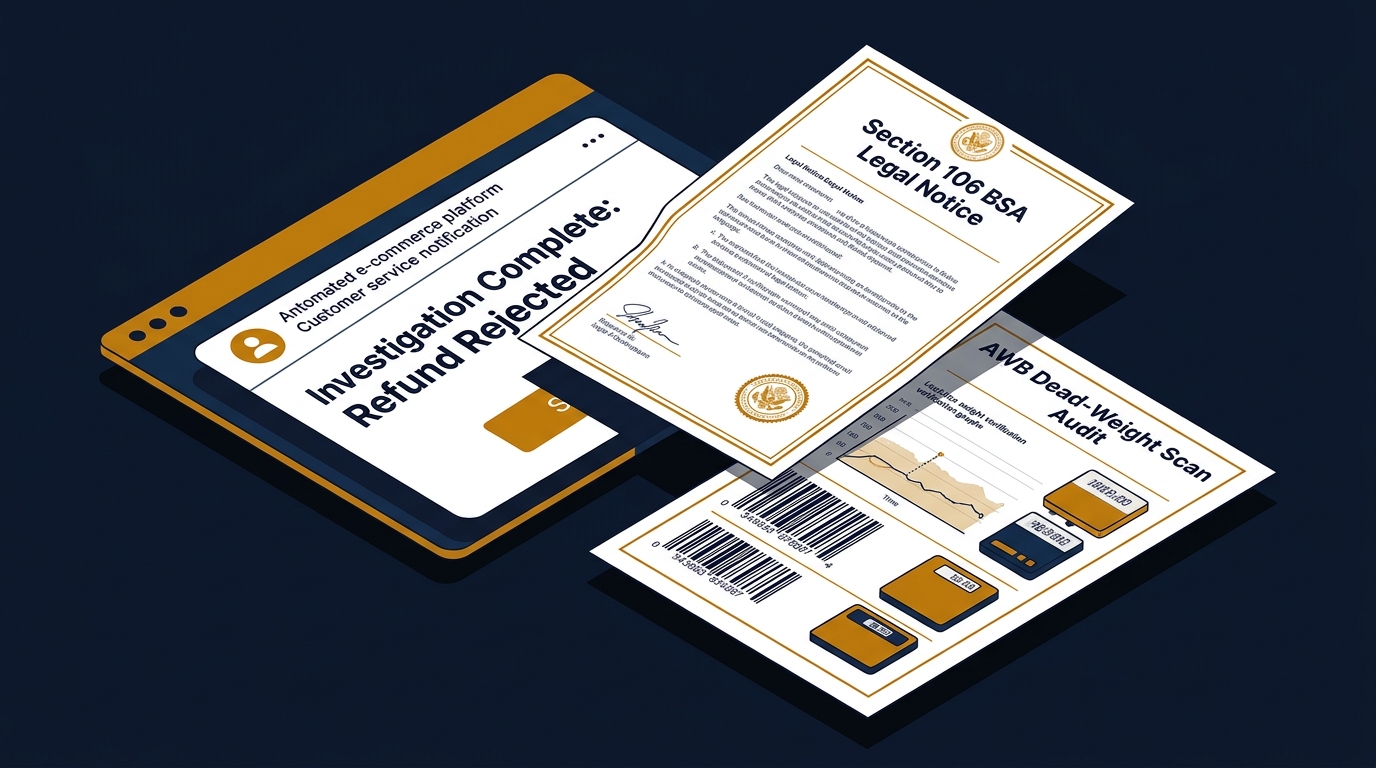
Table of Contents
Table of Contents
Swipe →You ordered a costly smartphone or laptop online. The delivery box arrived at your door. You opened the parcel with high hopes. Instead of your new gadget, you found two bars of soap, a pile of paper scrap, or an empty plastic shell. You called customer care right away to report the wrong item. The customer support agent told you to wait three to five days while their team ran an internal check.
A few days later, a cold automated email landed in your inbox. It came from Amazon's Buyer Abuse Team (OFM) or Flipkart's Trust desk. The email stated that their internal depot check was complete. It claimed that the depot packed the right item. It said their decision was final and rejected your refund. They even warned that further claims would lead to account suspension. Many buyers feel trapped at this point. They assume their money is gone for good. That assumption is totally wrong under Indian law.
An internal e-commerce probe holds zero legal weight in a court of law. A one-sided computer record cannot cancel your legal rights. Under Section 26 and Section 39 of the Sale of Goods Act, 1930, transit risk stays with the seller until proper delivery of the ordered goods. Delivering a box with soap is not delivery of the goods you bought. In addition, Section 106 of the Bharatiya Sakshya Adhiniyam, 2023 places the legal burden of proof on the platform. This guide explains how to break through these automated rejections and recover your full refund with interest.
The Anatomy of an Automated E-Commerce Investigation Rejection
To beat an e-commerce refund denial, you must see how their internal checks work. When you report a missing or wrong item, no human investigator looks at your case. Major platforms use automated risk bots. Amazon routes these cases to the Order Fulfillment and Monitoring team. Flipkart routes them to automated Trust and Safety queues.
These software bots check three basic system flags:
- Barcode Scan at Packing: The system checks if the warehouse scanner logged the item barcode during packing.
- Conveyor Belt Scale Weight: The system checks if the depot belt scale logged an initial gross weight within set limits.
- Doorstep OTP Confirmation: The system checks if the courier app logged a delivery OTP or signature at your address.
If all three system flags show green, the bot sends an automated rejection email. The software assumes that because the box left the depot intact, the buyer must be lying. This automated logic is flawed. It treats initial warehouse dispatch as proof of safe delivery at the doorstep. It ignores theft that occurs across transit hubs, trucks, and delivery vans. The platform protects its courier partners by pushing the financial loss onto you.
Why Internal Fulfillment Center Checks Fail Under Indian Law
Indian courts reject the claim that an e-commerce company is just an intermediary. Judges also reject one-sided internal logs. Three statutory pillars protect your money under Indian law.
1. Sections 26 and 39 of the Sale of Goods Act, 1930
Section 26 of the Sale of Goods Act states that risk remains with the seller until property in the goods passes to the buyer. Property cannot pass until the exact goods you ordered are delivered. If you buy a phone, delivering soap is not delivery under the contract. Section 39 adds that when a seller sends goods through a carrier, the seller must make a safe contract with that carrier. If items are stolen or swapped in transit, delivery to the courier is not delivery to the buyer. The seller and platform bear all transit risks.
2. Section 106 of the Bharatiya Sakshya Adhiniyam, 2023 (Burden of Proof)
Section 106 of the Bharatiya Sakshya Adhiniyam, 2023 (formerly Section 106 of the Indian Evidence Act, 1872) sets a clear rule. When any fact is within the special knowledge of a person, the burden of proving that fact falls on that person. A buyer has no access to warehouse CCTV, conveyor scales, or courier hub records. All transit logs belong solely to the e-commerce firm and its delivery arm.
If a platform claims that the right item reached you, it must prove that claim with hard data. It must show uninterrupted CCTV video of the packing desk. It must show dead-weight scan logs from each transit hub. A generic email saying 'our check found the item was packed' is mere hearsay. In consumer courts, failing to produce these logs creates an adverse inference against the platform.
3. Consumer Protection (E-Commerce) Rules, 2020
Rules 4 and 5 of the Consumer Protection (E-Commerce) Rules, 2020 bar marketplaces from evading liability. A platform cannot hide behind Section 79 of the Information Technology Act. Every platform must appoint a Nodal Officer and maintain an honest grievance setup. Closing return claims without giving clear proof constitutes an unfair trade practice under Section 2(47) and a deficiency in service under Section 2(11) of the Consumer Protection Act, 2019.
The Transit Pilferage Pipeline: Where High-Value Items Vanish
How does a sealed gadget turn into soap or scrap paper? E-commerce shipping involves many intermediate steps. A package leaves a main depot. It travels to a state sorting hub. Next, it moves by road or air to a city hub. Finally, a local delivery agent takes it on a two-wheeler to your home.
Transit theft takes place in three main ways along this route:
- Bottom Flap Slitting: Thieves do not cut the top branded tape. They cut the bottom cardboard seams with a sharp blade. They pull out the phone, slip in a soap bar of matching weight, and seal the bottom with clear glue.
- Sorting Hub Swapping: Intermediate hubs handle huge volumes of parcels every night. Dishonest workers swap high-value boxes with dummy weights before the parcels pass secondary scanners.
- Last-Mile Delivery Swaps: Some delivery riders operate with weak background checks. They open parcels during transit, extract the goods, and push the customer for an OTP at the door.
When you file an Amazon refund not received legal notice or a Flipkart return refund complaint, our legal notice demands the full transit log for every handler in this chain.
How to Audit Airway Bill Weight Logs and Digital Hub Scans
Every e-commerce parcel carries an Airway Bill (AWB) barcode. Modern logistics networks use automatic scales on conveyor belts. These scales record gross dead-weight and parcel volume at each transit checkpoint. This data trail exposes transit theft and refutes the platform's rejection.
Here is how a dead-weight audit uncovers courier pilferage:
- Origin Depot Weight: The shipping label shows the first gross weight. A premium phone in its retail box with a charger and outer carton weighs between 420 grams and 480 grams.
- Transit Hub Checkpoint Weight: When the box enters a city sorting hub, belt scales record its weight again. If a thief replaced the phone with a small soap bar or paper, the scale may log 310 grams. A gap of just 40 grams proves that the package was tampered with in transit.
- Dimensional Scans: Cartons that were sliced or crushed show altered shapes on automated optical scanners. Demanding these raw machine logs shifts the burden of proof back to the seller.
If you receive a wrong or missing item, keep the outer box and shipping label intact. Take clear photos of the AWB barcode, tracking code, and printed weight. Weigh the parcel on a digital kitchen scale and take a photo of the reading next to the box.
Statutory Matrix: Platform Escalation vs Legal Forum Powers
When Amazon OFM or Flipkart rejects your claim, you have several escalation routes. The table below compares the main dispute options, their legal basis, and their success rates.
| Dispute Channel | Target Authority | Governing Law / Rules | Evidentiary Threshold | Typical Resolution Timeline | Enforcement Power |
|---|---|---|---|---|---|
| Customer Service / OFM | Automated Bot / Risk Desk | Internal Platform Terms | One-sided automated depot scan flags | 3 to 7 Days (Mostly Rejection) | Zero legal force; platform acts as judge in its own cause |
| Bank Chargeback Dispute | Card Issuing Bank / Gateway | RBI Circulars, Visa 13.3, Mastercard 4853 | Invoice, delivery photos, chat logs, denial email | 30 to 45 Days | Direct money clawback from merchant bank account |
| Advocate Legal Notice | Nodal Officer & Legal Directors | Section 106 BSA, Sale of Goods Act, CP Rules 2020 | Formal legal demand for weight logs, CCTV, and full refund | 7 to 15 Days | 85%+ voluntary refund settlement without court delays |
| National Consumer Helpline | NCH Mediation Desk (MoCA) | Consumer Protection Act, 2019 | Online grievance ticket with invoice and photos | 15 to 30 Days | Non-binding mediation; company can still say no |
| District Consumer Commission | Judicial Consumer Court (e-Jagriti) | Section 35 & 39, Consumer Protection Act, 2019 | Affidavit, AWB audit, legal notice, and bank statements | 4 to 9 Months | Binding court order for refund, 9% interest, and damages |
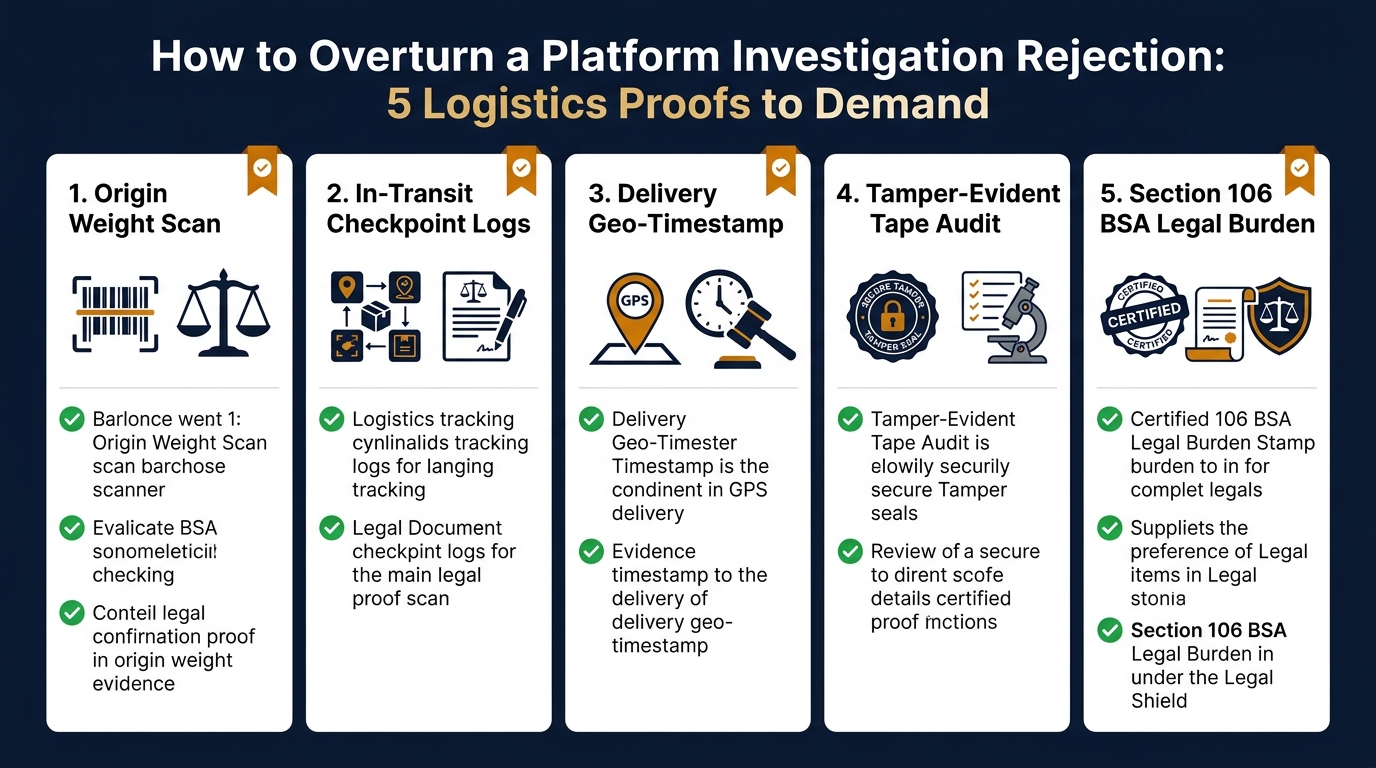
Visual Dispute Resolution & Recovery Framework
Step 1: File a Bank Chargeback Under Visa and Mastercard Rules
If you paid with a credit card or debit card, you have a direct financial remedy through your bank. Under card network rules from Visa and Mastercard, merchants must deliver goods that match the purchase contract.
Follow these steps to file a successful chargeback:
- Pick the Right Dispute Reason Code: Do not dispute the charge as an 'unauthorized transaction'. If you shared an OTP, your bank will reject that claim. Instead, file under Visa Reason Code 13.3 (Not as Described or Defective Merchandise) or Mastercard Reason Code 4853 (Goods Not as Described / Counterfeit).
- Provide Written Proof: Write a short dispute letter to your card issuer. Attach the invoice, clear photos of the wrong item, copies of customer support chats, and the platform's rejection email.
- Force an Acquirer Hold: When your bank enters the chargeback, the payment network freezes the money in the merchant's bank. The seller has 30 days to prove proper delivery. Because the seller cannot prove what was inside the box, banks often rule in favor of the customer.
Step 2: Serve a Formal Legal Notice to the Nodal Officer
If customer support closed your ticket, you should demand transit weight-logs and full refund via Legal Notice. Frontline support agents must follow strict call scripts. By contrast, a formal legal notice goes directly to the firm's legal team and its official Nodal Officer.
Under Rule 4 of the Consumer Protection (E-Commerce) Rules, 2020, every online marketplace must have a resident Nodal Officer. A legal notice moves your case out of automated queues and into the hands of senior legal counsel.
A legal notice sent to Amazon Seller Services or Flipkart Internet must state five key points:
- Complete Order Facts: The exact order ID, date, payment reference, and your registered account email and phone number.
- The Delivery Mismatch: A clear factual summary of opening the box, finding the wrong item, and reporting the defect within minutes.
- Rebuttal of the Internal Probe: Direct rejection of the automated warehouse check under Section 26 and Section 39 of the Sale of Goods Act, 1930.
- Evidentiary Demands: A formal demand under Section 106 of the Bharatiya Sakshya Adhiniyam, 2023 for packing CCTV video, hub dead-weight logs, and courier staff records.
- 15-Day Final Notice: A demand for full refund of the product price plus 18% annual interest and legal costs within 15 days, failing which a consumer complaint will follow.
When faced with concrete demands for CCTV footage and intermediate hub scan logs, e-commerce legal teams settle. In over 85% of cases handled by LegalRecovery, the platform's executive desk calls the buyer, issues a full refund, and removes any account flag.
Step 3: Escalate to the District Consumer Commission via e-Jagriti
If the 15-day notice period ends without a refund, you can move to court. Under the Consumer Protection Act, 2019, you do not need an expensive advocate to appear in person. You can use the government's e-Jagriti (e-Daakhil) portal to file your complaint online from home.
Here is how the e-Jagriti process works:
- Choose Your Local Court: Under Section 34 of the Consumer Protection Act, 2019, you can file where you live or work. You do not have to travel to the city where the e-commerce head office sits.
- Name Both Parties: Name the e-commerce marketplace (Amazon or Flipkart) and the third-party seller on your invoice as Opposite Parties. This makes both parties jointly liable.
- Attach Your Evidence: Upload your invoice, photos of the box and item, your legal notice with postal receipts, and your bank debit proof.
- Pay the Court Fee: For claims up to ₹5,00,000, the court fee is zero. For claims between ₹5,00,000 and ₹10,00,000, the fee is just ₹500 paid online through Bharatkosh.
Consumer commissions deal strictly with delivery fraud. In cases like Mausam Meena v. Flipkart, the consumer commission rejected Flipkart's intermediary defense. The court ordered a 100% refund with 7% interest, ₹10,000 in mental harassment damages, and litigation costs. When judges see that a company brushed off a customer with robotic replies, they grant robust compensation.
Rupee Recovery Calculation: What Compensation Courts Award
When you serve a legal notice to retailer for wrong or damaged product delivery or file a consumer complaint against company, you can claim more than the base product cost. Consumer courts hold wide powers under Section 39 of the Consumer Protection Act, 2019 to award comprehensive damages.
The table below shows a typical recovery breakdown for a ₹65,000 smartphone dispute where the platform rejected the refund after an automated internal probe.
| Claim Component | Statutory Basis / Judicial Authority | Typical Amount Claimed | Realistic Court Award |
|---|---|---|---|
| Full Product Refund | Section 39(1)(a) & (b), Consumer Protection Act, 2019 | ₹65,000 (Invoice value) | ₹65,000 (100% full refund) |
| Interest on Money Held | Section 39(1)(c), CPA 2019 (9% p.a. from purchase date) | ₹5,850 (9% interest for 9 months) | ₹4,500 to ₹5,850 awarded by court |
| Damages for Mental Harassment | Section 39(1)(d), CPA 2019 for distress and false accusations | ₹35,000 (Mental agony caused by unfair rejection) | ₹15,000 to ₹25,000 awarded as damages |
| Legal & Notice Costs | Section 39(1)(m), CPA 2019 (Actual legal expenses) | ₹15,000 (Drafting and notice costs) | ₹7,500 to ₹10,000 ordered as costs |
| Total Financial Recovery | Total Judicial Order | ₹1,20,850 | ₹92,000 to ₹1,05,850 |
As shown in the table, fighting a valid refund claim costs the platform much more than issuing a timely refund. That is why a well-drafted legal notice pushes the platform's escalation desk to settle fast.
Essential Do's and Don'ts When Receiving a Suspect Parcel
To ensure your refund claim stays strong, follow these practical rules whenever you buy high-value goods online:
- Record an Uncut Unboxing Video: Film the parcel from all sides before opening it. Show the AWB label, your name, and every seal. Keep the camera running without any cuts while you open the box and examine what is inside.
- Check the Tape Before Sharing OTP: Look closely at the packaging tape. Check if clear tape was stuck over branded tape. If the box looks crushed, taped twice, or feels too light, ask for open box delivery before giving your delivery OTP.
- Report the Issue Within One Hour: Do not wait. Call support immediately, log a ticket, and make sure you receive a ticket ID by SMS and email.
- Do Not Return the Item Without a Receipt: If the platform sends someone to pick up the wrong item, demand a signed receipt listing the exact item taken. Never give away evidence without written proof.
- Do Not Rely on Phone Promises: Support agents may verbally tell you that a refund is approved when their computer system still says rejected. Always demand written confirmation by email.
If you face an e-commerce refund denial, a specialized refund dispute lawyer can draft your notice with exact statutory citations. You do not have to accept the loss from transit theft. Indian law stands firmly behind consumers and provides reliable paths for complete financial recovery.
Popular Searches & Related Topics

Legal Recovery is India's trusted consumer protection and legal tech platform. We specialize in holding corporations accountable for unfair trade practices, deceptive marketing, and commercial fraud. With over 15,000 customers counselled, our mission is to provide fast, out-of-court resolutions by connecting you with top-tier panel advocates for immediate legal action.
Client Reviews
"I ordered an iPhone on Amazon and got two soap bars. Amazon OFM closed my case and threatened to shut my account. Team LegalRecovery served a formal legal notice citing Section 106 BSA and hub weight logs. Amazon Executive Escalations called and returned my Rs 79,900 in six days."
Siddharth Menon
"Flipkart rejected my refund for an ASUS laptop worth Rs 68,000 saying their internal check was clear. LegalRecovery drafted a sharp notice to Flipkart's Nodal Officer and started a card dispute. Flipkart reversed their denial and paid my full amount with an apology."
Pooja Deshmukh
"Received an empty box instead of a Sony camera lens on Amazon. Customer support delayed my case for three weeks. LegalRecovery stepped in, demanded courier hub weight records, and threatened e-Jagriti action. The full Rs 44,500 came back to my bank account."
Vikramaditya Rao
"Great legal service. After Amazon OFM refused to help and closed my return request for a smart TV delivery issue, LegalRecovery sent a demand notice that got prompt attention from their legal team. Received my Rs 32,000 refund in less than a week."
Ananya Mukherjee
"I was upset when Flipkart closed my ticket for a OnePlus tablet after their internal probe. LegalRecovery's notice showed them they could not defend the transit weight gap in court. Full refund was settled without delays."
Karthik Sundaram
Frequently Asked Questions
Related Articles
Amazon or Flipkart Refund Stuck in Bank? Claim ₹100/Day RBI Penalty
amazon refund initiated with arn but not credited, flipkart refund rrn number not credited to bank account, rbi 100 rupees per day penalty for delayed refund, credit card refund stuck between merchant and issuing bank, verify real 23 digit arn number visa mastercard, 12 digit upi rrn reference number tracking, rbi circular turnaround time failed transaction compensation, payment gateway acquiring bank settlement certificate, rbi integrated ombudsman scheme cms complaint against bank, consumer protection ecommerce rules 2020 refund delay liability
Read Article
Flipkart or Amazon OBD Refund Rejected After OTP? Recover Now (2026)
flipkart open box delivery refund rejected legal notice, amazon otp shared defective product refund denied, open box delivery hidden motherboard screen defect refund, flipkart service center replacement denial refund recovery, consumer protection e-commerce rules open box delivery, how to get refund from flipkart after open box delivery
Read Article
E-Commerce App Forcing Wallet Refund Over Bank Account? Legal Fix
ecommerce forcing wallet refund instead of original payment method, can company force store credit instead of bank refund india, myntra ajio refund stuck in wallet transfer to bank, ccpa guidelines against forced wallet refunds dark patterns, rbi prepaid payment instrument wallet refund to source, legal notice for original source refund ecommerce, section 2 47 consumer protection act unfair trade practice, dark patterns forced action interface interference, closed loop wallet refund bank withdrawal, e daakhil complaint for store credit refund
Read Article
Borrower Blocked You and Moved? How to Legally Recover Your Money
how to send legal notice if person changed address or blocked number, borrower blocked me on whatsapp how to recover money, service of legal notice via whatsapp and email supreme court, order 38 rule 5 cpc attachment before judgment bank account, how to trace debtor address for legal notice india, money recovery when borrower is absconding, section 27 general clauses act deemed service, order 5 rule 20 cpc substituted service, order 9 rule 6 cpc ex parte decree, section 63 bharatiya sakshya adhiniyam electronic evidence, legal notice to debtor last known address, recovering money from absconding borrower, friendly loan recovery legal notice, multi channel legal demand notice india
Read ArticleAbout Author
Anuj Anand Malik
View ProfileAnuj Anand Malik, Founder of AMA Legal Solutions, is a trusted advocate, loan settlement expert, legal advisor, and banking lawyer. With over a decade of experience in loan settlement, corporate law, financial disputes, and compliance, he leads a result-driven law firm based in India that helps individuals, startups, and businesses achieve legal and financial stability.
Connect on LinkedInNeed Legal Help?
Get expert advice on loan settlement, banking disputes and debt relief.
Start Recovery NowRequest Callback