Send a Legal Notice to Company for Not Paying Bonus
Recover your withheld annual performance bonus, statutory bonus dues, variable pay, and retention incentives with 18% commercial interest under the Payment of Bonus Act, 1965 and Indian Contract Act, 1872.
Table of Contents
Swipe →Quick Answer
Under Section 8, Section 10, and Section 19 of the Payment of Bonus Act, 1965 and Section 73 of the Indian Contract Act, 1872, an employee who has worked the qualifying period or achieved established performance key performance indicators (KPIs) possesses an enforceable legal right to receive statutory bonus and contractual variable pay. When an employer arbitrarily withholds, delays, or forfeits bonus payments post-resignation or during annual disbursement cycles, serving an advocate-drafted statutory legal notice demands immediate release of the principal sum alongside 18% commercial interest within 15 days. If the employer fails to comply within the notice window, the employee can initiate certificate recovery before the Chief Labour Commissioner under Section 21 of the Payment of Bonus Act, file a wage deduction complaint under Section 15 of the Payment of Wages Act, 1936, or file a summary recovery suit under Order 37 of the Code of Civil Procedure, 1908 in civil court.
1. Legal Framework: Statutory Bonus vs Contractual Variable Pay
Corporate bonus disputes in India typically fall into two distinct legal categories: statutory social welfare bonuses governed by the Payment of Bonus Act, 1965, and contractual incentive schemes, performance variable pay, retention bonuses, or sales commissions governed by the Indian Contract Act, 1872. Understanding this legal bifurcation is crucial when drafting a formidable legal demand notice that defeats corporate evasion tactics.
Under Section 1(3) of the Payment of Bonus Act, 1965, every factory and commercial establishment employing 20 or more persons (or 10 or more in specific notified states) is statutorily bound to disburse an annual bonus to eligible employees who have worked for not less than 30 working days in that accounting year (Section 8). Under Section 10, the statutory minimum bonus is fixed at 8.33% of the employee’s salary or wage earned during the accounting year or ₹100, whichever is higher, regardless of whether the employer has an allocable surplus. Where the allocable surplus exceeds the minimum bonus, Section 11 mandates the payment of bonus up to a statutory ceiling of 20% of the employee’s annual wage.
Statutory vs Contractual Bonus Comparison Matrix
| Legal Parameter | Statutory Bonus (Payment of Bonus Act, 1965) | Contractual Variable Pay / Performance Bonus |
|---|---|---|
| Governing Statute | Payment of Bonus Act, 1965 / Code on Wages, 2019 | Indian Contract Act, 1872 (Section 73) |
| Eligibility Threshold | Minimum 30 working days in the accounting year | Fulfilment of contractual KPIs, goals, or milestones |
| Quantum Range | 8.33% (statutory minimum) to 20% (maximum ceiling) | Agreed percentage of CTC (e.g., 10% to 50%+ of CTC) |
| Payment Deadline | Within 8 months from close of accounting year (Sec 19) | As per employment contract / annual appraisal cycle |
| Forfeiture Grounds | Strictly Section 9: Fraud, violent riotous act, theft/sabotage | Breach of contract; arbitrary forfeiture is void ab initio |
| Enforcement Forum | Labour Commissioner (Sec 21) & Labour Court | Summary Civil Suit (Order 37 CPC) / Payment of Wages |
For corporate executives, IT software architects, banking professionals, and consultants whose salaries exceed statutory ceilings, bonus structures are predominantly contractual. In landmark rulings such as Workmen of Deccan Sugar vs. Deccan Sugar and decisions from the Karnataka and Delhi High Courts, the judiciary has firmly established that once an employer includes performance incentives or variable pay in an employee’s Cost to Company (CTC) structure, and the employee achieves the specified benchmarks, the bonus ceases to be an act of corporate charity. It transforms into an accrued contractual debt that cannot be unilaterally cancelled by management.
2. Debunking Corporate Excuses: Forfeitures & Payroll Rules
Human Resource departments in IT services companies, startups, and consulting conglomerates routinely employ standard bureaucratic arguments to withhold earned bonuses from departing employees. These excuses collapse under judicial scrutiny when challenged through an advocate-drafted statutory notice:
Corporate Excuse 1: "Company policy requires the employee to be on active payroll on the disbursement date."
The Legal Reality: If an employee rendered full service during the evaluation period (e.g., April 1 to March 31) and successfully achieved their assigned deliverables, the entitlement to the bonus accrues at the end of that performance year. Delaying the administrative payout until June, July, or October does not extinguish the employee’s vested rights. Under Section 73 of the Indian Contract Act, 1872, an employer cannot profit from its own administrative payout timeline to strip an employee of compensation for work already performed. Courts hold such retrospective forfeiture clauses unconscionable and legally unenforceable.
Corporate Excuse 2: "The employee resigned during the notice period, so variable pay is forfeited."
The Legal Reality: Resignation is a statutory and contractual right of every employee. Serving an agreed notice period constitutes lawful compliance with the contract, not a breach. Under Indian labour jurisprudence, exercising a legal right to resign cannot be penalized by withholding compensation for past performance. The Madras High Court and Delhi High Court have repeatedly ruled that bonus earned for completed quarters or fiscal years must be settled in full during the Full and Final (FnF) settlement.
Corporate Excuse 3: "Bonus is 100% discretionary and subject to management goodwill."
The Legal Reality: Where an appointment letter specifies a formula, percentage of CTC, target achievement matrix, or company profitability milestones, the bonus is conditional, not discretionary. Once the employee satisfies the contractual conditions, the employer’s discretion is exhausted. Under the doctrine of promissory estoppel, an employer that induces an employee to perform with the promise of variable compensation cannot subsequently claim unfettered discretion to pay zero.
Corporate Excuse 4: "Bonus is forfeited due to alleged lack of client project handover."
The Legal Reality: Unsubstantiated allegations of improper handover or delayed deliverables cannot be used as an informal offset against earned compensation. Under Section 9 of the Payment of Bonus Act, 1965, forfeiture is permissible only upon formal dismissal following a proven domestic inquiry into fraud, violent conduct, or property sabotage. Unilateral deductions without a formal domestic inquiry violate statutory mandates and attract penal provisions.
3. Bonus Calculation: Statutory (8.33%-20%) & Variable Pay
Calculating the exact monetary claim before issuing a legal notice is essential. A vague demand allows corporate legal teams to delay proceedings, whereas an itemized calculation with statutory interest components commands immediate compliance.
AStatutory Bonus Computation
Under Section 10 and Section 12 of the Payment of Bonus Act, 1965, calculation is based on the statutory wage ceiling (currently ₹7,000 per month or the minimum wage for the scheduled employment, whichever is higher):
Minimum Statutory Bonus:
Bonus = 8.33% × (Eligible Monthly Basic + DA) × Months Worked
Maximum Statutory Bonus:
Bonus = 20.00% × (Eligible Monthly Basic + DA) × Months Worked
* Note: Minimum 30 days of continuous service in the accounting year is required.
BContractual Variable Pay Computation
For salaried executives and professionals whose bonus is tied to performance ratings or annual CTC target incentives:
Prorated Performance Bonus:
Bonus = (Annual Variable Component × Individual Appraisal Multiplier × Company Multiplier) × (Days Worked in Fiscal Year ÷ 365)
Statutory Interest Claim:
Interest = Principal Bonus × 18% p.a. × (Days Delayed ÷ 365)
* Under the Interest Act, 1978, interest starts accruing from the due date of disbursement.
Pro-Rata Entitlement for Mid-Year Departures
If an employee works for 9 months of a financial year and resigns, the employee is legally entitled to a pro-rata bonus for the 9 completed months under Section 13 of the Payment of Bonus Act, 1965 and the Indian Contract Act. Total forfeiture of bonus for partial-year service where the employee met their proportional targets is an unfair labour practice.
4. Pre-Notice Evidentiary Checklist & Section 63 BSA Digital Records
Under the Bharatiya Sakshya Adhiniyam, 2023 (BSA), electronic records including emails, HRMS screenshots, digital appraisal ratings, and WhatsApp correspondence are admissible as primary electronic evidence under Section 63. Before issuing a formal legal notice, compiling an airtight evidentiary dossier ensures immediate leverage during corporate negotiations.
Documentary Dossier Checklist for Unpaid Bonus Recovery
5. Critical Clauses in a Legal Notice for Unpaid Bonus
A poorly drafted legal notice that resembles a generic grievance email is easily dismissed by corporate legal departments. An effective statutory demand notice drafted by an experienced employment advocate must incorporate strict procedural elements:
Clause 1: Statement of Employment History & Flawless Performance
Recites the employee’s date of joining, designation, compensation structure, CTC variable pay breakdown, and verified record of fulfilling all operational targets without any misconduct charges or disciplinary notices.
Clause 2: Demonstration of Vested Statutory & Contractual Right
Cites Section 8 and 10 of the Payment of Bonus Act, 1965 and Section 73 of the Indian Contract Act, establishing that the bonus accrued as an earned monetary right upon completing the performance period, prior to resignation.
Clause 3: Demolition of Illegal Corporate Forfeiture Policies
Explicitly challenges any internal HR guidelines requiring active payroll presence on the disbursement date as unconscionable, violative of public policy under Section 23 of the Indian Contract Act, and contrary to established High Court precedents.
Clause 4: Itemized Quantum & 18% Commercial Interest Claim
Sets forth the exact principal bonus amount withheld, calculates daily accrued interest at 18% per annum under the Interest Act, 1978, and claims legal drafting expenses incurred by the employee.
Clause 5: Strict 15-Day Peremptory Demand & Multi-Forum Warning
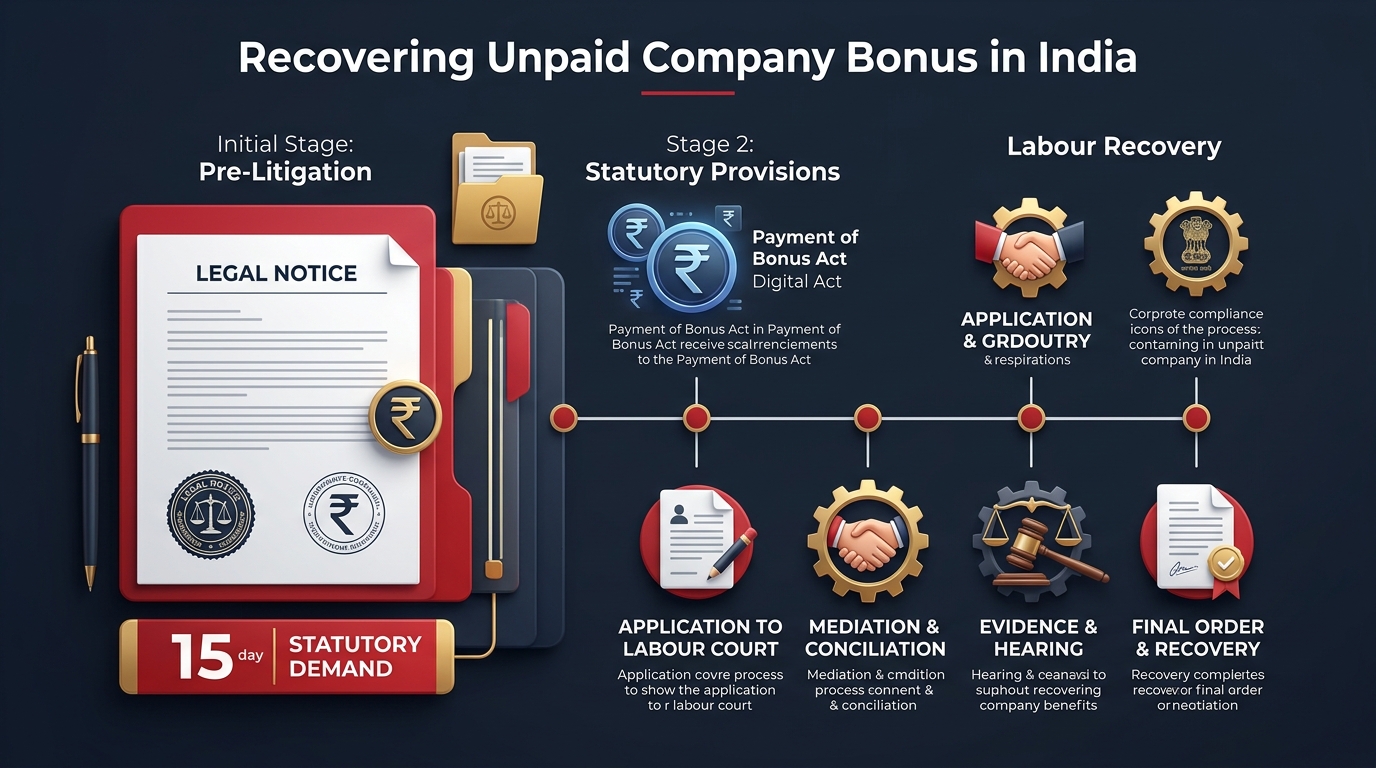
Grants a strict 15-day timeline from notice receipt for direct bank disbursement, failing which immediate proceedings will be initiated before the Labour Commissioner under Section 21, the Payment of Wages Authority, and the jurisdictional Civil Court with personal director liability.
6. Legal Escalation: Labour Commissioner & Civil Suits
When an employer fails to comply with the statutory demand notice within 15 days, multiple specialized legal forums are available under Indian law to attach assets and enforce payment:
Section 21 Payment of Bonus Act Recovery
The employee submits a recovery application to the State Government or designated Labour Commissioner under Section 21. Upon satisfying the authority that bonus is due, a Recovery Certificate is issued to the District Collector to attach company bank accounts and recover dues as arrears of land revenue.
Section 15 Claim with 10x Penalty
For employees covered under the wage threshold of the Payment of Wages Act, 1936, an application under Section 15 can be filed against unlawful deductions or delayed wages. The Authority possesses powers to order full wage disbursement along with compensation up to ten times the amount withheld.
Order 37 Code of Civil Procedure (CPC)
For senior executives and contractual variable pay claims exceeding labour thresholds, a summary suit under Order 37 CPC can be filed in the jurisdictional civil court. The defendant company must obtain leave to defend; failure to establish a substantial defense leads to a swift decree in favour of the employee.
Furthermore, under Section 28 of the Payment of Bonus Act, 1965, any employer who contravenes the provisions of the Act or fails to comply with statutory directions is punishable with imprisonment for a term which may extend to six months, or with fine, or both. Where the offence is committed by a company, Section 29 holds every director, manager, and officer in charge personally liable.
7. Step-by-Step Strategic Roadmap for Bonus Recovery
Legal Recovery executes a rigorous, multi-tiered recovery process designed to secure settlement without prolonged litigation:
Case Review & Contractual Analysis (Day 1)
Our senior employment advocates review your appointment letter, compensation structure, performance appraisal rating, KPI achievement records, and company bonus policies to quantify your exact claim and establish statutory vs contractual liability.
Custom Advocate Legal Notice Drafting (Day 1-2)
We draft a bespoke, hard-hitting statutory legal notice invoking the Payment of Bonus Act, 1965, Section 73 of the Indian Contract Act, 1872, and 18% commercial interest under the Interest Act, demolishing standard corporate forfeiture excuses.
Multi-Channel Legal Dispatch with Tracking (Day 2)
The notice is dispatched via Speed Post Registered AD to the company registered office and corporate headquarters, accompanied by digital service via official registered email to the Board of Directors, Managing Director, and HR Head, along with formal WhatsApp delivery.
Section 63 BSA Electronic Delivery Certification (Day 3)
We secure postal delivery tracking confirmations, email delivery logs, and WhatsApp read receipts, generating a legally valid Section 63 BSA electronic evidence certificate for trial readiness.
15-Day Peremptory Compliance Window & Advocate Negotiation (Days 4-15)
During the 15-day notice period, over 80% of companies instruct their legal departments to settle the claim directly to prevent quasi-judicial escalation, director liability, and reputational exposure.
Quasi-Judicial & Civil Enforcement (Day 16 Onward)
If the employer fails to disburse the dues, our panel advocates immediately file a Section 21 recovery application before the Labour Commissioner, approach the Payment of Wages Authority, or institute an Order 37 summary suit in civil court.
8. Frequently Asked Questions (FAQs)
Statutory References & Authoritative Legal Sources
Related Employment Dues & Legal Notice Guides

Legal Recovery
India's Trusted Recovery Platform
Legal Recovery is India's trusted online legal notice and dispute resolution platform, connecting corporate employees, software professionals, managers, and executives with seasoned panel advocates for rapid, advocate-vetted statutory demand notices at transparent flat fees. With ₹100 Crore+ recovered and 10,000+ cases resolved across India, Legal Recovery delivers verified legal impact without the delays and unpredictability of traditional law firms.
Company Withholding Your Earned Bonus?
Send an advocate-vetted statutory notice today. Over 80% of companies disburse withheld bonuses and variable pay within 15 days of notice service.
Flat fee • Advocate-drafted • Sent same day
Client Reviews
Ananya Deshmukh
"When I resigned as Senior Engineering Director at a Bengaluru multinational tech company after completing the full appraisal cycle with a 115% KPI rating, the employer withheld my contractual performance bonus of ₹5,40,000. They claimed that company policy required me to be on active payroll on the disbursement date, even though I had worked every single day of the financial year evaluated. Legal Recovery drafted a hard-hitting statutory legal notice invoking Section 73 of the Indian Contract Act, 1872, the Payment of Bonus Act, 1965, and landmark High Court precedents against arbitrary forfeiture. Within 11 days of receiving the legal notice via Speed Post AD and formal email to executive leadership, the company's legal department approved the full payout of ₹5,40,000 directly into my bank account without litigation. Invaluable legal support!"