How to Recover Money from a Borrower Through Bank Transfer in India
A transfer proves money moved. The messages and repayment trail help show whether it was a loan.
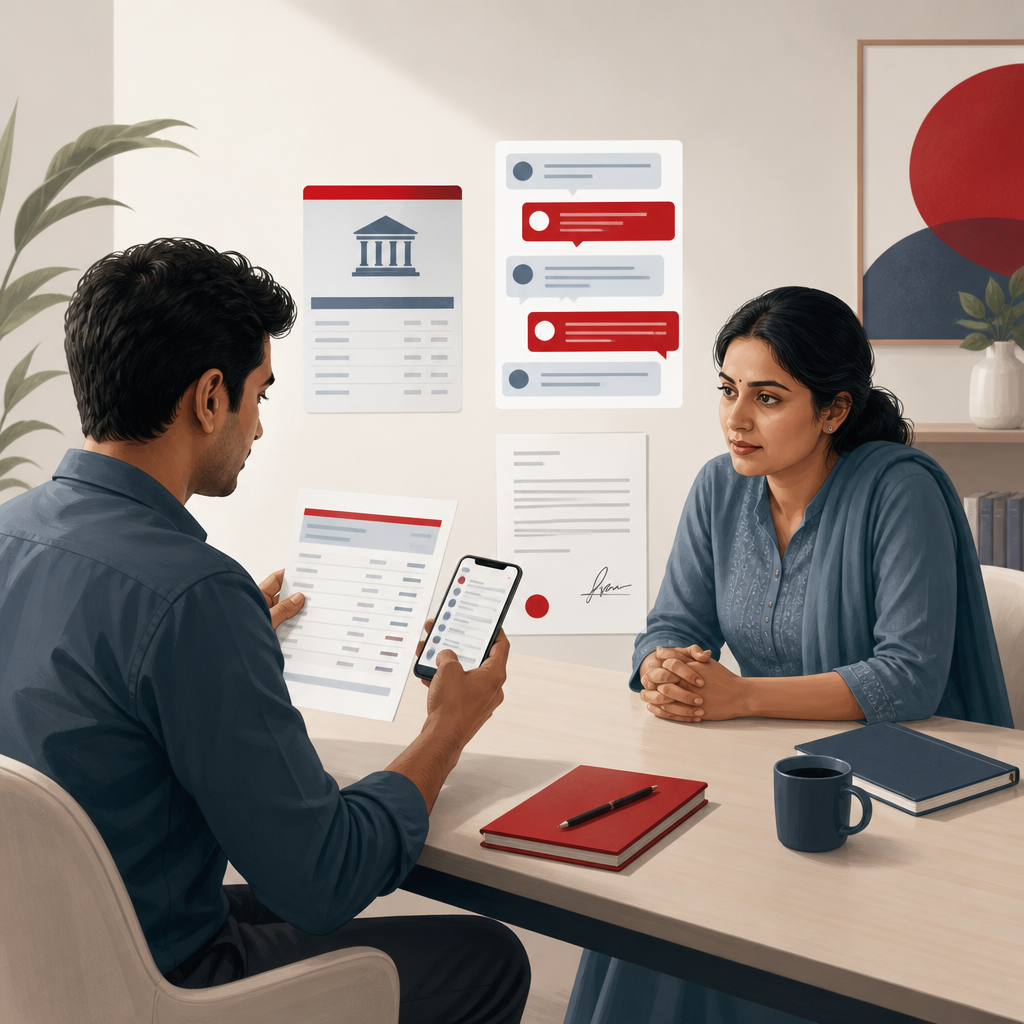
Table of Contents
Table of Contents
Swipe →“Yes, you sent me the money, but it was for our trip. I never borrowed it.” That response is often the real obstacle when someone refuses to return a bank transfer. Your statement proves money left your account and reached theirs. It does not, by itself, prove they agreed to repay it. To recover a private loan, connect the transfer to what was said before and after it: the request for money, the promised repayment, reminders, and any amount already returned.
The bank is usually a source of records, not the place that can compel your friend or relative to pay you. This guide is about money you lent someone by bank transfer or UPI. It shows how to assemble a credible claim, check the filing deadline, and choose a route that fits the evidence.
A transfer proves payment. What proves it was a loan?
Start with what your bank or UPI record can establish reliably: the date, amount, transaction reference, and accounts or payment identifiers involved. If the recipient denies receiving the money, that record matters enormously. If they admit receiving it but call it a gift, investment, shared expense, or repayment of an older debt, the record answers only half the question.
The other half is the agreement. Look for a message such as “Can you lend me ₹50,000 until my salary comes on the 5th?” A reply accepting that request, followed by a matching transfer, links the payment to a loan far more clearly than a statement entry labelled “transfer”. A signed note can help establish the amount and terms, but an unsigned conversation may still be useful when read with the payment trail and later conduct. An informal loan does not automatically fail because nobody signed a formal agreement; the difficulty is proving what both people agreed to. Our guide to recovering money without a written agreement addresses that problem in more detail.
Do not fill gaps with assumptions. A transfer does not establish a repayment date, an interest rate, or a penalty for delay. If those terms were agreed orally, write down when and how the conversation happened, then look for messages or actions that support your account. Under sections 10 and 73 of the Indian Contract Act, 1872, an enforceable agreement and its breach can support a repayment claim. The practical task is to show that this payment was made under such an agreement, not simply that money moved.
Reconstruct the loan from the digital trail
Keep the original sequence, not just a screenshot of the last reminder
Download the relevant bank statement or UPI transaction details and note each transaction ID. Preserve the conversation from before the advance through the latest repayment request. “I need it for rent; I’ll return it next month” and “Please give me another week” play different roles, but both may matter. Save emails, any signed note or promissory note, and proof of partial repayments. Keep the original chats on your device where possible, rather than relying only on cropped images. If you need to use electronic records in court, ask your lawyer about the applicable requirements for producing them.
Context protects you as well as strengthening your claim. A message saying “sending my share” may undermine a loan allegation even if another message later asks for money back. Do not delete inconvenient exchanges. Preserve the full thread and make a dated index so that someone who was not part of the conversation can follow it. For a closer look at what conversations can show, see using WhatsApp chats in a money recovery case.
Give every advance its own line
When money went out in instalments, a single total hides important differences. One transfer may have a clear loan request while another may have been for a shared booking. The following illustrative ledger shows how to keep the evidence and arithmetic together. Replace the examples with your actual records; do not describe a message as a loan acknowledgment unless its words support that reading.
Advance date | Amount sent | Bank or UPI reference | Message or document linking it to a loan | Repayment date and amount | Outstanding principal | Interest basis if agreed |
|---|---|---|---|---|---|---|
10 January 2025 | ₹50,000 | UPI ref. 101EXAMPLE | 9 January: “Lend me ₹50,000; I’ll return it after salary.” | 20 March 2025: ₹10,000, allocated to this advance | ₹40,000 | None recorded |
3 February 2025 | ₹20,000 | Bank ref. 202EXAMPLE | 2 February: “Can you lend another ₹20,000?” | None recorded | ₹20,000 | None recorded |
Total | ₹70,000 | Two references | Check complete message threads | ₹10,000 credited | ₹60,000 | No agreed interest shown |
If a repayment cannot fairly be assigned to one advance, mark the allocation as disputed rather than silently choosing whichever treatment helps your claim. Keep the credit entry and any message accompanying it. For example, “Here is the first ₹10,000 of the loan” may clarify both the payment and what the borrower thought they owed.
What if the borrower calls it a gift, investment, or shared expense?
Take the explanation seriously enough to test it. A judge or a person considering settlement will want to know why your account fits the surrounding facts better. The strongest evidence often comes from the borrower’s own words and actions, especially words close in time to the transfer. A promise to repay is different from a friendly thank-you; a request to “settle our trip costs” is different again.
Borrower’s likely explanation | Record that may address it | What the record can establish | What it cannot establish alone | Follow-up evidence to preserve |
|---|---|---|---|---|
“It was a gift.” | Pre-transfer request saying “lend” and naming an amount | The stated purpose when money was requested | That every later transfer had the same purpose | Your reply, matching transfer reference, later repayment promises |
“It was an investment.” | Messages promising return of a fixed sum rather than discussing returns or risk | Terms that may point towards repayment of a loan | That no separate investment arrangement existed | Full proposal, documents, and later discussions about losses or returns |
“It was your share of expenses.” | Requests for a short-term advance and messages saying “I’ll pay you back” | How the parties described this particular payment | Whether other shared expenses remain unsettled | Bills, booking records, expense splits, and repayment credits |
“I already returned it.” | Bank credits and chats identifying repayments | Amounts and dates that can be verified | Whether an alleged cash repayment also occurred | Receipts, cash-related messages, and a revised balance ledger |
Timing can change the weight of a record. A repayment promise made soon after the transfer is usually easier to connect to it than a vague “I’ll sort it out” months later. Conversely, if the transfer followed a discussion about buying into a business, you should not ignore that discussion and quote only a later demand for money. Build the case around the complete transaction, including facts the borrower is likely to raise.
If the borrower offers a new explanation only after receiving reminders, retain those replies too. They may reveal exactly what is disputed: receipt, purpose, amount, or whether repayment is already complete. Knowing which point is contested helps you avoid sending a broad accusation when a precise account and supporting documents would be more persuasive.
Visual Dispute Resolution & Recovery Framework
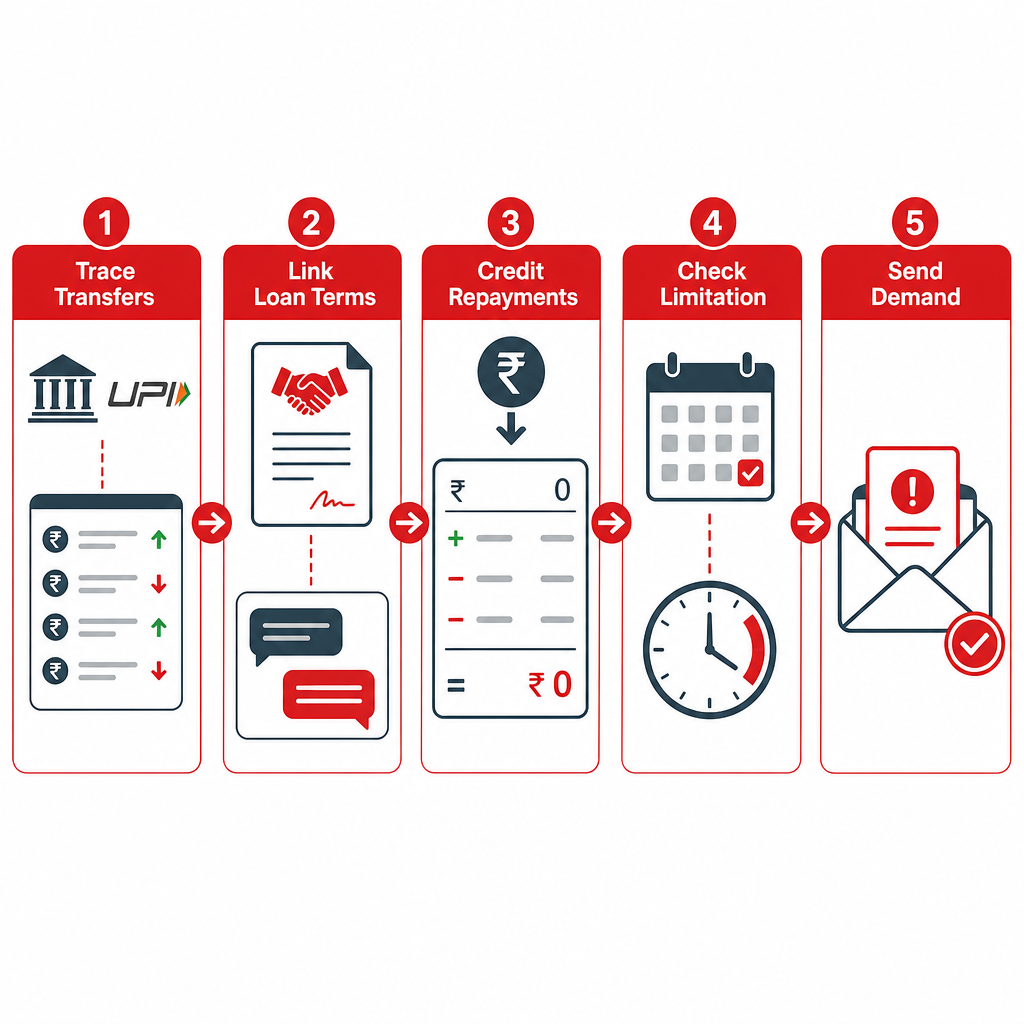
Calculate the balance without inflating the claim
A defensible demand starts with a simple reconciliation: each advance minus every repayment credited to it equals outstanding principal. The sample ledger above produces ₹60,000 in outstanding principal, not ₹70,000. Include payments made by bank transfer, UPI, or cash if you acknowledge receiving them. If the borrower claims a cash repayment you dispute, state that it is disputed and ask for the date and supporting record rather than treating the allegation as proof.
Interest needs a basis of its own
There is no automatic interest rate or late-payment penalty for a friendly loan. If you agreed interest, identify the rate, the period, and the message or document supporting it. Show the calculation separately from principal. Do not add compound interest or a round-number “damages” charge merely because repayment has been delayed.
Interest can still be a legal question even without an agreed rate, but it should not be presented as guaranteed. Where no written instrument fixes when payment is due, section 3(1)(b) of the Interest Act, 1978, makes a written notice specifying that interest will be claimed, and from when, significant for a pre-suit interest claim; the court assesses a reasonable rate. Once a money suit is filed, section 34 of the Code of Civil Procedure, 1908, governs the court’s discretion over interest during and after the suit. If interest is important to your claim, have its basis checked before stating a final figure.
A clean calculation also helps settlement. Someone who cannot immediately pay ₹60,000 may propose documented instalments. You can consider that without giving up the original records: specify dates, amounts, how payments will be identified, and what happens if an instalment is missed.
Check the three-year clock before sending a demand
Do not wait for another polite conversation if an old advance is approaching its deadline. Under Articles 19 and 21 of the Schedule to the Limitation Act, 1963, a suit for money lent generally has three years from the loan date. That includes an ordinary loan described as “payable on demand”. The demand-based starting point for money deposited under Article 22 should not be assumed to apply to a loan. With several advances, check the dates separately.
A reminder or legal notice sent later does not, by itself, restart those three years. A qualifying acknowledgment of liability in writing and signed by the borrower before limitation expires can start a fresh period under section 18 of the Limitation Act. Part-payment before expiry may affect time under section 19, subject to its requirement that the payment be acknowledged in the payer’s handwriting or in a writing signed by them. Do not rely on an unexplained bank credit or an informal chat as an automatic extension; have the precise record assessed.
Suppose you advanced money on 10 January 2025 and the borrower later wrote, “I still owe you ₹40,000,” signing a dated note while the claim was still in time. That note deserves immediate legal review for its effect on limitation. If the three years have already expired, the question changes: a written, signed promise to pay a time-barred debt may be enforceable under section 25(3) of the Indian Contract Act. A casual “I’ll pay someday” should not be treated as a safe substitute.
Because the result depends on dates and wording, check the time limit for a money recovery case before spending weeks exchanging demands. If the deadline is close, ask a lawyer about filing promptly. A beautifully drafted notice cannot repair an expired filing period.
Choose a route that fits what you can prove
A civil suit is the usual contested-recovery route
If the borrower disputes the loan or will not settle, a civil recovery suit asks the competent court to decide the claim. Under section 20 of the Code of Civil Procedure, the place of filing generally depends on where the defendant resides or carries on business, or where the cause of action arose. The correct court also depends on its monetary jurisdiction, and court fees vary by state and court. Your ledger, complete messages, transfer records, and repayment credits become the foundation of the case.
Order XXXVII of the Code of Civil Procedure provides a summary-suit procedure for claims meeting its conditions, such as certain claims based on a written contract or promissory note. A UPI transfer alone does not qualify a claim for that procedure. Ask a lawyer to assess the actual documents rather than choosing a faster-looking route by its name. The civil money recovery suit guide explains what filing involves. The official eCourts e-Filing portal may be available where the relevant court has adopted it.
A dishonoured cheque has its own, shorter timetable
If the borrower gave you a cheque towards an enforceable debt and it bounced, sections 138 and 139 of the Negotiable Instruments Act, 1881, may provide a separate complaint route. Present the cheque within its validity, generally three months. After receiving information that it was dishonoured, send the statutory demand for the cheque amount within 30 days. The drawer then has 15 days from receiving that notice to pay; a complaint must generally follow within one month after the cause of action arises. Jurisdiction is governed by section 142(2), usually by the payee’s account branch when the cheque was deposited through an account.
This notice is not interchangeable with a general loan-demand letter. If part of the debt was repaid before you presented the cheque, get advice before demanding its full unadjusted amount: that mismatch can defeat a section 138 case. A cheque called “security” also needs examination against the debt actually due. See the cheque dishonour notice timeline if a return memo has just arrived. Interim compensation of up to 20% of the cheque amount is permitted under section 143A, but it is not automatic.
Settlement is useful when both sides will engage
You can approach the local District Legal Services Authority about a pre-litigation Lok Adalat. It can record a consensual settlement; it cannot impose repayment on a borrower who refuses to agree. For a friend or relative who acknowledges the loan but needs time, a documented plan may save both sides the cost and uncertainty of a suit. Read more about recovery without going to court. An ordinary one-off friendly loan is not automatically a commercial dispute, and repeatedly lending for profit raises separate questions under applicable state money-lending law.
Send a demand the borrower can answer precisely
Once you have checked limitation and any cheque-notice deadline, put the claim into a document that lets the borrower verify it. Identify each advance by date, amount, sending and receiving account or UPI details, and transaction reference. Quote or identify the message or note that shows it was a loan and state the repayment term you can support. List all repayments with credit given. Then show the calculation plainly: outstanding principal plus supportable interest minus any further payments equals the amount demanded.
Attach or clearly identify the relevant statement entries, signed note, messages, and, if applicable, the cheque return memo. Give a specific payment deadline and method, and invite the borrower to send a dated, written repayment proposal if immediate payment is not possible. Avoid threats or unsupported accusations. A firm letter is more effective when the recipient can see exactly which transaction and balance they must answer. For a topic-specific starting point, see the guide to a legal notice for a loan given to a friend.
Send the demand to an address you can substantiate, preserve the signed copy, postal receipt, tracking record, and any delivery acknowledgment. You can also retain copies of email or WhatsApp delivery and replies, but do not assume those records replace a required statutory method or deadline for a cheque complaint. Keep subsequent offers and payments in the same file so the balance remains current.
If preparing this feels difficult, LegalRecovery handles this type of matter under its personal money recovery service. You can submit the case online, have the records reviewed, and have a professionally drafted notice dispatched by registered post, followed by documented follow-up and escalation. Its notice service starts at ₹1,499 flat fee, with online case management; its process explains the stages. That can help you organise and pursue the demand, but no notice service can guarantee payment or remove the need for court proceedings if the dispute remains contested.
The most useful next move is therefore not another message saying “please return my money”. It is a dated account of what you advanced, why it was a loan, what has come back, and how much time remains to act. That gives the borrower a fair opportunity to pay or explain a genuine disagreement, and gives you a sounder basis for the route that follows.
Popular Searches & Related Topics

Legal Recovery is India's trusted consumer protection and legal tech platform. We specialize in holding corporations accountable for unfair trade practices, deceptive marketing, and commercial fraud. With over 15,000 customers counselled, our mission is to provide fast, out-of-court resolutions by connecting you with top-tier panel advocates for immediate legal action.
Client Reviews
"Illustrative review draft for approval, not a verified customer testimonial: I had transferred money to a friend and the main issue was proving it was a loan, not a shared expense. LegalRecovery helped organise the UPI records and repayment messages into a clear demand notice. The follow-up was professional and easy to track."
Aarav Mehta
"Illustrative review draft for approval, not a verified customer testimonial: A relative had returned only part of the amount I lent. LegalRecovery helped set out the original transfers, the repayment credits and the balance in a clear notice. I appreciated that the team focused on the records and explained the next steps without promising a guaranteed recovery."
Priya Nair
"Illustrative review draft for approval, not a verified customer testimonial: My former roommate said my bank transfer was for household expenses, although our messages discussed repayment. LegalRecovery helped me present the relevant transaction details and messages in an organised legal notice. The service was responsive and the delivery records were shared with me."
Rohan Kulkarni
"Illustrative review draft for approval, not a verified customer testimonial: I had made several transfers to a family member and needed to account for a small repayment before asking for the balance. LegalRecovery helped me put the dates, references and credits into a clear notice. I found the online process straightforward and the communication helpful."
Sneha Iyer
Frequently Asked Questions
Related Articles
About Author
Team LegalRecovery
View ProfileTeam LegalRecovery is a dedicated team of legal and financial professionals specializing in loan settlement, banking disputes, debt relief, and corporate compliance. We are committed to helping clients achieve debt freedom and business stability through expert strategic advisory.
Connect on LinkedInNeed Legal Help?
Get expert advice on loan settlement, banking disputes and debt relief.
Start Recovery NowRequest Callback