How to Send a Legal Notice to a Client Who Refuses to Pay
A practical look at invoice details, proof, deadlines, and next steps for freelancers and businesses in India.

Table of Contents
Table of Contents
Swipe →You finished the work, sent the invoice, and expected to be paid. Instead, the client keeps saying “next week,” raises a vague objection, or stops replying. That is frustrating, especially when you have already paid for the time, materials, or people needed to deliver the job. A legal notice can turn scattered reminders into a clear demand with a deadline. This guide explains what to check first, what to put in the notice, how to send it, and what you can do if the client still refuses to pay.
Before sending a notice, pin down exactly what is owed
A strong notice starts with a number you can explain. Check each invoice against your bank statement and ledger, including advances, part-payments, credit notes, and agreed deductions. If three invoices are unpaid but the client paid part of one, your notice should show that adjustment. An inflated or unexplained demand gives the client an easy reason to dispute the whole claim.
Check the agreement and the payment trigger
Find the contract, purchase order, accepted quotation, or email agreeing to your scope and rate. Then identify when payment became due. Was it 15 days after invoicing, on delivery, or after approval of a milestone? If approval was required, gather proof that you requested it and note whether the client actually raised an objection at the time.
An unsigned formal contract does not mean you have no case. Emails, messages, a purchase order, delivery records, invoices, and the client’s conduct may help show what was agreed. But do not assume an invoice alone proves that every billed item was accepted. If the client has made a specific quality complaint, read it carefully and collect your reply, revision history, and sign-offs before demanding payment.
Make one final, specific payment request
If you have only sent casual reminders, a short email may resolve the matter without a notice. State the invoice numbers, exact outstanding amount, and a firm date for payment. Ask the client to identify any disputed item in writing rather than saying the “accounts team is checking.” Keep the exchange. It may reveal whether this is a genuine disagreement or simply a delay.
Freelancers can use the same approach as larger businesses: establish what was promised, show what was delivered, and separate a real objection from silence. For a deeper look at common freelance disputes, see these freelancer payment recovery options. If several invoices are involved, deal with each one separately in your working papers, even if you eventually send a single notice.
The proof to collect before you draft anything
You do not need a perfect file, but you do need a coherent one. Save original emails and message threads where possible, rather than relying only on cropped screenshots. Put documents in date order so someone unfamiliar with the project can follow the story: agreement, work, delivery, invoice, due date, reminders, and response.
Keep this | What it helps establish | Check before sending |
|---|---|---|
Contract, purchase order, quotation, or accepted messages | Who contracted with you, the scope, price, and payment terms | Is the named client the person or business you plan to notify? |
Invoices and invoice-wise statement | What you billed, when it was due, and the balance claimed | Have you deducted every advance, credit, and part-payment? |
Delivery files, challans, milestone approvals, or sign-offs | That you supplied the goods or completed the work | Can you match each delivery to its invoice? |
Emails, WhatsApp chats, and objection or revision records | Reminders, admissions, acceptance, and how disputes were addressed | Have you preserved the full conversation and dates? |
Ledger, bank statement, and relevant GST records | Payment history and consistency of your accounts | Does the claimed outstanding amount match your records? |
If the order was given orally, write down who agreed to it, when, what they requested, and who witnessed the discussion. Then gather the messages and delivery evidence that support your account. For an eligible supplier filing through MSME Samadhaan, the ministry’s guidance calls for a work order or, where the order was oral, an affidavit. It also permits multiple invoices in one PDF. For more help organising a freelance claim, use this payment recovery evidence checklist.
What should your legal notice actually say?
Think of the notice as a clear, documented opportunity for the client to settle, not as an angry final warning. It should let the recipient check your figures, understand your position, and know exactly how to respond. You may draft it yourself, although a lawyer’s review can be useful where the amount is substantial, the contract is complicated, or the client disputes delivery.
Use a straightforward structure
Identify both sides. Use your correct name and address and the actual contracting person or business’s name and recorded business address. If you dealt with an employee, check whether your contract was with that employee or their company.
Set out the transaction. Give the order or agreement date, scope, agreed price or rate, and when you delivered the goods or completed each milestone.
Show the calculation. List invoice numbers, dates, due dates, original amounts, payments received, and principal still outstanding. Attach an invoice-wise statement if there is more than one invoice.
Explain any interest. State the contract term or applicable statutory basis and show how you calculated it. Do not add an arbitrary penalty and present it as automatically payable.
Make a precise demand. Provide the amount sought, bank details for payment, and a reasonable deadline, often 7 to 15 days. Invite a specific written objection with supporting details if the client disagrees.
State the next step calmly. Say that you may consider the appropriate recovery process if the deadline passes. Avoid threats, accusations you cannot prove, or claims that payment is already court-ordered.
For example, the central request can be simple: “Our records show ₹[amount] outstanding against invoices [numbers], after accounting for payments received. Please pay by [date] to [details], or send a specific written objection with supporting documents by that date.” Check every placeholder, attachment, and bank detail before dispatch. This legal notice drafting checklist can help you review the format.
Be careful when the client alleges poor work
Do not pretend the objection does not exist. Briefly state what was delivered, refer to any approval or agreed revisions, and explain why you say the amount remains due. If part of the invoice is genuinely disputed, consider identifying the undisputed balance separately and asking for that payment immediately. Keep the tone factual: the goal is recovery, not winning an argument over email.
Under sections 73 and 74 of the Indian Contract Act, compensation for breach depends on the applicable legal rules; a penalty written into a contract is not automatically recoverable in full. Claim interest or other charges only after checking their basis. A notice is a demand, not a court order or a guarantee that the client will pay.
Visual Dispute Resolution & Recovery Framework
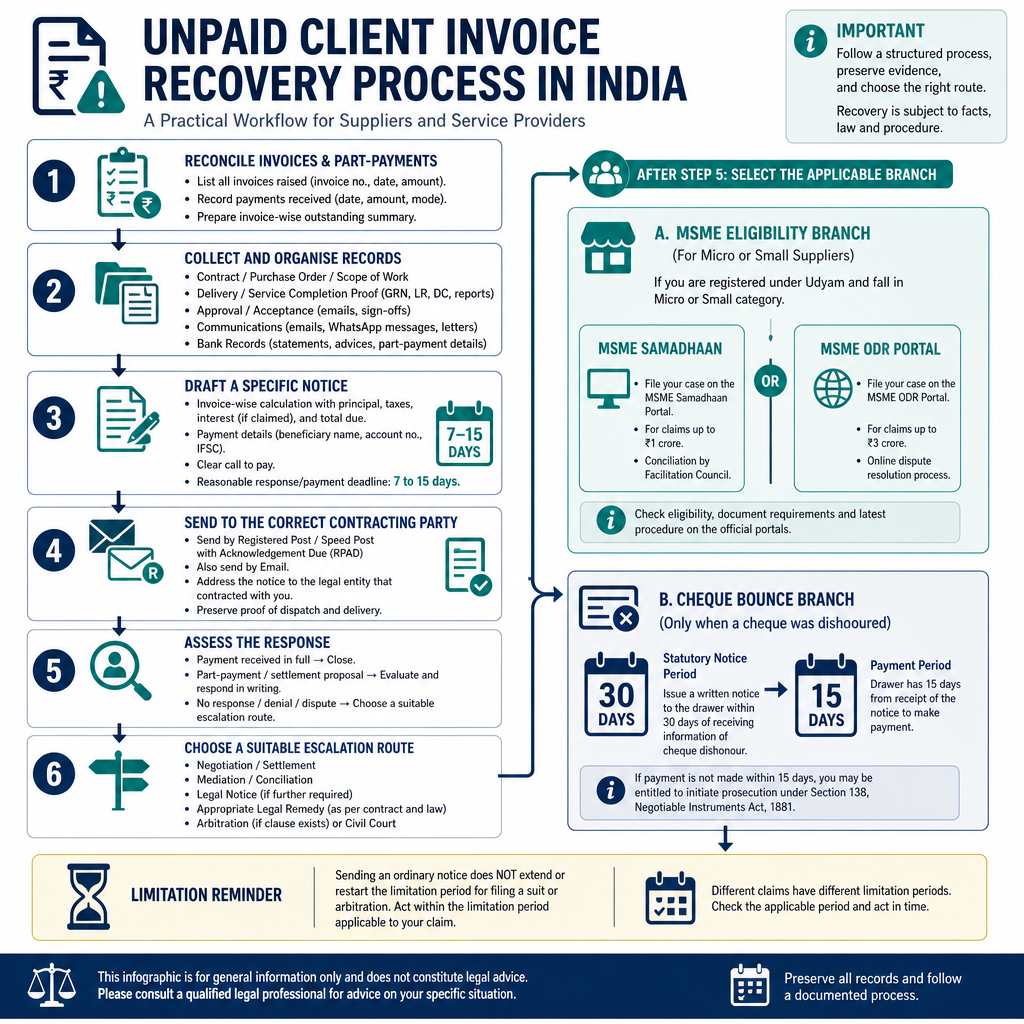
How do you send it and prove the client received it?
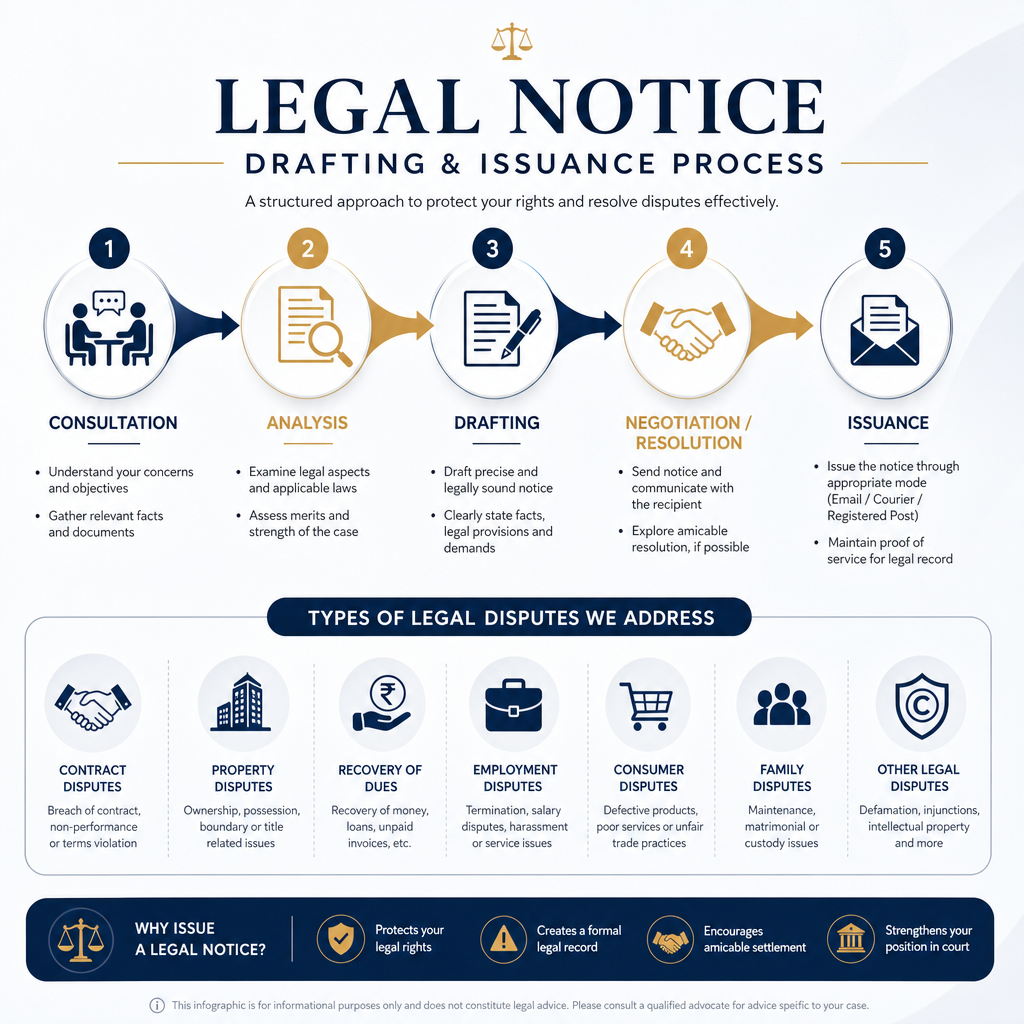
Send the signed notice to the correct contracting party at its recorded business address. Registered post provides a dispatch record and tracking history. Also email it to the contact address used for the transaction, particularly if that is where the client accepted orders or discussed invoices. Keep the signed copy, attachments, postal receipt, tracking result, delivery proof, and sent email together.
A message that disappears into the wrong inbox or goes to an unrelated branch can create an avoidable dispute. Recheck the company name, address, email spelling, and invoice references. If the client has changed address, preserve your evidence of the address you used and seek advice on further service rather than assuming one failed delivery settles the issue. For a closer look at the practicalities, read about ways to deliver and document a legal notice.
If preparing and tracking this yourself feels difficult, LegalRecovery’s freelancer and client payment recovery service covers unpaid client dues; its vendor and invoice recovery service addresses B2B outstanding payments. Its online process starts with case submission and expert review, followed by a professionally drafted notice dispatched by registered post, multi-channel follow-up, and escalation where appropriate. Pricing starts at ₹1,499 flat fee. You can manage the service online without a court visit to start the process, although any later legal proceeding has its own requirements.
Which legal route applies if the deadline passes?
The right next step depends on who you are, what you supplied, and whether the client gave you a cheque. Do not choose a forum simply because its website is easy to find. In particular, the National Consumer Helpline deals with consumer grievances; it is not ordinarily the forum for a freelancer or supplier chasing a customer’s unpaid invoice.
If you are an eligible micro or small supplier
Check whether you qualify for the delayed-payment route under the Micro, Small and Medium Enterprises Development Act, 2006. It does not automatically cover every freelancer or every business described as an MSME. For an eligible micro or small supplier, an agreed payment period cannot exceed 45 days from acceptance. Delayed payment attracts compound interest with monthly rests at three times the RBI bank rate under sections 15 and 16.
You can submit an eligible claim through MSME Samadhaan or the MSME ODR portal, launched on 27 June 2025; a physical application to the state Micro and Small Enterprises Facilitation Council (MSEFC) is also possible. The state council handles the reference, first attempting conciliation and, if that fails, arbitration. The Act specifies 90 days for deciding a reference, but that statutory target is not a promise of when you will receive money. A buyer seeking to set aside an award must deposit 75% under section 19.
Do not wait because you assume the MSME route has no time limit. In July 2025, the Supreme Court held in Sonali Power Equipments that a time-barred MSME claim may enter conciliation, but limitation applies to subsequent arbitration. Compare the routes in this guide to MSME Samadhaan and legal notices, and check eligibility before filing.
If you are pursuing an ordinary money claim
Discuss a civil suit, or a qualifying commercial suit, with a lawyer. For a fixed debt arising from a qualifying written contract, the summary procedure under Order XXXVII of the Code of Civil Procedure may be available; it does not apply to every invoice dispute. A qualifying commercial suit that does not seek urgent interim relief generally requires pre-institution mediation under section 12A of the Commercial Courts Act. That statutory process is three months, extendable by two months with consent.
If the client is willing to negotiate, a pre-litigation Lok Adalat through the district legal services authority may be worth exploring, but a settlement requires agreement. Court e-filing is available for supported filings. These are escalation options, not steps you must take automatically the morning after your notice deadline.
If a cheque bounced, treat the dates differently
A bounced cheque given for a legally enforceable debt has its own strict route under sections 138 and 142 of the Negotiable Instruments Act. Send the written demand within 30 days of receiving the bank’s dishonour information. The drawer then has 15 days from receiving the notice to pay. If they do not, the magistrate complaint ordinarily must be filed within one month after that period. Do not substitute the ordinary 7-to-15-day invoice notice timetable for these deadlines. An unpaid invoice that was meant to be paid by bank transfer is not a cheque-bounce case. See the cheque-bounce notice timeline if a cheque is involved.
What if the client ignores the notice or offers instalments?
When the deadline expires, check your delivery proof and look for three things: payment, a specific objection, or a credible settlement proposal. Silence does not make your claim automatically successful. Nor does a reply saying “we will look into it” necessarily justify another long wait. Decide promptly whether to negotiate, use an eligible MSEFC route, or seek advice on filing a suit.
If the client offers instalments, put the amount and payment dates in writing. Specify how the outstanding balance is calculated, what happens if an instalment is missed, and whether any dispute is being settled in full. Record each payment and issue an acknowledgment that matches the agreement. Do not casually write that everything is settled after receiving only the first instalment.
Watch the limitation period while negotiating. Many claims for goods, work, or breach of contract have a three-year limit under the Limitation Act, 1963, but the date it starts depends on the type of claim. A signed acknowledgment made before the applicable period expires can start a fresh limitation period under section 18. Sending your own legal notice does not, by itself, restart that clock. If an invoice is old, get advice now rather than allowing repeated promises to use up your time. This guide explains time limits for money recovery claims.
There is no reliable number of days in which a notice “works.” Some clients pay or propose terms quickly; contested proceedings can take much longer than statutory targets. What the notice gives you is a clear demand, a documented opportunity to respond, and a sensible point at which to make your next decision.
Your practical plan for this week
Today: reconcile the invoices, confirm the contracting party, and save the agreement, delivery proof, payment record, and messages. Next: send one precise request if you have not already done so, then prepare a notice that states the calculation, payment details, objection process, and deadline. After dispatch: save proof of sending and delivery, mark the response date, and check the limitation position.
If the client replies, address what they actually say. If they do not, choose the recovery route that fits your claim rather than sending endless reminders. Your first task is not to master every court procedure. It is to make your unpaid amount provable, give the client a fair and firm chance to pay, and act on the result while your options are still open.
Popular Searches & Related Topics

Legal Recovery is India's trusted consumer protection and legal tech platform. We specialize in holding corporations accountable for unfair trade practices, deceptive marketing, and commercial fraud. With over 15,000 customers counselled, our mission is to provide fast, out-of-court resolutions by connecting you with top-tier panel advocates for immediate legal action.
Client Reviews
"A client had delayed payment on two freelance project invoices and was not responding to my reminders. LegalRecovery helped organise the invoice details and delivery records, drafted a clear notice, and kept me updated on dispatch and follow-up. The client responded and we agreed on payment dates. The process felt professional and straightforward."
Aarav Mehta
"I was chasing a business client for an overdue design invoice and was unsure how to make a formal demand. LegalRecovery reviewed the documents I had, explained the next steps, and sent a properly structured notice. The client replied with a specific payment proposal, which gave me a clear way to move forward."
Priya Nair
"Our small business had several unpaid supplier invoices to follow up on. LegalRecovery helped present the invoice-wise balance clearly and arranged the notice and delivery tracking. We appreciated the practical communication and the reminder to keep the supporting records together. The client later paid the outstanding amount."
Rohit Sharma
"After completing contract work, I received repeated promises of payment but no firm date. LegalRecovery made the notice process easy to understand, checked the payment calculation, and handled the formal dispatch. The client responded after receiving it and we documented an instalment arrangement. I was satisfied with the clear updates and professional tone."
Sneha Kulkarni
Frequently Asked Questions
Related Articles
About Author
Team LegalRecovery
View ProfileTeam LegalRecovery is a dedicated team of legal and financial professionals specializing in loan settlement, banking disputes, debt relief, and corporate compliance. We are committed to helping clients achieve debt freedom and business stability through expert strategic advisory.
Connect on LinkedInNeed Legal Help?
Get expert advice on loan settlement, banking disputes and debt relief.
Start Recovery NowRequest Callback