Legal Notice for Property Dispute Money Stuck
Recover stuck token deposits, earnest money, commercial booking advances, delayed project refunds, and statutory interest from defaulting builders, property vendors, and commercial landlords across India.
Table of Contents
Swipe →Quick Answer
Commercial buyers, investors, and business allottees can serve an advocate-vetted statutory legal notice to defaulting property developers, vendors, or commercial landlords under Sections 70, 73, and 74 of the Indian Contract Act, 1872 and Section 18 of the Real Estate (Regulation and Development) Act, 2016 (RERA), demanding immediate refund of stuck token money, earnest booking advances, and accrued statutory interest within a mandatory 15-day window. Under settled Supreme Court jurisprudence, a seller cannot arbitrarily forfeit commercial booking deposits without proving actual financial damage. Serving a formal statutory notice crystallizes the developer’s breach, establishes an indisputable pre-litigation record, and unlocks fast-track commercial remedies including Section 12A Pre-Institution Mediation under the Commercial Courts Act, 2015, Order 37 summary recovery suits, and corporate insolvency petitions under the Insolvency and Bankruptcy Code, 2016.
1. Statutory Framework: Contract Act, RERA & Commercial Courts Act
Commercial real estate transactions in India involve substantial capital outlay, complex deal structuring, and tight business timelines. When a transaction for an office floor, retail showroom, commercial plot, IT park suite, or co-working development stalls due to developer defaults, regulatory non-compliance, or title defects, the buyer’s capital becomes severely jeopardized. The Indian legal architecture provides robust statutory mechanisms across civil, commercial, and regulatory forums to compel defaulting counterparties to disgorge retained funds with commercial interest:
Indian Contract Act, 1872 (Sections 70, 73 & 74)
Under Section 73, any party suffering financial harm from a breach of contract is entitled to direct compensatory damages. Section 74 explicitly regulates penalty clauses and earnest money forfeiture, prohibiting arbitrary retention of advances. Section 70 enforces the doctrine of quantum meruit and unjust enrichment, mandating restitution when an unperformed commercial deal falls through.
Read Indian Contract Act, 1872 (India Code) →RERA Act, 2016 (Sections 12, 13 & 18)
Under Section 18 of RERA, if a commercial promoter fails to hand over possession in accordance with the terms of the agreement for sale or abandons the project, the buyer possesses an unconditional statutory right to withdraw from the project and demand a full refund of all amounts paid alongside prescribed SBI MCLR + 2% compound interest.
Read RERA Act, 2016 Provisions (India Code) →Commercial Courts Act, 2015 (Section 2(1)(c)(vii) & 12A)
Agreements relating to immovable property used exclusively in trade or commerce are categorized as "Commercial Disputes." Under Section 12A, mandatory Pre-Institution Mediation and Settlement (PIMS) through the District Legal Services Authority (DLSA) expedites recovery without prolonged trial cycles, backed by specialized commercial benches.
Governed under Commercial Courts Act, 2015 (Pre-Institution Mediation)Specific Relief Act, 1963 (Sections 10, 20 & 22)
Empowers commercial buyers to enforce specific performance of contracts or seek substituted performance alongside statutory claims for refund of earnest money and substantial compensatory damages under Section 21 and Section 22 whenever the vendor defaults on execution.
Governed under Specific Relief Act, 1963 (Sections 10, 20 & 22)2. The "Non-Refundable Token" Myth: Supreme Court Jurisprudence
One of the most ubiquitous defenses deployed by commercial property developers, brokers, and private sellers is that the token advance, booking fee, or earnest money deposit is strictly "non-refundable" under unilateral booking forms or preliminary Memorandums of Understanding (MoU). Under Indian contract jurisprudence, this claim is legally untenable and has been repeatedly struck down by the Supreme Court of India.
Landmark Precedent: Kailash Nath Associates v. Delhi Development Authority (2015) 4 SCC 136
The Supreme Court of India held that Section 74 of the Indian Contract Act, 1872 applies squarely to the forfeiture of earnest money deposits. The Apex Court ruled that a vendor or statutory authority cannot forfeit earnest money arbitrarily unless the party asserting the forfeiture produces concrete, demonstrable evidence of actual financial damage or loss suffered. If no actual loss is proven, or if the loss is negligible, forfeiting the deposit constitutes an unlawful penalty, and the entire advance must be refunded to the buyer.
Key Judicial Principles Governing Commercial Property Deposit Refunds
- ✓Prohibition on Indefinite Delays: In Pioneer Urban Land & Infrastructure Ltd. v. Govindan Raghavan (2019) 5 SCC 725 and Fortune Infrastructure v. Trevor D'Lima (2018) 5 SCC 442, the Supreme Court established that an allottee or buyer cannot be forced to wait indefinitely for possession or sanction clearance and is unconditionally entitled to a refund with compensation.
- ✓One-Sided Clauses Void: Standard boilerplate contracts where the seller charges 18% interest for buyer delays but offers nominal or zero penalty for project delays are classified as unfair trade practices and declared null and void.
- ✓Concurrent Remedies Permitted: In Imperia Structures Ltd. v. Anil Patni (2020) 10 SCC 783, the Supreme Court clarified that remedies under RERA are in addition to, and not in derogation of, other civil, commercial, and consumer protection laws.
3. Common Scenarios of Stuck Commercial Property Funds
Commercial transactions break down across several predictable factual patterns. Identifying the precise breach is essential to craft an airtight statutory demand notice that preempts procedural defenses:
Pre-Agreement Token Money Default
Buyer deposits earnest token money against an MoU or expression of interest (EOI). The transaction collapses prior to signing the formal Agreement for Sale due to defective title search, unauthorized zoning, or lack of environmental NOCs. Seller unlawfully withholds token funds.
Commercial Builder Construction Stoppage
Commercial office or retail mall promoter halts construction for years, fails to deliver fit-outs, or diverts construction capital into other projects. Commercial buyers who invested 30% to 90% of unit value are left with stranded capital and no possession.
Undisclosed Mortgages & Defective Titles
Seller conceals existing bank hypothecations, pending litigation, SARFAESI attachment notices, or joint ownership encumbrances on commercial plots or retail buildings, rendering peaceful ownership and mutation legally impossible.
Commercial Lease Security Deposit Withholding
Corporate landlords refuse to refund substantial commercial security deposits (often running into ₹20 Lakhs to ₹1 Crore) upon expiration or termination of commercial leases, inventing arbitrary dilapidation charges without architectural survey backing.
Material Alteration of Sanctioned Commercial Plans
Developer unilaterally alters the layout, reduces super built-up to carpet ratio, eliminates dedicated parking bays, or converts retail anchor zones into common corridors without statutory consent under Section 14 of RERA.
4. Evidentiary Checklist & Section 63 BSA Digital Records
Under the Bharatiya Sakshya Adhiniyam, 2023 (BSA), electronic records, banking logs, and digital communications carry primary evidentiary value when certified under Section 63 (formerly Section 65B of the Indian Evidence Act). Before serving the statutory notice, assemble the following evidentiary dossier:
| Document / Evidence Type | Statutory Purpose | Evidentiary Value under BSA 2023 |
|---|---|---|
| Bank Statements & RTGS/NEFT Transaction Slips | Proves exact quantum of consideration transferred, date of remittance, and recipient corporate account. | Primary documentary proof of payment under Section 61 BSA. |
| Memorandum of Understanding (MoU) / Allotment Letter | Establishes commercial terms, agreed milestone timelines, possession dates, and refund contingencies. | Substantive written contract defining contractual obligations. |
| WhatsApp Communications & Email Trails | Evidences seller acknowledgments, promises to refund, delay admissions, and pre-litigation correspondence. | Admissible electronic evidence under Section 63 BSA certificate. |
| RERA Project Registration & Quarterly Progress Reports | Demonstrates developer construction defaults, lapsed completion dates, or failure to register commercial unit. | Public statutory record admissible without formal witness proof. |
| Advocate Title Search & Encumbrance Certificate (EC) | Demonstrates undisclosed mortgages, bank charges, litigation attachments, or defect in vendor ownership. | Conclusive proof of fraudulent inducement and title failure. |
5. Key Clauses in a Statutory Demand Notice to Builders & Sellers
A boilerplate or generic demand notice fails to trigger institutional urgency in commercial counterparties. An advocate-drafted statutory notice must be custom-engineered to incorporate specific legal covenants, statutory citations, and multi-tier litigation warnings:
1Factual Chronology of Transaction & Consideration Remittance
Itemizes the date of booking, description of the commercial immovable property (unit number, floor, super area, carpet area, municipal survey number), exact bank reference numbers (UTR), and total quantum of advance capital disbursed.
2Specific Covenants of Default & Breach of Contract
Details the counterparty’s failure to deliver sanction plans, obtain Commencement Certificate (CC), complete construction within agreed timelines, execute registered agreement for sale under RERA Section 13, or produce unencumbered title deeds.
3Rebuttal of Forfeiture & Invocation of Kailash Nath Doctrine
Formally rebuts any unilateral forfeiture clauses by citing Section 74 of the Contract Act and Supreme Court precedents, demanding that the vendor substantiate actual financial damages or immediately refund the deposit in full.
4Peremptory 15-Day Demand with Prescribed Commercial Interest
Provides a strict 15-day peremptory deadline for the direct bank transfer of the principal advance plus compound interest calculated at SBI MCLR + 2% per annum under RERA rules or 18% commercial rate under contract law.
5Multi-Forum Judicial Escalation & Director Liability Notice
Puts company directors, partners, and managing promoters on notice that failure to comply will trigger Section 12A Commercial Mediation, RERA Section 18 complaints, Order 37 summary recovery suits, NCLT insolvency petitions, and criminal prosecution under Section 316/318 of the Bharatiya Nyaya Sanhita, 2023.
6. Multi-Forum Remedies: RERA, Commercial Court, CPC & BNS
When the counterparty fails to comply with the statutory demand notice, the commercial buyer can select from several potent judicial forums based on the quantum of claim and corporate structure of the defaulting entity:
| Judicial Forum / Remedy | Statutory Ground | Typical Resolution Timeline | Key Strategic Advantage |
|---|---|---|---|
| RERA Authority / Adjudicating Officer | Section 18 & 31 of RERA Act, 2016 for project delays and failure of delivery. | 4 – 8 Months | Mandatory statutory interest (SBI MCLR + 2%) and power to attach project bank accounts. |
| Commercial Court / Section 12A Mediation | Section 2(1)(c)(vii) & Section 12A Commercial Courts Act, 2015 (Claims ≥ ₹3 Lakhs). | 3 – 6 Months (PIMS) | Fast-track mediation with summary judgment provisions under Order XIII-A CPC. |
| Civil Court Summary Suit (Order 37 CPC) | Order 37 Code of Civil Procedure, 1908 for liquidated debts based on written MoUs/cheques. | 6 – 12 Months | Defendant must obtain leave to defend; failure results in immediate decree execution. |
| National Company Law Tribunal (NCLT) | Section 7 or Section 9 of Insolvency and Bankruptcy Code, 2016 (IBC). | 6 – 12 Months | Threat of Corporate Insolvency Resolution Process (CIRP) ousting existing promoter management. |
| Criminal Complaint under BNS 2023 | Section 316 (Criminal Breach of Trust) & Section 318 (Cheating) of Bharatiya Nyaya Sanhita. | 2 – 6 Months | Personal non-bailable exposure for company directors and managing promoters. |
7. Step-by-Step Legal Roadmap to Reclaim Stuck Property Funds
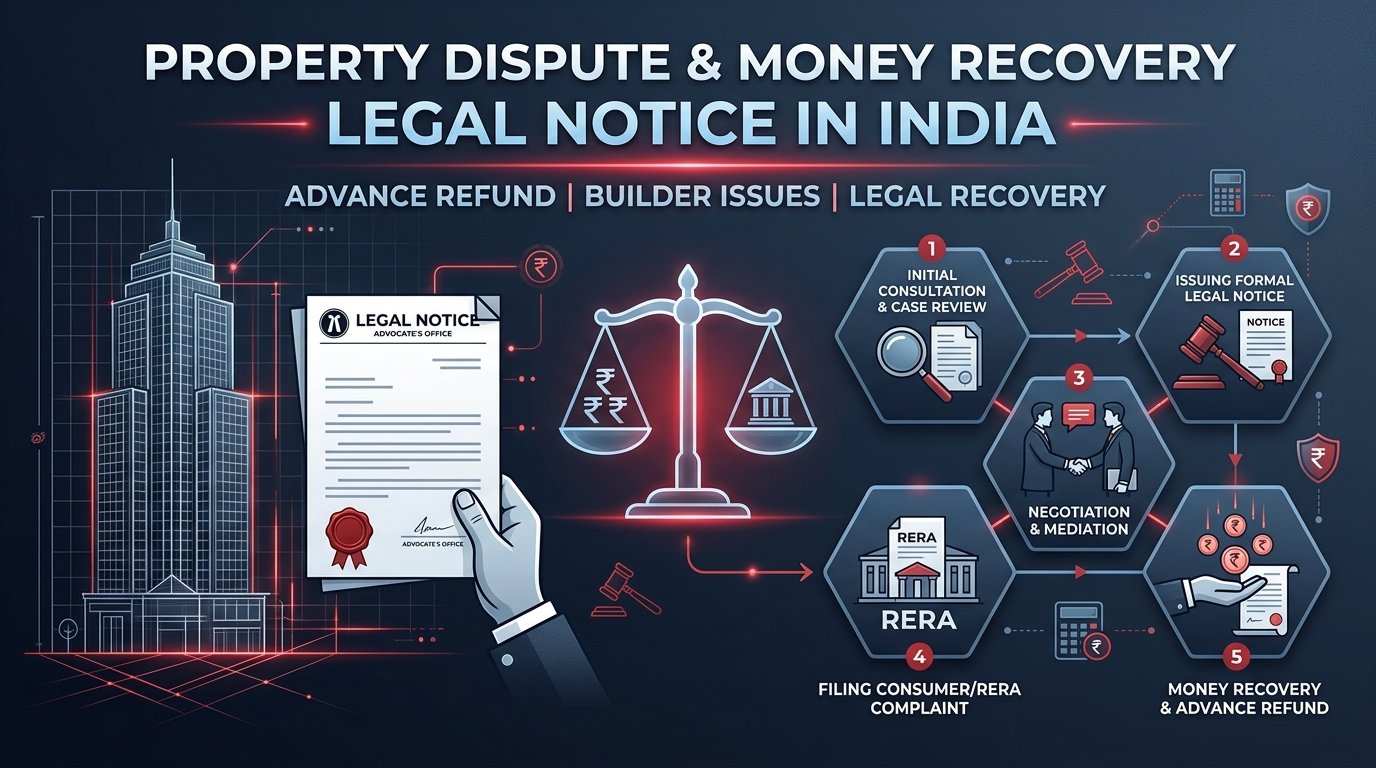
Legal Recovery executes a battle-tested 5-step operational protocol to maximize recovery speed while maintaining comprehensive judicial readiness:
Dossier Compilation & Financial Reconciliation
Gather all transaction receipts, bank UTR numbers, booking application forms, draft agreements, email correspondence, and WhatsApp chats. Prepare a detailed calculation statement showing the principal advance and accrued statutory interest.
Advocate Drafting & Statutory Legal Notice Formulation
A specialized real estate panel advocate drafts the formal statutory legal demand notice on legal letterhead, incorporating specific sections of the Indian Contract Act, RERA, Commercial Courts Act, and Bharatiya Nyaya Sanhita.
Multi-Channel Service with Section 63 BSA Digital Tracking
The notice is dispatched simultaneously via India Post Registered Speed Post with Acknowledgment Due (AD), official company email with read receipts, and verified WhatsApp with timestamped delivery tracking under Section 63 BSA.
Pre-Litigation Settlement Negotiations & Conciliation
Over 78% of defaulting builders and property vendors initiate settlement discussions during the 15-day notice window to avoid public RERA filings, freezing of escrow accounts, or commercial court injunctions.
Immediate Judicial Escalation upon Notice Expiry
If the counterparty fails to settle the dues within the stipulated 15 days, our panel advocates immediately transition the matter into RERA Section 18 recovery proceedings, Section 12A commercial mediation, or Order 37 summary recovery suits.
8. Frequently Asked Questions
Clear, authoritative answers to critical questions regarding commercial property disputes, advance refunds, and legal notice procedures in India.
Related Real Estate & Commercial Dispute Recovery Guides
Tenant Damaged Property Recovery
Recover repair damages and unpaid repair costs from defaulting tenants.
Security Deposit Refund from Landlord
Reclaim commercial and residential rental security deposits unlawfully withheld.
Recover Unpaid Rent from Tenant
Statutory demand notice and eviction proceedings under the Transfer of Property Act.
Business Unpaid Dues Recovery
Fast-track recovery for corporate vendors, suppliers, and B2B commercial dues.
B2B Pending Invoice Recovery
Enforce MSMED Act 45-day payment statutory deadlines with compound interest.
Business Partner Cheating & Dues
Recover diverted commercial partnership profits and misappropriated capital.

Legal Recovery
India's Trusted Recovery Platform
Legal Recovery is India's premier online legal notice and commercial dispute resolution platform, connecting property buyers, real estate investors, corporate tenants, and commercial allottees with seasoned panel advocates for rapid, advocate-vetted statutory demand notices at transparent flat fees. With ₹100 Crore+ recovered and 10,000+ disputes resolved across India, Legal Recovery delivers verified legal impact without the delays and unpredictability of traditional law firms.
Property Money Stuck with Builder or Seller?
Send an advocate-vetted statutory notice today. Over 78% of developers and property vendors settle refund claims within 15 days of notice service.
Flat fee • Advocate-drafted • Sent same day
Client Reviews
Siddharth Kulkarni
"I booked a 1,850 sq. ft. commercial office suite in an upcoming IT tower and deposited ₹38,50,000 as token booking advance. When the developer failed to furnish municipal layout approvals and fire safety NOCs within the committed 6-month timeline, I requested an immediate cancellation and full refund. The developer abruptly refused, citing a one-sided "non-refundable earnest money" clause in their draft MOU. Legal Recovery assigned a senior property advocate who drafted and served a formidable statutory legal demand notice under Sections 73 and 74 of the Indian Contract Act, Section 18 of RERA, and the Commercial Courts Act, citing the landmark Supreme Court ruling in Kailash Nath Associates v. DDA. Faced with the threat of RERA escalation and freezing of commercial project bank accounts, the developer agreed to a full settlement and disbursed the entire ₹38,50,000 plus 12% p.a. interest within 14 days of notice service. Truly outstanding and professional legal service!"