Legal Notice to College for Not Paying Security Deposit
Recover withheld institutional caution money, hostel security deposits, library fees, and 18% statutory interest from defaulting universities, engineering institutes, and private colleges under UGC Guidelines and the Consumer Protection Act, 2019.
Table of Contents
Swipe →Quick Answer
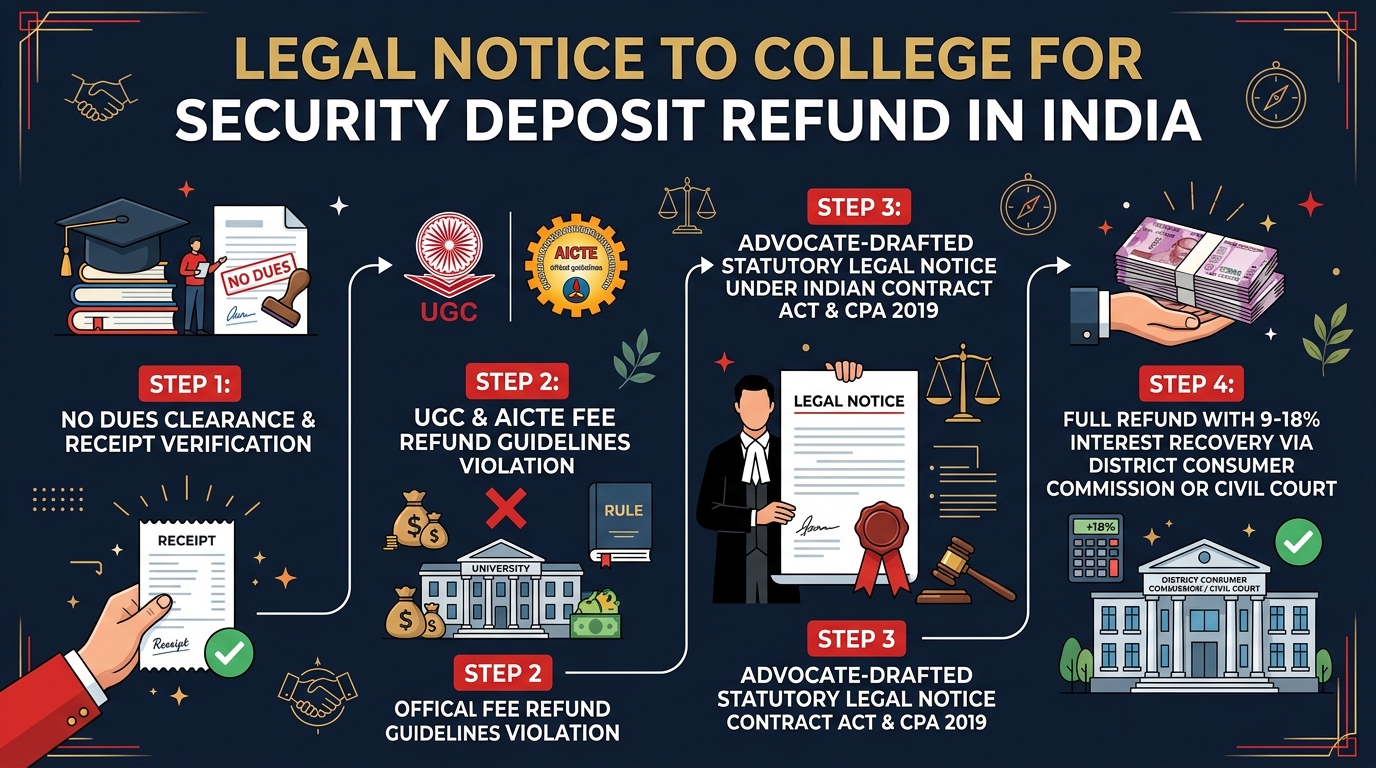
A student or parent can issue an advocate-drafted statutory legal notice to a college, private university, or educational institute under Section 70 and Section 73 of the Indian Contract Act, 1872, read with binding University Grants Commission (UGC) Fee Refund Guidelines, AICTE Approval Process Regulations, and Section 2(11) of the Consumer Protection Act, 2019, demanding the immediate refund of withheld caution money, laboratory deposits, and hostel security deposits within a mandatory 15-day settlement period. Under Indian law and landmark National Consumer Disputes Redressal Commission (NCDRC) judgments, educational institutions cannot lawfully forfeit or retain caution deposits once a student has vacated the premises or graduated and submitted an approved No-Dues Clearance Certificate. If the educational trust or college management fails to release the principal deposit amount alongside 9% to 18% statutory interest within the stipulated 15 days, the student can initiate digital fast-track litigation through the National Consumer E-Daakhil Portal, file a formal regulatory complaint before the UGC Anti-Retention Grievance Cell, or institute a summary suit under Order 37 of the Code of Civil Procedure, 1908.
1. Statutory Rights: UGC & AICTE Caution Money Refund Rules
Every academic year across India, millions of undergraduate, postgraduate, engineering, and medical students pay substantial upfront deposits designated under nomenclatures such as "Institutional Caution Money," "Hostel Security Deposit," "Laboratory Breakage Fund," or "Central Library Caution Deposit." By regulatory definition, these deposits are strictly caution funds held in fiduciary trust by the academic body to cover contingent physical damages to institutional infrastructure during the student's tenure. Upon completion of the academic degree or upon formally vacating university premises with a certified No-Dues Clearance, the educational institution is under an absolute statutory obligation to refund 100% of the caution money.
The University Grants Commission (UGC) Public Notice on Fee Refund and Non-Retention of Original Certificates and the All India Council for Technical Education (AICTE) Approval Process Handbook (Clause 8.2) lay down unequivocal statutory mandates governing higher education institutions:
Binding Regulatory Norms Mandated by Higher Education Authorities:
- ✓100% Refund of Caution Deposits: Unlike non-refundable tuition fees, caution money and security deposits must be refunded in full without any arbitrary administrative percentage cut, service fee, or processing deduction.
- ✓Zero Retention Period Post-No Dues: Once the graduating student submits the departmental No-Dues clearance, the university finance wing must disburse the refund within 15 to 30 days via direct electronic bank transfer (NEFT/RTGS).
- ✓Absolute Prohibition on Withholding Academic Degrees: Section 4.1 of the UGC Regulations explicitly states that no university, deemed-to-be university, or affiliated college shall withhold original academic degrees, grade cards, migration certificates, or character certificates on the pretext of pending administrative security clearances or financial disputes.
- ✓Regulatory Penalties for Defaulting Institutes: Institutions that willfully withhold caution deposits face severe regulatory sanctions under the UGC Act, 1956, including withdrawal of degree-granting approval, de-recognition from central research funding, and forfeiture of accreditation status under the National Assessment and Accreditation Council (NAAC).
Despite these express regulatory provisions, hundreds of private universities and unaided professional colleges across Maharashtra, Karnataka, Delhi-NCR, Tamil Nadu, and Uttar Pradesh systematically stonewall refund applications, utilizing student security funds as unearned working capital. Serving an advocate-drafted statutory legal notice puts the governing trust on formal notice that continued non-compliance triggers direct regulatory reporting to the UGC Central Grievance Portal and the jurisdictional State Directorate of Higher Education.
2. Legal Nature of Caution Money: Bailment vs. Unlawful Enrichment
From the standpoint of Indian jurisprudence, security deposits and caution funds hold a distinct legal status separate from academic tuition or service fees. When a student remits caution money at the time of college admission, a statutory relationship of fiduciary bailment is established under Section 148 of the Indian Contract Act, 1872. The college acts as a bailee entrusted with specific funds for a conditional purpose—namely, indemnification against verified physical breakages. Under Section 160 of the Indian Contract Act, the bailee is under a strict legal duty to return the bailed money to the bailor without demand as soon as the purpose for which it was bailed has been accomplished.
Furthermore, under Section 70 of the Indian Contract Act, 1872, where a party delivers funds to another not intending to do so gratuitously, and the recipient enjoys the commercial benefit thereof, the recipient is legally bound to make compensation or restore the sum in full. Withholding caution money transforms the institution's possession into unjust enrichment and an illegal appropriation of student capital.
⚖Landmark Judicial Precedents on Caution Money & Fee Restitution:
1. Supreme Court of India: Islamic Academy of Education v. State of Karnataka (2003) 6 SCC 697
The Hon'ble Supreme Court held that educational institutions are strictly prohibited from indulging in commercial profiteering or collecting and retaining arbitrary capitation fees and unverified security deposits. The Court affirmed that charging or retaining funds beyond reasonable operational expenses without rendering corresponding service constitutes an unfair practice punishable under law.
2. National Consumer Commission (NCDRC): Buddhist Mission Technical Institute v. Ashok Kumar Gandhi
The NCDRC held that retaining refundable caution money, laboratory deposits, or original certificates post-course completion constitutes a grave deficiency in service under the Consumer Protection Act. The Commission ordered full refund of the security deposit along with 12% per annum interest and substantial punitive compensation for harassment.
3. National Consumer Commission (NCDRC): Registrar, University of Delhi v. Ashok Kumar
The National Commission ruled that once a student successfully obtains a certified No Dues Certificate from all university departments, the university possesses zero legal right to delay or forfeit caution deposits. The institution was directed to pay the entire principal deposit alongside penal interest and litigation costs.
3. Illegal Retention Excuses & Unfair Trade Practices by Colleges
When graduating students or parents approach the accounts and administrative offices of colleges to claim their security deposits, administrative staff frequently present fabricated hurdles. Under Section 2(47) of the Consumer Protection Act, 2019, these administrative tactics constitute actionable Unfair Trade Practices and Deficiency in Service:
1. "Unclaimed Deposit Forfeiture Clause"
Colleges often cite fine print in their prospectus claiming that caution money not claimed within 6 months or 1 year of graduation automatically lapses into the college general fund. The Supreme Court has repeatedly declared that one-sided forfeiture clauses in standard-form contracts are unconscionable, void under Section 23 of the Indian Contract Act, and cannot override statutory limitation laws.
2. "Annual Audit & Finance Approval Delays"
Institutions claim that caution deposits can only be released after the annual financial audit or board of trustees meeting, dragging disbursements for 1 to 2 years. Such internal administrative delays cannot defeat a student’s statutory right to immediate restitution upon No-Dues submission.
3. "Arbitrary Maintenance & Painting Deductions"
Hostel wardens and estate officers frequently impose blanket deductions of ₹5,000 to ₹25,000 for "general hostel painting," "batch farewell maintenance," or "unidentified wing damages" without proving individualized damage caused by the specific student.
4. "Missing Original Caution Money Receipt"
Account departments refuse refunds if the student misplaces the physical yellow fee receipt issued 3-4 years prior during admission. In the digital banking era, electronic transaction records, bank statements, and college ledger entries are conclusive evidence under Section 63 of the BSA.
5. "Mandatory Alumni Association Contribution"
Colleges unilaterally deduct ₹3,000 to ₹10,000 from refundable caution money as mandatory lifetime alumni membership or building development funds without explicit written consent from the graduating student.
6. "Degree & Migration Certificate Blackmail"
Refusing to release degree certificates, migration cards, or character certificates unless the student signs a waiver forfeiting their security deposit is an illegal coercive practice attracting both consumer and criminal sanctions.
4. Evidentiary Checklist: Documents, Receipts & No-Dues Clearances
Before serving a statutory legal notice on a college administration, assembling a watertight evidentiary paper trail is vital. Under the Bharatiya Sakshya Adhiniyam, 2023 (BSA) and the Consumer Protection Act, contemporaneous electronic records, bank statements, and administrative clearances establish an indisputable prima facie case of financial default.
| Document Category | Specific Evidentiary Proof | Statutory Weight & Legal Purpose |
|---|---|---|
| Admission Fee Receipts | Fee challans, online payment gateway receipts, or ledger breakdowns explicitly earmarking "Institutional Caution Money" or "Hostel Deposit" | Proves exact principal quantum paid under refundable head; establishes Section 148 bailment. |
| No-Dues Clearance Certificate | Official clearance form signed and stamped by Library, Laboratories, Hostel Warden, Sports Complex, Accounts, and HOD | Conclusively refutes any institutional claim of property damage, library dues, or pending fines. |
| Written Refund Applications | Copies of formal letters submitted to the Finance Officer/Principal with receiving stamps, or official support tickets | Proves formal demand made; establishes precise date when cause of action arose for interest calculation. |
| Email & Messaging Trail | Official email correspondence with the Registrar, Dean, or Accounts Section; WhatsApp communications with Hostel Warden | Admissible electronic evidence under Section 63 BSA; demonstrates deliberate institutional stonewalling. |
| Bank Statement & NEFT Proof | Bank account statement showing initial debit for admission and verifying zero subsequent credit from college | Establishes continuous financial loss and non-disbursement by the college. |
| Institutional Prospectus / Rulebook | Relevant pages of the college information brochure specifying caution deposit refund guidelines | Proves contractual terms and demonstrates institution's direct breach of its own published policies. |
5. Key Clauses in a Statutory Demand Notice to University/College
An advocate-vetted statutory legal notice is not a casual reminder letter. It is a formal pre-litigation legal instrument executed under the signature and seal of an enrolled advocate of the High Court. When served on the Vice-Chancellor, Registrar, Principal, and Chairman of the governing trust, it establishes enforceable civil and criminal accountability. A robust notice must incorporate six indispensable legal elements:
Precise Identification of Parties & Academic Enrollment Identity
The notice must explicitly state the student’s full name, roll number, registration number, course/department, batch duration (e.g., 2020-2024), and hostel room details, alongside the full corporate and trust identity of the university or educational society.
Itemized Factual Matrix & Financial Breakdown of Withheld Deposits
A granular table specifying each deposit head paid during admission: Institutional Caution Money (₹25,000), Hostel Security Deposit (₹30,000), Library Deposit (₹10,000), with corresponding receipt numbers, transaction dates, and mode of remittance.
Affirmation of Complete No-Dues Clearance & Property Handover
Clear legal averment that the student fulfilled all academic curriculum requirements, vacated university premises in pristine condition, and obtained certified No Dues clearances from all statutory departments without any outstanding liabilities.
Statutory Grounding under UGC Directives, Contract Act & CPA 2019
Explicit citation of Section 70/73 of the Indian Contract Act, UGC Public Notifications on Fee Refund, Section 2(11) & Section 2(47) of the Consumer Protection Act, 2019, and landmark Supreme Court/NCDRC precedents prohibiting forfeiture of caution money.
Peremptory 15-Day Cure Period & Claim for 18% Statutory Interest
A strict demand calling upon the college management to disburse the entire principal deposit amount directly into the student’s bank account within exactly 15 days of receipt of notice, failing which 18% per annum commercial interest shall accrue from the due date.
Multi-Forum Litigation Notice & Personal Trustee Liability Intimation
Unambiguous notice that failure to comply within 15 days will result in immediate filing of a Consumer Complaint on E-Daakhil seeking ₹1,00,000 damages for mental agony, regulatory petition before the UGC/AICTE Ombudsman, and criminal complaint under Section 316/318 of the Bharatiya Nyaya Sanhita, 2023 for criminal breach of trust.
6. Legal Remedies: Consumer Court, UGC Grievance & BNS Sanctions
If the educational institution fails to disburse the caution money within the 15-day peremptory notice window, the served legal notice unlocks four distinct, high-impact legal recovery avenues:
| Legal Forum | Statutory Basis | Average Timeline | Remedies & Compensation Available | Enforcement Power |
|---|---|---|---|---|
| District Consumer Disputes Redressal Commission (DCDRC / E-Daakhil) | Section 35, Consumer Protection Act, 2019 (Deficiency in Service & Unfair Trade Practice) | 3 – 6 Months | Full refund of deposit + 9% to 18% penal interest + ₹25,000 to ₹1,00,000 for mental harassment + litigation costs | Enforceable as a civil court decree; non-compliance punishable by imprisonment under Section 72 CPA. |
| UGC e-Samadhan Grievance Redressal Portal | UGC (Grievance Redressal) Regulations & Fee Refund Mandates | 30 – 60 Days | Regulatory directive ordering direct refund; show-cause notice issued to Vice-Chancellor | Threatens college degree recognition, NAAC ranking, and grants; compels fast institutional compliance. |
| Civil Court (Summary Suit under Order 37 CPC) | Order 37, Code of Civil Procedure, 1908 (Liquidated Debt on Written Receipts) | 6 – 12 Months | Fast-track money decree for exact liquidated caution amount plus contractual interest | Direct execution via bank account attachment and freezing of college trust accounts. |
| Criminal Complaint / Police FIR | Section 316 & 318 of Bharatiya Nyaya Sanhita, 2023 (BNS) | Immediate Action | Investigation into misappropriation of caution trust funds; personal summons to trustees | Creates immediate criminal exposure for trustees and directors, compelling swift out-of-court settlement. |
7. Step-by-Step Strategic Roadmap to Recover Caution Deposits
Recovering stuck caution money and security deposits from rigid academic administrations requires a disciplined, legally sequenced escalation strategy:
Consolidate Admission Receipts & Obtain Signed No-Dues Clearance
Gather all original or electronic fee challans, deposit vouchers, and your finalized No Dues Certificate bearing departmental signatures and stamps. Ensure you have your bank passbook/cancelled cheque ready for direct electronic transfer verification.
Send a Formal Written Reminder to Finance Officer & Principal
Submit a polite, written formal demand letter via registered email and physical hand-delivery to the accounts section, giving them 7 business days to credit your caution deposit under published UGC Guidelines. Preserve the acknowledgment copy.
Engage Legal Recovery to Draft an Advocate Statutory Notice
If the college fails to disburse the funds within 7 days, provide your case details to Legal Recovery. Our panel advocate drafts an airtight statutory legal demand notice itemizing the exact deposit heads, citing UGC/AICTE regulations, and invoking Section 70/73 of the Contract Act and Section 2(11) of CPA 2019.
Serve Notice via India Post Speed Post & Official Email Copies
The notice is dispatched simultaneously via India Post Speed Post with Acknowledgment Due (AD) to the Principal, Registrar, and Governing Trust Chairman, alongside tracked legal email delivery. The generated Postal Tracking Number and Section 63 BSA electronic dispatch certificate serve as concrete legal proof of service.
Execute Immediate Judicial Escalation upon 15-Day Expiry
Over 82% of universities and private colleges settle the full caution deposit within 15 days of receiving our advocate notice. If the administration remains non-compliant, we file an instant consumer complaint on the National E-Daakhil Portal seeking full refund, 18% interest, and ₹50,000+ compensation for mental harassment.
8. Frequently Asked Questions
Authoritative Legal & Regulatory References:
More Consumer & Fee Recovery Legal Guides

Legal Recovery
India's Trusted Recovery Platform
Legal Recovery is India's trusted online legal notice and dispute resolution platform, connecting students, parents, alumni, and consumers with seasoned panel advocates for rapid, advocate-vetted statutory demand notices at transparent flat fees. With ₹100 Crore+ recovered and 10,000+ cases resolved across India, Legal Recovery delivers verified legal impact without the delays and unpredictability of traditional law firms.
College Withholding Your Caution Money?
Send an advocate-vetted statutory notice today. Over 82% of universities and colleges disburse withheld security deposits within 15 days of notice service.
Flat fee • Advocate-drafted • Sent same day
Client Reviews
Rohan Varma
"After graduating from a private engineering institute in Pune, I submitted my complete No Dues clearance covering the hostel, central library, physics laboratories, and sports department. Despite having an official receipt of ₹65,000 for institutional caution deposit and hostel caution money, the college accounts department stonewalled my refund for 14 months with vague excuses about "audit delays" and "management approvals." Legal Recovery connected me with an advocate who drafted and dispatched a formidable statutory legal notice under UGC Fee Refund Guidelines, Section 70 of the Indian Contract Act, and the Consumer Protection Act, 2019. Within 12 days of receiving the notice via Speed Post and formal email copy to the Chancellor and Registrar, the college finance director personally contacted me and credited the entire ₹65,000 directly to my bank account along with an apology letter. Remarkable efficiency and legal clarity for students!"