Legal Notice for Insurance Claim Not Settled Delay
Compel private and public insurance companies to disburse delayed health, motor, life, fire, and commercial claims under the IRDAI 30-day settlement mandate, statutory penal interest rules, and Consumer Protection Act 2019.
Table of Contents
Swipe →Quick Answer
A policyholder facing an unsettled or delayed health, motor, life, or commercial insurance claim can serve an advocate-vetted statutory legal notice under Regulation 15 of the IRDAI (Protection of Policyholders’ Interests) Regulations, 2017, demanding immediate disbursement of the full claim amount alongside statutory penal interest at 2% above the prevailing bank rate within a 15-day compliance window. If the insurance company fails to settle the claim or offer justifiable grounds within the notice period, the policyholder can initiate summary adjudication before the Insurance Ombudsman for claims up to ₹50 Lakhs or file a consumer complaint for deficiency in service under Section 2(11) and Sections 35, 47, or 58 of the Consumer Protection Act, 2019. Furthermore, under landmark rulings by the Supreme Court of India in Gurmel Singh v. National Insurance Co. Ltd. (2022), insurers are legally barred from withholding policy payouts on hyper-technical or procedural grounds.
1. Statutory Mandate & IRDAI Timelines for Insurance Claim Settlement
Insurance contracts in India operate under the fundamental common law doctrine of uberrima fides (utmost good faith). While insurers rigorously enforce this duty on policyholders during underwriting, regulatory authorities and Indian judicial bodies have made it unequivocally clear that this reciprocal obligation binds the insurance company to assess, process, and disburse genuine claims expeditiously without bureaucratic evasion.
The primary regulatory authority governing claim settlement timelines is the Insurance Regulatory and Development Authority of India (IRDAI). Under the IRDAI (Protection of Policyholders’ Interests) Regulations, 2017 (and subsequent Master Circulars on Policyholder Protection), strict, non-negotiable procedural deadlines govern every phase of claim handling:
Key IRDAI Regulatory Timelines for General, Health & Life Claims:
- Surveyor Appointment within 72 Hours: When a claim requires an independent loss assessment (mandatory for motor, fire, or property claims above statutory thresholds), the insurer must appoint an IRDAI-licensed surveyor within 72 hours of receiving claim intimation.
- Survey Report Submission within 30 Days: The surveyor must conduct the inspection and submit the detailed final survey report to the insurer within 30 days of appointment. If complex forensic investigations are required, an extension may be granted, but the total investigation window cannot exceed 6 months from claim intimation.
- 30-Day Adjudication Window: Upon receipt of the surveyor’s report or the final clarifying document from the policyholder, the insurer must accept, offer settlement, or formally repudiate the claim within exactly 30 days.
- 7-Day Payment Rule: Where a claim settlement offer is accepted by the policyholder, the insurance company must disburse the settlement funds directly into the claimant’s bank account within 7 calendar days.
- Mandatory Penal Interest: If the insurer fails to make payment within the statutory 30-day adjudication or 7-day disbursement window without legal justification, it is statutorily liable to pay penal interest at 2% above the prevailing bank rate (repo rate) from the date of submission of the last relevant document until the actual date of payment.
Additionally, for health insurance claims, IRDAI’s Master Circular on Health Insurance Products mandates that Third-Party Administrators (TPAs) and insurers must communicate cashless authorization within 1 hour of intimation by the network hospital, and provide final cashless discharge clearance within 3 hours of receiving the final hospital bill. Withholding discharge clearances or converting valid cashless claims into prolonged reimbursement battles represents a direct regulatory breach.
2. Actionable Grounds: Unlawful Delays & Endless Query Loops
Insurance companies frequently deploy systemic administrative tactics designed to exhaust policyholders, forcing them to abandon claims or accept severely discounted partial settlements. Serving a comprehensive statutory legal notice legally pins down these unfair practices and transforms bureaucratic foot-dragging into verifiable evidence of actionable deficiency in service:
Endless Piecemeal Query Cycles
Rather than issuing a consolidated document requirement list within 15 days of intimation as required by IRDAI regulations, insurers issue repetitive, piecemeal queries every few weeks to artificially reset their internal 30-day settlement clocks.
Vague Pre-Existing Disease (PED) Allegations
Insurers often stall health claims by demanding decades-old outpatient medical records for unrelated lifestyle conditions (such as hypertension or diabetes) without demonstrating any direct causal nexus to the acute hospitalization condition.
Surveyor Report Suppression
In property, fire, and commercial loss claims, insurers frequently withhold copies of the independent surveyor’s assessment report from the insured while quietly lobbying the surveyor to re-quantify or downscale the assessed loss.
Coercive Full & Final Vouchers
Conditioning the release of admitted partial claim amounts on the insured executing an unconditional "Discharge Voucher" waiving all future claims has been repeatedly declared void and coercive by the Supreme Court of India.
Comparative Overview: Permissible Delays vs. Actionable Unlawful Delay
| Claim Stage | Statutory Regulatory Limit | Unlawful Conduct Triggering Legal Notice |
|---|---|---|
| Surveyor Appointment | Within 72 hours of intimation | Delaying surveyor assignment for weeks while physical evidence deteriorates |
| Survey Report Completion | 30 days (Max 6 months for special investigations) | Failing to file survey report and refusing to share report copy with insured |
| Claim Settlement Decision | 30 days from receipt of survey report/docs | Claim pending for 60+ days with continuous repetitive documentation requests |
| Fund Disbursement | 7 days from settlement acceptance | Non-payment beyond 7 days without applying statutory bank rate + 2% penal interest |
3. Legal Remedies: Ombudsman vs Consumer Forum vs Commercial Courts
When an insurance company defaults on its statutory settlement mandate, serving an advocate-drafted legal notice provides the crucial foundational milestone required to unlock multi-tiered legal remedies across specialized dispute resolution forums in India:
AInsurance Ombudsman (Speedy, Zero-Cost Statutory Forum)
Governed by the Insurance Ombudsman Rules, 2017 (amended in 2021 & 2023), this quasi-judicial authority handles personal lines of insurance (health, motor, life, home, personal accident) as well as sole proprietors and micro-enterprises.
- Pecuniary Jurisdiction: Claims up to ₹50 Lakhs (including interest and ex-gratia compensation).
- Pre-Requisite: Policyholder must have issued a prior written representation or legal notice to the insurer’s Grievance Redressal Officer (GRO) and received no resolution within 30 days.
- Binding Nature: The Ombudsman award is 100% legally binding on the insurance company (which must comply within 30 days), while remaining non-binding on the policyholder, preserving the right to appeal before consumer courts.
BConsumer Disputes Redressal Commissions (DCDRC / SCDRC / NCDRC)
Under the Consumer Protection Act, 2019, an unjustified delay in settling an insurance claim constitutes an actionable "deficiency in service" under Section 2(11) and an "unfair trade practice" under Section 2(47).
- District Consumer Disputes Redressal Commission (DCDRC): Claims and compensation up to ₹50 Lakhs.
- State Consumer Disputes Redressal Commission (SCDRC): Claims exceeding ₹50 Lakhs up to ₹2 Crore.
- National Consumer Disputes Redressal Commission (NCDRC): High-value claims exceeding ₹2 Crore.
- Statutory Remedies: Full insurance reimbursement, compound interest at 12–18% p.a., heavy damages for mental agony, and comprehensive litigation costs.
CCommercial Courts & High Court Civil Jurisdiction
For commercial entities, corporate factories, marine freight cargo, and large industrial property policies, claims are pursued before designated Commercial Courts under the Commercial Courts Act, 2015. The mandatory pre-institution mediation mechanism under Section 12A allows fast-track commercial debt recovery backed by formal legal demand notices.
4. Evidentiary Checklist & Claim Document Audit
A legally robust demand notice must be backed by an unassailable evidentiary audit. Before issuing a statutory legal notice to an insurance company, ensure all documentary exhibits are methodically indexed:
✓Complete Policy Schedule & Clauses
Original policy document, premium receipts proving continuous active cover, and the specific terms, conditions, and endorsement schedules in effect at the time of loss.
✓Claim Intimation & Reference Log
Timestamped email intimation, official claim reference number, SMS receipts, and portal submission confirmations establishing the exact date of loss reporting.
✓Primary Proof of Loss & Invoices
Hospital discharge summaries, diagnostic reports, indoor case papers (for health), repair estimates, spot survey photos, FIR/GD entry (for motor/theft), and audited inventory valuations.
✓Full Correspondence & Query Responses
Every letter, email thread, TPA query form, and policyholder reply demonstrating that all requested documents were fully supplied, establishing the commencement of the statutory 30-day clock.
5. Key Clauses in a Statutory Notice for Delayed Claim Settlement
A poorly drafted demand notice can be dismissed by insurance company legal departments as routine correspondence. To command immediate compliance, an advocate-vetted notice must incorporate four indispensable structural clauses:
Clause A: Factual Chronology of Policy Execution, Premium Payment & Claim Intimation
Recites the exact policy number, period of validity, proof of timely premium payments, detailed occurrence of the insured peril (e.g., emergency medical hospitalization, vehicular accident, commercial property fire), and precise timestamped intimation to the insurer/TPA.
Clause B: Detailed Documentary Compliance & Breach of IRDAI 30-Day Mandate
Explicitly details the date when the final document or survey inspection was completed, calculating the exact number of days the claim has remained unsettled beyond the statutory 30-day mandate under Regulation 15 of the IRDAI Policyholder Protection Regulations.
Clause C: Computation of Admitted Principal, Statutory Penal Interest & Damages
Quantifies the exact claim principal amount, accrues statutory penal interest at bank rate + 2% per annum, and asserts compensatory damages for gross mental distress, financial hardship, and harassment caused by the unlawful delay.
Clause D: Strict 15-Day Peremptory Compliance Window & Litigation Warning
Grants the insurance company a peremptory 15-day window from receipt to transfer the full outstanding claim amount along with accrued penal interest directly to the policyholder's bank account, failing which immediate proceedings will be initiated before the Insurance Ombudsman, Consumer Commission (NCDRC/SCDRC/DCDRC), and IRDAI Bima Bharosa portal at the insurer's sole risk and expense.
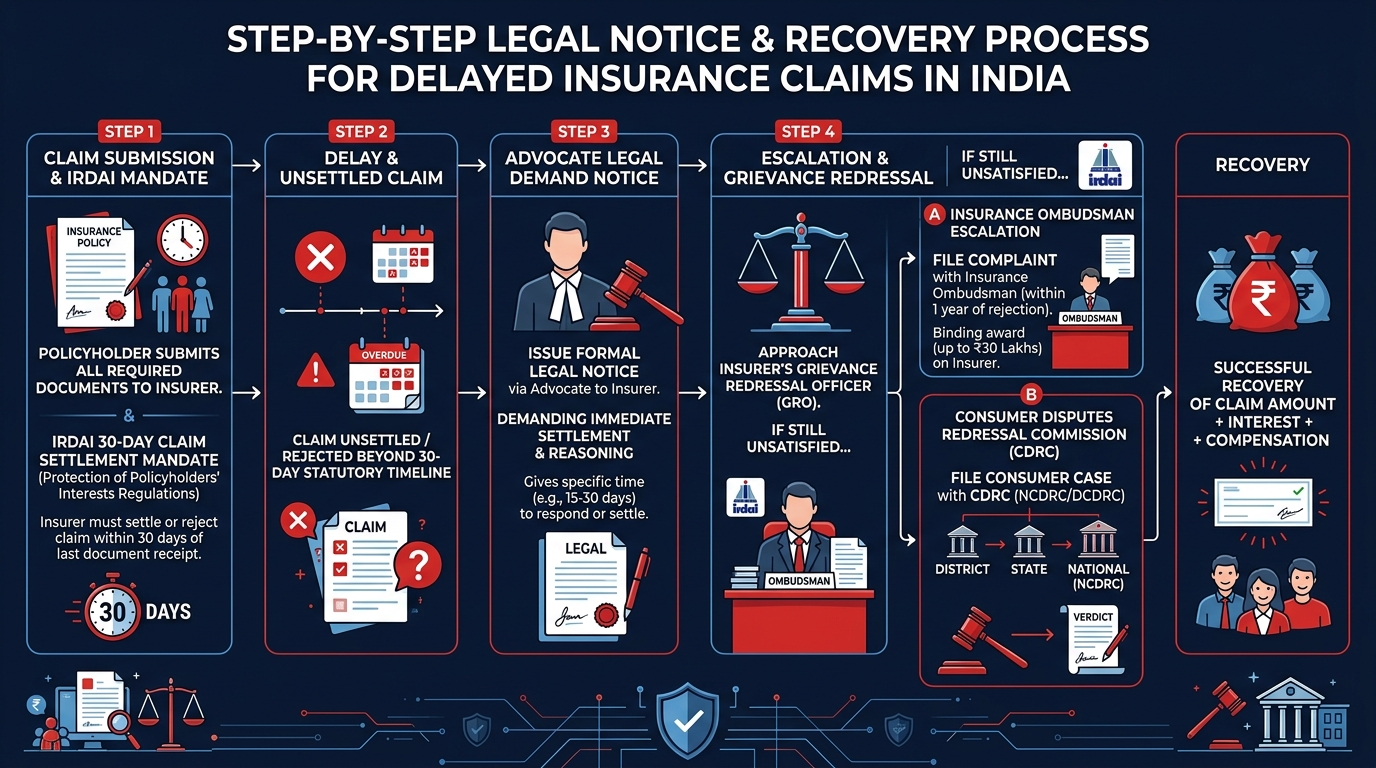
6. Strategic Roadmap: 15-Day Legal Demand to Full Recovery
Recovering delayed insurance claims requires a disciplined, time-bound legal pipeline. Legal Recovery follows a verified 5-stage protocol that achieves high-impact resolution without dragging policyholders through unnecessary years of court litigation:
Digital Intake & Policyholder Case Audit
Submit your policy details, claim reference number, denial/query letters, medical or loss invoices, and email threads via Legal Recovery’s encrypted portal. Our team validates policy terms, exclusions, and statutory limitation periods.
Advocate Drafting & Statutory Penal Interest Computation
A seasoned panel advocate drafts a bespoke, high-impact statutory demand notice incorporating IRDAI Regulation 15, the Consumer Protection Act 2019, Supreme Court precedents, and exact penal interest calculations.
Digital Signing & Multi-Channel Formal Service
The notice is digitally executed under the Information Technology Act, 2000 and served via India Post Registered Post AD and Speed Post directly to the insurer’s MD, Grievance Redressal Officer (GRO), and TPA, accompanied by verified email dispatch.
15-Day Real-Time Tracking & Settlement Negotiation
Track postal delivery status and courier consignment numbers on your live dashboard. Over 70% of insurance claims are expedited, approved, or settled during this 15-day window as legal departments prioritize advocate notices over regular customer tickets.
Ombudsman & Consumer Commission Escalation Package
If the insurer fails to disburse funds within the 15-day period, Legal Recovery prepares a complete, litigation-ready dossier for immediate submission before the Insurance Ombudsman or District/State Consumer Commission.
7. Frequently Asked Questions
8. Statutory References & Landmark Case Law
- IRDAI (Protection of Policyholders’ Interests) Regulations, 2017 — Regulation 15 Claim Settlement Procedures & Penal Interest, irdai.gov.in
- Consumer Protection Act, 2019 — Section 2(11) Deficiency in Service & Sections 35, 47, 58 Commission Jurisdiction, consumeraffairs.nic.in
- Insurance Ombudsman Rules, 2017 (Amended 2021 & 2023) — Council for Insurance Ombudsmen, cioins.co.in
- Supreme Court of India — Gurmel Singh v. Branch Manager, National Insurance Co. Ltd. (2022) 7 SCC 287 (Rejection on Technical Grounds Prohibited), main.sci.gov.in
- Supreme Court of India — Manmohan Nanda v. United India Assurance Co. Ltd. (2022) 4 SCC 582 (Uberrima Fides Duty on Insurers), main.sci.gov.in
- Supreme Court of India — New India Assurance Co. Ltd. v. Pradeep Kumar (2009) 7 SCC 787 (Surveyor Reports & Arbitrary Delays), main.sci.gov.in
- Indian Contract Act, 1872 — Section 73 (Compensation for Loss or Damage Caused by Breach of Contract), indiacode.nic.in
- National Consumer Disputes Redressal Commission (NCDRC) — Case Law on Delayed Insurance Claim Settlement, ncdrc.nic.in
More Consumer Protection & Dispute Guides

Legal Recovery
India's Trusted Recovery Platform
Legal Recovery is India's trusted online legal notice and dispute resolution platform, connecting policyholders, consumers, businesses, and professionals with seasoned panel advocates for rapid, advocate-vetted statutory demand notices at transparent flat fees. With ₹100 Crore+ recovered and 10,000+ cases resolved across India, Legal Recovery delivers verified legal impact without the delays and unpredictability of traditional law firms.
Insurance Company Delaying Your Settlement?
Send an advocate-vetted statutory notice today. Over 70% of insurers approve delayed claims and release pending funds within 15 days upon receiving formal notice from Legal Recovery.
Flat fee • Advocate-drafted • Sent same day
Client Reviews
Pranit Deshmukh
"My father had undergone an emergency coronary bypass surgery costing ₹18,45,000, and our cashless health insurance claim was stalled for more than 5 months by the private insurer under continuous, redundant queries about past medical history. Despite submitting complete hospital records, the insurer kept delaying the settlement without issuing an approval or formal repudiation. Legal Recovery drafted and served an exhaustive advocate-vetted statutory legal notice citing IRDAI Regulation 15, the 30-day settlement mandate, and Supreme Court precedents on penal interest. Within 11 days of receiving the notice, the insurance company contacted us, cleared the entire ₹18.45 Lakhs claim along with accrued interest, and waived all objections. Outstanding legal efficiency for policyholder recovery."