Legal Notice to Travel Agent for Holiday Package Refund
Recover advance tour package payments, compensation for hotel downgrades, cancelled flight components, and unilateral itinerary alterations under the Consumer Protection Act, 2019 and Indian Contract Act.
Table of Contents
Swipe →Quick Answer
An aggrieved traveler or consumer can serve an advocate-drafted statutory legal notice to a travel agent or tour operator under Section 2(11) and Section 2(47) of the Consumer Protection Act, 2019, demanding full refund of advance package payments, unrendered hotel stays, and cancelled excursion fees within 15 days. If a travel agency unilaterally alters the agreed itinerary, downgrades accommodation standards, or withholds refunds after trip cancellations due to unforeseen events, the tour operator commits an actionable deficiency of service and unfair trade practice under Section 73 and Section 56 of the Indian Contract Act, 1872. Serving a formal legal notice establishes crucial pre-litigation proof before filing a digital complaint on the E-Daakhil portal or initiating recovery proceedings before the District Consumer Disputes Redressal Commission for principal refund, 12% to 18% annual interest, and substantial compensation for mental agony.
1. Statutory Framework: Consumer Protection & Travel Laws in India
Every year, thousands of Indian families and corporate professionals plan domestic and international vacations by booking bundled holiday packages through travel agencies, destination management companies (DMCs), and online aggregators. When a travel operator fails to deliver the promised itinerary, abruptly cancels trips, downgrades hotel star categories, or withholds advance payments, the traveler is shielded by comprehensive statutory protections under Indian consumer and contract jurisprudence.
The primary legislative enactment governing holiday package disputes is the Consumer Protection Act, 2019 (CPA 2019), which establishes rigorous benchmarks for service delivery and penalizes deceptive commercial conduct:
- Section 2(11) (Deficiency in Service): Defines deficiency as any fault, imperfection, shortcoming, or inadequacy in the quality, nature, and manner of performance required to be maintained by or under any law or undertaken to be performed by a person in pursuance of a contract. Unilateral schedule cuts, uncleaned rooms, and missed guided tours fall squarely under this definition.
- Section 2(47) (Unfair Trade Practice): Prohibits travel operators from making false or misleading representations regarding the standard, quality, grade, composition, style, or model of services. Selling a package by showcasing luxury 5-star beachfront resorts and subsequently placing travelers in budget motels is a statutory offense.
- Section 2(46) (Unfair Contracts): Empowers consumer commissions to declare void any one-sided standard-form contracts that impose unreasonable forfeiture clauses, blanket non-refundable terms, or excessive cancellation penalties on travelers.
- Section 39 (Reliefs Granted by Commissions): Empowers consumer courts to direct the travel agency to refund the entire package price, pay compensation for loss or injury caused due to negligence, award punitive damages, and order payment of adequate legal costs.
Complementing consumer statutes, the Indian Contract Act, 1872 governs the foundational commercial relationship between the traveler and the tour operator:
- Section 56 (Doctrine of Frustration): When a tour becomes impossible to perform due to unforeseen force majeure events (such as flight bans, border closures, natural disasters, or unexpected visa refusals), the contract becomes void. Under Section 65, the travel operator is legally bound to restore any advantage or monetary advance received under the agreement to the traveler.
- Section 73 (Damages for Breach of Contract):The injured consumer is entitled to receive full compensation for any direct financial loss or damage naturally arising from the agency's contractual breach, including emergency bookings and alternate transport.
- Section 230 (Agent's Direct Liability): Where the travel agent creates and markets a bundled tour package as an independent packager rather than a disclosed booking conduit, the agent remains directly liable to the customer for failures of underlying airlines, bus operators, and resort properties.
Furthermore, the Supreme Court of India in the landmark ruling Pravasi Legal Cell & Ors. v. Union of India (2020) along with guidelines issued by the Directorate General of Civil Aviation (DGCA) in CAR Section 3, Series M, Part IV, explicitly mandates that airlines and booking agents must refund full passenger fares within statutory timelines without imposing coercive credit shells or unwarranted administrative deductions.
2. Actionable Grounds: Itinerary Cuts, Downgrades & Refund Denials
A formidable legal notice must specify the exact factual defaults and statutory breaches committed by the travel agency. Indian consumer commissions recognize multiple actionable failure scenarios:
Arbitrary Itinerary Alterations & Skipped Sightseeing
Tour operators unilaterally dropping key destinations, historical monuments, or premium mountain excursions (e.g., Mount Titlis, Burj Khalifa VIP passes) without traveler consent or proportional fee adjustments.
Hotel Star Downgrades & Substandard Living Facilities
Promising 4-star or 5-star city-center luxury accommodations in booking brochures, but forcing travelers into dingy, unhygienic 2-star suburban transit motels without functional air conditioning, heaters, or basic hygiene.
Unilateral Tour Cancellations & Forfeiture of Advances
Travel operators cancelling group departures due to low seat occupancy or internal logistics failures, while unlawfully withholding client advances under the pretext of non-refundable booking conditions.
Flight Rescheduling, Missed Connections & Lapsed Transfers
Booking poorly coordinated airline connections resulting in stranded passengers at transit hubs, or failing to provide pre-paid airport pickup and drop-off transfers in foreign destinations.
Visa Rejection & Refusal to Pass Through Vendor Refunds
Refusing to refund package components when an embassy rejects a visa application well before departure, despite airlines and hotels releasing full or partial refunds to the travel agency.
Hidden Surcharges & Coercive On-Tour Extortion
Demanding unexpected fuel surcharges, peak-season resort fees, or mandatory local guide tips mid-journey under threat of abandoning travelers in foreign jurisdictions.
3. Legal Remedies & Forum Jurisdiction: Consumer Commission to NCDRC
Indian law provides specialized judicial and quasi-judicial avenues for recovering money from defaulting travel operators. The pecuniary jurisdiction of Consumer Disputes Redressal Commissions is determined by the total consideration paid:
| Adjudication Forum | Pecuniary Jurisdiction | Statutory Basis | Available Remedies & Reliefs |
|---|---|---|---|
| District Consumer Commission (DCDRC) | Claims up to ₹50 Lakhs | Section 34, Consumer Protection Act 2019 | Full refund of package dues + 12–18% p.a. interest + compensation for mental agony & litigation costs |
| State Consumer Commission (SCDRC) | Claims ₹50 Lakhs to ₹2 Crores | Section 47, Consumer Protection Act 2019 | High-value group holiday disputes, corporate retreat defaults & appellate reviews |
| National Consumer Commission (NCDRC) | Claims exceeding ₹2 Crores | Section 58, Consumer Protection Act 2019 | Pan-India class action claims against major online travel aggregators and tour conglomerates |
| Civil Court (Summary Suit Order 37 CPC) | Based on Court Territorial Value | Code of Civil Procedure, 1908 | Fast-track summary recovery where travel agent issued written refund acknowledgment or dishonored cheques |
| Criminal Complaint (BNS Sec 316 & 318) | Criminal Proceedings | Bharatiya Nyaya Sanhita, 2023 | FIR and prosecution for fraudulent ghost packages, fictitious airline bookings, and financial cheating |
Landmark Precedents Holding Travel Operators Accountable
In Thomas Cook (India) Ltd. v. Dr. M.M. Shenoy (NCDRC 2019), the National Consumer Commission held that when a travel operator promises a specific standard of hotel and itinerary, any unilateral substitution with inferior properties constitutes gross deficiency of service, ordering a complete refund of tour fees along with punitive damages for distress. Similarly, in Cox & Kings Ltd. v. Ramachandran (NCDRC 2018), the commission affirmed that tour operators cannot hide behind fine-print exclusion clauses to deny refunds when scheduled excursions are omitted.
4. Pre-Notice Evidentiary Checklist & Agency Entity Verification
The success of your legal notice depends on presenting concrete documentary proof demonstrating the promised tour specifications, actual defaults, and monetary payments. Assemble the following key records:
Contractual Booking Proof
- ✓ Official holiday package booking voucher
- ✓ Signed quotation & detailed day-wise itinerary
- ✓ Tax invoice issued with GST breakdown
Payment & Transaction Records
- ✓ Bank account debit statements & UPI receipts
- ✓ Credit card transaction slips / EMI schedules
- ✓ Official payment acknowledgement receipts
Deficiency & Default Documentation
- ✓ Photographs & videos of substandard hotels
- ✓ Email notices of unilateral itinerary cuts
- ✓ Hotel bills paid out-of-pocket by traveler
Communication & Demand Trails
- ✓ WhatsApp chats with tour manager / travel agent
- ✓ Written emails requesting refund with dates
- ✓ Travel insurance rejection or claim letters
🏛️Agency Master Data Verification via MCA, GSTIN & Ministry of Tourism
To ensure legal enforceability in consumer courts, the notice must be served on the exact registered legal entity, citing its Corporate Identification Number (CIN), active Directors, and registered office address as recorded on the Ministry of Corporate Affairs (MCA) portal or GSTIN registry. Legal Recovery automatically validates company master records, IATA memberships, and Ministry of Tourism (Incredible India) approvals to prevent technical defects during service.
5. Key Clauses in a Statutory Notice for Tour Package Refund
An advocate-drafted statutory demand notice must be structured with precision, establishing the contractual terms, cataloging the specific breaches, and demanding strict financial restitution:
Engagement, Tour Scope & Financial Consideration Recital
Establish the exact date of package booking, total tour package cost, advance payment transaction IDs, passenger details, confirmed travel dates, and the written itinerary promised by the travel agency.
Chronological Statement of Material Breaches & Deficiencies
Articulate the exact breaches committed by the operator—such as arbitrary cancellation of sightseeing trips, substandard room allocations, unannounced flight schedule changes, or unfulfilled meal commitments.
Itemized Breakdown of Quantified Financial Claims
Itemize the exact unrefunded advance package fees, out-of-pocket expenses incurred on alternate arrangements, out-of-schedule cab fares, and calculate statutory interest at 18% per annum from payment date.
Statutory Liability under Consumer Protection Act & Contract Act
Invoke Section 2(11) (Deficiency in Service), Section 2(47) (Unfair Trade Practice) of CPA 2019, Section 56 and Section 73 of the Indian Contract Act, and landmark NCDRC and Supreme Court precedents.
15-Day Peremptory Demand & Multi-Forum Litigation Warning
Demand full refund and compensation within a mandatory 15-day window, explicitly notifying the operator of upcoming E-Daakhil consumer filings, damages for mental distress, and reporting to tourism licensing authorities.
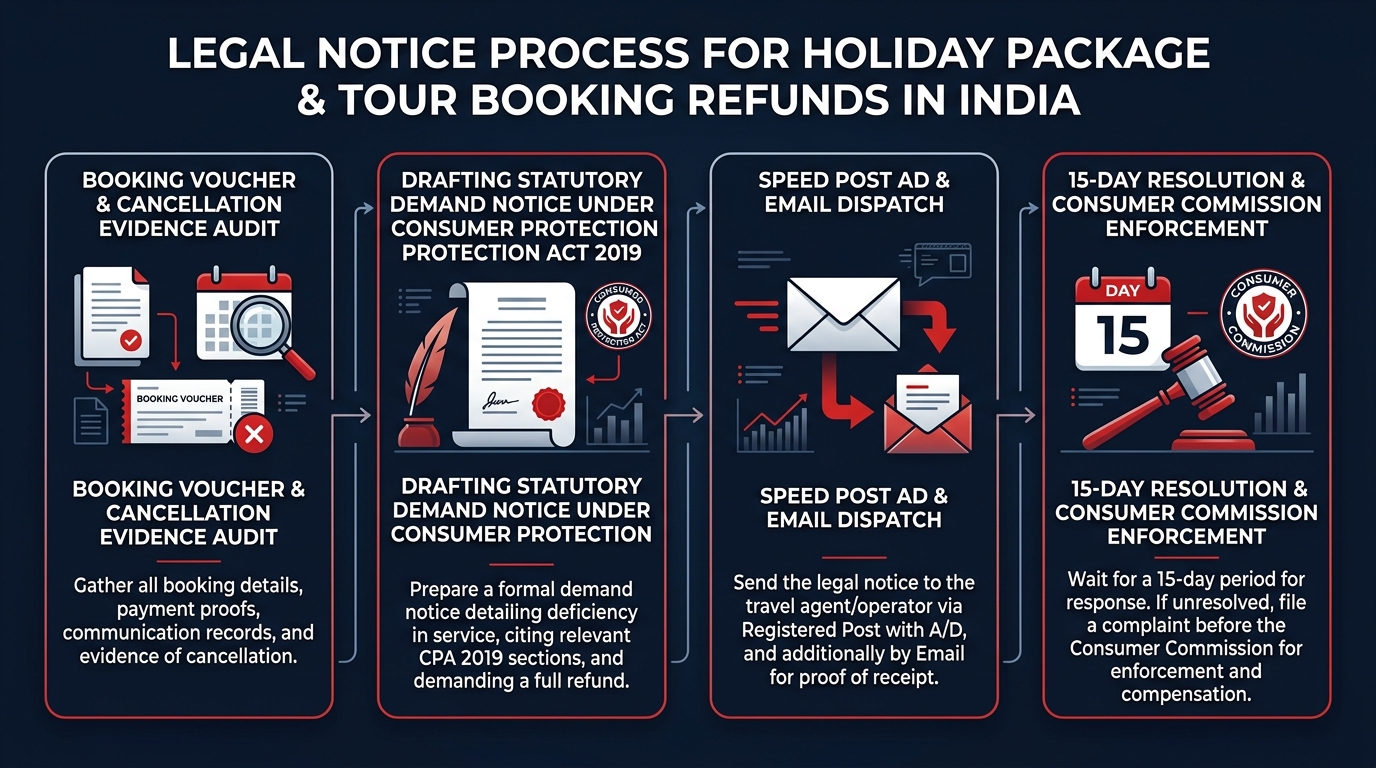
6. Strategic Roadmap: 15-Day Demand Notice to Consumer Court Filing
Serving a formal statutory legal notice through an established legal platform settles over 78% of travel package disputes out of court. When operators refuse voluntary compliance, Legal Recovery executes a seamless multi-tier escalation:
Advocate Vetting & Multi-Channel Verified Service
The notice is prepared on the advocate's official letterhead, digitally signed under Section 5 of the Information Technology Act, 2000, and served simultaneously via India Post Speed Post with A/D, registered corporate email, and WhatsApp delivery tracking.
Pre-Litigation Settlement & ODR Virtual Mediation
Upon receiving the notice, reputable travel agencies typically reach out to avoid public litigation. Legal Recovery facilitates structured Online Dispute Resolution (ODR) mediation to execute binding e-signed settlement deeds.
E-Daakhil Consumer Complaint & District Commission Filing
If the agency remains intransigent, our panel advocates file a formal consumer complaint on the national E-Daakhil portal under Section 35 of the CPA 2019, claiming full refund, 18% p.a. interest, and ₹1–5 Lakhs compensation for mental harassment.
Judicial Enforcement & Penalty Recovery under Section 71
Upon receiving a final favorable order from the Consumer Commission, if the travel operator delays execution, our advocates file enforcement proceedings under Section 71 and Section 72 of CPA 2019, carrying civil attachment and imprisonment penalties for non-compliance.
7. Frequently Asked Questions
Authoritative Legal & Statutory References:
- Consumer Protection Act, 2019 — Sections 2(11), 2(46), 2(47), 35 & 39 (consumeraffairs.nic.in)
- Indian Contract Act, 1872 — Section 56 (Doctrine of Frustration) & Section 73 (Breach of Contract) (indiacode.nic.in)
- Supreme Court of India — Pravasi Legal Cell & Ors. v. Union of India (2020) Airline & Package Refund Directives (main.sci.gov.in)
- National Consumer Disputes Redressal Commission (NCDRC) — Thomas Cook (India) Ltd. v. Dr. M.M. Shenoy (2019) (ncdrc.nic.in)
- Directorate General of Civil Aviation (DGCA) — Civil Aviation Requirements (CAR) Series M Passenger Charter (dgca.gov.in)
- Ministry of Tourism (Incredible India) — Guidelines for Recognition of Tour Operators and Travel Agencies (tourism.gov.in)
- Ministry of Corporate Affairs (MCA) — Company Master Data & Registered Office Verification (mca.gov.in)
More Consumer Protection & Travel Dispute Guides

Legal Recovery
India's Trusted Recovery Platform
Legal Recovery is India's trusted online legal notice and consumer dispute resolution platform, connecting travelers, vacationers, corporate clients, and consumers with seasoned panel advocates for rapid, advocate-vetted statutory demand notices at transparent flat fees. With ₹100 Crore+ recovered and 10,000+ cases resolved across India, Legal Recovery delivers verified legal impact without the delays and unpredictability of traditional law firms.
Travel Agent Refusing Package Refund?
Send an advocate-vetted statutory notice today. 78% of travel operators settle holiday refunds and compensation within 15 days upon receiving formal notice from Legal Recovery.
Flat fee • Advocate-drafted • Sent same day
Client Reviews
Dr. Aniruddh Sengupta
"I booked an 8-day deluxe family holiday tour to Switzerland and France worth ₹5,80,000 for my family of four through a well-known online travel agency. Two weeks before our scheduled departure, the operator unilaterally cancelled our Jungfraujoch mountain excursion, replaced our 4-star boutique lakeside hotel with a subpar suburban transit motel without heating, and refused a ₹2,40,000 refund when we objected to the altered itinerary. Legal Recovery drafted and served an advocate-vetted statutory legal notice citing Sections 2(11) and 2(47) of the Consumer Protection Act, 2019, the doctrine of frustration under the Indian Contract Act, and landmark NCDRC rulings on holiday cancellations. Within 11 days of receiving the notice, the agency's management conceded the deficiency, processed our full refund of ₹2,40,000, and credited an additional ₹35,000 towards compensation for inconvenience. Truly unmatched legal efficacy and speed."