Recover Money from Online Shopping Scam India
Defrauded by a fake ecommerce portal, fraudulent social media seller, or deceptive online merchant? Send an advocate-vetted statutory legal notice, trigger bank chargebacks, and enforce refund recovery under the Consumer Protection Act, IT Act, and BNS 2023.
Table of Contents
Swipe →Quick Answer
Consumers in India can recover money lost to online shopping scams by immediately dialing the 1930 National Cybercrime helpline within 2 to 24 hours to freeze suspicious fund transfers under the Citizen Financial Cyber Fraud Reporting and Management System. Simultaneously, serving an advocate-vetted statutory legal notice upon the fraudulent merchant and the payment aggregator enforces mandatory refund obligations under the Consumer Protection (E-Commerce) Rules, 2020 and Section 318 of the Bharatiya Nyaya Sanhita, 2023. If the merchant fails to refund the defrauded amount within 15 days, the buyer can initiate a bank chargeback under RBI Customer Protection Directives and lodge a formal statutory petition on the E-Daakhil consumer court portal for principal recovery, 18% annual interest, and litigation costs.
1. Common Online Shopping Scams & Fraud Typologies in India
With India’s rapid expansion into digital commerce, malicious operators exploit social media algorithms, search engine advertisements, and spoofed payment gateways to deceive buyers. Identifying the precise typology of the transaction is the first legal prerequisite for establishing jurisdictional cause of action and selecting the optimal recovery remedy.
Fake Websites & Brand Spoofing (Typosquatting)
Fraudulent entities clone legitimate retail portals (e.g., duplicate domains mimicking luxury fashion, electronics, or festive sale portals), collect upfront UPI or card payments, and disappear without shipping any goods.
Social Media & Instagram Storefront Scams
Unregistered commercial pages on Instagram, Facebook Marketplace, and Telegram promote heavily discounted branded items, demand direct UPI/QR code payment, and instantly block the customer upon funds receipt.
Empty Parcel & Counterfeit Goods Delivery
Sellers deliver packages stuffed with newspapers, stones, or cheap counterfeits instead of the contracted merchandise, subsequently rejecting return requests by fabricating proof of valid logistics delivery.
Deceptive Cash-on-Delivery (COD) Extortion
Couriers collect cash payments before permitting package inspection. Once the recipient discovers substandard or empty contents, courier logistics providers disclaim liability, and the fictitious sender details lead to untraceable addresses.
2. Statutory Legal Protections: CPA 2019, IT Act & BNS 2023
Indian jurisprudence provides a multi-layered statutory safety net to penalize online commercial fraud, protect electronic consumers, and mandate prompt financial restitution. Aggrieved consumers have rights rooted in four primary statutes:
A. Consumer Protection Act, 2019 & E-Commerce Rules, 2020
Under the Consumer Protection Act, 2019, every online purchaser qualifies as a "consumer" under Section 2(7). Key protective mandates include:
- Section 2(47) (Unfair Trade Practices): Explicitly prohibits misleading representations regarding the quality, standard, or grade of goods, as well as deceptive promises of refund or warranty.
- Rule 4 & Rule 5 of E-Commerce Rules, 2020: Mandates that all entities conducting e-commerce in India must disclose their legal entity name, principal geographic address, customer care numbers, and grievance redressal officer details.
- Section 89: Imposes criminal penalties including imprisonment up to 2 years and fines up to ₹10 Lakhs for manufacturers or service providers publishing false or misleading advertisements.
B. Information Technology Act, 2000 (Cyber Law Provisions)
The Information Technology Act, 2000 prescribes strict penal consequences for computer-facilitated commercial deceit:
- Section 66D (Cheating by Personation): Punishes anyone who, by means of any communication device or computer resource, cheats by personating a genuine merchant or brand with imprisonment up to 3 years and fines up to ₹1 Lakh.
- Section 66C (Identity Theft): Penalizes unauthorized fraudulent use of digital signatures, passwords, or corporate identities.
- Section 79 (Intermediary Due Diligence): Payment gateways, web hosting services, and social platforms lose safe-harbour immunity if they fail to take down fraudulent merchants upon receiving formal notice.
C. Bharatiya Nyaya Sanhita, 2023 (Criminal Penalties)
Replacing the Indian Penal Code, the Bharatiya Nyaya Sanhita, 2023 (BNS) provides potent penal sections for ecommerce fraud:
- Section 318 (Cheating): Cheating and dishonestly inducing delivery of property carries rigorous imprisonment up to 7 years along with mandatory fines.
- Section 316 (Criminal Breach of Trust): Punishes dishonestly misappropriating advance payments without delivering contracted goods.
- Section 336 (Forgery): Enforces criminal liability for creating fake invoices, forged shipping tracking receipts, or cloned digital payment portals.
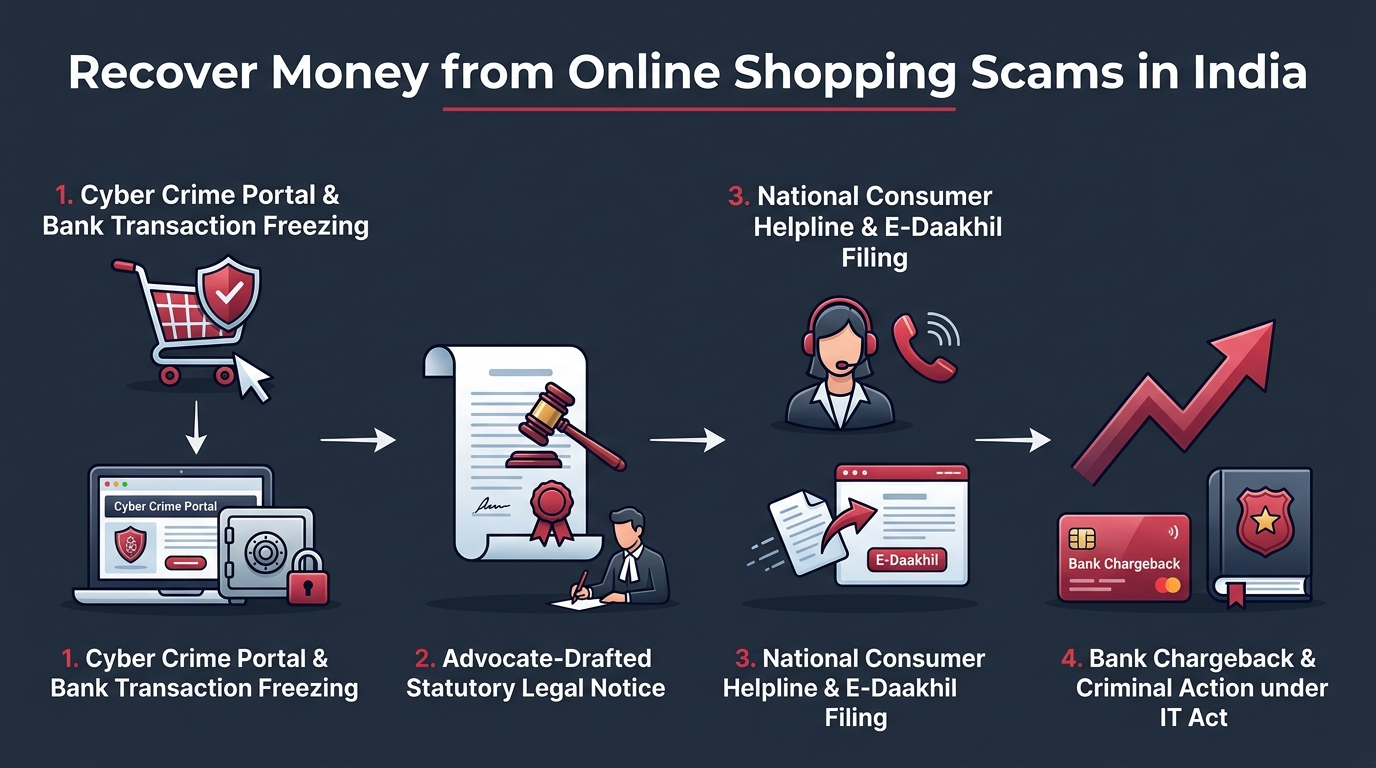
3. 4-Stage Legal Roadmap to Recover Defrauded Money
Recovering money from an online shopping scam requires a synchronized technical, banking, and legal intervention. Time is of the essence: funds must be frozen before scammers route them across multiple mule bank accounts.
Golden Hour Cyber Freeze via 1930 & Cybercrime Portal
Immediately dial the National Cybercrime Reporting Helpline 1930 (formerly 155260) within 2 to 24 hours of the fraudulent transaction. The portal automatically logs the transaction on the Citizen Financial Cyber Fraud Reporting and Management System (CFCFRMS), alerting the sender bank, payment gateway, and destination beneficiary bank to freeze the corresponding funds in transit.
Actionable Step: File a formal digital cyber complaint on cybercrime.gov.in and secure an Acknowledgement Number for statutory tracking.
Advocate-Drafted Statutory Demand Notice to Merchant & Payment Gateway
A formal legal notice is drafted on an advocate’s official letterhead, establishing conclusive evidence of fraud, breach of contract, and unfair trade practices. The notice demands complete reimbursement of the defrauded sum with 18% annual interest within 15 days, warning of criminal FIR filings under BNS Section 318 and civil summary claims.
Actionable Step: Serve the notice simultaneously via Speed Post AD, verified corporate email, and WhatsApp to the merchant, their domain registrar, and the acquiring payment gateway (e.g., Razorpay, Cashfree, PayU, PhonePe).
RBI Bank Chargeback & NPCI Dispute Escalation
If the transaction was executed using a credit card, debit card, or net banking, lodge a formal chargeback dispute with your card-issuing bank under the category of "Goods/Services Not Received" or "Defective/Counterfeit Product Delivered" under RBI Notification DBR.No.Leg.BC.78/09.07.005/2017-18. For UPI payments, raise an official UPI dispute through the National Payments Corporation of India (NPCI) portal.
Actionable Step: Submit the police acknowledgement, transaction UTR receipts, and legal notice copy to the bank’s Nodal Grievance Officer within 30 days.
Consumer Court Filing via E-Daakhil & CCPA Complaint
If the 15-day notice period expires without resolution, file an electronic consumer complaint on the government’s E-Daakhil portal (edaakhil.nic.in) before the District Consumer Disputes Redressal Commission. You are entitled to demand 100% principal reimbursement, commercial interest, legal costs, and punitive compensation for mental harassment.
Actionable Step: Simultaneously notify the Central Consumer Protection Authority (CCPA) under Section 18 of CPA 2019 to initiate class-action investigations and ban fraudulent merchant operations.
4. Digital Forensics & Pre-Notice Evidentiary Audit Checklist
The evidentiary strength of your legal notice and subsequent consumer court petition hinges on meticulous digital forensic documentation. Under Section 63 of the Bharatiya Sakshya Adhiniyam, 2023 (BSA), electronic records are fully admissible when backed by proper forensic trails.
Mandatory Evidentiary Checklist for Online Shopping Fraud:
- Webpage & Storefront Captures: Full desktop/mobile screenshots of the product listing, promised specifications, price tags, return/refund policies, and contact information before the fraudulent portal takes the listing offline.
- Banking & Payment Gateway Logs: Bank account statement highlighting the debit, UPI Unique Transaction Reference (UTR) number, Bank Reference Number (RRN), and digital payment gateway confirmation receipts (Razorpay/PayU/Cashfree transaction IDs).
- Electronic Invoices & Order Confirmations: PDF order confirmations, SMS dispatch alerts, email confirmations, and GSTIN invoices issued by the merchant or intermediary.
- Single-Take Unboxing Video: In empty box or counterfeit parcel cases, an uncut, continuous video recording starting from the unopened outer courier packaging showing the shipping label and tracking AWB number through to parcel contents inspection.
- Chat Transcripts & Communication Records: Certified exports of WhatsApp chats, SMS threads, Instagram direct messages, and email communications requesting refund or explanation, showing delivery timestamps and merchant read receipts.
- Domain WHOIS & MCA Data: Domain registration records retrieved via ICANN WHOIS lookup, IP hosting logs, and Ministry of Corporate Affairs (MCA) entity details if operating under an apparent corporate facade.
5. Essential Clauses in a Statutory Demand Notice for Shopping Fraud
A poorly worded or informal complaint email carries zero legal weight in an Indian court. A legally enforceable statutory notice must be drafted with precision by an experienced advocate, incorporating the following mandatory legal clauses:
1. Parties & Jurisdictional Authority Clause
Identifies the complainant as a bonafide consumer under Section 2(7) of CPA 2019 and establishes territorial and pecuniary jurisdiction based on the consumer’s place of residence under Section 34(2)(d) of the Act.
2. Statement of Facts & Electronic Contract Formation
Chronicles the exact timeline of purchase, consideration paid via electronic banking channels, transaction IDs, promised delivery dates, and specific instances of breach or misrepresentation.
3. Statutory Violations & Fraudulent Inducement Clause
Details statutory contraventions under E-Commerce Rules 2020, Section 2(47) CPA (Unfair Trade Practices), Section 66D IT Act (Cheating by Personation), and Section 318 BNS (Criminal Fraud and Inducement).
4. Joint & Several Liability of Intermediaries Clause
Puts payment aggregators, hosting providers, and delivery partners on notice under Section 79 of the IT Act, demanding immediate escrow freezing of the scammer’s nodal accounts.
5. Strict 15-Day Peremptory Demand & Damages Warning
Demands full principal refund plus 18% per annum statutory interest and ₹25,000 to ₹50,000 for mental agony and legal costs within a strict 15-day compliance window, failing which litigation commences.
6. Legal Notice vs Cyber Cell vs Consumer Court vs Chargeback
Understanding how different recovery avenues compare in terms of speed, cost, and legal effectiveness ensures you adopt the most aggressive multi-channel strategy:
| Remedy Pathway | Turnaround Time | Primary Objective | Statutory Authority | Success Rate |
|---|---|---|---|---|
| Advocate Statutory Legal Notice | 7 – 15 Days | Voluntary refund settlement & account freeze | CPA 2019, IT Act & BNS 2023 | High (76%) |
| Cybercrime 1930 / Portal Freeze | 24 Hours – 7 Days | Inter-bank lien & wallet fund freezing | MHA CFCFRMS Framework | High (Golden Hour) |
| Bank Card Chargeback | 30 – 90 Days | Direct reversal from acquirer bank | RBI Master Directions & Card Schemes | Moderate to High |
| E-Daakhil Consumer Commission | 3 – 9 Months | Binding court decree, 18% interest & damages | Consumer Protection Act, 2019 | Very High (Decree) |
7. Frequently Asked Questions
Authoritative Legal & Statutory References:
- Consumer Protection Act, 2019 & Consumer Protection (E-Commerce) Rules, 2020, consumeraffairs.nic.in
- Information Technology Act, 2000 — Sections 43A, 66C, 66D & 79 Intermediary Guidelines, indiacode.nic.in
- Bharatiya Nyaya Sanhita, 2023 — Section 316 (Criminal Breach of Trust) & Section 318 (Cheating), indiacode.nic.in
- Reserve Bank of India (RBI) — Limiting Liability of Customers in Unauthorized Electronic Banking Transactions, rbi.org.in
- Ministry of Home Affairs — National Cyber Crime Reporting Portal & 1930 Helpline Framework, cybercrime.gov.in
- National Consumer Disputes Redressal Commission (NCDRC) — E-Daakhil Electronic Filing Portal, edaakhil.nic.in
- Supreme Court of India — Landmark E-Commerce & Consumer Protection Precedents, main.sci.gov.in
More Consumer Protection & Dispute Guides

Legal Recovery
India's Trusted Recovery Platform
Legal Recovery is India's trusted online legal notice and dispute resolution platform, connecting defrauded online shoppers, consumers, businesses, and professionals with seasoned panel advocates for rapid, advocate-vetted statutory demand notices at transparent flat fees. With ₹100 Crore+ recovered and 10,000+ cases resolved across India, Legal Recovery delivers verified legal impact without the delays and unpredictability of traditional law firms.
Scammed by an Online Seller?
Send an advocate-vetted statutory notice today. 76% of fraudulent ecommerce operators and payment intermediaries settle and refund within 15 days of formal notice.
Flat fee • Advocate-drafted • Sent same day
Client Reviews
Kavita Shenoy
"I was defrauded of ₹48,500 after purchasing high-end photography gear from a sophisticated Instagram electronics storefront that turned out to be a fraudulent shell operation. The seller delivered a parcel containing broken ceramic tiles and immediately blocked my phone number and social media profile. Legal Recovery drafted and served an aggressive statutory legal notice citing the Consumer Protection (E-Commerce) Rules, Section 318 of the BNS, and Section 66D of the IT Act to both the fraudulent seller and the payment gateway intermediary. Within 11 days of receiving the advocate notice, the payment aggregator froze the merchant's nodal settlement account and processed a full ₹48,500 reimbursement back to my bank account. Exceptional, swift legal support for cyber commerce recovery."