Legal Notice for Online Shopping Dispute
Understand the exact legal steps to demand a refund, replacement, or compensation from e-commerce sellers for any online shopping dispute under the Consumer Protection Act, 2019.
Table of Contents
Swipe →Quick Answer
Consumers can send a legal notice for an online shopping dispute under the Consumer Protection Act, 2019, by demanding an immediate refund or replacement from both the seller and the e-commerce platform. A legally drafted notice provides a 15-day ultimatum to the retail entity to rectify the deficiency in service or unfair trade practice. Failure to comply with the legal notice empowers the consumer to file a formal complaint in the District Consumer Disputes Redressal Commission seeking the principal amount, compensation for mental agony, and legal costs.
1. What Constitutes an Online Shopping Dispute?
An online shopping dispute arises when an e-commerce platform, digital marketplace, or independent online retailer fails to deliver goods or services as promised, constituting a clear deficiency in service and an unfair trade practice under Section 2(11) and Section 2(47) of the Consumer Protection Act, 2019. When an entity accepts payment but dispatches an item that materially differs from the product description, specifications, or images presented at the point of sale, the seller breaches the implied contract of sale. The law mandates that the goods supplied must correspond strictly with the description under Section 15 of the Sale of Goods Act, 1930.
The delivery of incorrect, counterfeit, or defective items, as well as outright delivery failures and unauthorized cancellations, are not merely operational errors; they constitute legal violations of consumer rights. Whether the discrepancy involves receiving a completely different brand, a cheaper substitute, a wrong size, an incorrect color, a refurbished item instead of a new one, or facing a scenario where the seller refuses to process a legitimate refund, the liability rests entirely on the seller and the facilitating marketplace. According to the Consumer Protection (E-Commerce) Rules, 2020, e-commerce entities cannot refuse to take back goods or refuse to refund the consideration if the goods delivered are defective, deficient, or spurious.
Many consumers incorrectly assume that e-commerce return policies and terms of service supersede national legislation. However, internal company policies cannot override the statutory protections granted by the Consumer Protection Act. If a retailer's arbitrary 7-day return window expires, the consumer still retains the legal right to send a legal notice for an online shopping dispute within the two-year limitation period prescribed for filing a consumer dispute. The legal notice acts as the formal, legally binding mechanism to enforce these overarching statutory rights when internal customer support channels fail to provide an adequate remedy.
2. Legal Liability of E-Commerce Platforms vs. Third-Party Sellers
Identifying the correct legal entity is critical when preparing to send a legal notice for an online shopping dispute, as liability may fall on the e-commerce marketplace, the third-party seller, or both concurrently. E-commerce entities operate under two primary legal frameworks: inventory-based and marketplace-based models. Under the inventory-based model, the e-commerce platform owns the goods and is directly liable for any deficiency in service or product quality. Conversely, the marketplace model involves the platform merely acting as an intermediary between the buyer and a third-party seller.
Despite the intermediary status of massive marketplace platforms like Amazon, Flipkart, or Myntra, the Consumer Protection (E-Commerce) Rules, 2020, impose specific duties and liabilities on them. Section 5(3)(b) of the rules requires marketplace entities to provide a ticket number for each complaint lodged, enabling consumers to track the status of their grievance. More importantly, courts have consistently held e-commerce platforms jointly and severally liable for unfair trade practices committed by third-party sellers using their infrastructure. Landmark rulings by the National Consumer Disputes Redressal Commission (NCDRC) establish that marketplace platforms cannot completely evade liability by claiming 'safe harbor' protection under Section 79 of the Information Technology Act, 2000, particularly when they actively participate in the payment collection, logistics, and delivery ecosystem.
When drafting a legal notice, experienced advocates systematically address the legal notice to both the registered corporate office of the e-commerce platform and the specific third-party seller identified on the tax invoice. This dual-targeting strategy prevents corporate entities from shifting the blame in a continuous loop and ensures that maximum legal pressure is applied to facilitate a rapid refund. The notice explicitly demands that both parties coordinate to reverse the transaction and compensate the consumer for the gross deficiency in service.
3. Common Reasons for Disputes
Online shopping disputes manifest in various forms, each constituting a specific violation of consumer rights. Retailers and e-commerce platforms frequently attempt to reject legitimate return or refund requests by citing restrictive internal policies, demanding impossible evidentiary standards, or shifting the blame onto logistics partners. Understanding these standard scenarios allows consumers to pre-emptively gather the necessary proof to invalidate the seller's defense in a robust legal notice.
- Delivery of Counterfeit or Fake Products: Receiving a product that illegally mimics a registered trademark or brand, constituting an unfair trade practice and a violation of intellectual property laws. Sellers often refuse returns, claiming the product is genuine despite glaring discrepancies.
- Wrong Product Delivered: The delivery of an item that materially differs from the ordered specifications, such as a different model, incorrect color, wrong size, or an entirely unrelated object. Marketplaces frequently reject these claims citing a lack of an unboxing video.
- Defective or Damaged Goods: Receiving products that are physically damaged, non-functional, or inherently defective upon arrival. Sellers may attempt to shift liability to the courier service or claim the damage occurred post-delivery.
- Non-Delivery of Prepaid Orders: The failure of the platform to deliver goods despite a successful prepaid transaction, often accompanied by false delivery status updates claiming the package was handed to the customer.
- Refusal to Honor Warranties or Return Policies: Sellers illegally refusing to honor written warranties, guarantees, or statutory return rights, often citing arbitrary internal guidelines that contradict the Consumer Protection Act.
- Unauthorized Cancellations and Pricing Errors: Platforms unilaterally canceling confirmed orders, especially during sales, due to alleged pricing errors, which courts have recognized as a deficiency in service.
4. Comparison of Legal Remedies
Consumers face multiple avenues for dispute resolution when they encounter an online shopping dispute, ranging from internal escalation and government advisory bodies to formal pre-litigation notices and actual court litigation. Choosing the correct remedy dictates the speed and likelihood of recovering the disputed amount. The table below compares the primary legal mechanisms available in India.
| Remedy Type | Average Timeline | Legal Weight | Expected Outcome |
|---|---|---|---|
| National Consumer Helpline (NCH) | 30 to 60 Days | Low (Advisory) | Mediation attempt between the government and the company; no binding order can be passed against the seller if they refuse to cooperate. |
| Formal Legal Notice (Pre-Litigation) | 15 to 30 Days | High (Mandatory Prelude) | Direct out-of-court settlement, immediate refund, or replacement initiated by the company's legal department to avoid public court proceedings. |
| E-Daakhil (Consumer Court Complaint) | 6 to 24 Months | Absolute (Statutory/Binding) | Binding judicial order mandating a full refund, covering legal costs, and awarding punitive compensation for mental agony and harassment. |
5. Step-by-Step Notice Process
Sending a legal notice for an online shopping dispute requires strict adherence to a precise procedural sequence to ensure the communication is legally valid, binding, and admissible as primary evidence in a consumer court. Deviating from these steps can render the notice ineffective. Follow this chronological process:
Compile All Evidentiary Materials
Systematically gather the original tax invoice, delivery receipt, digital screenshots of the product listing at the time of purchase, high-resolution photographs of the defect or wrong item, and the unboxing video if available. Preserve all email correspondence and chat logs with customer support.
Identify the Defending Parties
Extract the correct legal entity names, corporate identification numbers (CIN), and registered office addresses of both the marketplace platform (e.g., Amazon Seller Services Pvt. Ltd.) and the third-party seller listed on the invoice. Address the notice to the Grievance Officer.
Draft the Legal Notice
Draft the document using formal legal terminology on the official letterhead of an enrolled advocate. The notice must explicitly invoke the relevant sections of the Consumer Protection Act, 2019, and detail the exact nature of the deficiency in service and unfair trade practice committed.
Establish a 15-Day Ultimatum
Conclude the legal notice with a definitive and non-negotiable compliance window, typically 15 days from the date of receipt, warning the company of impending civil litigation and proceedings in the District Consumer Disputes Redressal Commission if they fail to process the refund.
Dispatch via Registered Post & Electronic Means
Send the physical copies of the signed legal notice via India Post Registered Post with Acknowledgment Due (RPAD) to ensure legally recognized proof of delivery. Simultaneously, email a digital scanned copy to the official legal and grievance email addresses of the entities.
6. Essential Notice Elements
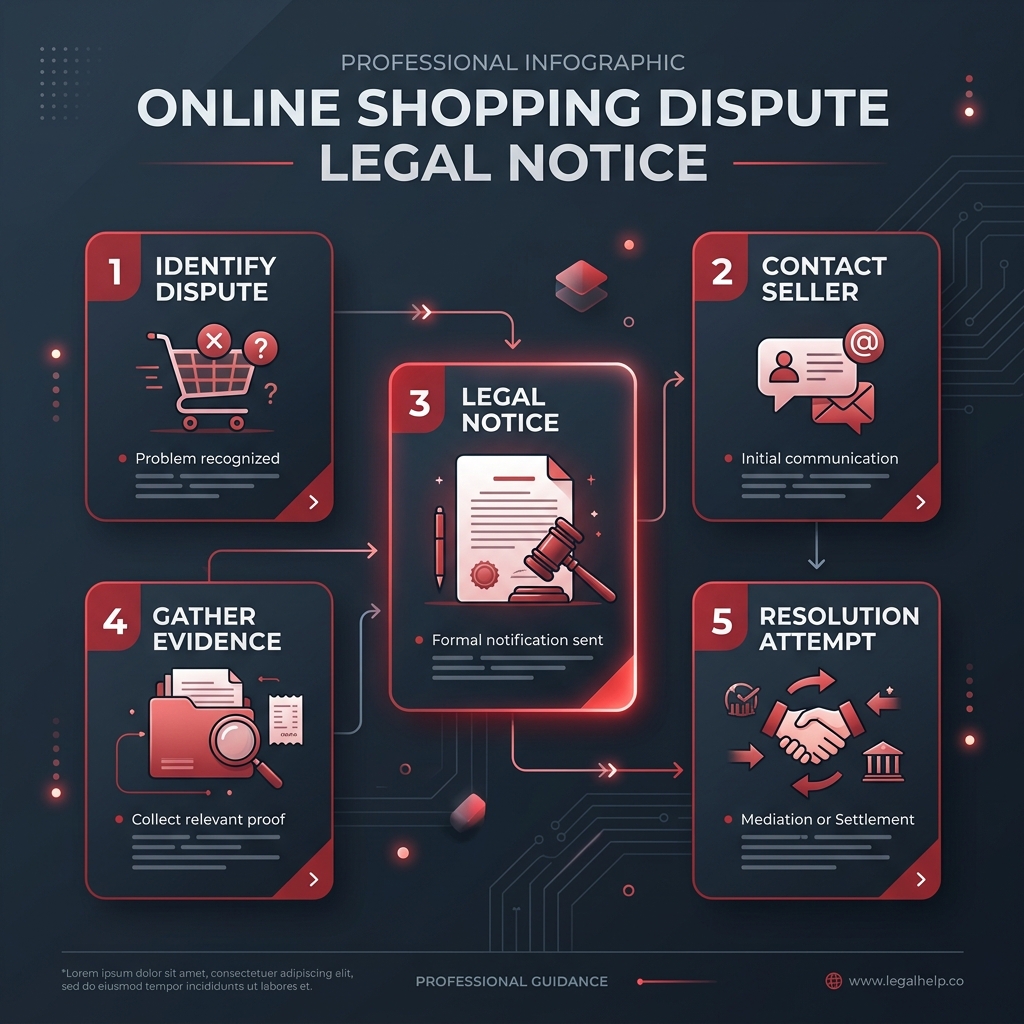
To ensure the document holds absolute legal validity and successfully forces a corporate settlement, the legal notice must contain specific structural elements and statutory references. A poorly drafted notice without legal backing is easily ignored by corporate legal departments.
- Header and Advocate Details: Official advocate letterhead displaying the Bar Council enrollment number, contact details, and signature.
- Cause Title: Clear, unambiguous identification of the Noticee (the companies) and the Client (the consumer).
- Chronology of Facts: Precise timeline detailing the date of order, transaction ID, payment method, delivery date, and the moment the defect or issue was discovered.
- Description of Breach: A detailed, factual comparison of the ordered product versus the delivered reality, outlining the specific deficiency.
- Evidence of Prior Escalation: A comprehensive summary of all complaint ticket numbers, emails, and failed mediation attempts to prove the exhaustion of internal remedies.
- Statutory Invocations: Explicit references to the Consumer Protection Act, 2019, Sale of Goods Act, 1930, and the Consumer Protection (E-Commerce) Rules, 2020.
- Demand Clause: A precise monetary calculation of the refund, compensation for mental agony, and the legal costs incurred in drafting the notice.
- Limitation Clause: A strict 15-day deadline for compliance, failing which the consumer reserves the right to initiate legal proceedings.
7. Resolution Timeline & Escalation
The timeline for resolving an online shopping dispute accelerates significantly once a formal legal notice is dispatched and received by the company's legal department. Under the Consumer Protection Act, consumers have a strict limitation period of exactly two years from the date the cause of action arises (the date of the dispute or last communication) to file a formal complaint in court.
Upon receiving the legal notice via Registered Post, the corporate legal department of the e-commerce entity has 15 days to investigate and respond. In clear-cut cases involving wrong product deliveries, counterfeit goods, or blatant deficiencies, the company will typically contact the consumer or their advocate within 7 to 10 days to initiate an out-of-court settlement. This settlement usually involves the immediate dispatch of a return courier and a full refund of the principal amount to avoid the compounding costs of defending a losing case in court.
If the 15-day ultimatum expires without a satisfactory resolution, or if the company replies with a frivolous denial, the consumer must immediately escalate the matter by filing a formal complaint in the District Consumer Disputes Redressal Commission. This can now be done digitally via the government's e-Daakhil portal. The consumer court will review the previously sent legal notice and the tracking receipt as definitive proof that the consumer exhausted all pre-litigation avenues, strengthening the case for punitive damages.
8. Frequently Asked Questions
Send Legal Notice
We match you with a panel advocate, handle the custom drafting, physically post the notice, and track its delivery in real-time.
Client Reviews
"Sent a legal notice for an online shopping dispute regarding a fake product. I got my full refund within 12 days. The lawyer drafted a very strong notice."
More Consumer Protection Guides

Legal Recovery is India's trusted consumer protection and legal tech platform. Founded in 2022 and headquartered in New Delhi, Legal Recovery has counselled 15,000+ people on consumer disputes, defective products, and e-commerce frauds. Legal Recovery focuses on fast out-of-court settlements and connects you with top panel advocates.