Can I Send a Legal Notice by Myself?
Explore the process of sending legal notices independently.

Table of Contents
Table of Contents
Swipe →Drafting and Sending a Legal Notice: Understanding Self-Representation in India
In India, serving a legal notice is often the first formal step in various legal proceedings. It acts as a pre-litigation tool, providing the recipient with an opportunity to settle disputes without engaging in lengthy court proceedings. The question arises: can an individual send a legal notice by themselves, or must they always seek the help of a lawyer? While hiring a legal professional can ensure accuracy and adherence to legal standards, you are indeed allowed to send a legal notice on your own. This comprehensive guide will walk you through the intricate process of preparing and dispatching a legal notice without the assistance of a lawyer.
Legal Framework Governing Legal Notices
A legal notice is a formal communication that indicates your intention to initiate legal proceedings if the recipient does not comply with your demands. In Indian law, there is no specific statute solely dedicated to legal notices. However, their legitimacy and enforceability have been well-established through various judgments and legal precedents. Notably, several sections of Indian Acts such as the Indian Contract Act, the Consumer Protection Act, and the Negotiable Instruments Act make implicit references to the necessity of legal notices in certain contexts. For instance, the Section 138 of the Negotiable Instruments Act mandates sending a legal notice within 30 days of a cheque bounce occurrence.
Identifying the Need and Purpose of a Legal Notice
Before drafting a legal notice, it is essential to understand its purpose. A legal notice serves multiple functions: it acts as a formal communication tool, it lays down your claims or demands clearly, and it can also serve as evidence in subsequent legal proceedings. The notice must articulate the facts of the case, the relief being sought, and a reasonable time frame for compliance. This document is not merely perfunctory. It acts as a strong impetus for the parties involved to resolve their disputes amicably.
Legal notices are applicable in diverse situations such as recovering debts, addressing breaches of contract, resolving landlord-tenant conflicts, and dealing with consumer grievances. To explore how this applies in specific contexts like freelancer payment recovery, you may refer to specialized guides.
Step-by-Step Guide to Drafting a Legal Notice
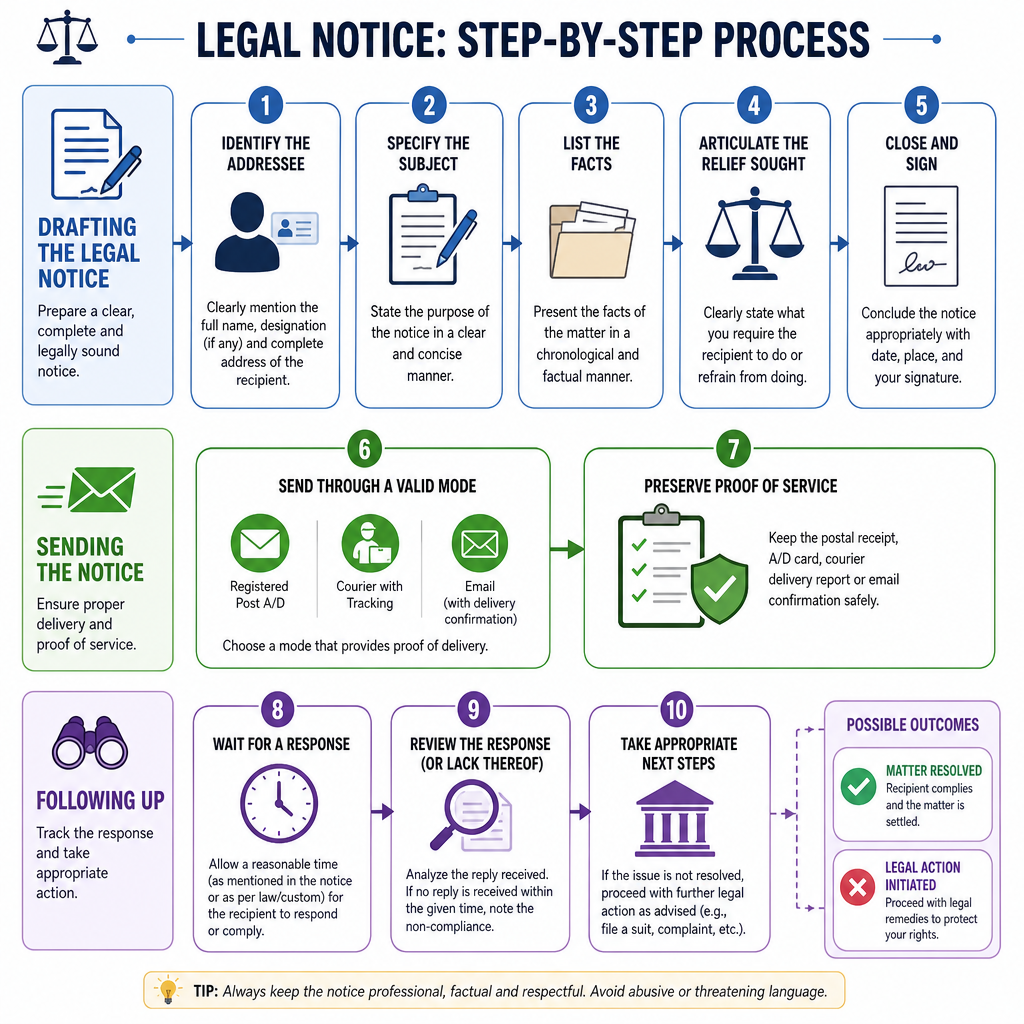
Drafting a legal notice involves meticulous attention to detail. Here's a step-by-step guide on how to draft a competent legal notice:
Identify the Addressee: Know who will receive the notice. This could be an individual, a company, or an organization. Correct identification ensures that the notice legally binds the intended party.
Specify the Subject: State the purpose of the notice clearly at the beginning. Whether it's a demand for money, resolution of a contract issue, or compensation, clarity is essential.
List the Facts: Chronologically document the sequence of events that led to the dispute. Include dates, times, and relevant actions taken by both parties.
State the Legal Grounds: Mention the legal provisions under which your claims are valid. This could be sections of the Indian Contract Act, Consumer Protection Act, etc.
Articulate the Relief Sought: Define what you want the recipient to do to resolve the issue. Be precise about the remedies you seek and the time frame within which you expect compliance.
Affix Your Signature: Even if you draft the notice yourself, signing it is crucial to its validity.
Documentation and Evidence Collection
Supporting your claims with evidence is crucial for the effectiveness of a legal notice. Before drafting, gather all relevant documents such as contracts, emails, text messages, and any other communication records that corroborate your story. For instance, if you are dealing with personal loan recovery, ensure you collect proof of loan disbursement and any prior repayment attempts made by the borrower.
Category of Dispute | Mandatory Evidentiary Documents | Admissibility in Court |
|---|---|---|
Debt Recovery | Loan Agreements, Payment Receipts | Admissible if authenticated |
Consumer Complaints | Purchase Receipts, Warranty Cards | Admissible under the Consumer Protection Act |
Property Disputes | Sales Deed, Lease Agreement | Admissible if registered |
Delivery Methods for Legal Notices
Once the legal notice is drafted, delivering it correctly is critical for its enforceability. There are several ways to serve a legal notice:
Registered Post: Send the notice via registered post with acknowledgment due (R.P.A.D.). This is the most traditional and widely accepted method.
Email: While a traditional post is preferred, in today's digital age, email is becoming increasingly accepted, especially if you have prior electronic communications with the recipient.
Online Platforms: Several platforms now offer services to send legal notices online. These platforms can ensure that notices comply with legal standards and are delivered appropriately.
For more information on sending legal notices online, you can visit the Legal Recovery online notice service.
Visual Dispute Resolution & Recovery Framework
Statutory Timeframes and Limitations
Understanding the statutory timelines associated with sending a legal notice is crucial, especially in cases like cheque bounce and consumer grievances. The law prescribes specific time frames within which the notice must be sent and responded to, failing which the recipient may lose the right to initiate legal proceedings.
For instance, in the case of a cheque bounce, the legal notice must be sent within 30 days from the date of receiving information about the cheque's dishonor, and the recipient is given 15 days to settle the dues. Non-compliance within this period can lead to further legal proceedings.
Scenario | Legal Notice Deadline | Response Time |
|---|---|---|
Cheque Bounce | 30 Days | 15 Days |
Consumer Complaint | 2 Years from the date of cause | Not defined, but 30 days is reasonable |
Property Possession Delay | 3 Years from agreed possession date | Not defined, but generally 15-30 days |
Consequences of Ignoring a Legal Notice
Once a legal notice is served, the recipient must take it seriously. Ignoring it can result in unwelcome legal consequences. If the recipient fails to respond within the stipulated time, the sender may proceed to file a court case. The courts often view a lack of response as an implicit admission of guilt or negligence, thereby strengthening the sender's case.
For example, if a tenant ignores a legal notice over unpaid rent, the landlord may initiate eviction proceedings or claim recovery of dues through the civil courts. To learn more about dealing with landlord-tenant issues, explore related resources on rental deposit recovery.
Filing a Court Case Following a Legal Notice
If the recipient does not comply with the demands of your legal notice, the next step is often to initiate formal legal proceedings. Depending on the nature and value of the dispute, this could involve filing a suit in a civil court, a consumer forum, or a specialized tribunal.
Civil Court: For disputes involving property, contracts, or debts exceeding certain thresholds, the district or high courts are the competent authorities.
Consumer Court: For grievances involving goods and services, consumer forums at the district, state, or national levels can be approached.
Specialized Tribunals: For specific issues like tenancy disputes or builder possession delays, forums like RERA or rent control boards may be relevant.
Practical Strategies for Dispute Resolution Without Court Intervention
While sending a legal notice is a formal step, many disputes can be resolved amicably without legal intervention. Here are some practical strategies:
Mediation and Conciliation: Engaging in mediated discussions can often lead to mutually agreeable solutions without the need for litigation.
Negotiation: Direct negotiation with the other party might resolve the matter swiftly, especially if both parties are open to compromise.
Alternative Dispute Resolution (ADR): Methods like arbitration and conciliation provide alternative routes to traditional court proceedings, often being faster and less expensive.
For additional guidance, consider consulting our effective legal debt recovery strategies blog.
Conclusion: Empowering Individuals in Legal Processes
Sending a legal notice yourself can be a cost-effective and empowering way to initiate dispute resolution. While the process requires careful attention to detail and understanding of legal frameworks, it is entirely feasible for individuals to represent themselves. However, consulting a legal professional is advisable for complex disputes or high-stakes claims. Platforms like Legal Recovery offer resources and services to assist you in drafting, sending, and following up on legal notices effectively.
Popular Searches & Related Topics

Legal Recovery is India's trusted consumer protection and legal tech platform. We specialize in holding corporations accountable for unfair trade practices, deceptive marketing, and commercial fraud. With over 15,000 customers counselled, our mission is to provide fast, out-of-court resolutions by connecting you with top-tier panel advocates for immediate legal action.
Client Reviews
"The guide was incredibly detailed and helped me send my legal notice confidently. The step-by-step instructions made the process straightforward."
Rohit Sharma
"I was able to resolve a long-standing debt issue using the instructions provided. This resource is invaluable for anyone looking to manage legal matters independently."
Priya Mehta
"I appreciate the clarity of information provided. The detailed explanation of statutory timelines was particularly helpful in my property dispute."
Vikram Patel
"As someone unfamiliar with legal processes, this guide was a lifesaver. It empowered me to take action without immediately resorting to legal fees."
Anjali Verma
"The section on alternative dispute resolutions was eye-opening. I successfully negotiated an agreement with a client based on the tips shared."
Deepak Nair
Frequently Asked Questions
Related Articles
About Author
Team LegalRecovery
View ProfileTeam LegalRecovery is a dedicated team of legal and financial professionals specializing in loan settlement, banking disputes, debt relief, and corporate compliance. We are committed to helping clients achieve debt freedom and business stability through expert strategic advisory.
Connect on LinkedInNeed Legal Help?
Get expert advice on loan settlement, banking disputes and debt relief.
Start Recovery NowRequest Callback