Legal Recovery Notice for Business Transaction Non-Payment
Effective strategies for handling non-payment in business transactions

Table of Contents
Table of Contents
Swipe →In the realm of business transactions, non-payment by a client or partner can be a significant challenge, potentially impacting cash flow, operations, and overall business stability. A legal recovery notice for business transaction non-payment serves as a formal communication to the debtor, demanding payment of dues within a specified timeframe. This process is not only crucial for maintaining financial stability but also for asserting legal rights under the Indian legal framework.
Contractual Enforcement and MSME Samadhan Legal Remedies for Unpaid Client Invoices
In India, the issue of unpaid client invoices is governed by several statutory provisions, including the Indian Contract Act, 1872, and the Micro, Small and Medium Enterprises Development (MSMED) Act, 2006. These laws provide a structured pathway for businesses to recover dues while ensuring legal compliance. The first step in addressing unpaid invoices is to understand the contractual obligations and rights stipulated in the agreement between the parties.
Under the Indian Contract Act, a contract is an agreement enforceable by law. Therefore, when a client fails to pay for goods or services rendered, it constitutes a breach of contract. Businesses, particularly those registered under the MSMED Act, can leverage specific provisions that mandate timely payments from buyers and allow for the recovery of interest on delayed payments.
The MSME Samadhan Portal is a government initiative facilitating the resolution of delayed payments. Businesses can file an online application for delayed payments, which is then attended to by the Micro and Small Enterprises Facilitation Council (MSEFC). This platform provides a streamlined approach, ensuring that disputes are resolved efficiently and cost-effectively.
To initiate the recovery process, businesses must ensure that all communications related to the transaction - such as purchase orders, invoices, and delivery notes - are well-documented and maintained. These documents serve as critical evidence in substantiating claims of non-payment.
The Role of Legal Notices in Recovering Dues
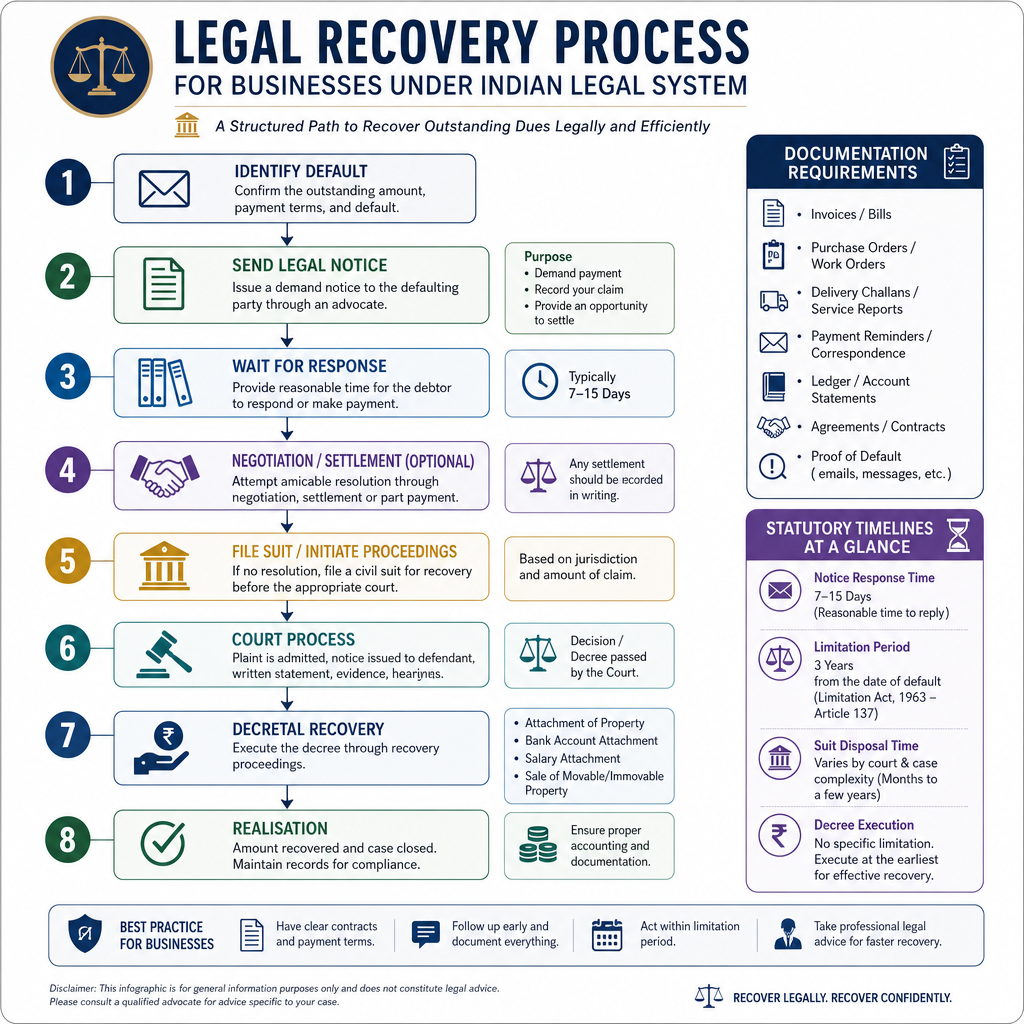
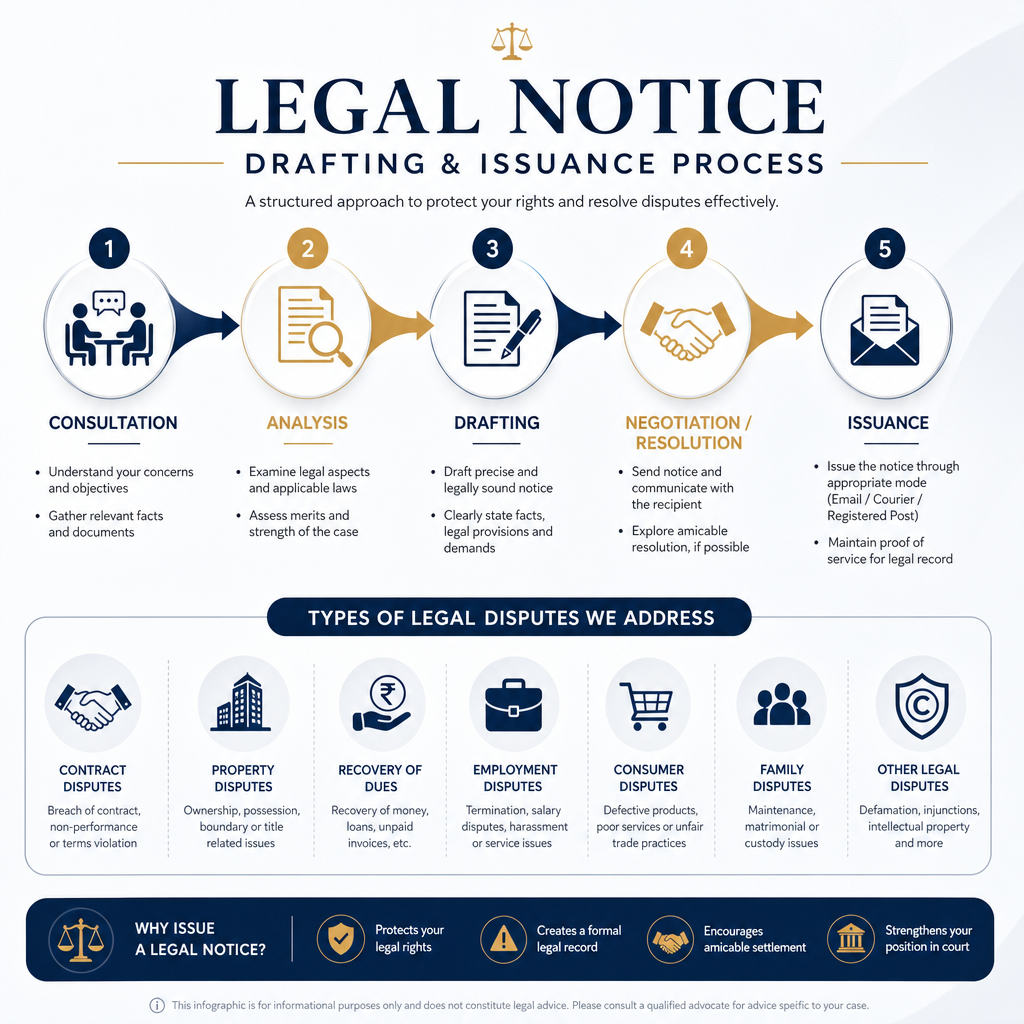
Sending a legal notice is often the first formal step taken by creditors seeking to recover dues. A legal notice serves multiple purposes: it acts as a final reminder to the debtor, outlines the intention to pursue legal action if the debt is not cleared, and provides a legal basis should the matter escalate to court.
Drafting a legal notice requires precision and adherence to legal standards. It should explicitly state the amount due, the basis of the claim (including contract terms and payment timelines), and the deadline for payment. Typically, a period of 15 to 30 days is provided to the debtor to make the payment or respond to the notice. The notice should be sent through registered post, ensuring a record of delivery.
In drafting a notice, it is critical to clearly articulate the consequences of non-compliance, which may include legal proceedings, interest on delayed payments, and potential damages. Engaging legal professionals or opting for online legal notice services can enhance the effectiveness and compliance of the notice.
Evidence and Documentation: Building a Strong Case
Successful recovery of dues hinges on the strength of the evidence presented. The courts require concrete proof of the transaction and the ensuing default. Below is a table discussing the essential documents that should be collated and preserved as part of the recovery process:
Category of Dispute | Mandatory Evidentiary Documents | Admissibility |
|---|---|---|
Unpaid Invoices | Original invoices, purchase orders, delivery receipts | Primary evidence admissible in court |
Breach of Contract | Signed contract, correspondence evidencing acceptance of terms | Critical for establishing contractual terms |
Delayed Payments | Correspondence with client regarding payment reminders, transaction records | Supports claims of repeated reminders |
Maintaining comprehensive records of all transactions and communications is essential. Emails, SMS, and even WhatsApp messages can be admissible as evidence, provided they are authenticated and relevant to the case. Establishing a timeline of events, supported by documentation, can significantly bolster a legal claim.
Statutory Timelines and Deadlines for Recovery
Understanding statutory timelines is crucial for ensuring timely initiation of recovery actions. In India, the Limitation Act, 1963 stipulates that the time frame for filing a suit for recovery of money is generally three years from the date the payment becomes due. However, specific statutes, such as the MSMED Act, may provide different timelines and procedural requirements for recovery.
Action Type | Statutory Deadline | Relevant Legislation |
|---|---|---|
Filing a recovery suit | 3 years from due date | Limitation Act, 1963 |
MSME payment resolution | Within 45 days of due date | MSMED Act, 2006 |
Cheque bounce notice | 30 days from cheque return | Negotiable Instruments Act, 1881 |
Adherence to these timelines is imperative. Failing to act within the statutory deadlines can result in the loss of legal remedies or weakening of the case. It is advisable to consult with legal experts or services like LegalRecovery.in to ensure compliance with all procedural requirements.
Visual Dispute Resolution & Recovery Framework
Practical Strategies for Dispute Resolution
While legal notices and court actions are integral to the recovery process, exploring alternative dispute resolution (ADR) methods may be beneficial in certain cases. Mediation, arbitration, and conciliation are recognized by Indian law and can offer quicker and less adversarial solutions.
Mediation involves a neutral third party facilitating negotiations between the parties to reach a mutually acceptable resolution. Arbitration, on the other hand, involves a more formal proceeding where an arbitrator renders a decision that is binding on both parties. Conciliation is similar to mediation but typically involves more active participation by the conciliator in proposing solutions.
These ADR methods are particularly effective in commercial disputes where maintaining business relationships is important. They offer advantages such as confidentiality, speed, and cost-effectiveness. The Arbitration and Conciliation Act, 1996 provides the legal framework for conducting these proceedings in India.
Another viable strategy is utilizing online dispute resolution platforms, which offer digital solutions to dispute resolution, significantly reducing geographic and logistical barriers.
Filing a Civil Suit for Recovery of Money
When amicable solutions fail, filing a civil suit for recovery of money becomes necessary. The process involves several steps, beginning with the drafting of a plaint - a formal statement of the case to be presented in court. The plaint should detail the facts of the case, the legal grounds for recovery, and the relief sought.
Once the plaint is drafted, it must be filed in the appropriate court, typically a civil court with jurisdiction over the dispute. The court fee, calculated based on the amount of relief sought, must be paid at the time of filing.
After the suit is filed, the court issues a summons to the defendant, who is required to appear and respond. The defendant may file a written statement contesting the claims, after which the court proceeds with evidence collection, examination, and arguments before delivering a judgment.
Court proceedings can be lengthy and complex, necessitating a clear understanding of procedural rules and evidentiary requirements. Engaging experienced legal counsel or leveraging vendor and invoice recovery services can provide strategic advantages in navigating the legal system.
Leveraging Technology for Effective Legal Recovery
In today’s digital age, technology plays a pivotal role in streamlining legal processes and enhancing accessibility to justice. Platforms like LegalRecovery.in offer innovative solutions for sending legal notices, conducting online dispute resolution, and managing legal documentation efficiently.
These platforms provide automated tools for drafting and sending legal notices, ensuring compliance with legal standards while reducing costs and time. They also enable tracking of notice delivery and responses, providing real-time updates and facilitating timely legal actions.
Additionally, online portals simplify the process of filing complaints and accessing legal advice, empowering businesses to take proactive steps in recovering dues. The integration of technology in legal services not only enhances efficiency but also democratizes access to legal remedies, making it easier for businesses to enforce their rights.
Conclusion: Proactive Legal Recovery for Business Sustainability
Legal recovery of dues is a critical component of financial management for businesses, ensuring liquidity and operational stability. By understanding legal frameworks, maintaining robust documentation, and leveraging technology, businesses can effectively address non-payment issues and safeguard their interests.
Proactive measures, such as timely legal notices, strategic use of ADR methods, and engagement of professional legal services, can enhance the recovery process, minimizing disruptions and fostering healthy business relationships. For more detailed guidance on legal recovery processes and solutions, visit the LegalRecovery blog for comprehensive resources and insights.
Popular Searches & Related Topics

Legal Recovery is India's trusted consumer protection and legal tech platform. We specialize in holding corporations accountable for unfair trade practices, deceptive marketing, and commercial fraud. With over 15,000 customers counselled, our mission is to provide fast, out-of-court resolutions by connecting you with top-tier panel advocates for immediate legal action.
Client Reviews
"The legal recovery service was exceptional. The team helped us recover our dues swiftly and legally. Highly recommended for businesses facing non-payment issues."
Rajesh Kumar
"We were skeptical at first, but the professionalism and speed with which our issue was handled was impressive. The MSME Samadhan Portal process went smoothly thanks to their guidance."
Priya Sharma
"Their expertise in drafting legal notices was evident. It made all the difference in resolving our payment dispute. Kudos to the legal team for their support."
Arjun Mehta
"A highly efficient service! The online tools provided by LegalRecovery.in saved us time and effort. Recovery was faster than we expected."
Neha Gupta
"From start to finish, the process was seamless. The structured approach and technology integration ensured a successful recovery of our outstanding payments."
Vikram Desai
Frequently Asked Questions
Related Articles
About Author
Team LegalRecovery
View ProfileTeam LegalRecovery is a dedicated team of legal and financial professionals specializing in loan settlement, banking disputes, debt relief, and corporate compliance. We are committed to helping clients achieve debt freedom and business stability through expert strategic advisory.
Connect on LinkedInNeed Legal Help?
Get expert advice on loan settlement, banking disputes and debt relief.
Start Recovery NowRequest Callback