Understanding the Legal Recovery Process Effectively
Navigate the legal recovery process with confidence and clarity.
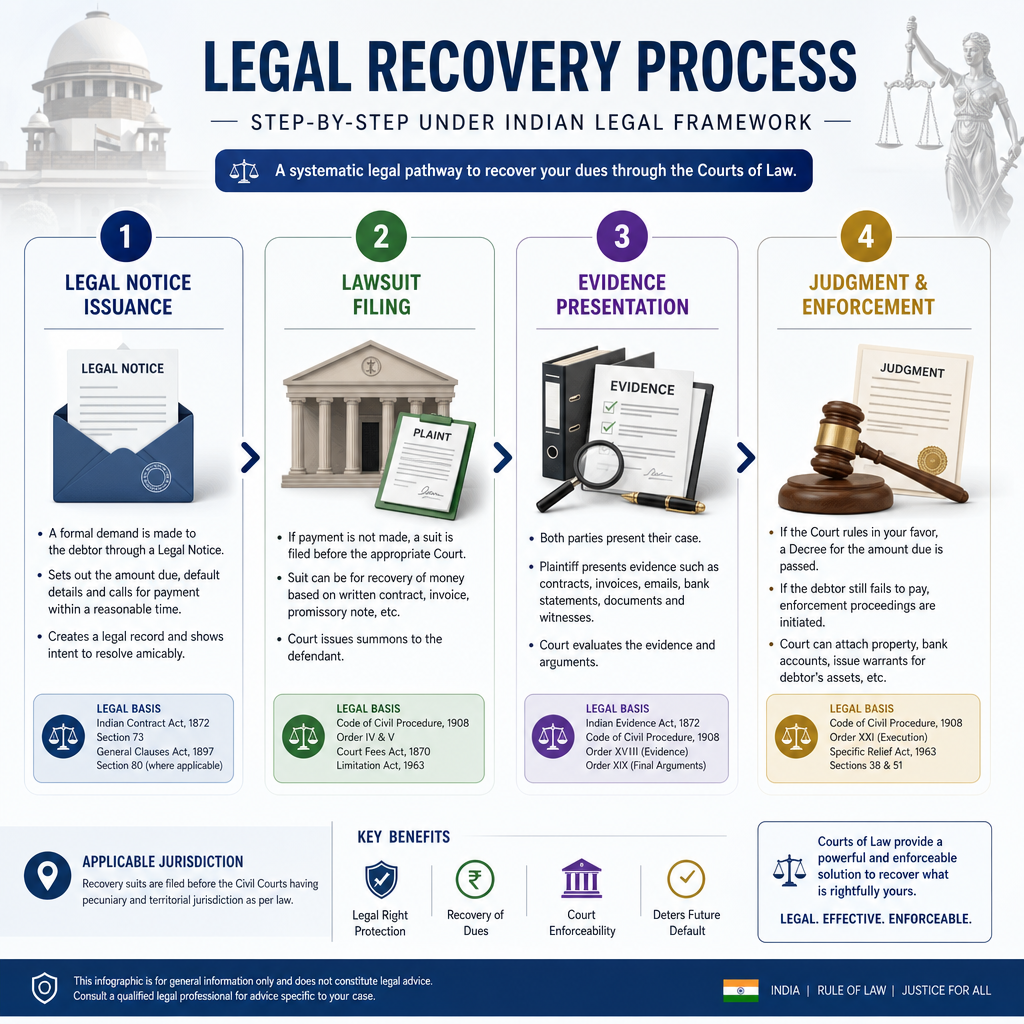
Table of Contents
Table of Contents
Swipe →Unpaid invoices, withheld security deposits, pending freelance milestone payments, or defaults from trusted friends financial defaults can choke your cash flow and disrupt your peace of mind. Navigating the Indian legal ecosystem to reclaim what is rightfully yours often feels overwhelming. The sheer volume of statutes, jurisdictional rules, and procedural nuances can leave businesses and individual creditors feeling stuck.
However, recovering outstanding dues does not have to be an endless, stressful battle. When approached with a strategic, systematic blueprint, the legal recovery process in India transforms from an intimidating maze into a highly structured, reliable administrative mechanism. By aligning your strategy with established recovery frameworks, you can leverage civil, criminal, and corporate laws to compel defaulting parties to settle their accounts swiftly.
At Legal Recovery, we specialize in demystifying these intricate frameworks, turning complex statutory laws into actionable recovery pathways. Whether you are an entrepreneur managing corporate defaults, a professional seeking withheld wages, or an individual dealing with a broken personal contract, mastering the modern legal recovery process is your first step toward financial restitution.
1. The Anatomy of the Legal Recovery Process: A Foundational Overview
The modern Indian judicial framework offers several distinct pathways for debt collection, asset reclamation, and contract enforcement. To choose the right approach, you must first understand the core pillars of the legal recovery process.
                           [ FINANCIAL DISPUTE ARISES ]
                                        │
                                        ▼
                         [ Send Formal Demand Notice ]
                                        │
                     ┌──────────────────┴──────────────────┐
                     ▼                                     ▼
           [ Civil Pathways ]                    [ Corporate / Criminal ]
                     │                                     │
     ┌───────────────┼───────────────┐                     ├───────────────────────────────┐
     ▼               ▼               ▼                     ▼                               ▼
[Summary Suit] [NCLT Insolvency] [Consumer Court]   [Cheque Bounce (Sec 138)] [Criminal Breach of Trust]
 (Order 37)     (IBC Process)   (Refund Disputes)   (Negotiable Instruments)     (Sec 405/420 IPC)
Civil vs. Criminal Recovery Pathways
A common point of confusion for creditors is deciding whether to pursue a civil remedy or initiate criminal proceedings. The answer depends heavily on the nature of the transaction and the conduct of the debtor.
Civil Remedies: These focus primarily on compensation and financial restitution. Mechanisms such as summary suits under Order 37 of the Civil Procedure Code (CPC) or insolvency filings aim to extract the owed funds or liquidate assets to satisfy the debt. Civil routes assess the contractual obligation and enforce payment.
Criminal Remedies: These apply when the debtor's actions involve bad faith, fraud, or intentional deception at the inception of the transaction. For instance, filing a complaint for cheating or criminal breach of trust focuses on punishing the offender, though it often acts as a powerful psychological catalyst for a fast financial settlement.
The Power of Pre-Litigation Strategy
Litigation should rarely be your first step. A well-designed pre-litigation strategy saves time, cuts costs, and preserves commercial relationships. This stage relies heavily on structured communications, formal ledgers, and clear demand letters.
Initiating clear, legally sound correspondence leaves an undeniable paper trail that validates your claims if you eventually need to go to court. Exploring these initial steps on our about page reveals how a structured pre-litigation approach forms the foundation of any successful recovery attempt.
2. Navigating Specific Recovery Segments: Tailored Solutions
No two monetary defaults are identical. A strategy that works perfectly for a corporate vendor will fail when applied to a real estate developer or an employer holding back a salary. Achieving a high success rate requires customizing the legal recovery process to the specific category of your dispute.
Salary and Employment Dues
When an employer unjustly holds back wages, variables, or severance pay, employees often feel they lack the leverage to fight back. Fortunately, Indian labor laws provide clear protections for workers.
                  [ UNPAID SALARY / SEVERANCE ]
                                │
                                ▼
               [ Issue Formal Legal Demand Notice ]
                                │
             ┌──────────────────┴──────────────────┐
             ▼                                     ▼
    [ Employment Tribunal ]               [ Civil Court Route ]
             │                                     │
   (Labor Court Filing /                 (Summary Suit under Order 37
    Payment of Wages Act)                 for Quick Debt Judgment)
The Payment of Wages Act, 1936, alongside the Industrial Disputes Act, 1947, provides a robust framework for employees to claim unpaid compensation. In addition, if your employment contract explicitly details your fixed remuneration, you can file a summary suit under Order 37 of the CPC for fast relief.
A formal legal demand notice is often enough to make HR departments and corporate boards release pending funds to avoid public litigation. For a step-by-step breakdown of your workplace rights, explore our guide on the recovery of salary and employment dues.
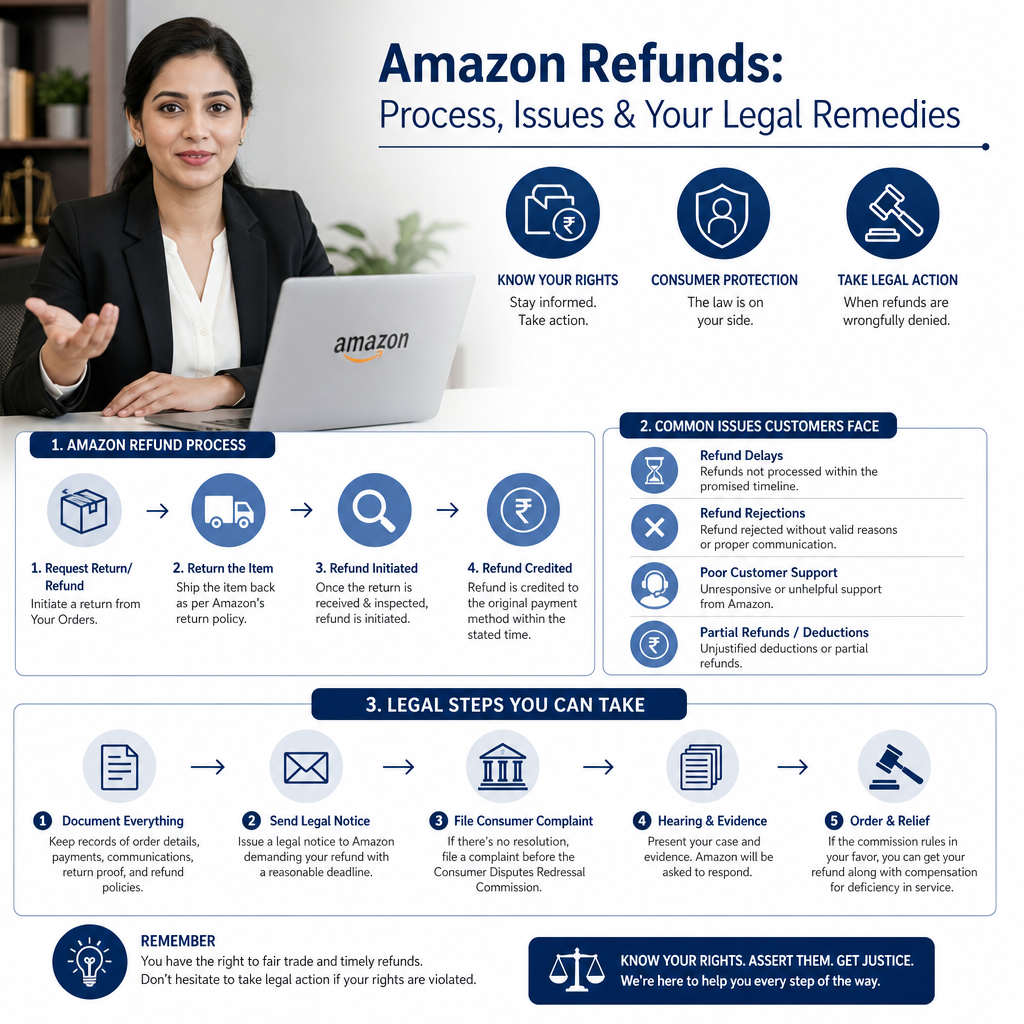
Refunds and Consumer Complaints
Have you paid a premium for a service that was never delivered, or purchased goods that turned out to be defective? When companies refuse to issue refunds, standard customer care tickets rarely solve the problem.
The Consumer Protection Act, 2019, established a highly effective three-tier quasi-judicial system (District, State, and National Commissions) to address these issues. This framework protects consumers from unfair trade practices and structural service deficiencies.
Filing an online complaint through the E-Daakhil portal simplifies the process, making it an affordable and practical way to claim refunds, interest, and emotional compensation. To learn how to build a strong consumer case, check out our insights on refunds and consumer complaints.
Security Deposits and Rental Recoveries
The relationship between landlords and tenants frequently falls apart over security deposits. Many landlords create arbitrary deductions or flatly refuse to return deposits when a lease ends. Conversely, landlords regularly face tenants who stop paying rent while refusing to vacate the premises.
                      [ LEASE / RENTAL DISPUTE ]
                                  │
                                  ▼
               [ Review Registered Lease Agreement ]
                                  │
                ┌─────────────────┴─────────────────┐
                ▼                                   ▼
      [ Tenant Seek Deposit ]             [ Landlord Seek Eviction ]
                │                                   │
     (File via Rent Control/             (Issue Notice to Quit /
      Civil Court Order 37)               File Civil Eviction Suit)
Under the Model Tenancy Act and state-specific rent control laws, both parties have clear statutory protections. A formal legal notice based on a registered lease agreement is highly effective for recovering these funds.
If a tenant defaults on rent, landlords can initiate eviction proceedings alongside a civil suit to recover the arrears. For a deeper look at balancing these property dynamics, view our dedicated resources on security deposits and rental recoveries.
Freelancer and Client Payments
The gig economy moves at a breakneck pace, but it is highly vulnerable to payment defaults. Freelancers and independent contractors routinely face clients who ghost them after final project deliverables are approved.
Protecting yourself starts with clean documentation: signed scope-of-work sheets, clear email approvals, and itemized invoices. If a client defaults, you can use digital evidence under Section 65B of the Indian Evidence Act to launch a civil recovery suit.
In addition, if your freelance business qualifies as a micro-enterprise under the MSMED Act, you can access specialized fast-track arbitration tribunals. Read more about protecting your independent business on our portal for the recovery of freelancer and client payments.
Recovering Money from Friends or Relatives
Loaning money to a friend or relative based on trust often leads to difficult situations when they refuse to pay you back. Without a corporate contract, many creditors assume they have no legal recourse.
                     [ PERSONAL LOAN DEFAULT ]
                                 │
                                 ▼
               [ Audit Available Paper & Digital Trail ]
                                 │
             ┌───────────────────┼───────────────────┐
             ▼                   ▼                   ▼
    [ Promissory Note ]    [ Bank Transfer ]   [ WhatsApp / Emails ]
             │                   │                   │
             └───────────────────┼───────────────────┘
                                 │
                                 ▼
                [ Issue Section 138 Notice / ]
                [ Civil Suit for Debt Recovery ]
Even without a formal deed, a paper trail consisting of bank transfer logs, WhatsApp messages, emails, or promissory notes is legally binding. You can use these records to issue a formal demand notice or file a civil recovery suit based on an oral agreement.
If they issued a cheque that later bounced, you can also initiate immediate criminal proceedings under the Negotiable Instruments Act. For a compassionate but firm approach to handling these delicate situations, read our guide on the recovery of money from a friend.
Airline and Travel Recoveries
Flight cancellations, sudden tour operator bankruptcies, and systemic refund delays from third-party booking apps leave thousands of travelers stranded and out of pocket every year.
The Directorate General of Civil Aviation (DGCA) enforces strict Passenger Charter guidelines that mandate clear compensation scales and timeline requirements for flight disruptions. If an airline or travel agency refuses to pay, you can file a complaint with the consumer courts for deficient service. Learn how to assert your traveler rights through our guide on airline and travel recoveries.
Vendor and Invoice Recoveries
Unpaid business-to-business (B2B) invoices disrupt cash flow and can threaten the survival of small and medium enterprises (SMEs). Managing commercial debt collection requires an assertive, legally sound approach.
                        [ B2B INVOICE DEFAULT ]
                                   │
                                   ▼
                 [ Check MSME Registration Status ]
                                   │
                ┌──────────────────┴──────────────────┐
                ▼                                     ▼
         [ Registered MSME ]                  [ Non-MSME Corporate ]
                │                                     │
     (File with MSME Samadhaan             (Summary Suit / Insolvency
     Council for 45-day Mandate)            Notice via IBC Code)
For companies registered under the Micro, Small and Medium Enterprises Development (MSMED) Act, 2006, the MSME Samadhaan portal provides an excellent recovery tool. It mandates that buyers pay interest at three times the bank rate set by the RBI if they miss the 45-day payment window. For non-MSME transactions, Order 37 summary suits or corporate insolvency notices offer strong alternatives. Review our end-to-end commercial solutions on our vendor and invoice recoveries engine.
Property and Builder Disputes
Delays in handing over possession, hidden charges, and structural defects by real estate developers can trap your life savings in incomplete projects.
The Real Estate (Regulation and Development) Act, 2016 (RERA), changed how these disputes are handled. Homebuyers can approach state RERA authorities to demand immediate possession, interest-bearing refunds for delays, or structural repairs. For complex cases involving insolvency, buyers can also approach the National Company Law Tribunal (NCLT) as financial creditors. Explore our real estate legal frameworks via our portal for property and builder disputes.
3. A Step-by-Step Blueprint to the Legal Recovery Process
Executing a successful debt recovery strategy requires careful planning, strict timeline management, and thorough documentation. Missing a step can delay your case or even cause a court to dismiss it entirely.
  STEP 1              STEP 2              STEP 3              STEP 4
┌──────────────┐    ┌──────────────┐    ┌──────────────┐    ┌──────────────┐
│ Document     │───>│ Formal Legal │───>│ Filing Court │───>│ Execution of │
│ Audit & Case │    │ Demand       │    │ Action       │    │ the Decree / │
│ Assembly     │    │ Notice       │    │ (Civil/Crim) │    │ Settlement   │
└──────────────┘    └──────────────┘    └──────────────┘    └──────────────┘
Step 1: The Documentation Audit & Case Assembly
Before sending a single notice, collect and organize all evidence related to the transaction. Your legal case stands on the quality of your documentation.
Contracts & Purchase Orders: Signed master service agreements (MSAs), sales deeds, leases, or purchase orders (POs).
Financial Ledgers & Invoices: Itemized invoices with proof of delivery, clean balance statements, and tax records like GSTR-2A entries.
Written Communications: Emails, WhatsApp chats, text messages, and meeting minutes confirming the debt or acknowledging the outstanding balance.
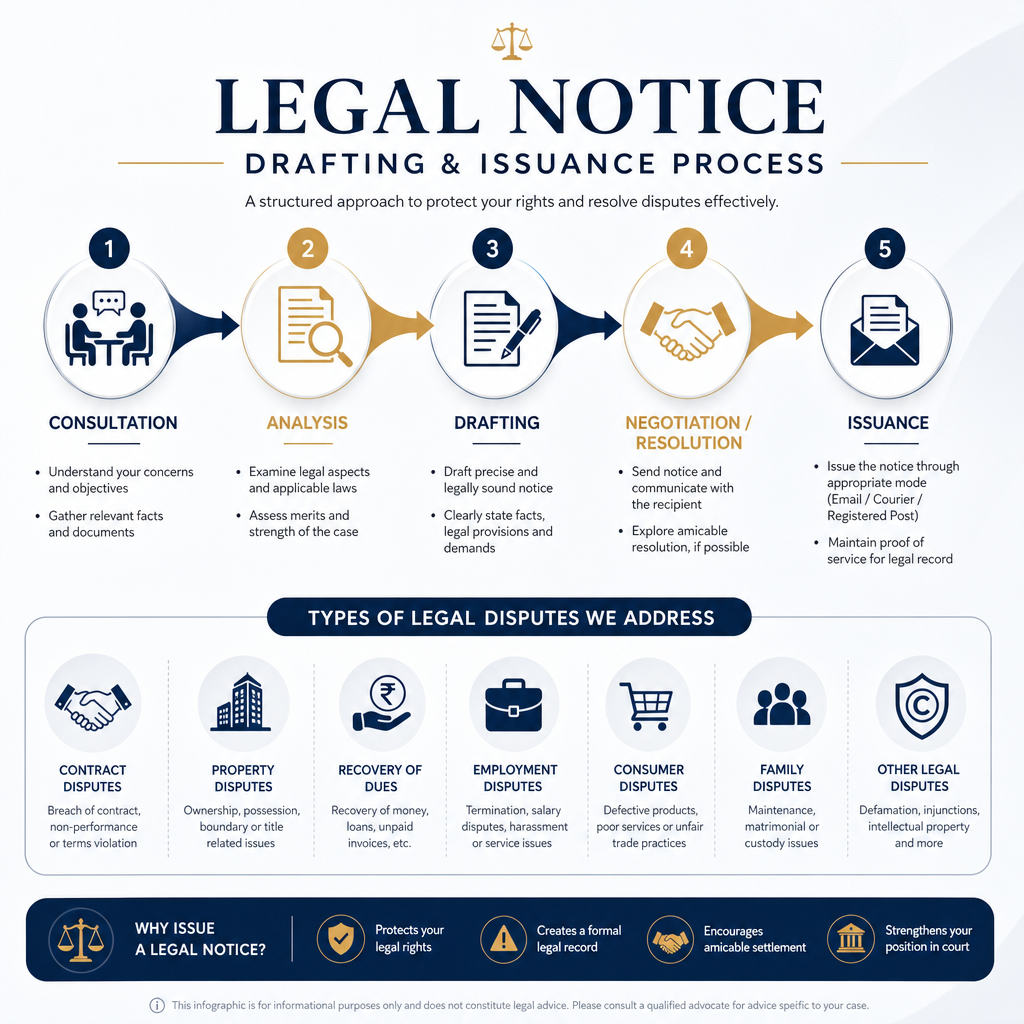
Step 2: Issuing the Formal Legal Demand Notice
A formal legal notice is a clear statement of intent that marks the official start of the legal recovery process. Drafted by an advocate, it details the origin of the debt, sets a strict deadline for payment (usually 15 to 30 days), and warns of impending legal action if ignored.
A professionally drafted notice shows the debtor that you are serious. Over 75% of standard commercial disputes are settled at this stage, as debtors prefer to pay rather than face expensive, public litigation.
Step 3: Selecting the Right Court and Filing Action
If the notice period ends without a response or a payment plan, you must file your case in court. Choosing where to file depends on the nature of your claim:
Civil Courts: Used for filing summary suits under Order 37 to secure a fast judgment on clear contractual debts.
Criminal Courts: Used under Section 138 of the Negotiable Instruments Act for bounced cheques, or Sections 406/420 of the Indian Penal Code (IPC) for fraud and cheating.
Specialized Tribunals: Used for filing targeted cases with RERA (property), NCLT (corporate bankruptcy), or the MSME Samadhaan Council.
Step 4: Execution of Decree and Final Debt Settlement
Winning your case and getting a court decree is a major milestone, but the process does not end there. If the debtor still refuses to pay, you must file an Execution Application under Order 21 of the CPC. This empowers the court to enforce the judgment by attaching the debtor's bank accounts, seizing physical assets, or liquidating property to recover your money.
To see how these steps fit together for your specific situation, look over our breakdown of operational steps on our how it works page.
4. Key Laws and Statutes in Debt Recovery
The Indian legal system features specialized statutes designed to handle different types of financial claims. Using the correct law ensures your case moves forward as efficiently as possible.
Statutory Provision / Act | Primary Focus Area | Key Recovery Advantage | Target Timelines |
Order 37, Civil Procedure Code (CPC) | Liquidated debts, bills of exchange, promissory notes | Restricts the debtor's right to defend without showing a valid case, leading to faster judgments | 6 to 12 Months |
Section 138, Negotiable Instruments Act | Dishonored or bounced cheques | Criminal offense that carries penalties of up to two years in prison, double the cheque value in fines, or both | 6 to 18 Months |
Insolvency and Bankruptcy Code (IBC), 2016 | Corporate defaults above INR 1 Crore | Empowers operational creditors to initiate corporate insolvency resolution processes (CIRP) against defaulting companies | 180 to 270 Days |
MSMED Act, Section 15-18 (Samadhaan) | Protection for registered micro & small enterprises | Mandates compound interest at three times the RBI bank rate for payment delays beyond 45 days | 90 Days |
Consumer Protection Act, 2019 | Product defects, refund delays, unfair trade practices | Low cost, simple online filing via E-Daakhil, and strong protections against corporate service failures | 3 to 6 Months |
Statutory Recovery Metrics & Resolution Benchmark
Disputes resolved via formal statutory legal demand notices.
Average statutory compliance response timeline.
Mandatory refund of statutory levies under Indian Acts.
Interest compensation claimable under MSME & NI Acts.
5. Strategic Pitfalls to Avoid in the Legal Recovery Process
Even with a strong case, basic strategic errors can delay your recovery or prevent you from collecting your funds.
The Law of Limitation
Under the Limitation Act, 1963, you generally have a strict three-year window to file a civil recovery suit, starting from the date the debt became due or when the debtor last acknowledged the balance in writing. If you wait too long, your claim becomes legally barred by limitation, leaving you with very few options to recover the funds.
Jurisdiction and Court Selection
Filing your case in the wrong court causes immediate delays. You must match both the geographic jurisdiction (where the cause of action occurred or where the defendant lives) and the pecuniary jurisdiction (the total financial value of your claim).
                            [ PECAUNIARY JURISDICTION CHECK ]
                                            │
               ┌────────────────────────────┼────────────────────────────┐
               ▼                            ▼                            ▼
       [ Small Claims ]             [ Senior Civil ]             [ High Court Civil ]
      (Claims up to 3 Lakhs)      (Claims 3 to 20 Lakhs)       (Claims exceeding 20 Lakhs)
Insolvency Risks
If a defaulting debtor is on the verge of bankruptcy, standard recovery actions may be paused by an automated moratorium under the IBC. In these situations, acting quickly to file your claims with the Interim Resolution Professional (IRP) is critical to protect your position among the remaining creditors.
6. Real-World Case Studies: Recovery in Action
Case Study 1: Resolving a Complex B2B Invoice Dispute
An IT services provider faced a major cash flow crisis when a corporate client withheld INR 45 Lakhs after a project milestone was completed. The client claimed the deliverables were incomplete, despite having signed off on them via email weeks earlier.
Strategy: The service provider initiated a formal legal recovery process by auditing their communication trail and issuing a sharp demand notice under Order 37 of the CPC.
Outcome: Faced with clear documentation and the threat of an open summary suit, the debtor settled 90% of the outstanding balance within 22 days of receiving the notice, avoiding court entirely.
Case Study 2: Reclaiming a Long-Overdue Commercial Security Deposit
A logistics firm relocated its warehouse but found its landlord refused to return an INR 12 Lakh security deposit, citing vague, undocumented "property maintenance costs."
Strategy: The firm issued a formal legal notice highlighting the terms of their registered lease agreement. They followed this up by preparing a civil suit for breach of contract and unjust enrichment.
Outcome: The landlord's legal team advised them to settle. The entire security deposit was returned via a bank transfer, along with a mutually agreed waiver of all disputed maintenance claims.
7. The Importance of Professional Legal Assistance
While understanding your rights is empowering, managing court filings, statutory deadlines, and procedural rules requires specialized expertise. Trying to navigate the courts alone can lead to technical mistakes that compromise your case.
[ Individual Effort ] ──> (Risks: High Costs, Delayed Filings, Procedural Rejections)
                                   Vs.
[ Legal Recovery ]    ──> (Benefits: Custom Strategy, Flat Rates, End-to-End Tracking)
At Legal Recovery, we combine deep legal expertise with modern efficiency to simplify debt collection. Our platform tracks every stage of your case, provides clear flat-rate pricing, and focuses on fast, practical resolutions.
We cut through standard bureaucratic delays to deliver results. Discover how our experienced legal team can help you build an effective, stress-free strategy by visiting our comprehensive services page.
Conclusion: Take Action on Your Outstanding Dues
Delaying your response to an unpaid debt only helps the defaulting party. As time passes, memories fade, documentation gets misplaced, and you run the risk of hitting strict statute of limitation deadlines. A systematic, legally sound strategy is the most reliable way to recover your funds and protect your financial health.
Whether you are managing a corporate invoice dispute, recovering a security deposit, or securing unpaid salary, the law provides clear, powerful tools to help you get paid. Taking a structured, professional approach shifts the leverage back to you, encouraging the debtor to settle.
Do not let uncooperative debtors disrupt your business or personal finances. Let our team handle the complexities of the courts while you focus on what matters most. Visit our blog for more tactical guides, or get in touch through our contact page today for a personalized evaluation of your case.
Popular Searches & Related Topics

Legal Recovery is India's trusted consumer protection and legal tech platform. We specialize in holding corporations accountable for unfair trade practices, deceptive marketing, and commercial fraud. With over 15,000 customers counselled, our mission is to provide fast, out-of-court resolutions by connecting you with top-tier panel advocates for immediate legal action.
Client Reviews
"The service was exceptionally professional and helped me recover my dues swiftly. Highly recommended!"
Rajesh Sharma
"I was impressed by the team's attention to detail and their strategic approach to my case. Thankful for their support."
Priya Patel
"Excellent legal expertise and a seamless recovery process. They made a complex procedure stress-free for me."
Ananya Mehta
"Their legal knowledge and prompt execution were instrumental in recovering my unpaid wages. Truly grateful!"
Vikram Joshi
"Professional and efficient service! They handled my cheque bounce case impeccably and secured a favorable judgment."
Sneha Rao
Frequently Asked Questions
Related Articles
About Author
Team LegalRecovery
View ProfileTeam LegalRecovery is a dedicated team of legal and financial professionals specializing in loan settlement, banking disputes, debt relief, and corporate compliance. We are committed to helping clients achieve debt freedom and business stability through expert strategic advisory.
Connect on LinkedInNeed Legal Help?
Get expert advice on loan settlement, banking disputes and debt relief.
Start Recovery NowRequest Callback