How to Get a Refund for Poor Service in India
If a provider delivered incomplete or poor work and refuses a refund, learn how to document your claim and escalate it.

Table of Contents
Table of Contents
Swipe →You paid someone to do a job, but the work was incomplete, poor, or nothing like what they promised. Now they are refusing to refund you, and every follow-up seems to lead nowhere. That is frustrating, especially when you are unsure whether you have enough proof or whether taking action will cost even more. You do have options. This guide will help you work out what refund to ask for, gather the right evidence, make a clear demand, and escalate your complaint if the provider still will not cooperate.
First, work out exactly what went wrong
“The service was bad” describes your experience, but a refund claim becomes stronger when you can point to something specific. Perhaps a repairer charged for a fix that never worked, a coaching provider failed to hold promised classes, or a maintenance company closed your complaint without doing the agreed work. Write down the promise and the result side by side.
Was the service disappointing, or was a promise broken?
A disappointing result does not always mean the provider must refund everything. For example, paying for coaching does not guarantee an exam result. But if the provider promised a particular number of classes and did not deliver them, you have a much clearer complaint. The same applies if a technician left the original fault unresolved despite charging for an agreed repair.
Look at the advertisement, quotation, booking confirmation, contract and messages you received before paying. What did the provider undertake to do? Was there a deadline, a specified scope of work, or a promise about who would perform it? Then note what was actually delivered. This comparison is the heart of your case, whether you are seeking a coaching fee refund or challenging another paid service.
What does consumer law say?
The Consumer Protection Act, 2019 protects people who pay for covered services. It calls a fault, shortcoming or inadequacy in the required quality, nature or manner of performance a deficiency in service. Misleading advertising and unfair practices may also be relevant. Services provided entirely free of charge and services under a contract of personal service are excluded, so the facts of the arrangement matter.
A Consumer Commission can, where justified, order the return of charges with appropriate interest, correction of deficient service, compensation for proven loss or injury, and costs. These remedies are not automatic. Your documents must show what went wrong and support what you are asking for. This is why a precise account of missed classes or unfinished repair work is more useful than an angry message saying the provider was “unprofessional”.
Collect proof before the messages disappear
You do not need a perfect contract to start. Many service arrangements are made through a booking page, a quotation and a WhatsApp conversation. Save them now, while you can still access the messages and payment history. Keep the original files as well as screenshots, and note dates where they are not obvious.
Keep this | What it helps show | Practical tip |
|---|---|---|
Advertisement, quotation or booking page | What the provider promised before you paid | Save the full page or message, not only a cropped line. |
Contract and refund terms | The agreed work, deadlines and cancellation conditions | Keep the version that applied when you booked. |
Invoice and payment record | Who received your money, how much and when | Match UPI or card entries to the invoice. |
Photos, videos and work orders | Incomplete work or a problem that remains unfixed | Include dates and a brief description of what each file shows. |
Emails, chats and complaint numbers | Your attempts to get the work fixed or obtain a refund | Preserve the provider’s replies, including refusals. |
Independent inspection or repair findings | What was wrong and what it cost to correct | Use these when the quality of work is disputed. |
Make a one-page timeline
List when you booked, what you paid, when the work was due, what happened, and when you complained. Add a reference to the supporting document beside each event. If there were several missed appointments, list them separately. This takes less time than repeatedly explaining the whole story to different customer-support agents, and it makes a later formal complaint much easier to follow.
Messages can help establish what was promised and how the provider responded. If most of your dealings were on your phone, this guide to using WhatsApp chats as evidence explains why preserving the complete conversation matters. Avoid editing screenshots in a way that removes surrounding context.
Keep your complaint factual
It is understandable to feel angry. Still, a calm account is more persuasive than accusations you cannot prove. Instead of “You cheated me”, write: “I paid ₹8,000 for four service visits. Only one visit took place, on 12 August, and the reported fault remains unresolved.” If you gave the provider a chance to correct the work, include that too. It shows that you tried to resolve the problem fairly.
How much of your money can you reasonably ask back?
Start with the amount paid, then consider what service, if any, you actually received. If nothing was delivered, a full refund may be a sensible demand. If useful work was completed but part was missing or defective, a proportionate refund or proper correction may be easier to justify. You can ask for a full refund where the failure warrants it, but paying an advance does not automatically make every rupee refundable after a disagreement.
Choose the remedy that solves your problem
Ask yourself whether you would still trust this provider to finish the job. If yes, set out exactly what must be corrected and by when. If the provider has repeatedly missed appointments or denied the fault, you may prefer money back so someone else can do the work. Be explicit: “Refund ₹6,000 for the three visits not provided” is clearer than “Do the needful”.
Where you have paid another professional to inspect or correct defective work, keep their report and receipt. They may help support a claim for documented loss. Under section 73 of the Indian Contract Act, 1872, an ordinary contractual breach can support recovery of loss that is proved and legally recoverable. It does not mean that every inconvenience attracts compensation. If you seek interest, compensation or costs, explain the basis for each amount rather than adding a large, unsupported figure.
What if the agreement says “no refunds”?
Read that term, but do not stop there. A cancellation policy is different from a provider taking payment and failing to deliver the agreed service. Point to the unperformed work, the provider’s own promises and your efforts to obtain a fix. Whether a particular term applies or can be challenged depends on the wording and facts; “no refunds” is not, by itself, an answer to every complaint.
For example, a gym may have rules for someone who simply changes their mind. That is different from a membership where promised facilities or services were not available. If that is your situation, the discussion of gym and subscription refunds may help you frame what was promised and what was missing.
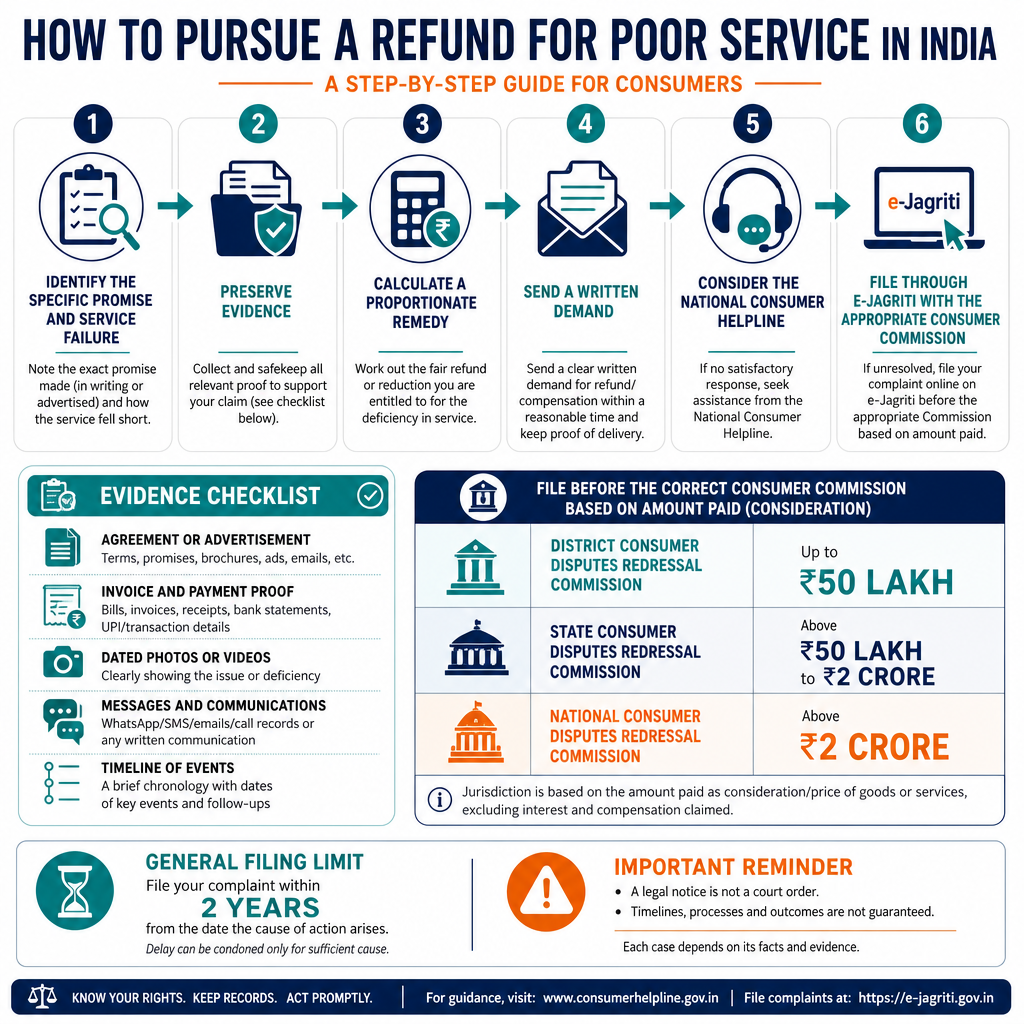
Visual Dispute Resolution & Recovery Framework
Step by step: what to do this week
You can begin without hiring a lawyer. The aim is to give the business a fair, documented opportunity to resolve the problem, while preparing for the next step if it refuses.
Identify the business you paid. Check the invoice, booking confirmation and payment receipt for its legal or trading name and official contact details. A complaint sent only to an individual worker may never reach the business responsible for the service.
Put your demand in writing. State what you bought, the amount and payment date, the specific failure, and the remedy you want. Attach copies of the most relevant evidence, not your only originals.
Give a clear reply date. Seven to fifteen days is a practical period for a response, depending on the problem. It is not a statutory waiting period. Ask the provider to confirm whether it will refund you or correct the work.
Send it to an official channel. Use the business’s published email or address and retain proof of delivery. You can also refer to an existing complaint number so the provider can find its earlier replies.
Record the outcome. If the provider offers a partial refund, check the calculation before accepting. If it promises a repair, get the scope and completion date in writing. If it stays silent, preserve that too.
A short demand you can adapt
“On 3 September, I paid ₹12,000 for the repair and testing described in your quotation. The repair was marked complete on 5 September, but the same fault continued, as shown in the attached video and my complaint of 6 September. Please correct the fault at no additional charge by 18 September, or refund the charges for the unsuccessful work. Please reply in writing.” Change the remedy and dates to fit your case; do not claim a technical fault you cannot establish.
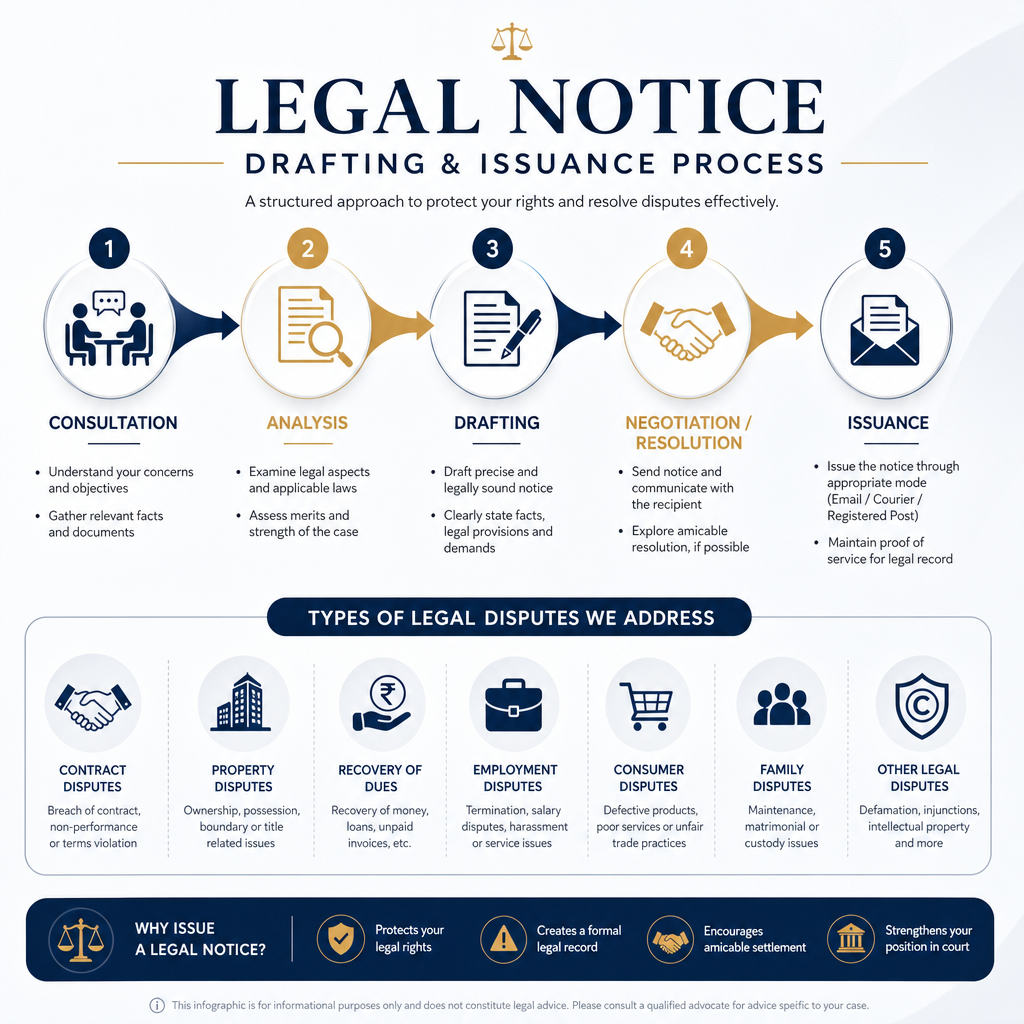
If a direct complaint has gone nowhere, a professionally drafted legal notice can set out the facts, evidence and demand more formally. It may prompt a response, but it is not a court order and cannot guarantee payment. You do not have to send one before every consumer complaint, so do not let notice exchanges consume months.
What if the provider still refuses?
Silence or a flat refusal does not end your options. You can use a free pre-litigation grievance channel, or seek an enforceable decision from a Consumer Commission. Choose based on how the provider has responded, the evidence you have and the time left to file.
Route | What you do | What it can achieve |
|---|---|---|
National Consumer Helpline (NCH) | Register your grievance at consumerhelpline.gov.in, call 1915 or WhatsApp 8800001915. | NCH forwards the issue to the business and facilitates a response. It does not issue an enforceable refund order. |
Consumer Commission | File with the appropriate District, State or National Commission through e-Jagriti at e-jagriti.gov.in, or approach the commission directly. | The commission can decide the dispute and order an appropriate remedy if your complaint succeeds. |
Which Consumer Commission handles your complaint?
Under the current jurisdiction rules, the deciding figure is the amount paid for the goods or services, not the larger amount you might request as compensation. The District Commission handles amounts paid up to ₹50 lakh; the State Commission handles amounts above ₹50 lakh and up to ₹2 crore; and the National Commission handles amounts above ₹2 crore. A District complaint can generally be filed where you live or work, which can make the process more accessible.
When filing, attach your timeline, payment proof, agreement or advertisements, evidence of deficient work, written demand and the provider’s response. State the remedy plainly. For a fuller walk-through of the filing process, see how to file a consumer complaint in India. NCH can be useful first, but it is not a required substitute for filing before the Commission if the dispute remains unresolved.
How long will this take, and is there a deadline?
There is no honest way to promise that a refund will arrive next week. A clear written demand sometimes resolves the matter quickly; other providers respond only after escalation. NCH says reaching a conclusion may take up to 30 days. That is a guide to its grievance process, not a guaranteed refund date.
For a Consumer Commission complaint, the Act envisages a decision in about three months after the provider receives notice, or about five months if testing is needed. These are targets. Serving notice, examining evidence, adjournments, appeals and enforcing an order can all add time. A reported coaching-refund case was decided in 79 days, but that does not predict how long your case will take.
Do not miss the filing period while negotiating
Consumer complaints generally need to be filed within two years of the cause of action. A commission can accept a later complaint if you show sufficient cause for the delay, but you should not rely on an extension. Mark the relevant dates and escalate in good time, even if customer support keeps saying your request is “under review”. This overview of time limits for recovery claims can help you see why delay matters, though the consumer-complaint deadline is the one to check for this route.
If you win an order and the provider still does not comply, the process does not simply stop. You can seek enforcement through the Consumer Commission under section 71 of the Consumer Protection Act; section 72 addresses non-compliance. Keep the order and records of any payment or communication after it, so you can show exactly what remains outstanding.
You can get help without handing over control
If you have already explained the problem three times and are tired of being ignored, getting help with a structured demand can take some pressure off. LegalRecovery assists with consumer refund complaints through online case submission, expert review, a professionally drafted notice sent by registered post, follow-up and escalation. Its case management is online, and pricing starts at a ₹1,499 flat fee. You can review how LegalRecovery’s process works before deciding whether that support is right for you.
Be clear about what such help does and does not do. A notice gives the provider a serious opportunity to settle; it cannot compel a refund on its own. If the dispute needs a Consumer Commission decision, that is a separate formal process, and participation may be required. You can also make your own written demand, use NCH and file a consumer complaint without first using a paid notice service.
The most useful thing to do today is small: save your payment proof and the original promise, write down exactly what was not delivered, and send a dated demand to the business. If you want support preparing that demand, LegalRecovery’s consumer refunds and complaints service is one option. Whether you proceed yourself or seek help, a specific claim backed by documents gives you a practical way forward.
Popular Searches & Related Topics

Legal Recovery is India's trusted consumer protection and legal tech platform. We specialize in holding corporations accountable for unfair trade practices, deceptive marketing, and commercial fraud. With over 15,000 customers counselled, our mission is to provide fast, out-of-court resolutions by connecting you with top-tier panel advocates for immediate legal action.
Client Reviews
"The coaching institute had not delivered several classes and was refusing to discuss a refund. LegalRecovery helped me organise the payment records and messages and sent a clear legal notice. The institute responded and refunded the fees for the classes it had not provided. I appreciated the practical updates throughout."
Ananya Sharma
"I paid for a home appliance repair, but the fault remained and my follow-ups were going unanswered. LegalRecovery helped put the facts and evidence into a formal demand. The service centre got back to me and agreed to refund the charge for the unsuccessful repair. The process was straightforward and professional."
Rohit Mehta
"A maintenance provider had closed my complaint without completing the agreed work and would not return the unused portion of my payment. LegalRecovery reviewed the documents and sent a legal notice on my behalf. The provider then offered a proportionate refund. I valued having a clear explanation of the next steps."
Priya Nair
"I had paid for a subscription service that was not delivered as promised, but customer support kept sending generic replies. LegalRecovery helped me make a concise, documented refund demand and followed up formally. The company eventually processed my refund. The support was responsive and helped me present the issue clearly."
Sandeep Kulkarni
Frequently Asked Questions
Related Articles
About Author
Team LegalRecovery
View ProfileTeam LegalRecovery is a dedicated team of legal and financial professionals specializing in loan settlement, banking disputes, debt relief, and corporate compliance. We are committed to helping clients achieve debt freedom and business stability through expert strategic advisory.
Connect on LinkedInNeed Legal Help?
Get expert advice on loan settlement, banking disputes and debt relief.
Start Recovery NowRequest Callback