How Can a Private Tutor Recover Unpaid Fees in India?
For lessons already taught, organize your proof, request payment, and consider a demand notice, settlement, or civil claim.
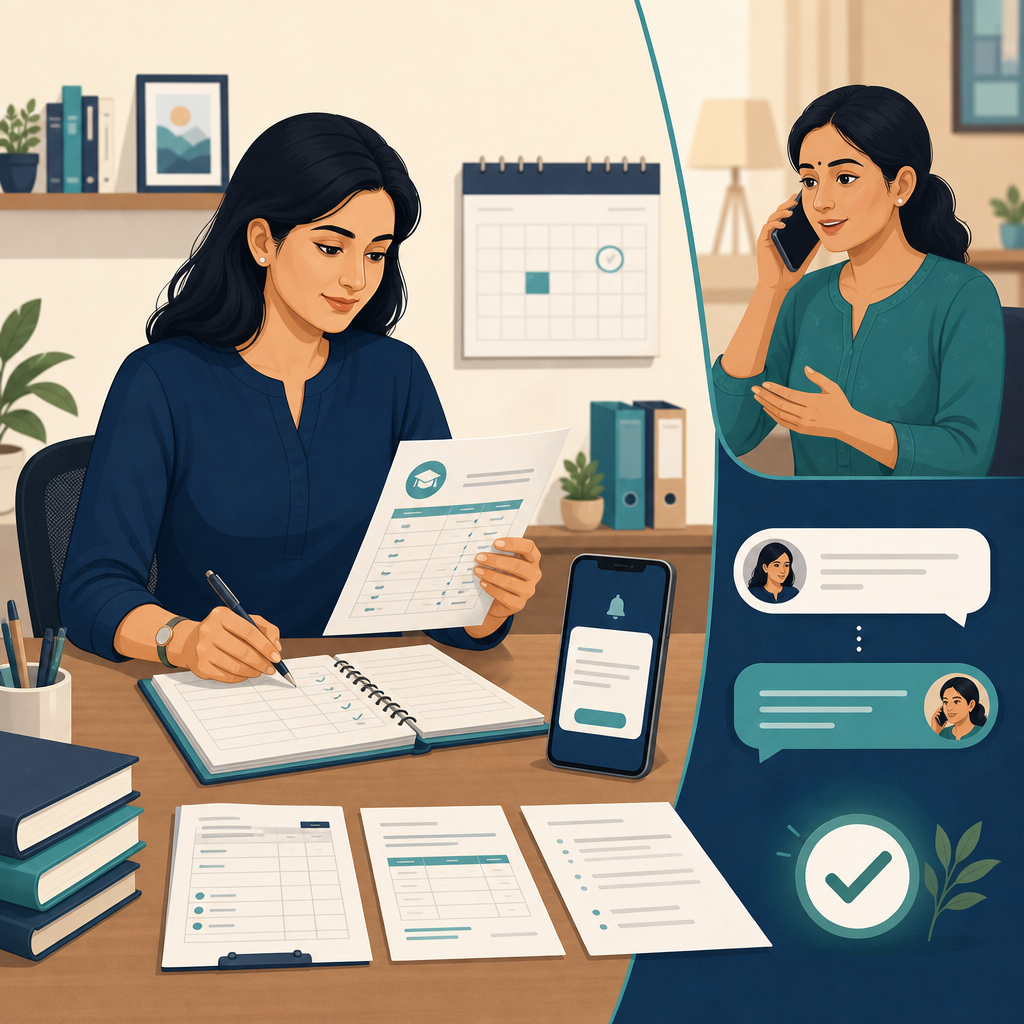
Table of Contents
Table of Contents
Swipe →You have taught the classes, prepared the lessons and made time for a student, but the fee still has not arrived. That is frustrating, especially when each reminder feels awkward. You do not have to choose between staying silent and starting a court case tomorrow. This guide explains how to work out what is owed, gather proof, ask the right person to pay and decide whether a notice, settlement or civil claim is worth pursuing.
Start with one question: who agreed to pay you?
A student may attend every class, but that does not necessarily make the student responsible for the bill. If a parent arranged the tuition and agreed to the fee, address your payment request to that parent. If an adult student booked and paid for their own lessons, the student may be the person to approach. For a coaching centre, check the admission form and any terms accepted at enrolment.
Next, separate fees for lessons already provided from fees for classes that never happened. A claim is easier to explain when it states the agreed rate, the dates taught, payments received and the balance due. If the family says the child stopped attending, compare that claim with your attendance records. If they dispute the rate, find the message or document in which it was agreed.
An agreement does not always have to be a formal signed contract. Messages arranging classes, a fee schedule accepted by the parent, earlier payments at the same rate and records showing that the lessons were taken can all matter. Under the Indian Contract Act, 1872, section 73 can support a claim arising from breach of an agreed payment arrangement. Section 70 may also be relevant where a service was provided without intending it to be free and the other person accepted its benefit. Neither provision removes the need to prove your facts.
For an independent tutor, this resembles a service-provider payment dispute, not a complaint by a consumer seeking a refund. A consumer commission is generally not the forum for a teacher to collect unpaid fees. There is also no general government portal that collects private tuition fees for you. Your practical options are a negotiated payment, a formal demand and, if necessary, a civil money-recovery case.
Put together a record that someone else can understand
You might know exactly what happened, but a parent, lawyer or court will need a clear trail. Do not wait until a dispute becomes hostile. Save the messages and payment records you already have, then prepare a simple month-by-month account. Keep original files where possible rather than relying only on screenshots cropped without dates or names.
What to keep | What it helps show | Practical check |
|---|---|---|
Admission form, agreed terms or messages | Who undertook to pay, the rate and when payment was due | Save the full conversation around the agreement, not one isolated message. |
Lesson plan, dated attendance or class logs | Which lessons were actually provided | Note cancellations, make-up classes and any change to the schedule. |
Invoices, receipts and bank or UPI records | What you billed and what was paid | Match each receipt to its month; avoid counting an advance twice. |
Reminders and replies | When you requested payment and whether the amount was disputed | Preserve any written promise to pay or acknowledgement of the balance. |
Postal and delivery records | Whether a later formal notice was sent to the right address | Keep the notice copy, receipt and tracking result together. |
Your account can be straightforward: “June: eight classes at ₹750 each, ₹6,000 billed, ₹2,000 received, ₹4,000 outstanding.” Repeat for each month and add the balances. If you charged different rates for different subjects or students, show that separately. A round number with no working behind it invites an avoidable argument.
Do not hide facts that complicate your claim. If you cancelled two classes and did not replace them, adjust the bill where required by your agreement. If the parent made a partial payment, record it. A careful calculation is more persuasive than a larger but uncertain demand.
No signed agreement? That does not automatically end the matter. Your WhatsApp conversation may help establish the fee arrangement, particularly when it matches lesson records and past payments. A lawyer can assess what the complete record proves, including any disagreement about who promised to pay.
What should you do this week?
Begin with a request that gives the other person a fair chance to resolve the problem. Parents may have overlooked an invoice, misunderstood the number of classes or be dealing with a temporary difficulty. A calm, specific message makes it easier for them to pay and gives you a useful written record if they do not.
Reconcile the account. List every unpaid period, the classes delivered, the agreed price, payments and the exact balance. Check whether an advance or cancellation credit changes it.
Send a dated invoice or statement. Address it to the person who agreed to pay. Include your payment details and attach the calculation, rather than sending only “Please clear my dues.”
Ask for a clear response. State a reasonable date for payment and invite them to identify any disputed entry. Keep the conversation in writing even if you also speak by phone.
Consider a written instalment plan. If they cannot pay all at once, record the total acknowledged, instalment amounts, due dates and payment method. Do not treat an informal promise as money received.
Review the reply. Correct genuine mistakes promptly. If they acknowledge the debt but keep postponing payment, decide whether the amount justifies a formal demand.
You could write: “I taught eight maths classes in June at the agreed fee of ₹750 per class. After your ₹2,000 payment on 10 June, ₹4,000 remains due. Please pay by 15 July or let me know by 12 July if you disagree with any class or payment listed in the attached statement.” Change the dates and figures to match your records.
Keep communication with the adult who agreed to pay, rather than putting pressure on the child. Do not publicly shame a student or hold certificates or other documents hostage to force payment. If a dispute continues, use a payment claim, not the student’s paperwork, as your remedy.
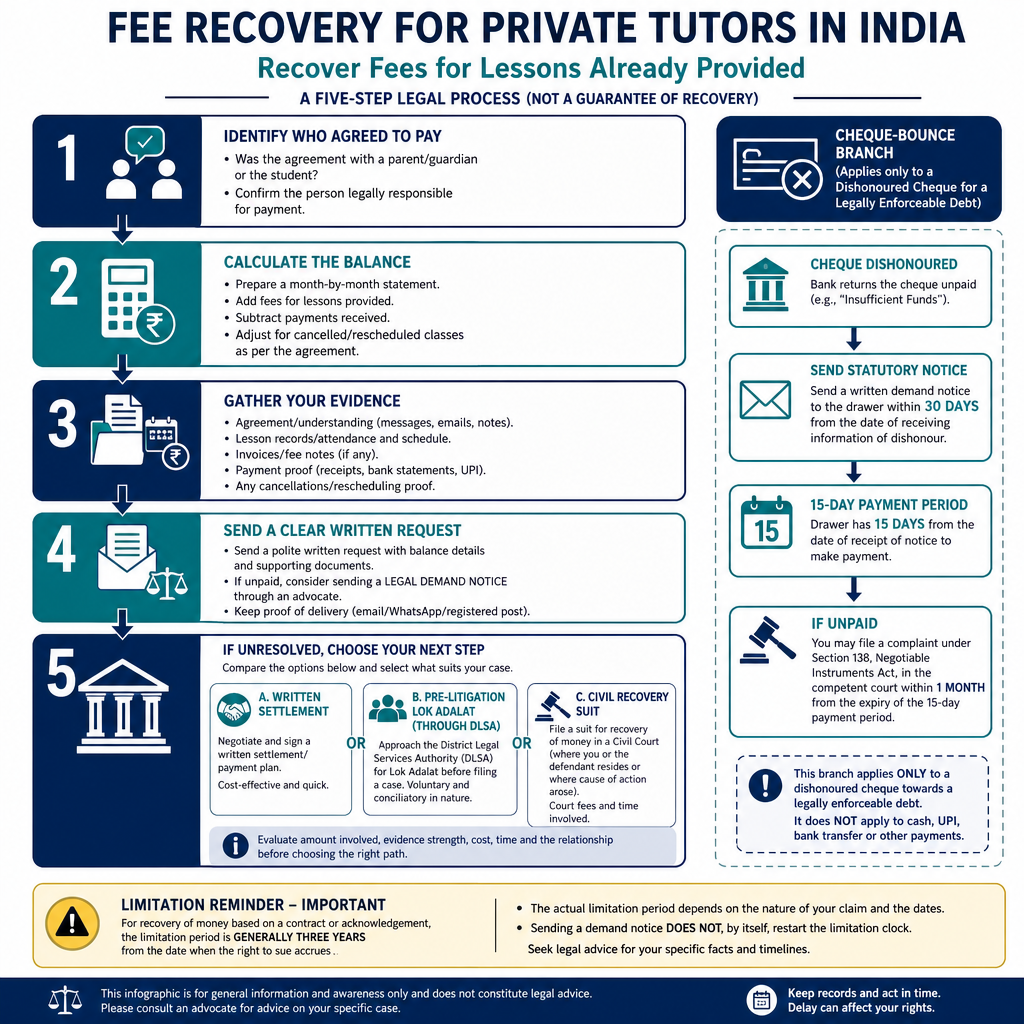
Visual Dispute Resolution & Recovery Framework
When is a legal notice worth sending?
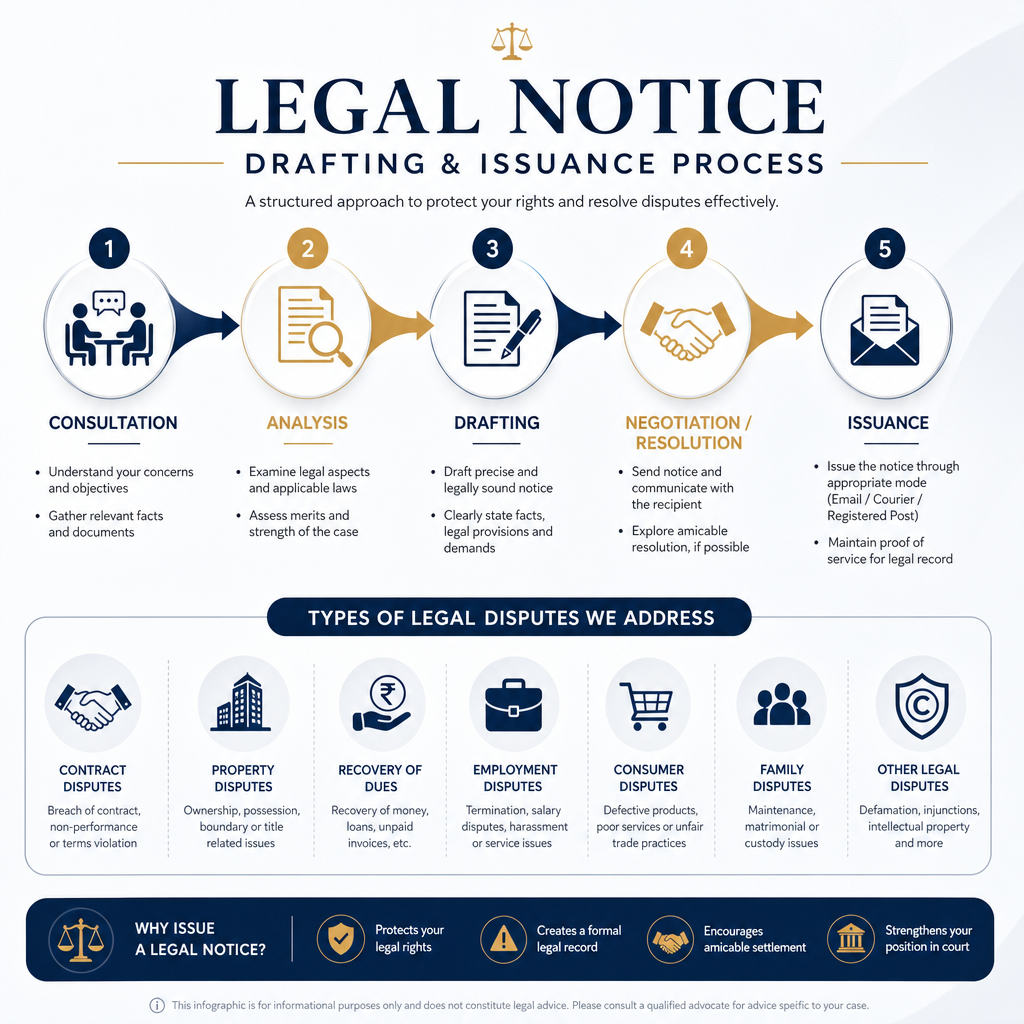
If a clear invoice and reasonable reminders have gone nowhere, a demand notice can show that you are serious while leaving room to settle. It is a formal statement of your claim, not a court order. The recipient may pay, propose instalments, dispute the amount or ignore it. A notice cannot guarantee recovery.
A useful notice identifies the person responsible for payment, explains the fee arrangement, lists the lessons and unpaid amount, accounts for money already received and asks for payment within a stated period. It should be sent to an address you can support with delivery records. If there is a genuine dispute about cancelled classes or the agreed rate, the notice should deal with it accurately instead of pretending it does not exist. This money-recovery notice drafting guide can help you see what details to assemble before seeking professional review.
For an ordinary tuition-fee debt, a notice might allow 7 to 15 days for payment or a reply. That is a practical deadline you choose for negotiation, not a statutory rule that makes payment automatic. A demand notice also does not, by itself, restart the time limit for filing a suit. If the debt is old, speak to a lawyer promptly rather than waiting through repeated notice cycles.
LegalRecovery offers an online route to request a professionally drafted legal notice. You submit the case and records online; legal experts review them; a notice is drafted and dispatched by registered post; and follow-up and escalation may follow. Its stated pricing starts at ₹1,499 as a flat fee. An independent tutor’s unpaid client fee is closest to its service-provider payment work, but check that your particular case is covered before paying. Its five-step process can be managed online without an initial court visit; if you later file a suit, separate court procedures may still require participation.
Whatever route you use, be cautious about adding late fees, notice charges or interest simply because payment has been delayed. You may need to prove an agreement or other legal basis for each extra amount. In a 2025 Bengaluru school-fee case, the court awarded the proved unpaid fees but rejected late fees and notice charges that the school had not substantiated. Keeping the principal claim accurate gives settlement a better chance.
If the notice is ignored, compare your next options
Silence after a notice is disappointing, but it does not mean your claim has vanished. It means you need to compare the likely recovery with the time and expense of the next step. For a single month’s modest fee, a workable instalment offer may be more valuable than a long contest. For a larger balance, getting legal advice on a suit may make sense.
Option | What happens | Best point to check |
|---|---|---|
Direct settlement | You agree on a payment or written instalment schedule. | Can the payer commit to realistic dates and make a first payment? |
Pre-litigation Lok Adalat | The District Legal Services Authority helps both sides try to settle before a suit. | Settlement needs both sides’ agreement; there is no Lok Adalat filing fee. |
Civil recovery suit | A court decides the claim on the pleadings and evidence. | Will the amount at stake justify legal costs, time and possible enforcement? |
You can ask the District Legal Services Authority, usually at the district court, about a pre-litigation Lok Adalat. It cannot force an unwilling person into a settlement. If the parties do agree, its award is enforceable like a civil-court decree. Some people may also qualify for free legal aid through the legal services authorities; women are eligible irrespective of income. NALSA’s helpline is 15100.
If settlement fails, a lawyer can assess a civil suit for recovery of money in the court with jurisdiction. Ask about the documents needed, court fees, likely lawyer costs and whether the payer appears able to satisfy a judgment. Where local courts have adopted electronic filing, it may be available, but do not assume the entire case will happen online.
A lawyer may also check whether the summary-suit procedure under Order XXXVII of the Code of Civil Procedure, 1908, is available for a fixed debt arising from a written contract. It is not an automatic shortcut for every tutor with a WhatsApp chat. Otherwise, an ordinary recovery suit may be the appropriate route. The court can consider interest under section 34 of the Code, but you should not present a particular rate as guaranteed.
Neither a public-grievance portal for government services nor a consumer complaint filed by you as the fee collector replaces these routes. If you would prefer to focus on agreement first, see how recovery without going to court usually depends on a clear demand and the other side’s cooperation.
Do not let a small debt become a time-barred one
Repeated “I will pay next week” messages can make it tempting to wait indefinitely. Write down when each fee became due now, even if you hope to settle. The limitation period can depend on how your arrangement was structured, and each monthly instalment may need to be checked separately.
Under the Limitation Act, 1963, Schedule Article 18 generally gives three years from completion of work where no payment time was fixed. Article 55 provides three years from breach for applicable contract claims. A lawyer can identify which provision fits your tuition agreement and when time started running for each unpaid amount. For example, an agreed monthly payment date can raise a different timing question from a single fee payable after a completed course.
A qualifying written acknowledgement of liability or part-payment can affect the limitation calculation under sections 18 and 19, subject to their legal requirements. Do not assume every vague message saying “soon” qualifies. Equally, sending your own invoice or demand notice does not itself reset the clock. If a payment has been outstanding for close to three years, get advice about filing in time rather than relying on ongoing discussions. This guide to money-recovery time limits explains why the relevant dates matter.
Be realistic about duration as well as deadlines. A settlement may be reached at an available Lok Adalat sitting if both sides cooperate. Contested civil litigation can take years, and collecting after a decree may take further effort. That is why a sensible written settlement for the principal can sometimes serve you better than pursuing every disputed extra charge.
What if the parent disputes classes or gives you a cheque?
Not every unpaid fee has the same answer. If a parent says the student missed lessons, compare the agreed cancellation terms with the actual attendance and messages about rescheduling. If you teach through a coaching centre, check the admission terms and any applicable state requirements before demanding fees for classes that were not provided. Do not assume guidelines for coaching centres create a nationwide fee-collection power.
If the parent admits that lessons took place but disputes the rate, show the fee message, published schedule they accepted or a pattern of earlier payments. If there was never a clear rate, seek advice before claiming an inflated figure. Your goal is to show a fair, supportable amount that the other person can understand.
A bounced cheque is a separate situation with strict deadlines. If a cheque was issued towards a legally enforceable fee debt and the bank returned it unpaid, keep a copy and the bank return memo. Under sections 138 and 142 of the Negotiable Instruments Act, 1881, the statutory demand must generally be sent within 30 days of learning of dishonour. The drawer then has 15 days after receiving the notice to pay; a complaint normally follows within one month after the cause of action arises. Get prompt legal help with these dates. An unpaid UPI request, a failed transfer or an ordinary refusal to pay is not a cheque-bounce case. The cheque-bounce timeline is useful only if you actually received a cheque that was dishonoured.
For most tutors, the next move is less complicated: finish your account, save proof of the classes and agreed fee, then send the responsible payer one precise written request. If that does not work, consider a notice and a realistic settlement before weighing a civil claim. You earned the fee by teaching; approaching its recovery one documented step at a time gives you a clearer path forward.
Popular Searches & Related Topics

Legal Recovery is India's trusted consumer protection and legal tech platform. We specialize in holding corporations accountable for unfair trade practices, deceptive marketing, and commercial fraud. With over 15,000 customers counselled, our mission is to provide fast, out-of-court resolutions by connecting you with top-tier panel advocates for immediate legal action.
Client Reviews
"I was owed payment for freelance design work and had invoices and messages but was unsure how to make a formal demand. LegalRecovery explained the notice process clearly and helped organize the claim. The client responded after receiving the notice, and we agreed on payment without starting a court case."
Ananya Sharma
"A client had delayed payment for my consulting invoices despite several reminders. LegalRecovery helped me present the amount and supporting records in a clear legal notice. I appreciated the professional updates and the chance to resolve it through discussion."
Rohit Mehta
"I had completed tutoring work for a family, but the agreed fees remained unpaid. LegalRecovery helped me set out the classes, payments received and balance in a structured demand. The parent agreed to a written instalment plan, which made the next steps much clearer."
Priya Nair
"My freelance client kept postponing payment for completed work. LegalRecovery guided me on the documents to share and prepared a formal notice that stated my claim accurately. The client then contacted me to discuss settlement. The service was straightforward and kept my communication professional."
Karan Verma
Frequently Asked Questions
Related Articles
About Author
Team LegalRecovery
View ProfileTeam LegalRecovery is a dedicated team of legal and financial professionals specializing in loan settlement, banking disputes, debt relief, and corporate compliance. We are committed to helping clients achieve debt freedom and business stability through expert strategic advisory.
Connect on LinkedInNeed Legal Help?
Get expert advice on loan settlement, banking disputes and debt relief.
Start Recovery NowRequest Callback