How Can Businesses Recover Unpaid Invoices from Hospitals in India?
If a hospital owes your business for supplies or services, learn how to document the dues and pursue payment.

Table of Contents
Table of Contents
Swipe →Running a hospital means providing care even when payment is uncertain. But when a patient leaves with an unpaid balance, that shortfall affects staff, suppliers, and your ability to keep services running. You may also be unsure whom to approach: the patient, a relative who signed the admission form, or an insurer. The way forward is to establish exactly what is owed, check who agreed to pay it, and pursue the right person through a documented payment request. This guide walks you through those steps and explains your options if payment still does not arrive.
Start with the bill, not the demand
An unpaid discharge bill is not always a single, undisputed debt. A patient may have paid a deposit, the insurer may have approved part of the claim, or the family may be questioning a particular charge. Before asking for payment, give someone on your accounts team the job of producing one final, reconciled figure.
Work out what remains unpaid
Put the date-wise, itemised bill beside every receipt, bank entry, credit note, insurer approval, and deduction. Check whether a payment is still being processed or has been posted to the wrong account. If a charge was entered twice or does not match the tariff disclosed to the patient, correct it now. A reliable calculation makes a payment conversation easier and gives you a stronger record if the dispute later reaches conciliation or court.
If the family objects to a charge, ask them to identify it in writing. Respond with the relevant bill entry and explanation rather than repeating the total due. Do not treat a genuine billing query as a refusal to pay. Equally, do not let a continuing exchange about one charge obscure an agreed balance that remains unpaid.
Separate the patient’s share from a third party’s share
Cashless treatment can leave several different amounts on the same bill: an insurer-approved sum, deductions under the policy, and a possible patient contribution. Reconcile the insurer or third-party administrator’s decision and your agreement with them before telling the patient what they personally owe. If an insurer has delayed a decision, that delay alone does not establish that the patient must pay its share.
For cashless claims, an IRDAI circular dated 29 May 2024 requires insurers to decide pre-authorisation requests within one hour and final discharge authorisation requests within three hours of receiving them. Use those deadlines to follow up with the insurer. An unpaid AB-PMJAY scheme claim needs a different route again: the National Health Authority’s grievance system, not a demand for an ordinary patient bill. Keeping these amounts separate prevents you from pursuing the wrong payer.
Who actually agreed to pay?
It can feel natural to call the family member who handled admission. That person may be your best contact, but being an attendant or relative does not automatically make them personally liable. Read what each person signed before naming them in a payment demand.
The patient may have accepted the hospital’s payment terms. Someone else may have expressly undertaken to pay or signed a guarantee. The exact words matter: a signature acknowledging admission or receiving documents is not necessarily a promise to clear the bill. Keep the full signed form, not just its signature page, along with the signatory’s name and address.
The Indian Contract Act, 1872 provides the general basis for an enforceable agreement under section 10, compensation where a person enjoys a non-gratuitous service under section 70, and compensation for breach under section 73. Which basis supports your claim depends on the documents and circumstances. A lawyer can help identify the correct person to approach rather than assuming every accompanying relative is a guarantor.
Two Delhi trial-court decisions show why this check matters. In a judgment dated 21 November 2024, a court awarded ₹2,62,168 against a patient and a son who had personally undertaken payment, but not another son without that proof. In a judgment dated 26 April 2025, a court held that a widow who signed as an attendant was not personally liable merely for doing so; recovery against her was limited to any estate she inherited. These outcomes depended on the evidence in those cases. They are a reminder to identify your debtor carefully, not a shortcut for deciding every hospital bill.
The records that make your claim credible
You do not need to overwhelm the recipient with a patient’s entire file. You do need a clear trail showing what was agreed, what care or services were billed, what has been paid, and how you calculated the balance. Gather it while staff can still explain any unusual entries.
Keep this record | What it helps establish | What to check now |
|---|---|---|
Signed admission, payment and guarantee terms | Who accepted payment responsibility | Read the undertaking’s precise wording; identify each signatory |
Disclosed tariffs, estimates and revisions | What the patient was told about charges | Preserve dated versions and any communication about changes |
Relevant treatment and discharge records | That the billed services were provided | Limit sharing of clinical details to what the claim requires |
Date-wise itemised bills | How each charge contributes to the total | Correct duplicates and explain disputed entries |
Receipts, bank entries and insurer or TPA decisions | Payments, approvals and deductions | Reconcile them against the final balance |
Messages, demands and delivery proof | What was requested and how the recipient responded | Save complete conversations, not isolated screenshots |
If a patient or payer agrees to instalments, record the outstanding total, each due date, the amount of each instalment, and who is undertaking to pay. Ask for a signed written acknowledgment where possible. A promise such as “we will sort it out soon” is harder to act on than an agreed schedule with specific dates.
Keep clinical records secure. Your accounts team, notice provider, or lawyer generally needs only the information necessary to support the claim. Avoid circulating sensitive treatment details in broad email chains or attaching a full medical history to a routine reminder. If the dispute concerns whether a particular service was supplied, share the relevant material through an appropriate secure channel.
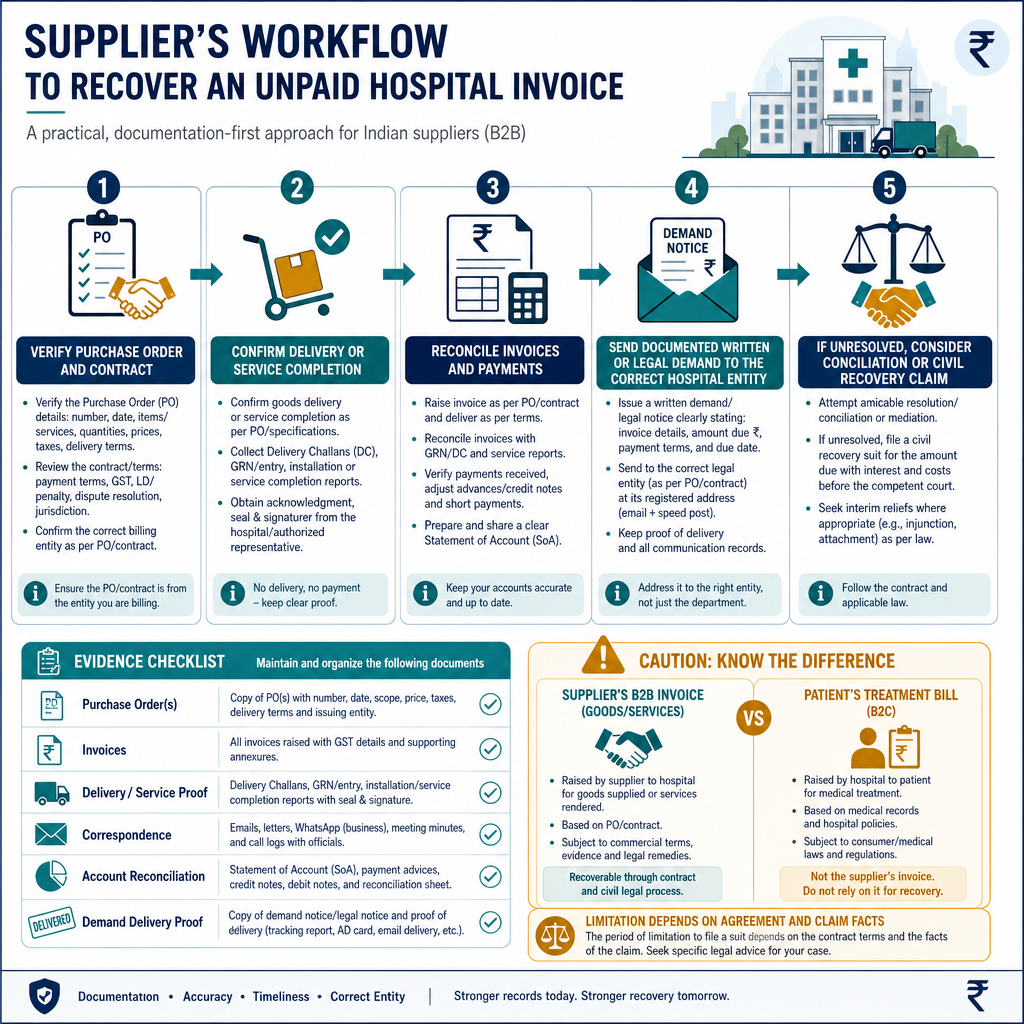
Visual Dispute Resolution & Recovery Framework
What should you do this week?
A calm, staged approach often gives the payer room to resolve the bill without a lawsuit. It also shows that your hospital has been reasonable if formal action becomes necessary. Start promptly: waiting for an informal promise to turn into payment can make records harder to find and leave less time to bring a claim.
Reconcile the account. Confirm the final amount, remove incorrect charges, and distinguish patient dues from insurer or scheme-payment issues.
Identify the person responsible. Check admission forms, payment terms, and any express guarantee. Verify the address you will use for correspondence.
Send a clear written demand. State the patient’s reference details, itemised balance, payments already credited, payment instructions, and a date for a response. Ask the recipient to identify any disputed entries.
Consider a practical settlement. If full payment is difficult, propose instalment dates the payer can realistically meet and confirm the agreement in writing.
Escalate if needed. Keep proof that the demand was delivered and seek advice about conciliation or a civil claim rather than letting the matter drift.
What goes into a useful legal notice?
A lawyer’s notice should tell the recipient precisely why your hospital says the money is due and give them a fair opportunity to pay or explain their objection. Include the correct payer’s name, the basis of their obligation, the reconciled sum, supporting bill details, and where payment should be made. Keep the tone factual. An inflated total or an unsupported allegation against a relative can distract from a valid claim.
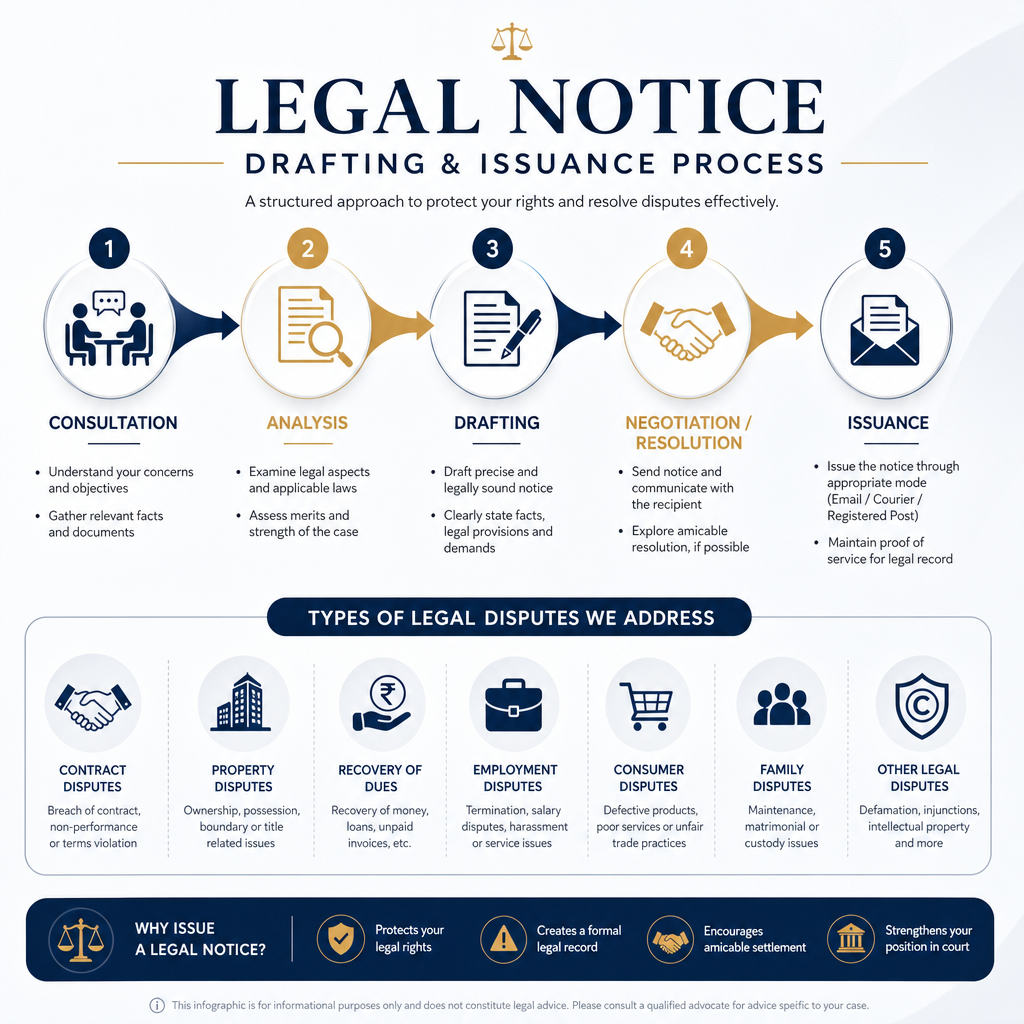
You can allow 15 days for a response if that suits the situation. It is a practical choice, not a universal statutory notice period for hospital-bill recovery. If you want help preparing one, LegalRecovery’s online legal notice service can review the details and arrange professional drafting and dispatch by registered post. Its five-step process starts with online submission and expert review, then moves through notice, follow-up and escalation toward resolution. Pricing starts at ₹1,499 flat fee; check what your particular case requires before proceeding.
An ordinary patient-treatment bill is not the same as an unpaid supplier invoice. If your business supplied equipment, medicines, or services to a hospital and the hospital has not paid, use the purchase order, delivery or service proof, and invoices to pursue that B2B debt. LegalRecovery places such claims under vendor and invoice recovery. The distinction matters because your contract and the person who owes you are different.
What if the notice is ignored?
Silence is frustrating, but it does not mean you have run out of options. First check that your demand reached the right person and that no insurer decision, billing correction, or payment has changed the balance. Then choose a route proportionate to the amount and the strength of your documents.
Try conciliation before a contested case
You can approach the local District Legal Services Authority about a pre-litigation Lok Adalat. An ordinary pre-litigation Lok Adalat helps parties settle; it cannot impose a settlement when they do not agree. Ask the Authority whether a Permanent Lok Adalat is appropriate for your hospital-service dispute. Under the Legal Services Authorities Act, 1987, hospital service is a public-utility service. A party may apply to a Permanent Lok Adalat before filing in court if the matter falls within its jurisdiction and ₹1 crore monetary limit. It attempts conciliation first and may decide the dispute if conciliation fails.
Bring your reconciled account and the payment undertaking, and be ready to explain contested charges. A settlement is more likely to hold if its dates and amounts are workable. If you want to understand non-court approaches before choosing a forum, see this guide to recovering money without going to court.
When a civil suit makes sense
A civil money suit is the ordinary court route for an unpaid treatment bill. In appropriate cases, Order XXXVII of the Code of Civil Procedure, 1908 permits a summary suit for a fixed debt arising from a written contract or guarantee. Do not assume that every hospital bill qualifies: the written terms and the nature of the claim need review. Section 34 also allows a court to award interest, but it does not guarantee the rate your hospital requests.
For example, the Delhi court that awarded ₹2,62,168 in November 2024 allowed 6% interest rather than the 18% sought. In the April 2025 case, another court examined date-wise charges and free-treatment eligibility before reducing the recoverable bill to ₹3,18,269. Preparing for those questions early is more useful than assuming the amount on your first statement will be awarded unchanged. Read more about the civil recovery process if settlement is not working.
LegalRecovery can manage its notice and follow-up stages online, without a court visit for those stages. If a dispute proceeds to litigation, however, court requirements depend on the case. Court e-filing is available where adopted, but an online notice service should not be mistaken for a promise that a lawsuit will never require your participation.
How long can you wait, and how long might recovery take?
Do not wait indefinitely because the family is “arranging funds.” Limitation rules set deadlines for bringing court claims, and the correct starting date depends on the agreement and the kind of claim. Under Article 18 of the Limitation Act, 1963, where requested work has no fixed payment time, the period is generally three years from completion of the work. That article will not necessarily govern every hospital bill. Ask for a case-specific limitation check well before three years have passed.
A signed written acknowledgment of liability made before the limitation period expires can start a fresh period under section 18 of the Limitation Act. A demand notice by itself does not restart the clock. An unsigned message or a later acknowledgment should not be treated as a substitute for timely legal advice. If an instalment proposal is being discussed near a deadline, confirm what it does, and does not, change before you postpone action. This explanation of the time limit for money-recovery cases can help you prepare that conversation.
There is no dependable notice-to-payment timetable. Some people pay after seeing a corrected bill; others dispute responsibility throughout. In the ₹2,62,168 Delhi case, notices were sent in 2019 and 2020, while the decree came on 21 November 2024. That is one case, not a prediction for yours, but it shows why a notice should be part of a planned escalation rather than a promise of quick payment.
Protect the hospital’s claim without pressuring the patient
A discharged patient must not be detained to secure payment. An unpaid treatment bill is ordinarily a civil recovery issue. Keep discharge and payment collection separate, and give staff a clear route for referring unresolved balances to the accounts or legal team instead of trying to resolve them at the bedside.
The most effective next move is usually modest: prepare one accurate statement, check who actually promised to pay, and send a documented request to that person. If they raise a valid error, correct it. If they need time, put realistic instalments in writing. If they refuse or stop responding, consider conciliation or a civil claim before the deadline passes. You can use LegalRecovery’s money-recovery notice guidance to understand the notice stage, or contact the team about your documents and the appropriate route. A careful first step will not guarantee recovery, but it puts your hospital in a much better position to pursue what is genuinely owed.
Popular Searches & Related Topics

Legal Recovery is India's trusted consumer protection and legal tech platform. We specialize in holding corporations accountable for unfair trade practices, deceptive marketing, and commercial fraud. With over 15,000 customers counselled, our mission is to provide fast, out-of-court resolutions by connecting you with top-tier panel advocates for immediate legal action.
Client Reviews
"Our company had an overdue supplier invoice with a hospital. LegalRecovery helped organise the purchase order and delivery records and prepared a clear legal notice. The hospital responded and we were able to agree on payment dates. The process and follow-up were professional."
Amitabh Sharma
"A client had held back payment for my freelance work despite several reminders. LegalRecovery made the notice process straightforward and helped me present the invoice and work records clearly. I appreciated the timely updates and practical guidance."
Priya Nair
"My previous employer had not cleared my full and final settlement. LegalRecovery reviewed my documents and arranged a formal notice. The matter received attention after that, and I was satisfied with how clearly the team explained the next steps."
Rohit Mehta
"My landlord was delaying the return of my security deposit after I moved out. LegalRecovery helped me set out the amount and supporting messages in a proper notice. Communication was clear, and I was pleased with the resolution."
Kavita Reddy
Frequently Asked Questions
Related Articles
About Author
Team LegalRecovery
View ProfileTeam LegalRecovery is a dedicated team of legal and financial professionals specializing in loan settlement, banking disputes, debt relief, and corporate compliance. We are committed to helping clients achieve debt freedom and business stability through expert strategic advisory.
Connect on LinkedInNeed Legal Help?
Get expert advice on loan settlement, banking disputes and debt relief.
Start Recovery NowRequest Callback