How to Get Money Back from Someone You Lent It To in India
A legal notice can demand repayment, but proof, limitation deadlines and the right next step determine what you can do.
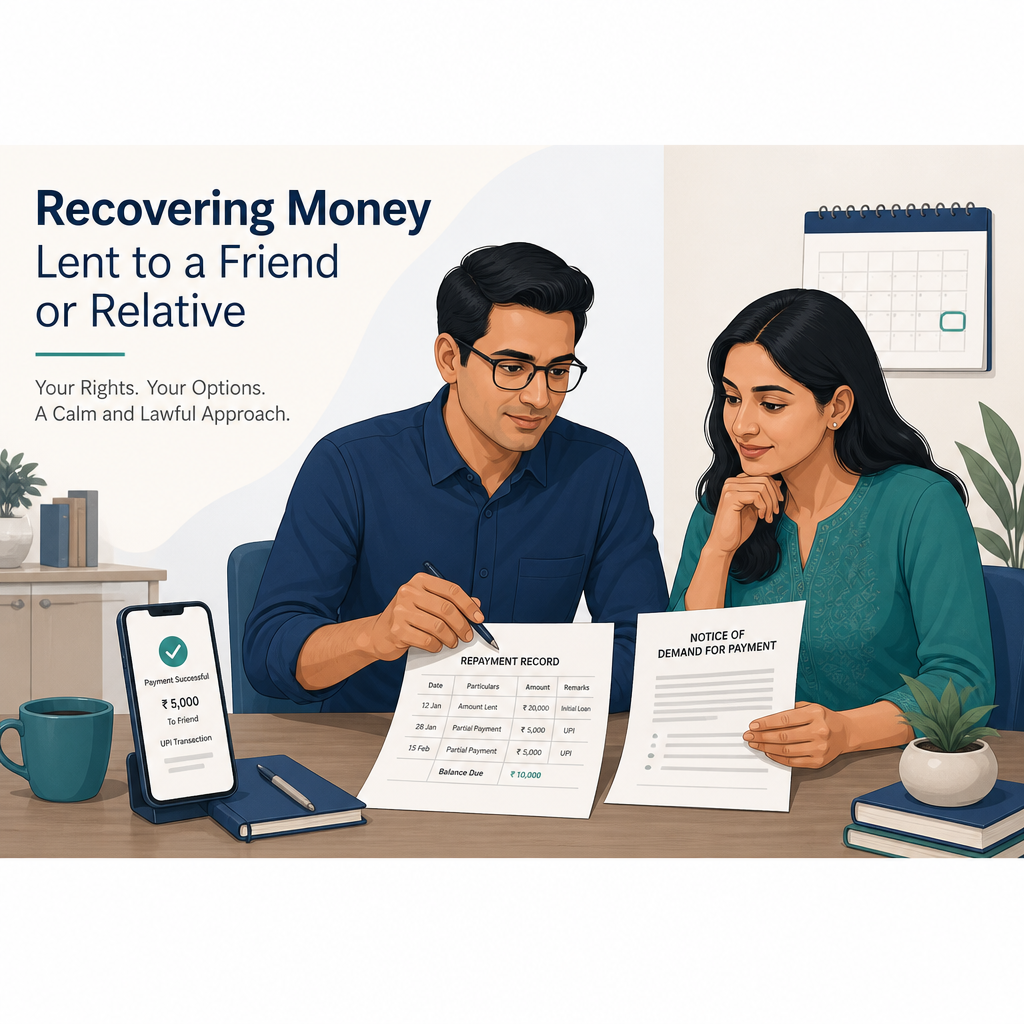
Table of Contents
Table of Contents
Swipe →You lent money because someone needed help. Now the repayment date has passed, your messages are going unanswered, and asking again feels uncomfortable. You do not have to keep relying on reminders alone. This guide will help you gather proof, make a clear demand, understand when a legal notice can help, and choose the right next step if the person still does not pay.
First, work out exactly what you can prove
A friend who owes you money may say, “I never borrowed it,” or “That transfer was a gift.” This is why your first job is not to argue with them. It is to build a clear record showing that you gave them money as a loan, how much remains unpaid, and what was agreed about repayment.
Start with a simple balance sheet
Write down every amount you lent, its date and payment method. Then subtract every repayment you received. Keep this transaction-by-transaction calculation even if you lent the money in several instalments. A demand for an accurate balance is easier for the borrower to understand and harder to dismiss than a rounded figure recalled from memory.
What to collect | Why it helps | If you do not have it |
|---|---|---|
Bank statement, UPI record and transaction ID | Shows when and how money moved | Download the statement or transaction history from your payment app or bank |
Agreement, promissory note or repayment schedule | Helps show that the payment was a loan and when it was due | Look for messages discussing the amount, purpose and repayment promise |
WhatsApp messages, emails and replies to reminders | May show the borrower acknowledging the loan or asking for more time | Preserve the full conversation, not only a screenshot of one favourable line |
Records of part-payments | Help establish the correct outstanding balance | Match each credit to the borrower and the conversation around it |
Borrower’s correct name and address | Needed to send a notice and, if necessary, take further action | Check documents and earlier correspondence before dispatch |
What if it was cash, or nothing was signed?
You can still consider recovery if there is no written agreement. Messages in which the person calls the money a loan, promises to return it or requests extra time may help. A cash lender should also preserve credible evidence of when they had the money, when they handed it over and what the borrower said about repayment. The fewer records you have, the more important it is to avoid overstating your case.
If you are unsure what counts as proof, start with this guide to recovering money without a written agreement. For digital conversations, it also helps to understand how WhatsApp chats can support a recovery case. Do not edit a chat or delete messages that appear unhelpful; the surrounding conversation may matter.
Can one legal notice really get your money back?
It might. A formal notice tells the borrower that you have calculated the debt, have supporting records and expect payment by a stated date. Some people pay, dispute the calculation or propose instalments once the request is put clearly in writing. But a notice cannot itself force repayment. If it is ignored, you may need a negotiated settlement or court action.
What your demand should say
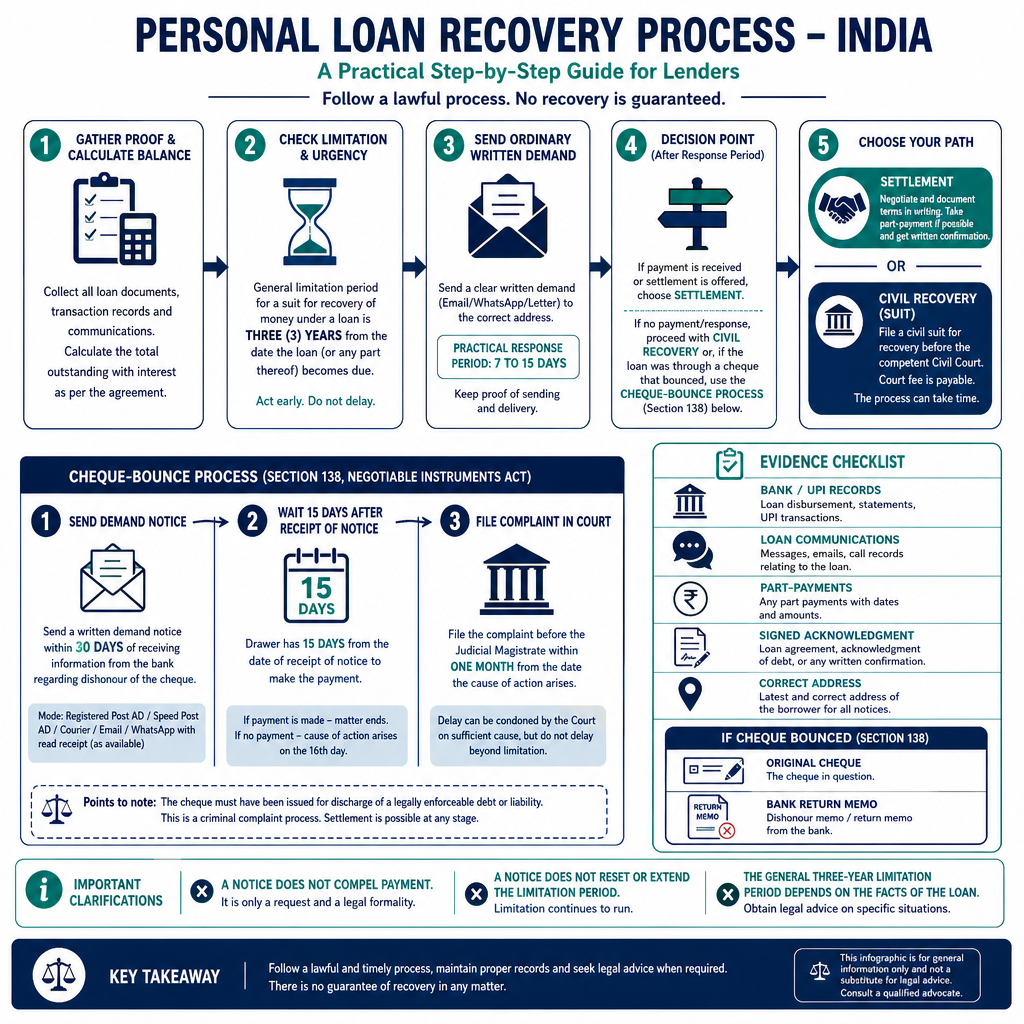
For an ordinary personal loan, a useful notice identifies both parties, lists the lending dates and amounts, explains why the money was a loan, accounts for repayments already made, and states the balance demanded. It should give a reasonable deadline and tell the borrower how to pay or respond. A period of 7 to 15 days is a practical choice for an ordinary demand, not a legal guarantee that the matter will be resolved within that time.
Keep the tone factual. If you agreed to interest or another payment term, state its basis rather than adding a surprising amount to make the notice sound stronger. Check every date and figure before sending it. A notice that demands money already repaid gives the other person an easy reason to challenge you.
Send it in a way you can later prove
Save the signed notice, dispatch details and delivery record. Use the borrower’s correct address; you can also keep copies of any email or message through which you shared the demand. The point is to establish what you asked for and when. For a closer look at the contents and delivery of a personal-loan demand, see how to send a legal notice to a friend.
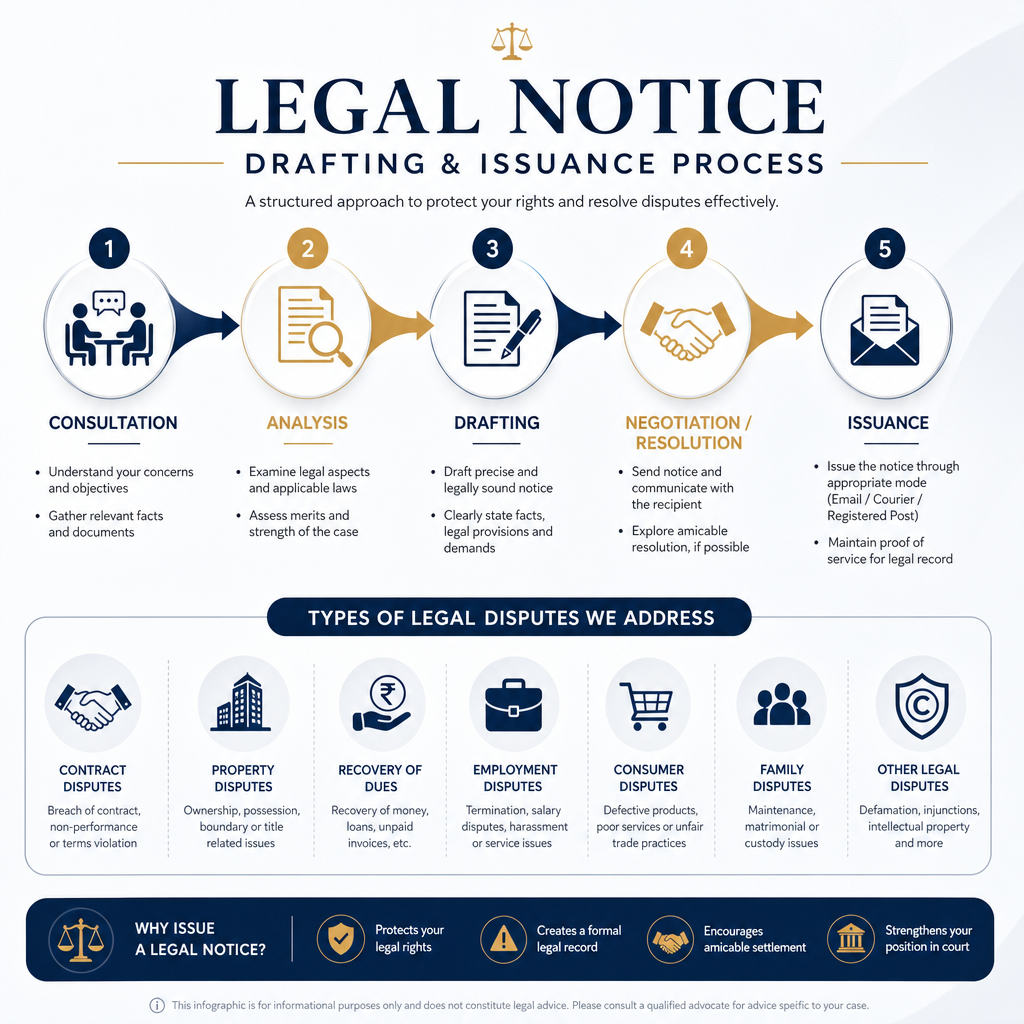
If drafting the notice feels like the hardest part, LegalRecovery’s personal money recovery service covers loans to friends and relatives. You submit the case online; legal experts review it, draft a notice and dispatch it by registered post, followed by follow-up and escalation. Its online case-management process starts at a flat fee of ₹1,499. Ask what that fee covers before proceeding, especially if further action becomes necessary.
Do not let the deadline for a case slip by
When someone keeps promising “next month,” waiting can feel kinder than taking action. It can also put your claim at risk. The Limitation Act, 1963 generally gives three years for a suit to recover money lent, but the date from which that period runs depends on the loan terms and the applicable provision. Do not assume the clock starts only when you finally send a demand.
This matters especially when the loan was described as “payable on demand.” Those words do not automatically mean you can wait indefinitely and start the three-year clock whenever you choose to ask. If you lent money years ago, have the dates and documents checked promptly. A legal notice sent by you does not restart the limitation period.
Can a repayment or written promise give you more time?
Sometimes. Sections 18 and 19 of the Limitation Act can provide a fresh limitation period after a qualifying written, signed acknowledgment of the debt or qualifying part-payment, provided it happens before the existing period expires. Whether a particular message or payment qualifies depends on its details. Do not rely on a vague “I’ll see what I can do” as a safe extension.
If the deadline may be close, prioritise advice about filing a claim over another round of reminders. The guide to money-recovery time limits explains why the original lending date, repayment terms and later acknowledgments all need attention.
Visual Dispute Resolution & Recovery Framework
Was the repayment cheque returned unpaid?
A bounced cheque changes the route you may be able to take. It does not replace the need to prove a legally enforceable debt, but the Negotiable Instruments Act, 1881 provides a specific process for a cheque issued against one. Section 139 also creates a presumption in the holder’s favour, which the drawer may rebut.
Do not use the ordinary 7-to-15-day demand timetable for a cheque-bounce complaint. Section 138 has its own deadlines:
Step | Cheque-bounce deadline | Keep this record |
|---|---|---|
Send the written demand | Within 30 days of receiving bank information that the cheque was dishonoured | Original cheque, bank return memo, notice and dispatch proof |
Allow the drawer to pay | 15 days after they receive the notice | Delivery record and any response or payment |
Consider filing the complaint if unpaid | Generally within one month after the cause of action arises following that 15-day period | Complete cheque and notice records for legal review |
These deadlines apply to the cheque-bounce route, not to every unpaid personal loan. If a cheque has bounced, note the date you received the bank’s dishonour information and seek help without delay. See the cheque-bounce notice timeline before sending a generic demand with the wrong deadline.
What if they ignore the notice or dispute the loan?
Silence is frustrating, but it is useful information: a notice alone has not resolved the matter. Keep its delivery record, note when the response period ended and decide what action makes sense before limitation expires. If the borrower disputes the amount, compare their version with your transaction list. A genuine accounting difference may be easier to settle than a fight over the entire loan.
Offer an instalment plan only if it is clear and recorded
If the person cannot pay at once but is willing to cooperate, propose dates and amounts they can realistically meet. Put the agreed balance, payment schedule and consequences of missed payments in writing, and prefer traceable bank transfers. Do not describe an informal promise as “case closed” while money remains outstanding. If your filing deadline is near, have the settlement terms and limitation position reviewed before relying on them.
Try settlement, then consider the appropriate civil court
You can approach your District Legal Services Authority about referring a pre-litigation dispute to a Lok Adalat. There is no court fee for that process, but a settlement requires agreement from both sides; it is not a way to impose payment on someone who refuses to settle. People who meet the eligibility rules can also request free legal aid.
If settlement fails, a civil recovery suit may be the next step. A summary suit under Order XXXVII of the Code of Civil Procedure may be available for a qualifying written contract, promissory note or other specified fixed-money claim. Otherwise, an ordinary recovery suit may be appropriate. The documents, amount and local court rules affect how and where you file. Courts that have adopted e-filing may allow online submission, but you should not assume that court proceedings will require no attendance.
A disputed case can take months or years, and costs should be considered against the amount owed. That is why a well-supported notice and a realistic settlement offer are worthwhile first steps, provided they do not cause you to miss a filing deadline. If your demand receives no answer, this guide to what to do when a legal notice is ignored can help you organise the next decision.
Is refusing to repay a crime?
Usually, non-payment by itself is a debt dispute, not proof of fraud. A friend may have behaved badly and still not have committed a criminal offence. Alleging cheating simply to frighten someone into paying can distract from the evidence you actually need for recovery.
There are exceptions where the facts support the distinct elements of an offence. Under the Bharatiya Nyaya Sanhita, 2023, cheating may be relevant where evidence shows dishonest intention from the outset; criminal breach of trust has different requirements. If the person asked for a loan intending never to repay, that intention needs evidence. A later inability or refusal to pay does not establish it on its own.
If what happened was online financial fraud rather than a genuine loan that went unpaid, report it promptly at cybercrime.gov.in or by calling 1930. For an ordinary personal loan, those channels are not a substitute for settlement or a civil claim. Likewise, a consumer complaint or an RBI Ombudsman complaint is generally not the route for collecting money lent privately to a friend.
Cash lending brings another concern, but it does not automatically erase every recovery option. In a September 2025 Supreme Court ruling concerning a friendly loan, the Court held that breaching the Income-tax Act’s cash-loan rule did not, by itself, make the debt unenforceable for cheque-bounce purposes. Tax consequences may still arise. If you lent cash, focus on truthful records and get advice on both the proof and the transaction; do not treat that ruling as a reason to skip documentation.
What should you do this week?
You do not need to decide today whether to go to court. You do need to protect your records and dates. Work through these steps in order:
Write down the timeline. Record each lending date, any agreed repayment date, every reminder, part-payment and promise to repay. Mark any cheque dishonour separately.
Calculate the balance. Match money sent against money returned. Set aside documents that show it was a loan, not a gift or investment.
Check urgency. If the loan is old or a cheque has bounced, check the applicable deadline before waiting for another reply.
Make a provable written demand. State the balance and a reasonable deadline. Keep the notice and delivery evidence. Use the statutory cheque-bounce process instead if you intend to rely on it.
Choose the response, not the emotion. If they offer instalments, record the agreement. If they dispute the debt, review the proof. If they ignore you, consider settlement assistance or the appropriate legal claim.
LegalRecovery describes its online notice and follow-up process as five stages: submit your case, receive legal review, have a professional notice drafted and sent by registered post, move through follow-up and escalation, and work towards resolution. You can start that notice process online without visiting a court. If a lawsuit becomes necessary, however, its requirements are separate, and neither a platform nor a notice can promise recovery.
The most helpful move is a manageable one: gather your proof, calculate what is owed and check your deadline. Then you can ask for repayment clearly, knowing what you will do if the answer is still silence.
Popular Searches & Related Topics

Legal Recovery is India's trusted consumer protection and legal tech platform. We specialize in holding corporations accountable for unfair trade practices, deceptive marketing, and commercial fraud. With over 15,000 customers counselled, our mission is to provide fast, out-of-court resolutions by connecting you with top-tier panel advocates for immediate legal action.
Client Reviews
"I had lent money to a friend and was getting vague promises instead of a repayment date. LegalRecovery helped organise the payment records and prepare a clear legal notice. The follow-up helped us agree on a written instalment plan, and I appreciated the straightforward updates."
Aarav Mehta
"My relative had stopped responding about a personal loan. The team explained what documents could support my claim and helped send a properly worded notice. We reached a repayment arrangement after the notice, and the process felt much more manageable."
Priya Nair
"I was unsure how to approach a friend who had not returned the money I lent. LegalRecovery reviewed my transaction details, drafted the demand clearly, and kept me informed about dispatch and follow-up. The borrower responded and started repaying in agreed instalments."
Rohit Sharma
"I wanted a formal way to request repayment from a family member without making unsupported threats. LegalRecovery helped me present the amount and payment history clearly in a legal notice. The guidance on keeping records and documenting the settlement was especially useful."
Sneha Iyer
Frequently Asked Questions
Related Articles
About Author
Team LegalRecovery
View ProfileTeam LegalRecovery is a dedicated team of legal and financial professionals specializing in loan settlement, banking disputes, debt relief, and corporate compliance. We are committed to helping clients achieve debt freedom and business stability through expert strategic advisory.
Connect on LinkedInNeed Legal Help?
Get expert advice on loan settlement, banking disputes and debt relief.
Start Recovery NowRequest Callback