How to Legally Recover Money from a Friend Who Owes You
Claim Your Money Back Using Legal Notices and Recovery Strategies

Table of Contents
Table of Contents
Swipe →Understanding the Dynamics of Friendly Loans
Lending money to a friend can often seem like a noble gesture, a testament to trust and friendship. However, when the time comes to retrieve the loaned amount, and your friend is evasive or unresponsive, it can strain even the strongest of relationships. Friendly loans are typically informal, often lacking written agreements, which makes the recovery process challenging. However, there are legal avenues to explore that can help you reclaim your funds.
The Nature of Friendly Loans
Friendly loans are usually verbal agreements made in good faith. They are meant to help a friend in need without the formalities of interest rates or repayment schedules. However, this informality can lead to complications when the borrower fails to repay. Unlike formal loans, there is often no promissory note or legal documentation, making it harder to prove the existence of the loan in a legal setting.
Common Challenges in Recovering Friendly Loans
The lack of documentation is the primary hurdle in recovering friendly loans. Without a written contract, proving that the money was loaned becomes difficult. Additionally, personal relationships can complicate matters, as the borrower may feel that the loan was a gift rather than a loan. Emotional factors can also deter lenders from taking legal action, fearing the loss of friendship.
Legal Framework for Recovering Money from Friends
Despite the informal nature of friendly loans, the Indian legal system provides mechanisms to recover such debts. Understanding these legal frameworks can empower you to take action confidently.
Using Section 65B of the Indian Evidence Act
Section 65B of the Indian Evidence Act allows for electronic evidence to be admissible in court. If your loan transaction with a friend was communicated or documented via electronic means—such as emails, WhatsApp messages, or UPI transactions—these can serve as evidence. Ensure that all electronic communications are preserved and printed to serve as proof of the loan agreement.
Filing a Summary Suit Under Order 37 of CPC
Order 37 of the Code of Civil Procedure (CPC) provides a mechanism for the swift recovery of debts. This type of suit is beneficial because it limits the defenses available to the defendant, making it harder for them to contest the claim. To file a summary suit, you must ensure that you have some form of written acknowledgment, such as messages or emails that substantiate the debt.
Leveraging Section 138 of the Negotiable Instruments Act
If your friend issued a cheque that bounced, you can invoke Section 138 of the Negotiable Instruments Act. This section criminalizes the act of cheque bouncing and can serve as a strong legal tool to compel repayment. You must send a legal notice to the borrower within 30 days of the cheque bounce, demanding payment within 15 days.
Statutory Recovery Metrics & Resolution Benchmark
Disputes resolved via formal statutory legal demand notices.
Average statutory compliance response timeline.
Mandatory refund of statutory levies under Indian Acts.
Interest compensation claimable under MSME & NI Acts.
Practical Steps to Recover Your Money
Recovering money from a friend doesn't have to ruin your relationship. By following a structured approach, you can maintain decorum while ensuring that your financial interests are protected.
Document All Interactions
Start by documenting every interaction with your friend regarding the loan. This includes text messages, emails, and any form of acknowledgment of the loan. Even if there was no initial documentation, a consistent record of requests for repayment can be powerful evidence.
Send a Formal Legal Notice
Before taking legal action, consider sending a formal legal notice. A legal notice serves as a final warning and a formal request for repayment before proceeding to court. LegalRecovery.in offers services to draft and send these notices, ensuring that they comply with legal standards.
Consider Mediation or Arbitration
Mediation or arbitration can be a less adversarial alternative to court proceedings. Involving a neutral third party can help both parties reach a mutually agreeable solution, preserving the friendship while ensuring repayment.
The Role of LegalRecovery.in in Your Money Recovery Journey
LegalRecovery.in is a modern legal-tech platform that simplifies the process of recovering debts. By leveraging technology, LegalRecovery.in handles the legal complexities, allowing you to focus on other aspects of your life.
How LegalRecovery.in Can Assist You
LegalRecovery.in offers a comprehensive suite of services to help you recover your money. This includes drafting and sending up to three legal notices and filing a legal complaint on your behalf. Their services are designed to be affordable, efficient, and effective, ensuring that you have the best chance of recovering your funds.
Why Choose LegalRecovery.in
Choosing LegalRecovery.in means entrusting your case to experts who understand the nuances of debt recovery. Their team is equipped to handle all types of recovery cases, using technology to streamline the process and increase the chances of success. With LegalRecovery.in, you can recover your money legally and professionally.
Conclusion: Reclaiming Your Peace of Mind and Recovering What is Yours
Recovering money from a friend can be a delicate process, fraught with emotional and legal complexities. However, with the right approach and the support of a reliable legal-tech platform like LegalRecovery.in, you can navigate these challenges effectively. The key is to act promptly, document all interactions, and leverage the legal tools available to you. Remember, reclaiming your money is not just about the financial aspect; it's about ensuring fairness and maintaining the integrity of your relationships.
LegalRecovery.in stands ready to assist you in this journey, providing the expertise and resources needed to recover what is rightfully yours. Whether it's drafting legal notices or filing a complaint, their team is dedicated to ensuring that your rights are upheld and your financial interests are protected.
Don't let unpaid debts disrupt your peace of mind. Take action today and start your recovery journey with LegalRecovery.in. With their support, you can recover your funds legally and efficiently, restoring balance and trust in your financial dealings.
Start Your Recovery Today by contacting LegalRecovery.in and take the first step towards reclaiming your peace of mind.
Disclaimer: The legal information provided in this article is for educational and informational purposes only and does not constitute formal legal advice. Please consult with a qualified legal professional or use a structured legal-tech service like LegalRecovery.in for your specific legal case.
Popular Searches & Related Topics

Legal Recovery is India's trusted consumer protection and legal tech platform. We specialize in holding corporations accountable for unfair trade practices, deceptive marketing, and commercial fraud. With over 15,000 customers counselled, our mission is to provide fast, out-of-court resolutions by connecting you with top-tier panel advocates for immediate legal action.
Client Reviews
"LegalRecovery.in made the process of recovering my money from a friend seamless and efficient. Highly recommended!"
Amit
"I was able to get my loaned money back quickly with the help of LegalRecovery.in. Excellent service!"
Priya
"The team at LegalRecovery.in was professional and supportive throughout the recovery process. Great service!"
Rohan
Frequently Asked Questions
Related Articles
How Can I Get Back Money Someone Owes Me in India?
If a friend or relative keeps delaying repayment, learn what proof to preserve, how to make a demand, and when to act.
Read Article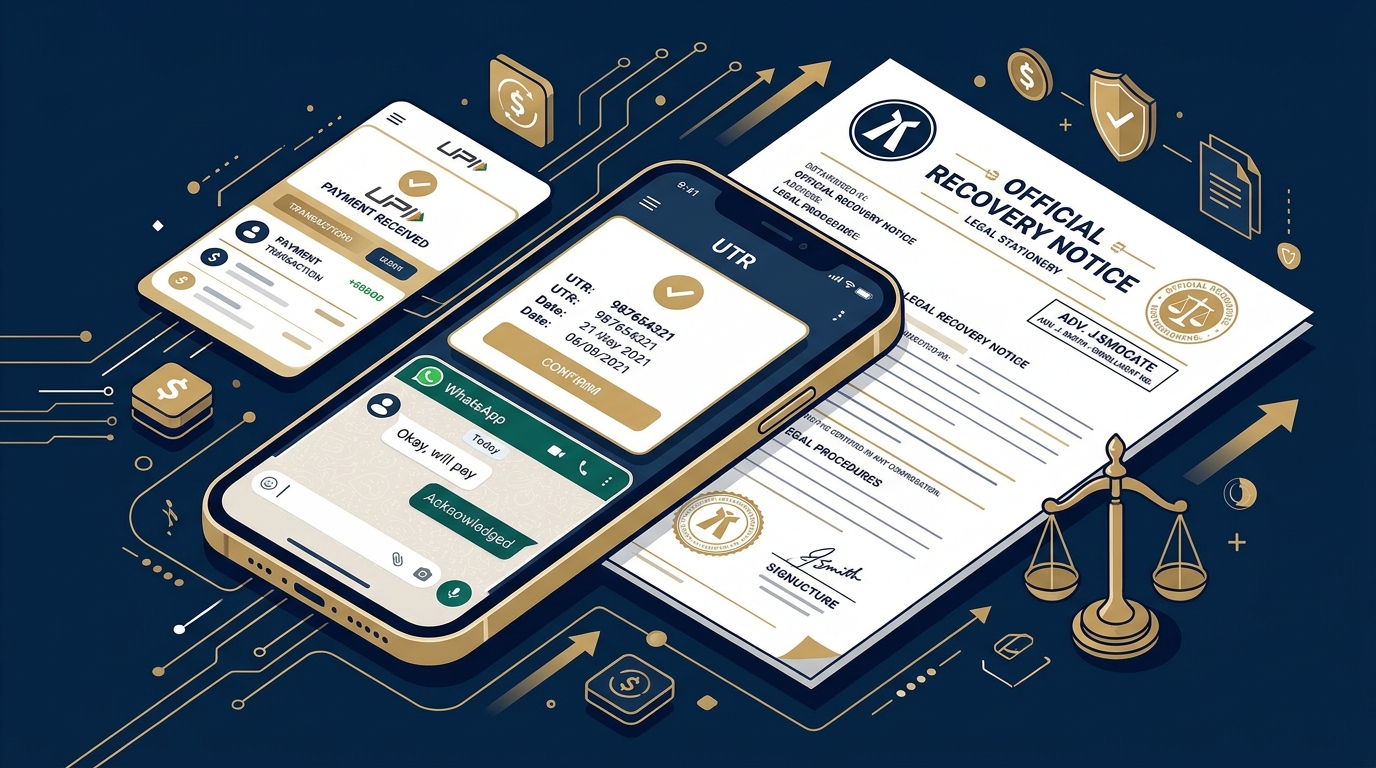
How to Recover Money Lent to a Friend via UPI or GPay (2026)
recover money from friend sent via upi without agreement, how to recover money from friend legally in india, gpay transaction proof for money recovery case, section 63 bharatiya sakshya adhiniyam whatsapp evidence, legal notice to friend for money recovery, friendly loan recovery without promissory note, section 70 indian contract act non gratuitous transfer, upi utr number evidence civil recovery, order 37 cpc summary suit friendly loan, admissions trap legal notice strategy, section 18 limitation act acknowledgment of debt
Read Article
How to Recover Money Owed to You in India
The right next step depends on why the money is owed, who owes it and which forum can hear your claim.
Read Article
How a Money Recovery Lawyer in India Can Help You Recover Money
The right process depends on who owes you money, what proves it, and which forum can order repayment.
Read ArticleAbout Author
Anuj Anand Malik
View ProfileAnuj Anand Malik, Founder of AMA Legal Solutions, is a trusted advocate, loan settlement expert, legal advisor, and banking lawyer. With over a decade of experience in loan settlement, corporate law, financial disputes, and compliance, he leads a result-driven law firm based in India that helps individuals, startups, and businesses achieve legal and financial stability.
Connect on LinkedInNeed Legal Help?
Get expert advice on loan settlement, banking disputes and debt relief.
Start Recovery NowRequest Callback