Can You Get Your Money Back After Being Scammed?
Explore Legal Steps to Recover Funds from Scammers
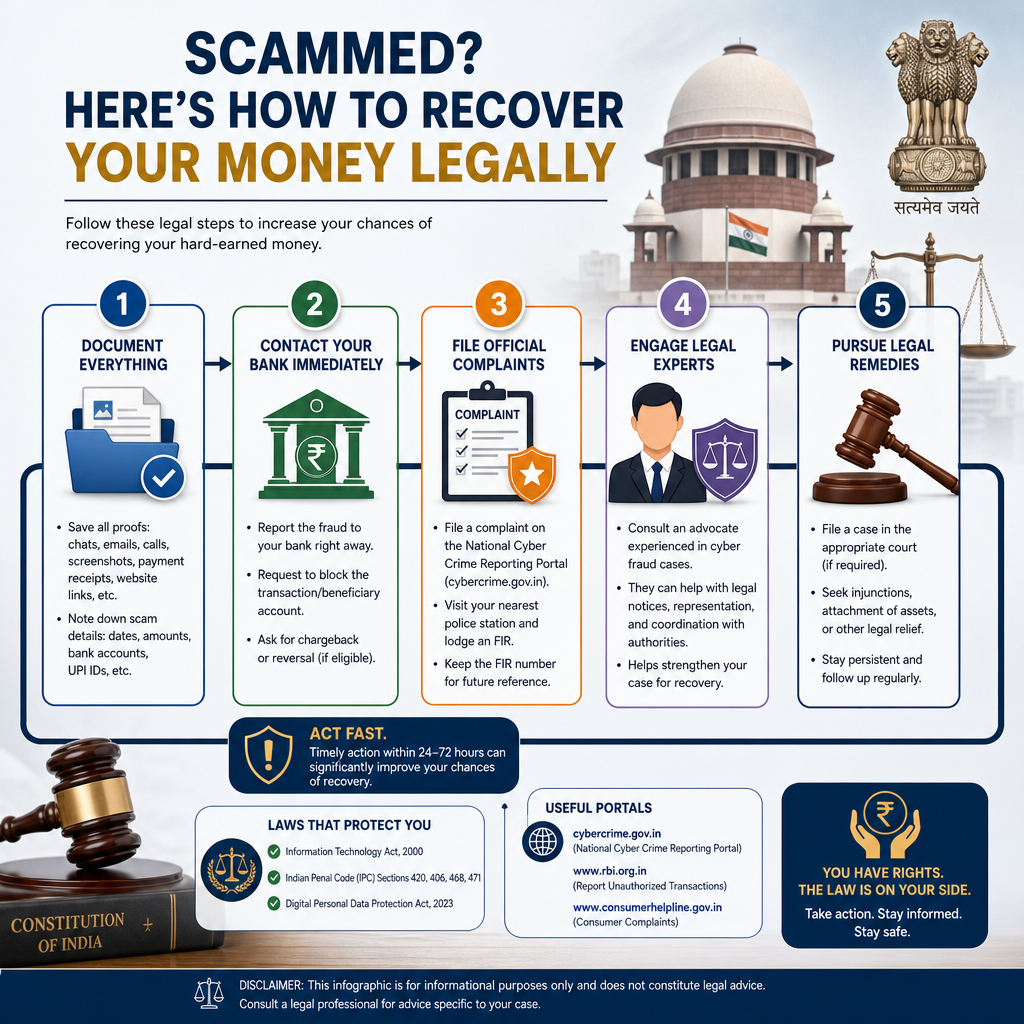
Table of Contents
Table of Contents
Swipe →Can You Get Your Money Back After Being Scammed? The Ultimate Legal and Practical Recovery Guide
Falling victim to a financial scam is an incredibly distressing experience. In the immediate aftermath, a wave of confusion, anger, and panic typically sets in. The absolute first question that flashes across every victim's mind is a critical one: can you get your money back after being scammed?
The short, definitive answer is yes, it is legally and practically possible to recover your money after being scammed, but your success depends heavily on time, precision, and using the right legal channels.
+-----------------------------------------------------------------------------------+
|                           CRITICAL SCAM RECOVERY TIMELINE                         |
+-----------------------------------------------------------------------------------+
|   0 - 2 Hours: "The Golden Hour" -> Call 1930 & notify bank to freeze the funds.  |
|   Within 24 Hours: File formal cyber complaint at cybercrime.gov.in.             |
|   Within 48 Hours: Visit your bank branch to submit an unauthorized dispute form. |
|   Beyond 48 Hours: Issue formal Legal Notices & pursue statutory recovery actions.|
+-----------------------------------------------------------------------------------+
With the rapid expansion of UPI, digital wallets, and online payment mechanisms across India, financial frauds have grown increasingly sophisticated. Scammers deploy advanced psychological manipulation, structural spoofing, and intricate routing networks to siphon away hard-earned money.
Navigating the landscape of recovery requires a comprehensive approach. It involves a deep understanding of banking regulations, cybercrime frameworks, consumer rights, and civil litigation strategies.
Whether you are dealing with a complex digital payment fraud, a commercial vendor dispute, or a personal transaction gone wrong, this detailed guide provides the strategic legal pathways to reclaim what is rightfully yours.
Understanding the Landscape of Financial Scams and Your Recovery Rights
To determine exactly how can you get your money back after being scammed, it is necessary to first classify the specific type of fraud you have encountered. Different financial scenarios fall under distinct legal frameworks and statutory remedies in India.
For instance, when a scam involves unauthorized digital transfers, it is governed primarily by banking regulations and cyber law. On the other hand, if a corporate entity or developer fails to deliver on a contractual obligation, it becomes a consumer or commercial dispute.
Common Categories of Financial Scams Covered in this Guide
Cyber Frauds & Digital Payment Scams: These encompass malicious phishing links, UPI address spoofing, identity theft, fake customer care interactions, and investment or Ponzi schemes executed via digital channels.
Commercial and Consumer Contract Violations: This involves situations where money is voluntarily transferred to a verified vendor, builder, or service provider, but they completely fail to fulfill their obligations or intentionally vanish with the funds.
Peer-to-Peer and Employment Frauds: These include situations ranging from salary non-payments by employers to individuals refusing to return substantial personal loans.
To explore the full spectrum of recovery options tailored to specific legal disputes, you can review our extensive list of dedicated services.
Can You Get Your Money Back After Being Scammed? The Legal Reclaim Framework
When evaluates whether can you get your money back after being scammed, the primary legal answer rests upon the laws governing electronic transactions, data security, and consumer protection in India. Your right to restitution is protected by clear statutory provisions.
1. The Legal Base: Information Technology Act, 2000
The primary legislative weapon against online scamming is the Information Technology Act, 2000 (specifically Sections 43A, 66C, and 66D). These sections prescribe severe criminal penalties for identity theft, cheating by personation using computer resources, and computer database breaches. Crucially, they establish that cyber fraud is a recognized criminal offense, giving law enforcement agencies the mandate to trace and freeze illicitly moved funds.
2. The Banking Defense: RBI's Consumer Liability Protections
The Reserve Bank of India (RBI) regularly updates its directives on customer liability for unauthorized electronic banking transactions. Under the latest consolidated guidelines, a victim’s liability can be reduced to zero under specific conditions:
Zero Liability: If the scam or breach occurs due to a systematic deficiency or negligence on the part of the bank, the customer has absolute zero liability, regardless of whether they report it or not.
Third-Party Breach Reversals: If a third-party breach occurs where neither the bank nor the customer is at fault, the customer still enjoys zero liability—provided they report the unauthorized transaction to the bank within 3 working days of receiving the transaction alert.
Limited Liability Window: If you report the scam within 4 to 7 working days, your maximum liability is capped at nominal amounts (ranging from ₹5,000 to ₹25,000 depending on the account type), with the remaining balance eligible for a reversal.
+-----------------------------------------------------------------------------------+
|                     RBI CUSTOMER LIABILITY TIERS AT A GLANCE                      |
+-----------------------------------------------------------------------------------+
| Reporting Windows   | Source of Security Breach          | Maximum Liability      |
+---------------------+------------------------------------+------------------------+
| Any Time            | Bank Negligence / System Error     | Zero Liability         |
| Within 3 Days       | Third-Party Fraud (No User Fault)  | Zero Liability         |
| 4 to 7 Days         | Third-Party Fraud (No User Fault)  | Capped (Max ₹25,000)   |
| Beyond 7 Days       | Third-Party Fraud (No User Fault)  | Subject to Bank Policy |
+---------------------+------------------------------------+------------------------+
3. The Consumer Shield: Consumer Protection Act, 2019
If your financial loss stems from a commercial entity, online store, e-commerce site, or service provider that misled you, your recovery pathway is governed by the Consumer Protection Act, 2019. The Act protects you against "unfair trade practices" and "deficiencies in service." This gives you the right to file an absolute claim for a complete refund alongside heavy interest and emotional distress damages.
Step-by-Step Practical Guidance to Get Your Money Back
If you have been scammed, you must act systematically. Following a structured sequence maximizes the likelihood of successfully tracing, freezing, and recovering your lost assets.
+------------------------------------------------------------------------------------+
|                             IMMEDIATE RECOVERY SEQUENCE                            |
+------------------------------------------------------------------------------------+
|  [Step 1: Emergency Freeze]                                                        |
|  Call 1930 / Dial Bank Support -> Initiate Immediate Lien Protocol                 |
|         │                                                                          |
|         ▼                                                                          |
|  [Step 2: Cyber Portal Filing]                                                     |
|  Log onto cybercrime.gov.in -> Upload Transaction Records & Obtain Formal NCRP acknowledgement |
|         │                                                                          |
|         ▼                                                                          |
|  [Step 3: Bank Reversal Claim]                                                     |
|  Submit Written Dispute Form -> Secure Provisional Credit via Section 76 M/N Rules  |
|         │                                                                          |
|         ▼                                                                          |
|  [Step 4: Formal Legal Demands]                                                    |
|  Serve Binding Legal Notice -> Initiate Civil Recovery under Order 37 of CPC       |
+------------------------------------------------------------------------------------+
Step 1: Execute an Emergency Freeze within the "Golden Hour"
The first two hours following a financial scam are known as the Golden Hour. During this brief window, the stolen funds usually sit in the primary mule account or are in transit within the banking network before being systematically layered or withdrawn via ATMs.
Call 1930 Immediately: The National Cyber Crime Helpline (1930) operates a real-time citizen financial cyber fraud tracking module. When you call, the operator takes your account details and the transaction ID, coordinates with the bank's nodal officer, and places an immediate lien (freeze) on the funds in the suspect's destination bank account.
Contact Your Bank's Fraud Wing: Call your bank’s dedicated emergency fraud hotline or log into your mobile application to freeze your cards, net banking access, and UPI profiles immediately. Request the bank to issue an tracking ticket for the unauthorized transaction.
Step 2: File an Official Cybercrime Complaint
Once the initial phone calls are made, you must formalize the incident on the central portal.
Go to the official National Cyber Crime Reporting Portal.
Register your account and select "Report Financial Fraud."
Provide precise transaction markers: UTR (Unique Transaction Reference) numbers, dates, times, exact beneficiary bank account numbers, and any suspected phone numbers or URLs.
Download the generated National Cyber Crime Report acknowledgement PDF. This document serves as primary legal proof for all subsequent banking and judicial actions.
Step 3: File a Formal Written Dispute and Claim Reversal at Your Bank
Do not rely entirely on phone calls or online forms. Visit your bank's home branch physically within 48 hours of the incident.
Submit a written application detailing the fraud, accompanied by the printout of your Cyber Crime Portal acknowledgement.
Fill out the bank's official Customer Dispute Form or Unauthorised Electronic Transaction Form.
Formally request a provisional credit of the scammed amount to your account while their internal investigation plays out, citing the RBI guidelines on limited customer liability.
Step 4: Issue a Binding Legal Notice to the Counterparty
In cases where the scammer’s identity is known, or where a platform, merchant, or individual has taken your money under false pretenses, criminal portals alone may not recover your funds. You need to initiate a formal legal action.
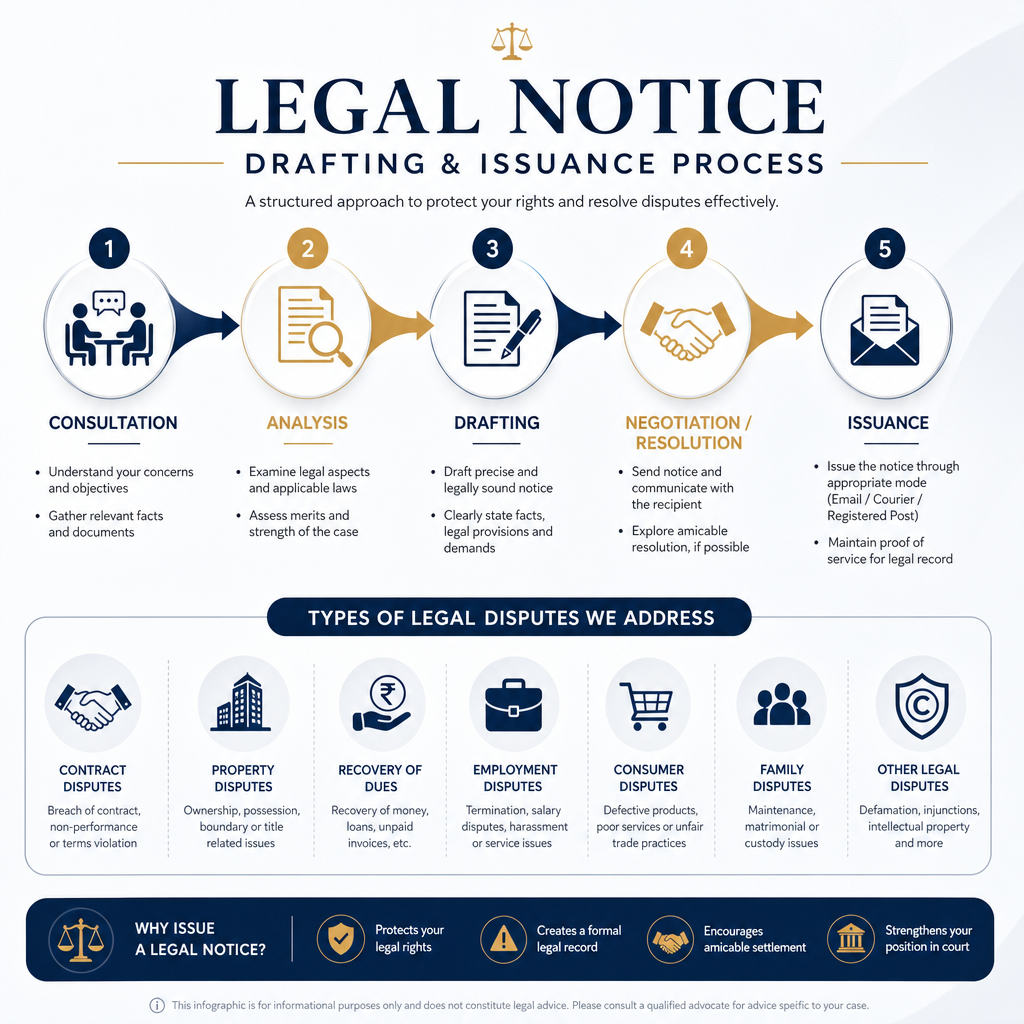
Serving a legally sound, strategically drafted Legal Notice is often the most efficient way to prompt swift settlement. A legal notice signals that you are prepared to pursue civil and criminal litigation, which frequently compels scammers or non-compliant vendors to return the money immediately to avoid legal escalations.
How Legal Recovery Can Help in Sending a Legal Notice to Recover From a Scammer
When you are stranded wondering can you get your money back after being scammed, handling the legal machinery on your own can feel overwhelming. Scammers and fraudulent entities rely heavily on public hesitation to pursue litigation.
This is where Legal Recovery steps in to level the playing field. We specialize in handling complex financial recovery, asset tracking disputes, and deploying legal notice protocols to reclaim your stuck funds.
+----------------------------------------------------------------------------------------+
|                             LEGAL RECOVERY NOTICE CAMPAIGN                             |
+----------------------------------------------------------------------------------------+
|  [Victim Strategy Intake] -> [Evidence Mapping & Drafting] -> [Official Notice Service] |
|                                                                       │                |
|  [Reversal / Restitution] <--- [Pre-Litigation Settlement Mandate] <───┘                |
+----------------------------------------------------------------------------------------+
Strategic Case Assessment and Evidence Mapping
Our legal team assesses your transaction records, communications, and available identification data. We map out the exact statutory infractions committed by the scammer under the Information Technology Act, the Indian Penal Code (or Bharatiya Nyaya Sanhita), and relevant consumer protection laws.
Drafting and Serving an Enforceable Legal Notice
A casual email demand or text message can be easily ignored. A formal Legal Notice issued on an established legal letterhead cannot. Legal Recovery helps you draft and send a highly authoritative legal notice to the scammer or non-compliant entity.
This notice clearly outlines:
The exact facts of the financial fraud or contractual default.
The specific provisions of law violated by their actions.
A strict 15-day ultimatum to return the scammed amount in full.
A clear warning of impending civil recovery suits and criminal prosecution if they fail to comply.
Managing Pre-Litigation and Settlement Negotiations
Often, when a scammer, fraudulent vendor, or defaulting platform receives a formal legal notice, they realize the risks of escalating the matter. Our legal professionals handle all communication and settlement negotiations with the opposing counterparty, ensuring a secure timeline for your money to be transferred back to your account.
To learn more about our operational ethos, corporate standards, and track record in debt and fraud restitution, read more about us. To understand exactly how we manage a case from asset intake to final settlement, check our detailed guide on how it works.
Statutory Recovery Metrics & Resolution Benchmark
Disputes resolved via formal statutory legal demand notices.
Average statutory compliance response timeline.
Mandatory refund of statutory levies under Indian Acts.
Interest compensation claimable under MSME & NI Acts.
Sector-Specific Fraud Paradigms and Targeted Recovery Solutions
Financial scams are not uniform. The strategy required to recover your money depends on the specific context of the transaction. Below, we break down specific recovery strategies across different financial sectors.
+------------------------------------------------------------------------------------+
|                         RECOVERY PATHWAYS BY FRAUD TYPE                            |
+------------------------------------------------------------------------------------+
|  Employment/Salary Scams   ───> Summary Suits (Order 37 CPC) & Labour Commissioner  |
|  E-Commerce/Refund Frauds  ───> INGRAM Portals & State Consumer Commissions        |
|  Real Estate/Builder Scams ───> RERA Statutory Claims & NCLT Insolvency Filings    |
|  Freelance/B2B Invoices    ───> MSMED Arbitration & Commercial Court Petitions     |
|  Personal Loan Defaults    ───> Negotiable Instruments Act (Sec 138) / Civil Suits |
+------------------------------------------------------------------------------------+
1. Corporate and Employment Frauds
Many job seekers fall victim to employment scams that demand upfront "security deposits" or processing fees for fake job placements. Similarly, freelancers and employees often face situations where employers withhold their earned wages.
If an organization has scammed you out of your hard-earned wages or job deposits, you can pursue dedicated legal remedies through our framework for the recovery of salary and employment dues.
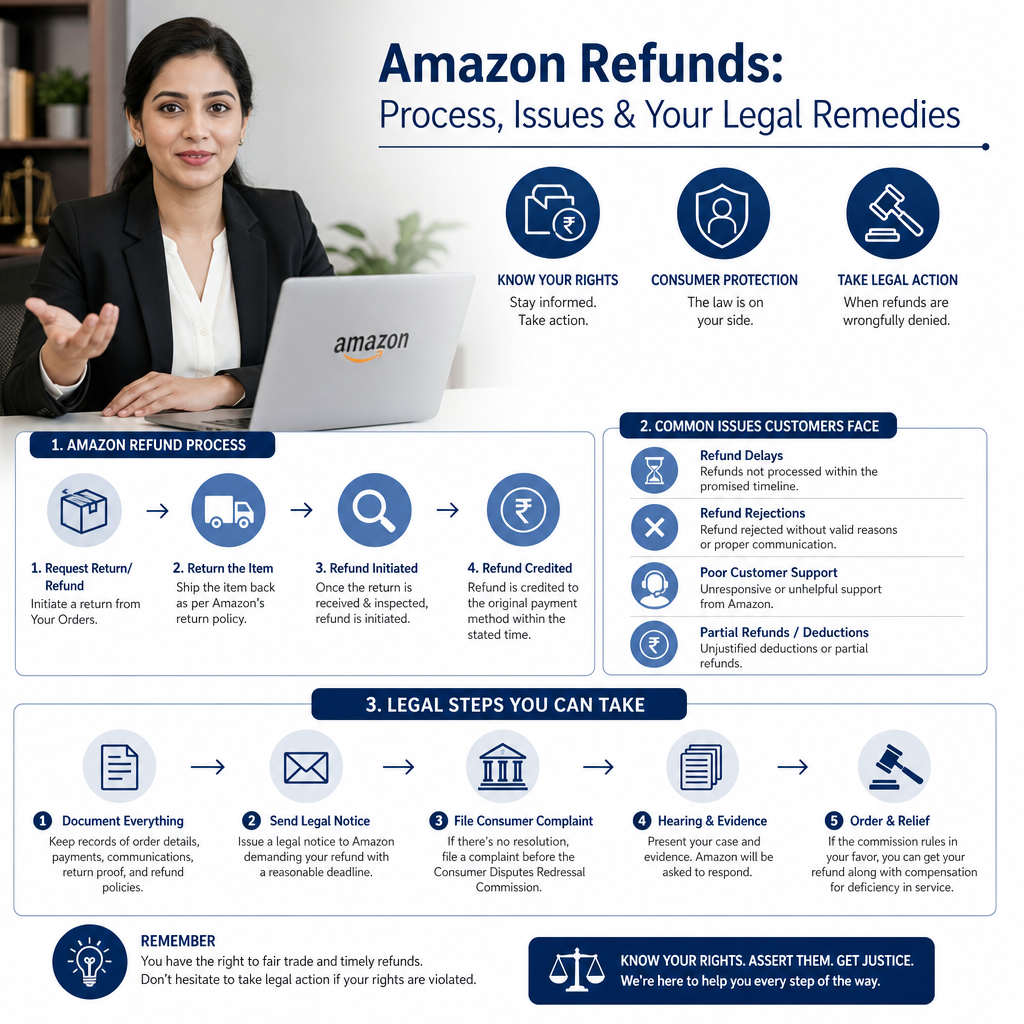
2. Consumer E-Commerce and Digital Purchase Scams
This category covers situations where an online platform charges you for goods or services, delivers counterfeit items, or refuses to issue a valid refund, effectively scamming you under the guise of an e-commerce transaction.
Your recovery pathway here involves leveraging the Central Consumer Protection Authority (CCPA) and filing specific claims for refunds and consumer complaints.
3. Tenant Landlord and Rental Scams
Rental scams often involve fake landlords who demand advance booking amounts for properties they do not own, or actual landlords who illegally withhold substantial security deposits at the end of a lease term.
To challenge these wrongful retentions, you can utilize our legal frameworks for security deposits and rental recoveries.
4. Freelancer and Client Payment Defaulters
Independent contractors and digital creators are frequently targeted by scam clients who request extensive project deliverables and then disappear or block all communication channels without clearing invoices.
To protect independent professionals, we provide dedicated mechanisms for the recovery of freelancer and client payments.
5. Peer-to-Peer Financial Deceptions
This common issue involves lending substantial funds to an acquaintance, friend, or relative based on personal trust, only for them to avoid communication or refuse to return the money once the agreed-upon period ends.
When personal agreements are broken, you can initiate formal legal actions through our guidelines on the recovery of money from a friend.
6. Airline, Hospitality, and Travel Scams
These scams involve fraudulent booking portals, fake flight aggregators, or airlines that cancel operations and withhold refunds through deceptive fine-print clauses.
You can pursue institutional recovery by using our services for airline and travel recoveries.
7. B2B Vendor and Corporate Invoice Defaults
In commercial sectors, unscrupulous vendors or corporate buyers may accept raw materials or services and systematically default on their invoices, severely impacting your business cash flow.
Commercial recovery requires an aggressive legal strategy. You can deploy our specialized services for vendor and invoice recoveries.
8. Real Estate, Builder, and Property Disputes
Real estate scams are among the most financially devastating, often involving builders who collect massive advance bookings and then indefinitely delay construction or abandon projects entirely.
Property recovery requires leveraging statutory real estate frameworks. You can review our legal pathways for property and builder disputes.
For a comprehensive look at real-world recovery case studies, statutory legal updates, and actionable guides on combatting digital financial fraud, visit our legal informational repository at our official blog.
Comprehensive Analytical Comparison of Recovery Mechanisms
To choose the right approach for your situation, it helps to compare the primary legal and institutional recovery methods available in India based on processing speeds, optimal use cases, and jurisdictional reaches.
Recovery Vector | Primary Target | Estimated Resolution Time | Jurisdictional Reach | Key Prerequisite Document |
National Cyber Helpline (1930) | Online Banking, UPI, Wallet Fraud | 2 to 48 Hours (Account Freeze Window) | Pan-India Financial Networks | Transaction UTR Number / Bank Statement |
RBI Banking Ombudsman (CMS Portal) | Bank Deficiencies, Delayed Reversals | 30 to 45 Days | All Regulated Indian Banks & NBFCs | Bank Dispute Rejection / 30-Day No-Response |
Pre-Litigation Legal Notice | Known Defaulters, Vendors, Firms | 15 to 30 Days | Universal (Individual or Corporate Entities) | Written Proof of Debt or Digital Evidence |
Consumer Forums (NCDRC/State Commissions) | E-commerce Frauds, Service Deficiencies | 3 to 6 Months | Based on Claim Valuation Limits | Invoice, Receipts, Proof of Interaction |
Summary Suit (Order 37, CPC) | Unpaid Invoices, Promissory Notes, Cheques | 6 to 12 Months | Competent Civil Jurisdictions | Signed Written Contracts, Dishonoured Cheques |
Key Takeaways: Protecting Yourself Against Future Scams
While knowing how can you get your money back after being scammed is vital, preventing financial fraud in the first place is always the safest approach. Incorporate these security habits into your daily digital routine:
Enforce the 24-Hour Cool-Off: When adding a new beneficiary on net banking or a UPI application, enforce a strict waiting period before executing large transfers.
Verify Merchant Domains: Always look closely at payment gateways and e-commerce URLs. Scammers often use subtle typos (e.g., swapping "l" for "1") to mimic trusted banking portals.
Never Share Your OTP or Access Credentials: No legitimate bank official, customer service representative, or legal authority will ever ask for your PIN, password, or One-Time Password (OTP).
Use Documented Agreements: Avoid making substantial financial transfers based on verbal promises alone. Ensure every transaction is backed by a written agreement, invoice, or receipt.
Conclusion: Take Action with Legal Recovery to Reclaim Your Funds
Falling victim to a scam can be a destabilizing experience, but you do not have to navigate the recovery process alone. As we have covered throughout this guide, the answer to can you get your money back after being scammed is an absolute yes—provided you act quickly and leverage the appropriate legal tools. Whether your situation requires a real-time cyber freeze, an institutional banking escalation, or a binding legal demand, taking a structured approach is the key to a successful recovery.
Time is your most valuable asset when dealing with financial fraud. Delays give scammers more opportunities to layer, transfer, or withdraw your stolen funds, making recovery significantly more challenging. Initiating immediate action through authorized legal and institutional channels is the most effective way to protect your financial rights and recover your capital.
If you are dealing with a fraudulent vendor, an unresponsive platform, an uncooperative debtor, or a complex financial scam, let our team of legal strategists help you. We can draft and serve an authoritative legal notice to the counterparty, manage all communications, and pursue every available legal avenue to recover your funds.
Don't let scammers walk away with your hard-earned assets. Contact us today through our official contact page to schedule a detailed assessment of your case and start your journey toward recovery.
Popular Searches & Related Topics

Legal Recovery is India's trusted consumer protection and legal tech platform. We specialize in holding corporations accountable for unfair trade practices, deceptive marketing, and commercial fraud. With over 15,000 customers counselled, our mission is to provide fast, out-of-court resolutions by connecting you with top-tier panel advocates for immediate legal action.
Client Reviews
"Legal Recovery helped me get back a significant amount of money from an online investment scam. Their expertise and support were invaluable throughout the process."
Rahul Sharma
"I was a victim of a job-related scam and thought my money was gone forever. Thanks to Legal Recovery, I received a full refund. Highly recommend their services!"
Sneha Patel
"The team at Legal Recovery guided me efficiently through the legal maze after an online fraud incident. Their attention to detail and dedication were impressive."
Arjun Verma
"After discovering a scam, I was lost and anxious. Legal Recovery was quick to respond and took the necessary legal actions for me. Truly grateful for their help."
Priya Kumar
"Professional and knowledgeable, Legal Recovery provided me with the confidence and support needed to tackle a complex scam case. Their service exceeded my expectations."
Vikram Mehta
Frequently Asked Questions
Related Articles
About Author
Team LegalRecovery
View ProfileTeam LegalRecovery is a dedicated team of legal and financial professionals specializing in loan settlement, banking disputes, debt relief, and corporate compliance. We are committed to helping clients achieve debt freedom and business stability through expert strategic advisory.
Connect on LinkedInNeed Legal Help?
Get expert advice on loan settlement, banking disputes and debt relief.
Start Recovery NowRequest Callback