My Money Is Stuck: How Can I Get It Back in India?
Practical steps for recovering unpaid salary, refunds, deposits, invoices, personal loans and builder payments in India.

Table of Contents
Table of Contents
Swipe →When money you are owed does not arrive, it can be hard to know whether to send another message, make a complaint or speak to a lawyer. You do not have to work out every legal option today. Start by identifying why the money is stuck, putting your proof in one place and making a clear request for payment. This guide shows you how to do that, when a legal notice may help and where to go if the other side still refuses to pay.
First, work out what kind of payment is stuck
The right next step depends on who owes you money and why. An employer withholding salary, a seller delaying a refund and a landlord retaining a deposit may all say “please wait”, but they do not lead to the same complaint process. If you choose the wrong route, you can lose time without getting closer to payment.
Your situation | What to check first | A sensible starting point |
|---|---|---|
Unpaid salary or final settlement | Salary slips, employment terms, exit emails and the amount due | Write to HR or the employer with an itemised demand |
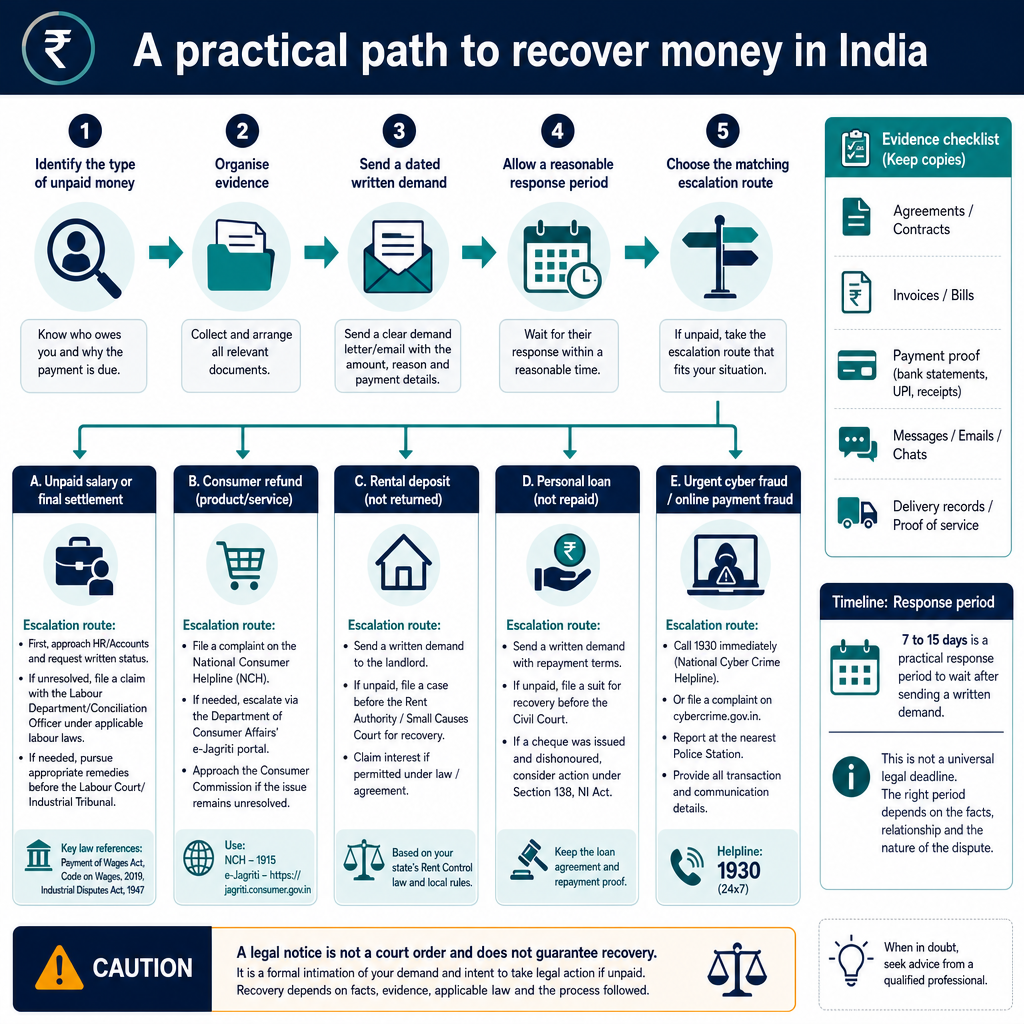
Refund for a product or paid service | Order details, cancellation terms, delivery status and refund promises | Complain to the seller or platform, then consider the National Consumer Helpline |
Rental or PG security deposit | Agreement, move-out date, condition of the property and claimed deductions | Ask the landlord or operator for a written deduction breakdown and the balance |
Money lent to someone personally | Transfer proof, chats showing it was a loan and any repayment date | Send a factual repayment request before considering a civil claim |
Do not assume every dispute belongs in a consumer commission. Paying for goods or services is different from lending money to a friend. Likewise, a landlord’s deposit dispute may need a different route from a complaint about an undelivered online order. If you are dealing with a withheld salary or final settlement, start with the employment record. For a seller refusing a refund, start with the order and payment record. For a deposit your landlord has kept, start with the rental terms and move-out evidence.
One urgent exception: if someone tricked you into transferring money, do not wait to send an ordinary demand notice. Call the cybercrime helpline on 1930, take immediate steps to prevent further loss and complete a report at cybercrime.gov.in. Acting quickly may help authorities stop funds moving, although reporting does not guarantee recovery.
Get your proof together before sending another reminder
You do not need a perfect contract to begin. You do need a clear account of what happened. Gather anything that shows the amount paid or earned, why it should come back to you and what the other person has said about paying it. Put the records in date order so that someone unfamiliar with the dispute can understand it quickly.
For salary: Keep your offer letter, salary slips, attendance or work records, resignation or termination correspondence and final-settlement calculation.
For a refund: Save the invoice, order confirmation, cancellation request, return tracking, applicable terms and messages promising a refund.
For a deposit: Keep the rent agreement, proof of deposit, move-out messages, handover receipt and photographs showing the property’s condition.
For any payment: Save the transaction reference or UTR, relevant account statement, emails, chats and complaint numbers.
Write a simple timeline alongside those documents: “Paid ₹20,000 on 4 June; cancelled on 6 June; refund promised by 20 June; followed up on 25 June.” That is more useful than forwarding a long, unsorted chat. If the other side says you damaged a room or failed to finish work, include their explanation and your response. A fair account helps you spot what is actually disputed.
Is a WhatsApp conversation enough?
A chat can help show that money was owed, especially if it identifies the amount, reason and repayment promise. It is stronger when it matches a payment record and other documents. Export the conversation, preserve the original on your phone and avoid cropping away dates or context. If you lent money without a written agreement, do not give up simply because you have no signed paper; look for messages acknowledging that it was a loan rather than a gift.
Also check your arithmetic now. Separate the amount definitely owed from any interest, damages or disputed deductions you might want to claim. An accurate, explainable demand is easier for the other side to resolve and easier to take forward if they refuse.
Make one clear written request for repayment
Repeated calls can feel productive, but they are difficult to prove later. Once your documents are ready, send a dated request by email or another channel you can preserve. Keep it calm and specific, even if you have already been ignored. The aim is to give the other side a fair opportunity to pay and to leave a reliable record of your demand.
Identify the payment: the amount, the date and why it is due.
State what has happened so far, including any refund or repayment promise.
Ask for payment to a specified account or payment method by a specific date.
Request a written explanation and supporting documents for any amount they dispute.
Save your message, attachments and proof of delivery.
For example: “My ₹15,000 security deposit became refundable when I handed over the flat on 2 August. You have proposed a ₹3,000 deduction but have not shared a bill or explanation. Please send the deduction details and return the balance by 12 August.” Change the wording to fit your facts. Do not claim a deduction is unlawful before you have checked the agreement and the reason given.
For an ordinary civil or consumer demand, allowing around 7 to 15 days is often a practical choice. It is not a universal legal deadline, and no general rule says the recipient must reply or pay within that period. If your employer provides a calculation showing that part of your final settlement is disputed, ask them to identify each item. If a seller says a refund has been issued, ask for the transaction reference rather than starting the same conversation again.
A phone call may still help settle matters. Afterward, send a short written summary: “As discussed today, you said the refund will be processed by Friday.” If that account is wrong, the other side has an opportunity to correct it. You are building a usable record, not trying to turn every conversation into an argument.
Visual Dispute Resolution & Recovery Framework
Would a legal notice help if they keep delaying?
If a reasonable written request brings only silence or shifting promises, a legal notice can be the next step. It sets out your claim formally: who owes the money, the documents supporting it, the amount demanded, where payment should go and what action you may consider if the matter remains unresolved. It can show that you are serious without requiring you to file a case immediately.
A notice is not a court order. Sending one does not automatically recover the money, and it does not make an unsupported claim valid. It is most useful when you can identify the person or business responsible, calculate the amount and provide a reliable address for delivery. A vague threat sent to the wrong party is unlikely to help.
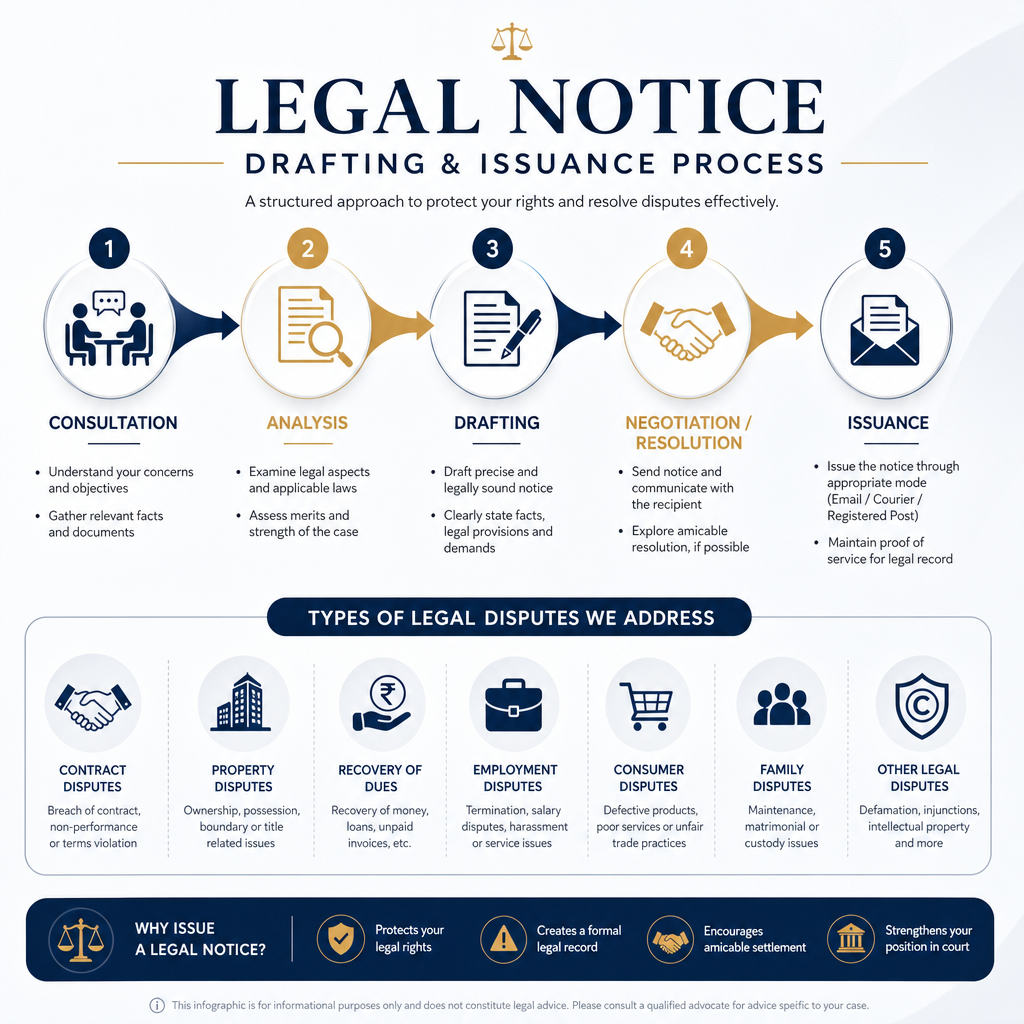
Before paying for drafting, ask what the service includes: review of your documents, the notice itself, dispatch, delivery proof and any follow-up. If you want help, LegalRecovery offers an online legal-notice process for claims such as unpaid salary, consumer refunds and rental deposits. Its stated starting price is ₹1,499 flat fee. You submit the case online, legal experts review it, a professional notice is drafted and sent by registered post, and follow-up and escalation can be managed online.
You can review how LegalRecovery’s five-step process works before deciding whether it fits your dispute. Its online case management means you do not need a court visit to use that service; it does not mean a later contested court case could never require your participation. Ask what happens after the notice if the recipient disputes the claim, offers only partial payment or cannot be reached.
Be especially careful about deadlines that are different from an ordinary demand. For example, if a cheque for a legally enforceable debt has bounced, the Negotiable Instruments Act sets a specific process: the written statutory demand must be sent within 30 days of learning of dishonour, and the drawer has 15 days after receiving it to pay. Do not substitute an informal “reply within seven days” message for that process.
What can you do if the notice is ignored?
First, check whether it was delivered and whether the other side has made an offer worth considering. A partial payment, a proposed instalment plan or a genuine calculation dispute calls for a different response from complete silence. If you agree to settle, put the amount and payment dates in writing. Do not describe the matter as fully settled until you understand what you are giving up and the agreed payment has arrived.
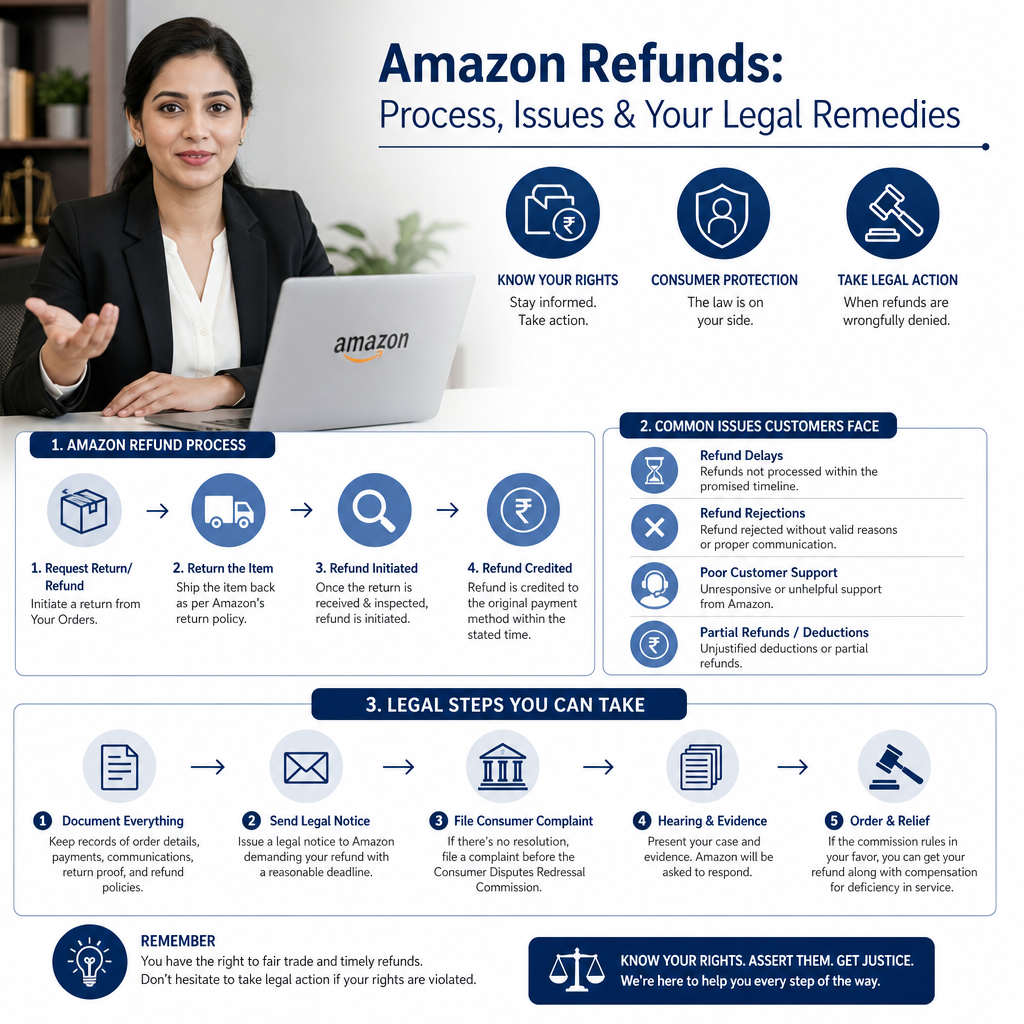
For an undelivered order or refused consumer refund
Try the National Consumer Helpline (NCH) or call 1915. It forwards grievances for possible pre-litigation resolution; it cannot itself issue a court order. Documented small refunds have been recovered through this route, so it can be worth trying before formal proceedings. Keep its complaint number and the seller’s replies.
If that fails, you can consider filing through e-Jagriti. Under the Consumer Protection Act, 2019, a consumer can file a complaint under section 35, and a commission can order remedies including a refund and, where justified, interest or compensation under section 39. The correct commission depends on the amount paid for the goods or services: District Commission up to ₹50 lakh, State Commission above ₹50 lakh to ₹2 crore, and National Commission above ₹2 crore. A private loan to a friend is not ordinarily a consumer purchase.
For salary, deposits or a personal loan
If an employer will not pay, the next avenue depends on your work arrangement and the nature of the dues. You may need advice about the labour authority or other forum available for your particular claim. For a rental deposit or personal loan, a civil recovery claim may be appropriate if a documented demand fails. Section 73 of the Indian Contract Act, 1872 addresses loss caused by breach of contract, but the facts and the agreement still matter.
Choose a route that can actually decide the dispute rather than paying to send notice after notice. The steps after an ignored legal notice should be based on your evidence, the amount involved, the other side’s response and the cost of pursuing the claim. Filing a case can help you seek an order, but neither a notice nor a filing guarantees payment, particularly if the person owing you money cannot be traced or has no funds.
How long do you have, and how long might recovery take?
Waiting for one more promise can seem easier than taking action. The risk is that legal filing limits continue to run while you wait. A recent reminder does not necessarily start the clock again, so record the original payment date, the date repayment became due and the date the dispute arose.
Consumer complaints are generally filed within two years under section 69 of the Consumer Protection Act, 2019, although a commission may consider a late filing where sufficient cause is shown. Many loan and deposit claims have a three-year limitation period under the Limitation Act, 1963, but the starting point varies with the type of claim. If you are close to a possible deadline, get advice promptly rather than assuming a notice gives you more time. This guide to money-recovery time limits can help you identify the dates to check.
Recovery time is less predictable. A clear request might resolve a misunderstanding in days; a negotiated repayment may take weeks; a contested case can take much longer. Consumer law aims for disposal within three months after notice to the other party, or five months if testing is needed, but actual proceedings may exceed those targets. NCH-partner companies are expected to respond to forwarded grievances within 30 days, not necessarily to pay within that time.
Set a date to review each step instead of waiting indefinitely. If you give someone 10 days to respond, check on day 11: have they paid, provided a credible payment date, explained a real dispute or done nothing? That answer tells you whether to negotiate, escalate or seek advice.
A realistic plan for the next seven days
You do not have to solve the entire dispute this week. You can, however, move it out of the cycle of vague promises. Start with the smallest action that makes your position clearer.
Today: Identify exactly who owes you money and calculate the amount. Write down when it became due.
Tomorrow: Save your agreement, payment proof, relevant messages and any explanation the other side has given. Make a short timeline.
Within two days: Send a calm, dated written demand with a reasonable response date and clear payment instructions.
After the response date: Check what you actually received. If there is a genuine dispute, ask for its supporting documents. If there is silence, consider a formal notice or the matching complaint route.
Before spending more: Check filing deadlines, likely costs and whether the person or business can be identified and contacted.
There is no single portal that retrieves every stuck payment, and you cannot force someone to pay by sending enough reminders. But you can replace uncertainty with a clear claim, organised proof and an escalation route suited to your situation. Whether you are chasing one month’s salary, a modest refund or a deposit you need for your next home, that is a practical place to begin.
Popular Searches & Related Topics

Legal Recovery is India's trusted consumer protection and legal tech platform. We specialize in holding corporations accountable for unfair trade practices, deceptive marketing, and commercial fraud. With over 15,000 customers counselled, our mission is to provide fast, out-of-court resolutions by connecting you with top-tier panel advocates for immediate legal action.
Client Reviews
"My previous employer had not cleared part of my final settlement. LegalRecovery helped me organise my employment records and sent a clear legal notice. The company responded after receiving it, and the follow-up process was easy to track online."
Ananya Sharma
"I was waiting for an online order refund and kept receiving vague updates. LegalRecovery reviewed my order and cancellation records and helped send a formal notice. I appreciated the clear communication and practical guidance on what to do next."
Rohit Mehta
"My PG owner had kept part of my security deposit without sharing a proper deduction breakdown. LegalRecovery helped me present the agreement, handover details and payment proof in a formal notice. The process felt organised and professional."
Priya Nair
"A client had delayed payment on my freelance invoice despite several reminders. LegalRecovery helped me set out the work completed, invoice amount and payment request clearly. The notice and online updates made the next steps much easier to understand."
Vikram Patel
Frequently Asked Questions
Related Articles
About Author
Team LegalRecovery
View ProfileTeam LegalRecovery is a dedicated team of legal and financial professionals specializing in loan settlement, banking disputes, debt relief, and corporate compliance. We are committed to helping clients achieve debt freedom and business stability through expert strategic advisory.
Connect on LinkedInNeed Legal Help?
Get expert advice on loan settlement, banking disputes and debt relief.
Start Recovery NowRequest Callback