Legal Recovery of Money from Insurance Claim
Master the steps to reclaim money from insurance claims
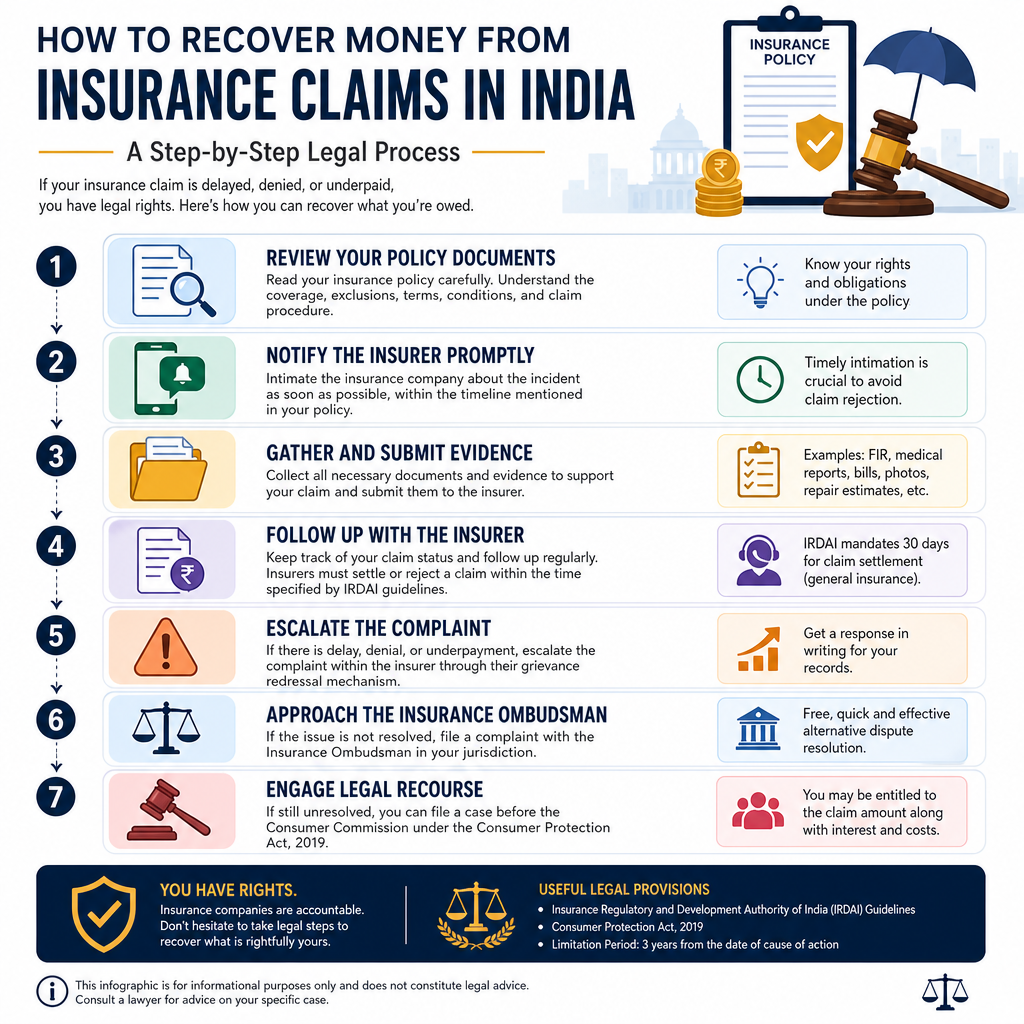
Table of Contents
Table of Contents
Swipe →In the realm of financial security, insurance policies serve as a vital tool for risk management. However, the journey from filing an insurance claim to the actual recovery of money can often be fraught with complexities. Understanding the legal framework and the procedural steps involved in the recovery of money from an insurance claim is essential for individuals seeking to navigate this intricate process. This article provides an exhaustive guide to mastering the steps involved in reclaiming money from insurance claims in India.
Understanding the Legal Framework for Insurance Claims in India
Insurance claims in India are governed by a set of regulations and acts that ensure policyholders are treated fairly and equitably. The Insurance Regulatory and Development Authority of India (IRDAI) plays a pivotal role in regulating the insurance sector. It is crucial to comprehend these laws to effectively pursue a legal recovery of money.
One of the primary legislations governing insurance in India is the Insurance Act, 1938. This act sets out specific provisions relating to the registration and licensing of insurance companies, the conduct of insurance business, and the protection of policyholders' interests. Additionally, the Consumer Protection Act, 2019 is instrumental in addressing grievances related to insurance claims, allowing policyholders to seek redressal through consumer forums.
The Payment of Wages Act, 1936, although primarily focused on the timely payment of wages, indirectly impacts insurance claims, as any delay in settlements can be seen as withholding of entitlements, akin to wage disputes. The Shops and Establishments Act also comes into play if an insurance settlement involves a business entity, ensuring that all financial transactions are transparent and lawful.
Moreover, the Gratuity Act, 1972 can influence insurance claims involving employment benefits. While primarily focused on gratuity payments, the act's principles on financial entitlements and employer liabilities can be applied to certain insurance scenarios. Understanding these legal frameworks is crucial for efficiently navigating the insurance claim process.
Essential Steps for Filing an Insurance Claim
Filing an insurance claim is the first step towards recovering money, and it involves several methodical procedures. Comprehensive knowledge of this process can significantly enhance the chances of a successful claim.
The initial step in filing an insurance claim is to review the policy document thoroughly. Understanding the terms, conditions, and exclusions of your insurance policy is crucial for a rightful claim. It is essential to ascertain the coverage provided and the circumstances under which a claim can be made.
Next, promptly notify the insurance company of the incident that gives rise to the claim. This can typically be done via a claim form provided by the insurer. It is vital to adhere to the timelines specified in the policy for reporting claims to avoid any disputes regarding delay in intimation.
The collection of evidence is a critical phase in the insurance claim process. Documentation such as medical reports, police FIRs (in case of theft or accidents), photographs of the incident site, and any other supporting documents should be meticulously gathered to strengthen the claim. Ensuring that all paperwork is complete and accurate is fundamental to avoid unnecessary delays and rejections.
After submitting the claim form and supporting documents, the insurance company will initiate an investigation. During this phase, it is important to cooperate fully with the insurer's representatives, providing any additional information they may require. Being proactive and responsive during this stage can expedite the settlement process.
Overcoming Challenges in the Claim Process
The path to a successful insurance claim is often laden with challenges, including disputes over the extent of coverage, delays in processing, and even outright rejection of claims. Understanding these challenges and preparing to address them is crucial for effective legal recovery.
One common challenge is disputes over policy terms. Insurance companies may interpret policy clauses differently, leading to disagreements on what is covered. To overcome this, policyholders should maintain a clear record of all communications and seek clarification on ambiguous terms from the insurer at the earliest.
Delays in claim processing are another frequent issue. Insurers may take longer than expected to assess and settle claims, citing reasons such as incomplete documentation or the need for further investigation. Keeping track of all correspondences and regularly following up with the insurer is essential to ensure timely processing.
Claim rejections, although disheartening, are not uncommon. Insurers might reject claims citing reasons such as non-disclosure of material facts, policy exclusions, or discrepancies in the information provided. In such cases, it is advisable to seek legal counsel to understand the grounds of rejection and explore possibilities of appeal or legal action.
In instances where disputes are unresolved through direct communication with the insurer, policyholders can approach the Insurance Ombudsman. The Ombudsman provides an alternative dispute resolution mechanism that is more accessible than traditional litigation. Understanding the jurisdiction and authority of the Ombudsman is vital for effectively utilizing this recourse.
Legal Recourse for Rejected Insurance Claims
When negotiations with the insurance company fail, and the claim is unjustly rejected, the legal system offers recourse. Understanding the avenues available for legal recovery of money from insurance claims is essential for policyholders seeking justice.
The Consumer Protection Act, 2019 provides a robust framework for addressing grievances against insurers. Policyholders can file a complaint with the Consumer Disputes Redressal Commission, which addresses disputes related to deficiency in service or unfair trade practices by insurance companies. The Act classifies consumer forums based on the claim amount, providing a structured approach to dispute resolution.
Another legal recourse is filing a complaint under the Indian Penal Code (IPC) for fraud or misrepresentation if there is evidence of wrongdoing by the insurer. Sections under the IPC dealing with cheating or criminal breach of trust can be invoked in cases where there is a deliberate intent to deceive the policyholder.
The Negotiable Instruments Act, 1881 may also be relevant if post-dated cheques issued by the insurer bounce. Legal action under this act ensures that policyholders can hold insurers accountable for payment defaults.
Additionally, policyholders can seek redress through civil suits for recovery of money. Filing a suit in the appropriate civil court requires careful drafting of the plaint, citing relevant laws and evidences that support the claim. Engaging a competent legal professional is advisable to navigate the complexities of litigation.
Statutory Recovery Metrics & Resolution Benchmark
Disputes resolved via formal statutory legal demand notices.
Average statutory compliance response timeline.
Mandatory refund of statutory levies under Indian Acts.
Interest compensation claimable under MSME & NI Acts.
Role of Evidence in Insurance Claim Recovery
Evidence plays a pivotal role in the recovery of money from insurance claims. The strength of the evidence can often determine the outcome of a dispute, making it imperative for policyholders to gather and present documentation effectively.
Medical evidence is crucial in health insurance claims. This includes doctor’s reports, diagnostic test results, hospital bills, and discharge summaries. These documents substantiate the occurrence of the medical event and the expenses incurred, forming the basis for the claim.
In motor insurance claims, evidence such as a police FIR, surveyor’s report, photographs of the accident site, and repair bills are critical. These documents help establish the facts of the incident and the extent of damage, allowing for a fair assessment by the insurer.
For property insurance claims, evidence of ownership, photographs of the damaged property, and expert valuations play a significant role. Comprehensive documentation ensures that the policyholder’s interests are adequately represented in the claim process.
Maintaining a meticulous record of all correspondence with the insurer, including emails, letters, and phone call logs, is essential. This not only aids in substantiating the claim but also provides a timeline of events that can be crucial in legal proceedings.
Drafting a Step-by-Step Guide for Claim Recovery
For policyholders seeking to reclaim money from insurance claims, a well-drafted step-by-step guide can act as a roadmap, ensuring that no critical aspect of the process is overlooked.
The first step involves a thorough review of the insurance policy to understand the terms, conditions, and coverage. This aids in setting realistic expectations for the claim and identifying potential areas of dispute.
Next is the timely notification of the insurer about the incident. This involves filling out the claim form, attaching all necessary documentation, and submitting it within the stipulated timeframe. Prompt notification helps in avoiding disputes related to delay in reporting.
The collection and organization of evidence is a critical step. Policyholders should ensure that all documents are complete, accurate, and in order, as this forms the foundation of the claim.
Engaging with the insurance company's representatives during the claim investigation process is crucial. Providing any additional information they may require and cooperating fully can expedite the resolution of the claim.
If disputes arise, policyholders should explore resolution through negotiation with the insurer. Documenting all communications during this stage is essential for potential legal proceedings.
Case Studies: Successful Legal Recoveries from Insurance Claims
Examining case studies of successful legal recoveries can provide valuable insights into the strategies and legal principles that lead to favorable outcomes in insurance claims.
In one notable case, a policyholder successfully challenged the rejection of a health insurance claim on the grounds of non-disclosure. The Consumer Disputes Redressal Commission ruled in favor of the policyholder, emphasizing the insurer's obligation to prove intentional suppression of facts. This case underscores the importance of transparency and the insurer's burden of proof in claim disputes.
Another case involved a motor insurance claim where the insurer disputed the extent of damage. The policyholder was able to establish the validity of the claim through independent expert assessments and photographic evidence, leading to a favorable court ruling. This highlights the significance of comprehensive documentation and expert testimony in claim disputes.
A property insurance claim case saw the insurer denying coverage due to alleged policy lapses. The policyholder, through meticulous record-keeping and timely premium payments, demonstrated compliance with policy terms, resulting in the court ordering the insurer to honor the claim. This case illustrates the importance of adhering to policy conditions and maintaining thorough records.
These case studies not only highlight the legal principles involved but also demonstrate the importance of strategic planning, evidence gathering, and legal expertise in achieving successful recoveries from insurance claims.
Conclusion: Mastering the Art of Legal Recovery
Recovering money from an insurance claim can be a daunting process, fraught with legal intricacies and procedural challenges. However, with a thorough understanding of the legal framework, diligent documentation, and strategic planning, policyholders can navigate this process effectively.
Legal Recovery offers a comprehensive suite of services to assist policyholders in reclaiming their rightful entitlements. Whether it's understanding the nuances of insurance laws, drafting an effective claim, or pursuing legal action in case of disputes, [Legal Recovery](https://www.legalrecovery.in/) is equipped to provide expert guidance and representation.
By mastering the steps outlined in this guide, policyholders can enhance their prospects of a successful recovery, ensuring that they receive the financial protection that their insurance policy promises.
For more information on legal recovery services, visit our [services](https://www.legalrecovery.in/services) page or contact us directly through our [contact](https://www.legalrecovery.in/contact) page.
Popular Searches & Related Topics

Legal Recovery is India's trusted consumer protection and legal tech platform. We specialize in holding corporations accountable for unfair trade practices, deceptive marketing, and commercial fraud. With over 15,000 customers counselled, our mission is to provide fast, out-of-court resolutions by connecting you with top-tier panel advocates for immediate legal action.
Client Reviews
"Legal Recovery's guidance was instrumental in reclaiming my insurance money. Their expertise in navigating the legal frameworks made the process seamless."
Amit Sharma
"I am extremely satisfied with the professional service from Legal Recovery. They helped me understand the complexities of my insurance claim and ensured a favorable outcome."
Sneha Rao
"The team at Legal Recovery was thorough and efficient. Their step-by-step guide on insurance recovery was clear and comprehensive. Highly recommended!"
Vikram Patel
"I was able to recover my insurance claim thanks to Legal Recovery's expertise. Their strategic planning and attention to detail made a huge difference."
Neha Gupta
"Legal Recovery exceeded my expectations in handling my insurance dispute. Their knowledge and dedication to my case were evident throughout the process."
Rajesh Kumar
Frequently Asked Questions
Related Articles
About Author
Team LegalRecovery
View ProfileTeam LegalRecovery is a dedicated team of legal and financial professionals specializing in loan settlement, banking disputes, debt relief, and corporate compliance. We are committed to helping clients achieve debt freedom and business stability through expert strategic advisory.
Connect on LinkedInNeed Legal Help?
Get expert advice on loan settlement, banking disputes and debt relief.
Start Recovery NowRequest Callback