Legal Notice Kaise Bheje? Step-by-Step Guide
Learn the process of sending a legal notice effectively and protect your rights.
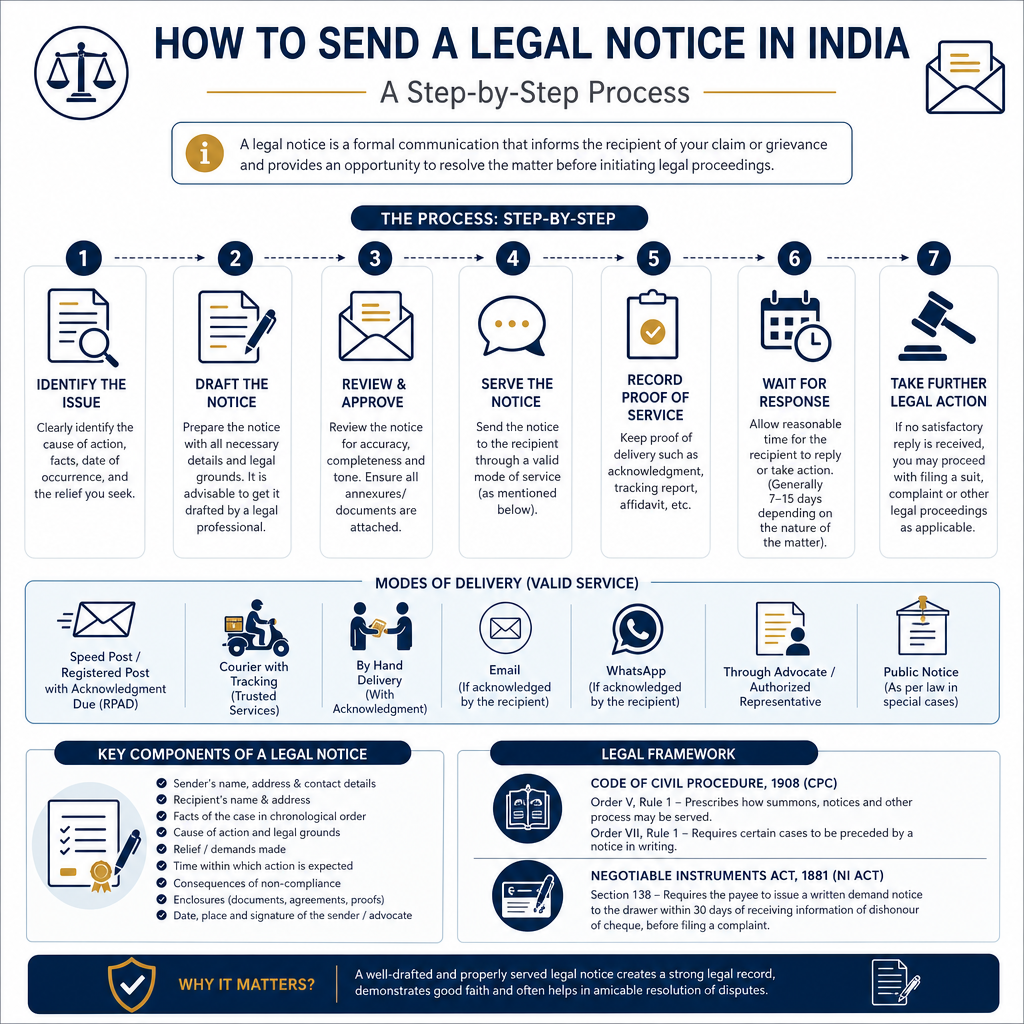
Table of Contents
Table of Contents
Swipe →Understanding the Concept of a Legal Notice
In the realm of legal proceedings in India, a legal notice serves as a crucial preliminary step before the initiation of any formal legal action. It is a formal communication sent by an individual or an entity to another party, alerting them of the sender’s intention to initiate legal proceedings if the issue at hand is not resolved amicably. Essentially, a legal notice acts as a means of enforcing the recipient's compliance with a legal obligation or to rectify a wrong committed against the sender.
Sending a legal notice is often a statutory requirement, especially in matters pertaining to civil disputes, consumer grievances, or contractual disagreements. By issuing a legal notice, the sender gives the recipient an opportunity to address the issue outside court, potentially saving time, resources, and the complexities of litigation. In India, the procedure for sending a legal notice and the legal framework surrounding it is governed by various statutes, including civil procedure laws and specific acts such as the Negotiable Instruments Act, 1881.
The importance of a legal notice lies not only in its potential to resolve disputes without litigation but also in its ability to serve as documented evidence in subsequent legal proceedings. A well-drafted legal notice outlines the sender’s claim, the legal basis of the claim, and the specific resolution sought. It is imperative that the notice is clear, concise, and devoid of any ambiguities to ensure that the recipient is fully aware of the implications of non-compliance.
In this comprehensive guide, we will delve into the intricate details of the process of sending a legal notice in India, elaborating on each step, the legal frameworks involved, and the strategic importance of this legal tool. We will also examine the role of legal notices across different types of disputes, supported by case studies and references to key legislations such as the Payment of Wages Act, the Shops & Establishments Act, and others. For more detailed insights into our legal services, visit our About Us page.
Step-by-Step Process of Sending a Legal Notice in India
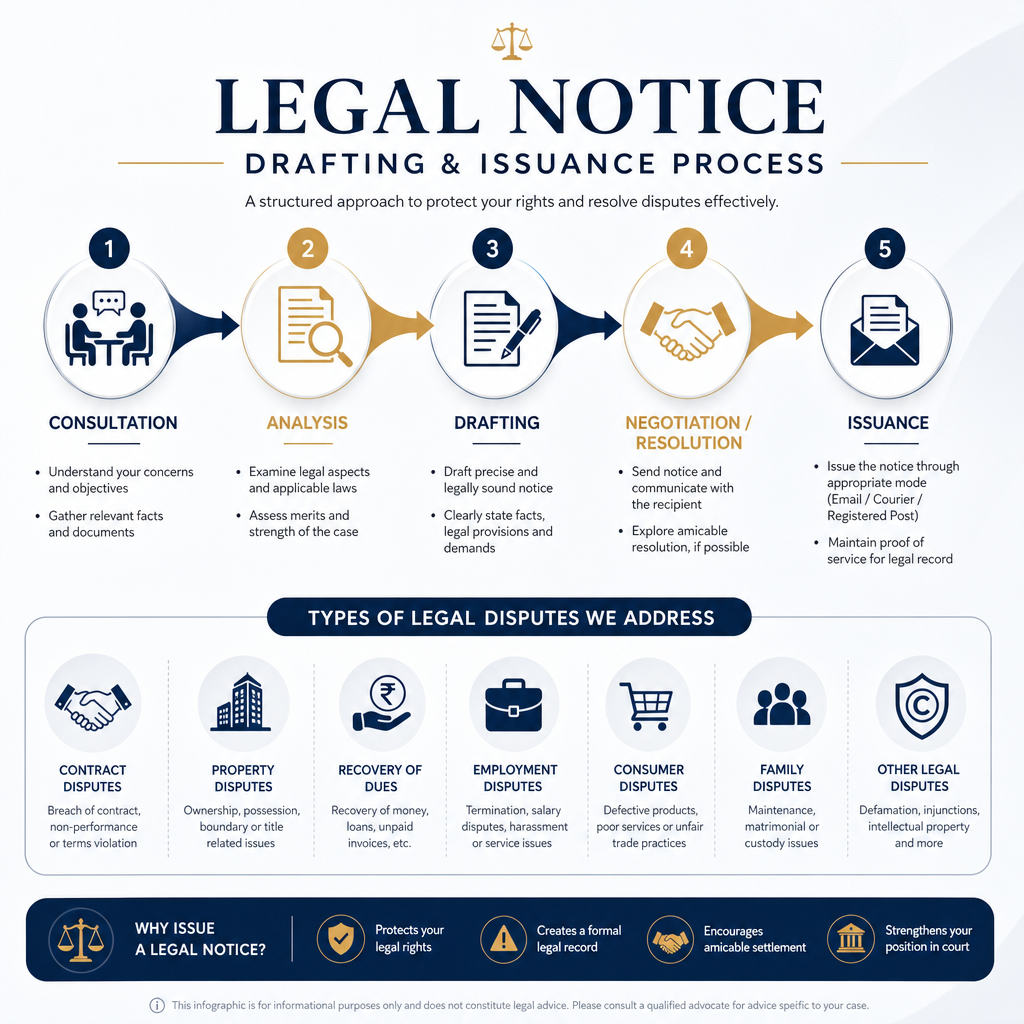
Step 1: Identify the Nature of the Dispute
The first and foremost step in sending a legal notice is to clearly identify the nature of the dispute. This involves understanding the factual background of the issue, the legal relationship between the parties, and the specific rights or obligations that have been breached. The nature of the dispute could pertain to non-payment of dues, breach of contract, property disputes, or any other civil matter. Identifying the dispute accurately sets the foundation for drafting a precise legal notice.
For instance, if the dispute relates to the recovery of unpaid salary, the provisions of the Payment of Wages Act, 1936 may be applicable. Similarly, in cases of tenant-landlord disputes, the relevant sections of the Rent Control Act or the Transfer of Property Act may govern the notice. Understanding the applicable legal framework helps in crafting a more effective legal notice.
Moreover, it is crucial to assess whether the dispute falls within any statutory limitation period. The Limitation Act, 1963 stipulates specific time frames within which legal actions must be initiated, which also applies to the issuance of legal notices.
Once the dispute is clearly defined and understood, the next step involves gathering the necessary evidence to substantiate the claims made in the legal notice. This evidence may include contracts, invoices, communication records, and any other relevant documents.
Step 2: Drafting the Legal Notice
The drafting of a legal notice is a meticulous process that requires a comprehensive understanding of both legal principles and the specifics of the case at hand. Although it is possible for individuals to draft legal notices themselves, it is highly recommended to engage a legal professional to ensure precision and adherence to legal norms. Legal Recovery offers expert services in drafting and sending legal notices, ensuring that every legal nuance is addressed. You can explore our services for more information.
A well-drafted legal notice typically includes several key components:
Details of the Sender: This includes the full name, address, and contact information of the person or entity sending the notice.
Details of the Recipient: The full name, address, and contact details of the person or entity to whom the notice is being sent.
Statement of Facts: A chronological account of the events leading to the dispute, presented in a clear and factual manner.
Legal Basis: A reference to the relevant laws, statutes, or contractual provisions that are applicable to the dispute.
Relief Sought: A clear and specific statement of the resolution or compliance being demanded from the recipient.
Time Frame for Compliance: A reasonable period within which the recipient must respond or comply with the demands of the notice.
Consequences of Non-Compliance: A warning of the legal actions that will be taken if the recipient fails to comply with the notice.
The language of the legal notice should be formal and professional, avoiding any defamatory or offensive statements. The notice should be signed by the sender or their legal representative.
Step 3: Sending the Legal Notice
Once the legal notice is drafted, the next step involves sending it to the recipient through a reliable mode of delivery. It is advisable to send the legal notice via registered post with acknowledgment due (RPAD) or through a courier service that provides a delivery receipt. This ensures that there is documented proof of the notice being sent and received, which can be crucial in any subsequent legal proceedings.
In addition to physical delivery, it is also prudent to send a copy of the legal notice via email. Electronic communication serves as an additional layer of documentation and helps expedite the notice’s reach to the recipient.
The sender should retain copies of both the notice and the delivery receipts as evidence. These documents will play a critical role if the matter escalates to litigation.
It is important to provide the recipient with a reasonable time frame to respond to or comply with the legal notice. Typically, this period is set at 15 to 30 days, depending on the nature of the dispute and the relief sought.
Legal Framework Governing Legal Notices in India
The Code of Civil Procedure, 1908
The Code of Civil Procedure, 1908 (CPC) lays down the procedures to be followed in civil litigation in India. Although the CPC does not specifically prescribe the requirement of a legal notice in all civil cases, it mandates the sending of notice in certain instances, such as suits against the government under Section 80. Understanding the procedural framework of the CPC helps in ensuring that the legal notice complies with legal requirements and can be enforceable in a court of law.
Section 80 of the CPC requires a two-month notice period to be provided to the government or public officer when a lawsuit is intended to be filed against them in respect of an act purported to have been done in their official capacity. This notice aims to offer the government an opportunity to take remedial measures and potentially avoid litigation.
Moreover, the CPC emphasizes the importance of serving notices and summons in a manner that ensures receipt by the concerned party, thereby upholding the principles of natural justice and due process.
For those interested in learning more about how procedural aspects are handled in legal recovery cases, our How It Works page provides detailed insights.
The Negotiable Instruments Act, 1881
The Negotiable Instruments Act, 1881, plays a pivotal role in the context of legal notices concerning bounced cheques. Section 138 of this Act criminalizes the dishonor of cheques due to insufficient funds or if the amount exceeds the arrangement made with the bank. In such cases, issuing a legal notice becomes a statutory requirement.
The Act mandates that the payee must send a written legal notice to the drawer of the cheque within 30 days from receiving information about the cheque’s dishonor. The notice should demand the payment of the cheque amount within 15 days of the receipt of the notice by the drawer.
If the drawer fails to comply with the notice requirements or make the payment within the stipulated time, the payee has the right to initiate a criminal complaint under Section 138 within one month from the expiry of the 15-day period.
Given the technicalities involved, it is advisable to seek professional legal assistance when dealing with cheque bounce cases. Legal Recovery’s Vendor and Invoice Recoveries service can provide expert guidance and support in such matters.
Statutory Recovery Metrics & Resolution Benchmark
Disputes resolved via formal statutory legal demand notices.
Average statutory compliance response timeline.
Mandatory refund of statutory levies under Indian Acts.
Interest compensation claimable under MSME & NI Acts.
Gathering Evidence and Documentation
The efficacy of a legal notice largely depends on the strength of the evidence backing the claims made within it. Ensuring that the notice is supported by comprehensive and relevant documentation is critical. The evidence not only substantiates the sender’s case but also enhances the credibility of the notice.
Depending on the nature of the dispute, the following types of documents may be vital:
Contracts and Agreements: These are crucial in disputes involving breach of contract or non-fulfillment of obligations.
Invoices and Receipts: They serve as proof of transactions and can be particularly important in cases involving unpaid dues or refunds.
Correspondence: Letters, emails, and other forms of communication can illustrate the sequence of events leading up to the dispute.
Bank Statements: In cases involving financial transactions, bank statements can provide irrefutable evidence of payments made or received.
Legal Documents: Previous legal communications, notices, or court documents that relate to the ongoing dispute.
Organizing this evidence methodically and presenting it clearly in the legal notice can significantly bolster the sender's position. At Legal Recovery, we offer specialized services for the Recovery of Salary and Employment Dues and more, ensuring a meticulous approach to evidence management.
Case Studies: Applications of Legal Notices
Case Study 1: Recovery of Unpaid Salary
Consider the scenario where an employee has not received their due salary for several months. The employer’s repeated assurances have not translated into actual payment, prompting the employee to consider legal action. In such cases, the first step involves sending a legal notice to the employer, demanding the immediate payment of the outstanding salary.
The legal notice would be drafted citing provisions from the Payment of Wages Act, 1936, which mandates the timely payment of wages to employees. The notice would include the total amount due, the period for which the salary is unpaid, and a reasonable deadline for payment, failing which legal proceedings may be initiated.
This approach not only serves as a formal demand for payment but also signals the employee’s seriousness about pursuing legal remedies. Often, the receipt of a legal notice prompts employers to settle the dues to avoid potential litigation.
Such cases illustrate the power of legal notices in enforcing compliance and safeguarding employee rights without initially resorting to court proceedings. For professional assistance in handling such matters, our Recovery of Salary and Employment Dues service offers comprehensive solutions.
Case Study 2: Consumer Grievances and Refund Claims
Another common application of legal notices is in the realm of consumer grievances. Suppose a consumer has purchased a product or service that was defective or did not meet the promised standards. Despite multiple attempts to resolve the issue with the seller, no satisfactory resolution is achieved. In such instances, sending a legal notice can be an effective recourse.
The legal notice would be drafted in accordance with the provisions of the Consumer Protection Act, 2019, highlighting the consumer’s rights and the seller’s obligations. The notice would demand rectification of the defect, replacement of the product, or a refund, as applicable.
This step serves as a formal notice to the seller regarding the consumer’s intent to escalate the matter if the issue is not resolved. Many sellers opt to settle disputes amicably upon receiving a legal notice to avoid adverse action and preserve their reputation.
Legal Recovery’s Refunds and Consumer Complaints service is designed to assist consumers in navigating such disputes effectively and efficiently.
Common Mistakes to Avoid When Sending a Legal Notice
Using Incorrect Legal References
One of the most common mistakes when sending a legal notice is the incorrect citation or application of legal principles and statutes. This can undermine the efficacy of the notice and weaken the sender’s position. It is essential to ensure that the legal notice is grounded in the correct legal framework relevant to the issue at hand.
For instance, citing provisions of the Indian Penal Code (IPC) in a civil dispute involving breach of contract may not be appropriate. Instead, the notice should reference relevant civil statutes such as the Indian Contract Act, 1872.
Incorrect legal references can also give the impression of a lack of legal expertise, which might embolden the recipient to dismiss the notice. Engaging a qualified legal professional can help avoid such errors and enhance the notice’s impact.
At Legal Recovery, our team of experts ensures that every legal notice is drafted with precision, leveraging a deep understanding of applicable laws and regulations. Our services offer strategic legal advice across various domains.
Omitting Key Facts or Evidence
Another critical mistake is the omission of key facts or evidence that support the claims made in the legal notice. A notice devoid of substantiating evidence risks being perceived as frivolous or unsubstantiated, reducing its effectiveness.
It is imperative to include all relevant facts, transactions, communications, and evidence in the notice. This not only strengthens the sender’s case but also provides the recipient with a clear understanding of the claims and the rationale behind them.
Moreover, the inclusion of comprehensive evidence reduces the likelihood of the recipient disputing the claims and can facilitate a quicker resolution.
Our approach at Legal Recovery emphasizes meticulous documentation and evidence management, ensuring that every legal notice is robust and compelling. For tailored assistance, explore our Security Deposits and Rental Recoveries service.
Conclusion: The Strategic Importance of Legal Notices
Legal notices are an integral part of the legal framework in India, serving as a powerful tool for dispute resolution and compliance enforcement. By providing a formal platform for negotiation and settlement, legal notices often preclude the need for costly and time-consuming litigation.
The strategic use of legal notices can expedite dispute resolution, protect legal rights, and foster a culture of accountability and compliance. However, the effectiveness of a legal notice hinges on its accurate drafting, adherence to legal norms, and thorough documentation of evidence.
For individuals and businesses seeking to navigate the complexities of legal disputes, professional legal assistance is invaluable. Legal Recovery offers expert services across a wide spectrum of disputes, including Recovery of Freelancer and Client Payments, Recovery of Money from a Friend, and Airline and Travel Recoveries.
To learn more about how Legal Recovery can assist in your legal needs, or to initiate a legal notice, feel free to Contact Us. We are committed to delivering expert legal solutions with integrity and diligence.
Popular Searches & Related Topics

Legal Recovery is India's trusted consumer protection and legal tech platform. We specialize in holding corporations accountable for unfair trade practices, deceptive marketing, and commercial fraud. With over 15,000 customers counselled, our mission is to provide fast, out-of-court resolutions by connecting you with top-tier panel advocates for immediate legal action.
Client Reviews
"Legal Recovery's service was exceptional. The legal notice they drafted was precise and the issue was resolved quickly."
Rahul Sharma
"I was impressed with the professionalism and detail in the legal notice drafted by Legal Recovery. The outcome was satisfactory."
Priya Nair
"The team at Legal Recovery made the process of sending a legal notice seamless and efficient. Highly recommended!"
Arjun Desai
"Thanks to Legal Recovery, my dispute was resolved without litigation. Their expertise in drafting legal notices is commendable."
Anita Mehta
"Legal Recovery provided excellent service. Their legal notice helped settle my consumer grievance quickly."
Vikram Singh
Frequently Asked Questions
Related Articles

About Author
Team LegalRecovery
View ProfileTeam LegalRecovery is a dedicated team of legal and financial professionals specializing in loan settlement, banking disputes, debt relief, and corporate compliance. We are committed to helping clients achieve debt freedom and business stability through expert strategic advisory.
Connect on LinkedInNeed Legal Help?
Get expert advice on loan settlement, banking disputes and debt relief.
Start Recovery NowRequest Callback